Launched in July 1971 as a ground-up redesign, the HQ sold 485,650 cars across sedans, wagons, Monaros, utes and vans.
The Holden HQ, on sale from 15 July 1971, replaced the HG with a new body, chassis and suspension, the biggest engineering break in the marque since 1948. Belmont, Kingswood, Premier, Statesman and Monaro models followed. Production reached 485,650 units, the highest total of any Holden.
No Holden has sold in greater numbers than the HQ, which found 485,650 buyers and has never been overtaken. It arrived on 15 July 1971 as the first ground-up redesign of a Holden since the original car of 1948.
What exactly was the Holden HQ?
The Holden HQ was a range of cars built in Australia from 1971 to 1974, released on 15 July 1971 to replace the HG series. It brought an all-new body, chassis and suspension, and it was later developed into successor models that carried the line through to the end of the WB series in 1985.
The engineering was a clean break. No Holden since the original 48-215 model of 23 years earlier had been engineered so radically. It used a perimeter frame with semi-monocoque, or unibody, construction, and no earlier full-size Holden had coil springs at the rear.
One decision came with a cost. To save money, Holden engineered the HQ for right-hand drive only, which ruled out left-hand drive markets. Exports fell from 41,181 in 1973 to just 7,440 in 1975, and the loss of export revenue left less money to fund the car that would follow the HQ-HZ line.
The most radically engineered Holden since the original 48-215 of 23 years earlier.
What did the HQ range include?
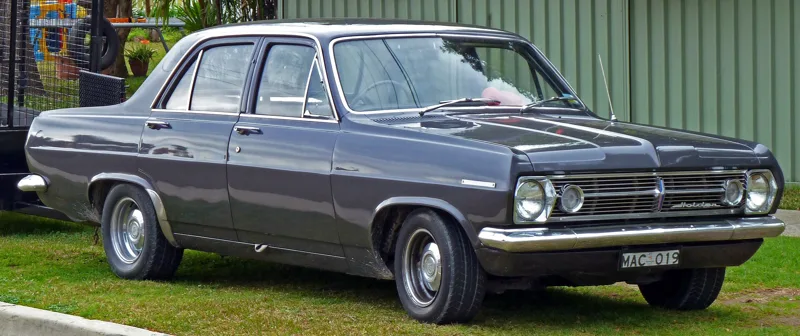
The mainstream passenger range was a four-door sedan and a five-door wagon in three trim levels: Belmont, Kingswood and Premier. Around them sat the long wheelbase Statesman, the Monaro coupes and a full commercial line of utilities, panel vans and a cab chassis truck.
- Belmont: the barebones car and successor to the Holden Standard, with a 173 cu in (2.8 L) six, a column-shift three-speed manual and plainer door trim.
- Kingswood: the midrange car, taking the place of the Special, with a more stylish interior, armrests as standard and extra exterior chrome.
- Premier: the top mainstream tier, with a woodgrain-style interior, full-length armrests, a centre console with bucket seats and extra exterior styling.
The Statesman, a long wheelbase four-door luxury sedan, was also released in July 1971. It replaced the Brougham from the HG range but was marketed as a Statesman rather than a Holden, in Statesman and Statesman de Ville forms.
The commercial side was broad. It covered a coupe utility, panel vans and a cab chassis truck, and the One Tonner was new for the HQ. In January 1974 the Sandman arrived, a sports utility and panel van that borrowed Monaro features such as sports instruments, a sports steering wheel and bucket seats, with rally-style wheels and a choice of two sixes and two V8s. It was identified by stick-on vinyl decals.
How did the Kingswood earn its place?
The Kingswood name arrived with the HK series in January 1968, replacing the Special, and it lasted in some form until the WB series ended in 1985. In the HQ it was the heart of the range, sitting between the bare Belmont and the plush Premier.
Late in 1972 Holden added the Kingswood Vacationer, a special edition of the sedan and wagon. The value package proved popular enough to return on various Holden models over the next twenty years or so. The Kingswood panel van joined the range with the HX series in mid-1976.
The ending was gradual. The Kingswood passenger car and panel van ceased production with the HZ series in 1980, and the smaller Commodore, released two years earlier, took over the passenger range. The name lived on in the utility built in the WB series from 1980 to 1985.
What made the HQ Monaro different?
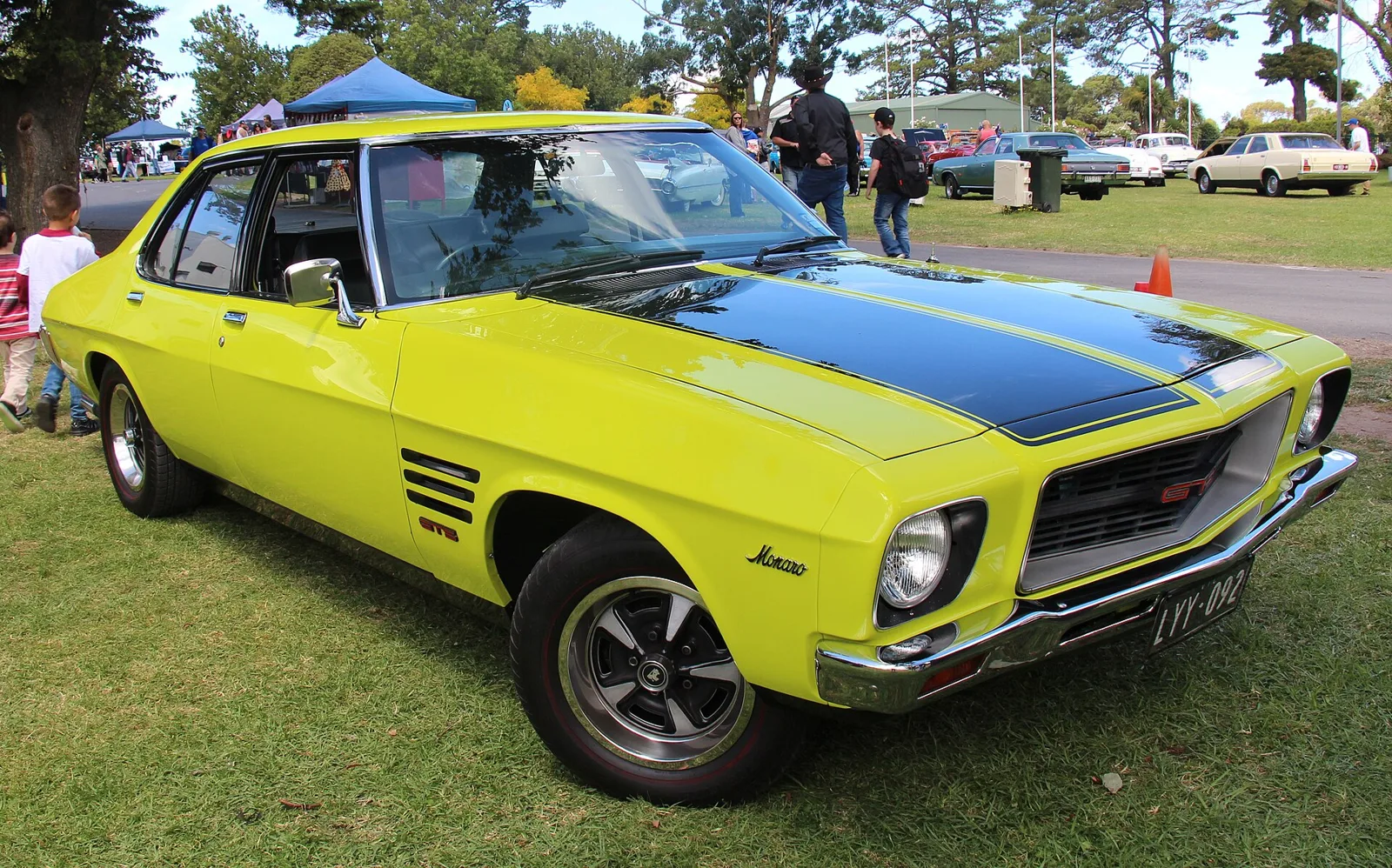
The HQ Monaro range began as two-door coupes only, in Monaro, GTS, GTS 350 and LS forms. The GTS was built on the Kingswood, with its own stripe, a choice of 253 or 308 V8, and either a four-speed Holden manual or a three-speed GM Turbo-Hydramatic 350 automatic.
Monaro owners got more equipment than most. The GTS had a heavy-duty Salisbury differential, a full interior with bucket seats, a sports steering wheel, a centre console, a tachometer and dual split gauges. The Monaro LS took the Premier's design language into the coupe.
In March 1973 two four-door sedans joined the line, the HQ GTS (option XV4) and the HQ GTS350 (option XW8). Like the SS, they were special vehicle packages fitted to a lesser model, in this case a V8 Kingswood sedan. The Monaro itself had been introduced in mid-1968, and it carried the identification coding of a Kingswood without ever wearing Kingswood badges.
On the track the picture changed. With the HQ, Holden's factory-backed production-car racing moved away from the V8 Monaro and on to the smaller six-cylinder LC Torana. Some Monaros and V8 Kingswoods were built for racing, notably Malcolm Ramsey's V8 Kingswood, but these HQs never matched the success of earlier Monaros or of the better-funded Torana teams.
Which engines powered the HQ?
| Engine | Capacity | Notes |
|---|---|---|
| Inline six | 2.8 L (173 cu in) | Carried over from the HG but enlarged; standard in the Belmont |
| Inline six | 3.3 L (202 cu in) | Carried over and enlarged; the biggest six sold in the car |
| Holden V8 | 4.1 L (253 cu in) | Later marketed as 4.2 litres |
| Holden V8 | 5.0 L (308 cu in) | Carried over from the HG |
| Chevrolet small-block V8 | 5.7 L (350 cu in) | Engine and drivetrain fully imported from the United States |
Most of the mechanical parts were Australian. Engines, transmissions and final drive assemblies came from Holden's casting plant at Fishermans Bend, with the exception of the 350, which arrived complete from Chevrolet, a fellow General Motors subsidiary.
Why did the HQ sell so well?
The HQ sold 485,650 units, the most of any Holden, though it stayed on sale longer than earlier models, so the figure partly reflects time. The record also shows a very wide range: a bare-bones Belmont, the Premier, a Statesman luxury car, V8 Monaros, utes and vans.
Demand for performance versions was strong. In 1972 Holden released the SS, a limited edition built from the Belmont V8 sedan under option code XV2 and borrowing the Super Sport name from Chevrolet. Its colours were Infra Red, a dark orange, Lettuce Alone, a light green, and Ultraviolet, a purplish grey. It came with a 253 or 308 V8, a four-speed manual and a 10-bolt Salisbury differential with a 3.36:1 ratio.
The SS was a hit with younger buyers who wanted power.
Production was a national effort. HQs were built at Acacia Ridge, Dandenong, Elizabeth and Pagewood, and local firms supplied parts such as wiper arms, glass, carpets, wiring and fasteners. In New Zealand, assembly at Trentham continued to 1975 so that left-over HQ parts, not needed for the HJ, would be used.
The car also travelled. Complete knock-down production started in Thailand in 1971, and kit assembly also went on for years in Indonesia and the Philippines. Mazda in Japan planned to build the HQ from kits, though that is believed not to have gone beyond a pilot stage. In South Africa the sedan was sold as the Chevrolet Kommando, the utility as the Chevrolet El Camino and the One Tonner as the Chevrolet El Toro.
Was the HQ built to ride like a Cadillac?
That was the brief given by Holden's Chief Engineer at the time, an American named George Roberts. He insisted the HQ should ride like a Cadillac and that its front suspension be engineered to understeer for safety reasons. Advertising promoted a jet-smooth ride over rough roads.
Motoring journalists kept criticising the handling, and the policy continued through the HJ and HX facelifts. It was arguable whether Australian buyers favoured the approach. Radical changes did not come until the HZ of 1977, which gained Holden's Radial Tuned Suspension and improved handling without hurting ride quality.
A famous magazine comparison followed. Modern Motor set the HZ against the BMW 528i and called the Holden a great handler spoiled by the car. Photographs showed the Holden cornering hard and smoothly while the BMW was shown spinning, but BMW later forced the magazine to admit it had instructed the BMW's driver to chuck the car at the bend far faster, in a deliberately unstable attitude.
What came after the HQ?
The HJ of 1974 changed the nose, toning down the soft look of the HQ shape. The Belmont name dropped off utilities and panel vans, which became unbadged, and the separate V8 models disappeared, so every Kingswood now shared a single model code whatever engine sat under the bonnet. Engine sizes were quoted in metric terms. The 3.3-litre six became the standard engine for the Kingswood and above, while the 2.8-litre six stayed in the Belmont and the commercials. Front disc brakes became standard on all Kingswoods and were omitted from the Belmont.
Special builds followed late in the HJ run: a Kingswood Deluxe sedan in July 1975, and a Kingswood Vacationer II in November 1975 that added automatic transmission, radial tyres, carpet, a radio and two-tone colours. Some HJ Premier-based cars were assembled by Mazda in Japan with the company's rotary engine and sold as the Mazda Roadpacer from 1975 to 1977. It was heavy, and the rotary of the day was severely underpowered. Mazda answered by adding electrical gadgets, which made performance worse.
The HX of 1976 changed little outside, but tightened government emissions controls forced significant engine changes, costing performance across the range and removing the smaller six. A Kingswood 50th Anniversary sedan appeared in November 1976. Then came the HZ in 1977 with Radial Tuned Suspension on every model. The Belmont was dropped, the Kingswood became the base sedan and wagon, and a slightly more upmarket Kingswood SL was added.
How can you tell one HQ from another?
Model coding does a lot of the work. In the HQ a V8 Kingswood sedan carried model code 0469 and its six-cylinder equivalent 0369. From the HJ onward all Kingswoods became a single model regardless of engine. The Belmont sedan was the base car, and the SS was always a Belmont V8 with the XV2 package.
Commercials need extra care. HG commercials continued alongside the HQ passenger cars until the HQ commercials arrived very late in 1971. The HG versions were upgraded to the HQ six-cylinder engines but kept HG transmissions and V8s, and an A prefix at the start of the chassis number on the firewall marks them out.
What is the HQ's life like today?
The HQ now has a second career in racing. From the late 1980s it became the basis of a one-make category focused on cost, which began in Tasmania and spread to every state and New Zealand as the entry-level series. Cars follow CAMS Group 3H rules, use the 3.3-litre (202 cu in) six, the largest six sold in the car, and are limited to four-door sedans.
The popularity of that category had a side effect. Racing teams raided wrecking yards for cheap spares, so parts and body panels became scarce, and the shortage fell on owners of road-going HQs. In 2024 HQ races were still being run regularly in each state and territory, and HQ Racing Australia organises an annual national event.
The company behind it has gone. On 11 December 2013 Holden announced that car and engine manufacture would stop by the close of 2017. The last Australian-made Commodore was built on 20 October 2017, and the Elizabeth plant shut down. Holden had produced nearly 7.7 million vehicles by then, and the 164-year-old company stopped trading as 2020 closed.