A Finnish laboratory found E10 used 0.07 of a litre more per 100 km than a lower-ethanol grade.
E10 petrol blends 10% ethanol with 90% gasoline and suits most modern cars and light vehicles without engine changes. It lifts octane slightly and, in a Finnish laboratory test, raised consumption by under 1%. Older engines and stronger blends are where makers and regulators urge caution, and Australia caps ethanol blends at 10%.
When Finnish researchers ran cars on two grades of petrol in the laboratory and measured the consumption over 100 kilometres, the E10 grade used 10.30 litres and the lower-ethanol grade used 10.23. The gap was 0.07 of a litre, in a country where many drivers believed E10 made their cars noticeably thirstier.
Is E10 petrol safe for modern cars?
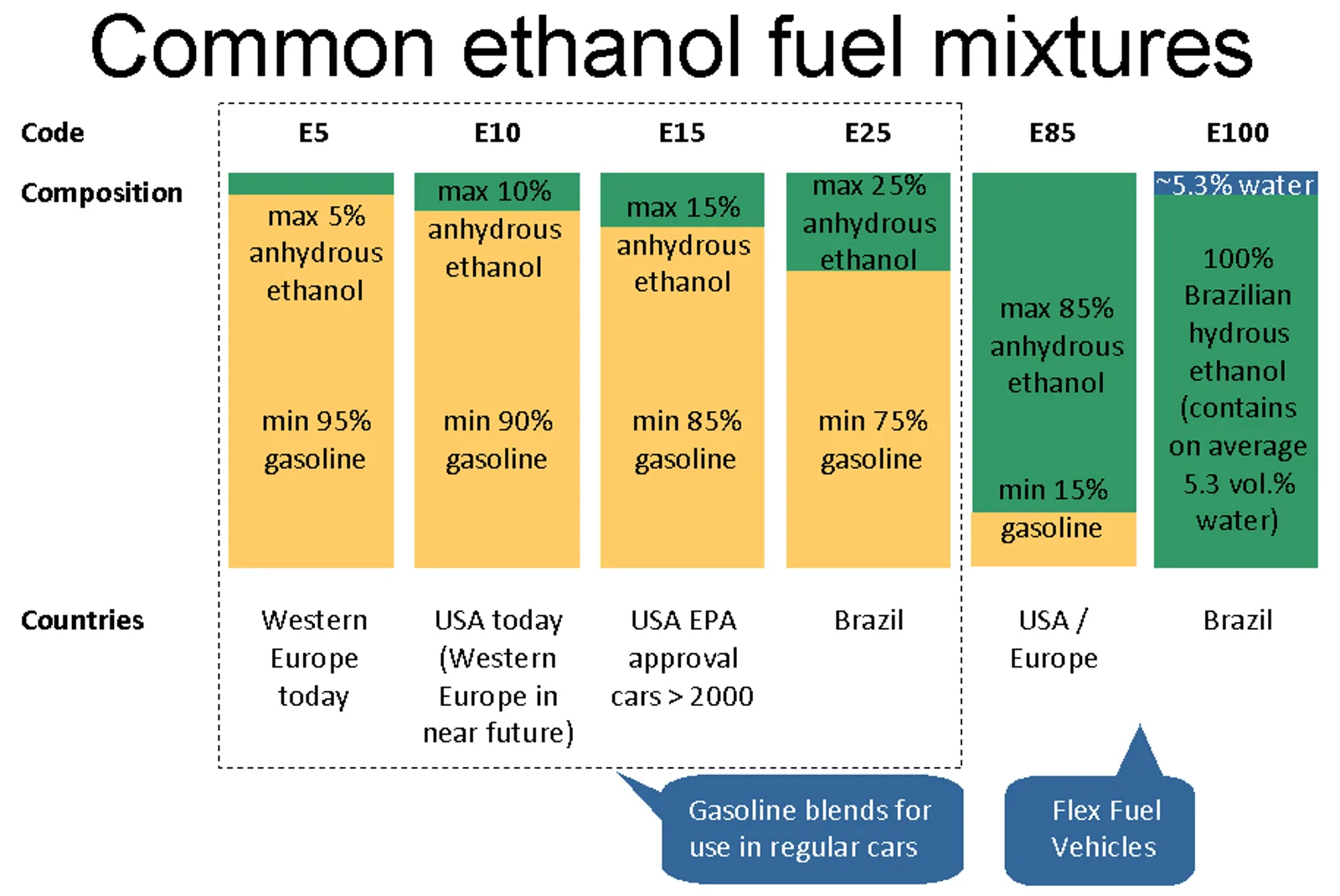
E10 is a mixture of 10% anhydrous ethanol and 90% gasoline, sometimes nicknamed gasohol, and most modern automobiles and light-duty vehicles can burn it in their existing engines, with no alteration to the engine or fuel system.
Wider evidence points the same way. Other low blends, such as E5 and E7, are generally safe for recent engines that were designed to run on straight gasoline. In the United States E10 is approved for all new automobiles. The Philippine Department of Energy says a mixture of up to 10% ethanol is not harmful to cars' fuel systems. In Sweden, where every 95-octane petrol has been E10 since 1 August 2021, all newer and many older petrol cars sold there are expected to cope, partly because the EU's Fuel Quality Directive (2009/30/EC) has applied there since January 2011. One exception to remember is aircraft: petrol containing alcohol is generally not recommended for them.
Ethanol is hygroscopic: it absorbs water vapour, and too much water can cause phase separation and engine stall.
What is an ethanol petrol blend, and how is E10 made?
The letter and number on the pump describe the share of ethanol by volume. E85 is 85% ethanol and 15% gasoline. Low-ethanol blends typically run from E5 to E25, but internationally the term most often means E10, which is used in more than 20 countries. The United States leads, where ethanol made up 10% of the gasoline fuel supply in 2011.
Ethanol is the same type of alcohol found in drinks, and most fuel ethanol is made by fermentation. Yeast turns the sugars from crops such as corn and sugarcane into ethanol and carbon dioxide, much as it does in a brewery. The solution that results is only about 15% ethanol, so it has to be distilled. A limit then appears: distillation can take purity only to 95 or 96%, because ethanol and water form a mixture that boils as one. That "hydrous" ethanol cannot be blended freely with petrol, so the remaining water has to be removed.
Most modern plants do this with molecular sieves. Picture a bed of tiny beads whose pores are the right size to trap water molecules but too small for ethanol to enter, rather like a sieve that catches only the smallest grains. When the beads are saturated they are cleaned under vacuum and reused. The method saves 3,000 btus per gallon (840 kJ/L) against the older azeotropic distillation, which dosed the mixture with benzene or cyclohexane.
| Blend | Ethanol share | Where it appears |
|---|---|---|
| E5 to E7 | 5% to 7% | Generally safe for recent engines that run on straight gasoline |
| E10 | 10% | Most modern cars, with no modification; the most common blend in Australia |
| E15 | 15% | US waivers cover model years 2001 and later; some makers warn warranties will not cover it |
| E20 to E25 | 20% to 25% | In use in Brazil since the late 1970s; Brazil's legal blend has been around E25 since 2007 |
| E85 | 85% | Flexible-fuel vehicles and specially designed or modified engines |
| E100 | Hydrous ethanol | Brazilian neat-ethanol and flex-fuel vehicles |
Does E10 hurt fuel economy?
A little, in theory, though in practice the effect is small. Pure ethanol holds only about two thirds of the energy of the same volume of pure gasoline, so a blend with ethanol in it contains slightly less energy per litre.
The Finnish study, carried out by the VTT Technical Research Centre in 2011, compared commercial grades 95E10 and 98E5 under controlled laboratory conditions. Over 100 kilometres (62 mi), average consumption was 10.30 litres (2.27 imp gal; 2.72 US gal) on 95E10 and 10.23 litres (2.25 imp gal; 2.70 US gal) on 98E5. The raw difference of 0.07 favoured the lower-ethanol grade, a rise of 0.7% with E10. Normalised, the figure became 1.0%, which matches an estimate of 1.1% from calorific values based on approximate fuel composition. The researchers found practically no difference in normal driving.
Evidence on stronger blends is mixed. In an early report on E10, E15 and E20, the US National Renewable Energy Laboratory saw no warning lights, no fuel filter plugging and no cold start problems at 24 and 10 degrees Celsius, and noted that the computers in newer vehicles adapt to the higher octane, which can mean lower emissions, more horsepower and in some cases better economy. Consumer Reports, by contrast, says ethanol is less energy-dense than regular gasoline, so E15 returns worse fuel economy.
E10 vs 95: what does the octane number change?
Ethanol has a very high octane rating, which is why it suits racing engines with high compression ratios. For ordinary driving the benefit is modest: E10 usually scores two to three octane numbers above ordinary petrol. A pump label such as 95E10 therefore describes two things at once, the octane rating of the grade and the ethanol content.
The comparison depends on the country. In Sweden all 95-octane petrol is E10. In Vietnam, from January 2018, all 92-octane fuel contains 5% ethanol (E5) while 95-octane fuel does not have to. In Australia, E10 is the most common ethanol blend, and cars that can run on E85 can also use E10 or straight petrol.
Why does water matter for older cars and ethanol blends?
Ethanol is hygroscopic: it draws water vapour out of the air. Absorbed water dilutes the fuel, and it can make an ethanol-gasoline blend separate into layers, which can stall the engine. This is why ethanol fuels must be kept in tightly sealed containers, and why ethanol cannot be shipped efficiently through long-distance pipelines like other liquid hydrocarbons. Fuel mileage also falls as water content rises. Blends with more ethanol tolerate more water: E30 can hold about 2% without separating, and above about 71% ethanol the remainder can be any mix of water or gasoline without separating.
That is the technical reason regulators treat stronger blends with caution. Australian legislation from July 2003 caps fuel ethanol blends at 10%, after vehicle testing showed that blends of 20% or more may cause problems in some older vehicles. Pumps dispensing blends that include fuel ethanol have to carry a label.
The United States offers a case study in how cautious the rules around the next step up can be. E15 is generally the highest ratio of ethanol that is possible in vehicles that some manufacturers recommend for E10, because ethanol attracts water and acts as a solvent. In October 2010 the Environmental Protection Agency allowed E15 only for cars and light pickups of model year 2007 or later, then extended the waiver in January 2011 to model years 2001 to 2006. It refused a waiver for motorcycles, heavy-duty vehicles and non-road engines, and was still studying whether older cars could withstand 15%. A 2012 survey by the American Automobile Association found that only about 12 million of more than 240 million light-duty vehicles on US roads were approved by manufacturers as fully compliant with E15. Five makers, BMW, Chrysler, Nissan, Toyota and Volkswagen, said E15 damage would fall outside their warranties, while General Motors said its 2012 and 2013 models could use up to 15% ethanol, as its owners' manuals state.
Where does E10 stand in Australia?
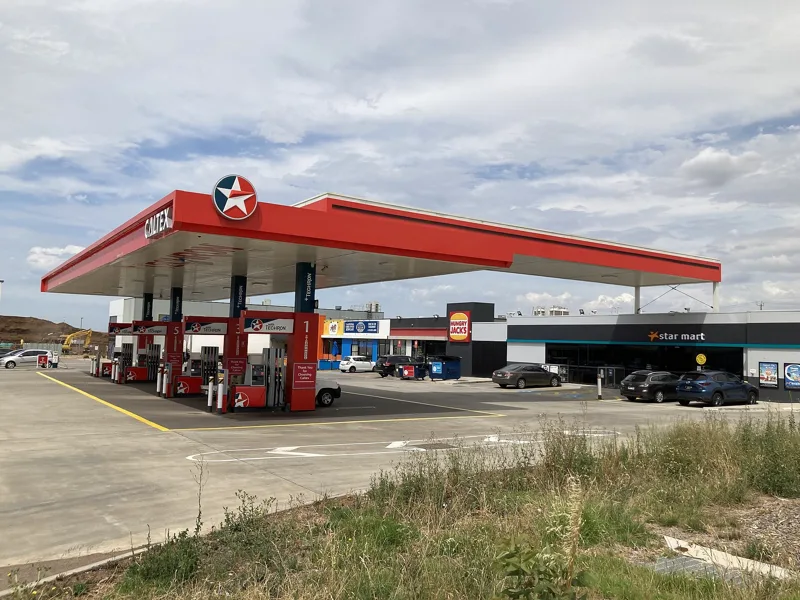
The most common ethanol blend in Australia is E10, available nationwide at upwards of 600 service stations. E85 is sold at a smaller number of outlets that target specialised vehicles. Under the Fuel Quality Standards Act 2000, E85 may only be used in vehicles specifically designed or modified for it, which includes flexible-fuel vehicles and V8 racing supercars. Saab's BioPower 9-3 and 9-5 were the first flexible-fuel cars on sale there, arriving in 2007 as United Petroleum began offering E85 at a pair of its stations, one in Sydney and one in Melbourne. Caltex joined in during 2010 with Bio E-Flex, and the Supercars Championship has used E85 since the start of the 2009 season.
Two states have written mandates. New South Wales requires bioethanol to make up 6% of petrol sales, which in practice means about 60% of all petrol sold needs to be E10. Queensland's mandate began on 1 January 2017 with ethanol making up 3% of a station's regular and ethanol-blended unleaded sales every quarter, and was due to rise to 4% on 1 July 2018. Customers remain free to choose what they buy. The mandates attract controversy. In 2017 the Productivity Commission recommended scrapping both by the end of 2018, arguing that they affect competition and end up costing consumers more through premium fuel substitution.
Both states have also run education campaigns, partnering with motoring clubs: the New South Wales government and the NRMA launched "Fuel for Thought" in 2017, and the Queensland government and RACQ have a similar "E10 OK" programme. Each offers a compatibility checker and information on ethanol-blend fuels.
Australia has three major fuel ethanol facilities, which make ethanol chiefly using wheat waste starch, sorghum grain and molasses, with a combined capacity of around 440 million litres a year. About 68% of production comes from a single facility in New South Wales, the Manildra Group's plant at Bomaderry, which turns wheat waste starch into 300 million litres. In Queensland, United Petroleum's plant at Dalby uses sorghum and Wilmar's plant at Sarina ferments molasses to produce 60 million litres a year. Even so, Australia is a small producer overall, accounting for 0.2% of world bioethanol production in 2017, and biofuels supplied only 0.5% of transport fuel energy in 2016-17. Domestically produced fuel ethanol was effectively exempt from excise until 30 June 2021, while petrol carried excise of 38.143 cents per litre.
What does E10 do for emissions?
E10 can cut carbon monoxide emissions by 20 to 30% under the right conditions, and reduces carbon monoxide and greenhouse gases such as carbon dioxide by an estimated 2% compared with regular gasoline. The trade-off is that it can raise evaporative emissions and some pollutants, depending on the age of the vehicle and the weather.
In Australia the greenhouse benefit varies with the raw material: an E10 blend produces 1.7% less greenhouse gas than unleaded petrol when the ethanol comes from wheat, and 5.1% less when it comes from molasses. Elsewhere, sugarcane ethanol in Brazil is credited with a more favourable energy balance than corn ethanol in the United States. The main objections are to food prices and land use, because ethanol crops compete for arable land. Cellulosic ethanol, made from plant fibre, is not yet economic.
Where this goes next
Blending rules continue to move country by country. E10 became the standard petrol in the United Kingdom in September 2021. India reached its 10% target in June 2022, five months ahead of schedule. Argentina approved a minimum of E12 from June 2021, with a waiver to E15 after October 2022. Chile was considering E5, and Panama, Bolivia and Venezuela were weighing E10. In Thailand, E10 was introduced nationwide in 2007 and replaced 91-octane pure gasoline in 2013.