How a swap station works, who owns the battery, and what became of Better Place and Tesla's swap plan.
Battery swapping replaces a discharged EV pack with a charged one at a station instead of recharging the car. Nio's automated stations do it in under five minutes, and by July 2026 the company ran 3,989 stations and had performed over 119 million swaps.
In 2015 Tesla closed the only battery swap station it had ever built, because customers showed little interest. By July 2026 the Chinese maker Nio was running 3,989 of them. Swapping has gone from a Tesla retreat to a working network.
What is battery swapping, and how long does a swap take?
Battery swapping means exchanging a car's discharged pack for a fully charged one instead of plugging in and waiting. Nio's automated stations take under five minutes. Tesla's 2013 Model S demonstration took just over 90 seconds, and Better Place needed five minutes in 2011.
The attraction is obvious for anyone who searches for how long it takes to swap an EV battery: the car spends minutes at the station rather than the time a charge needs. The idea has a long history in work vehicles too, since electric forklifts commonly use it, and it is the basis of Gogoro's scooter networks in Taiwan.
A swap that takes minutes only works when someone else owns the battery and a station is nearby.
Is battery swapping a new idea?
As far back as 1896 someone proposed a service built on exchangeable batteries, and from 1910 to 1924 the Hartford Electric Light Company ran one for electric trucks through the GeVeCo service. A similar scheme served owners of Milburn Electric cars in Chicago from 1917 for a few years.
The GeVeCo arrangement is worth a closer look because it solved the money problem in a way that still looks modern. The owner bought a truck from the General Vehicle Company, which was part-owned by General Electric, but without a battery. Power came from Hartford Electric in the form of a swappable pack, and both trucks and packs were designed so that the exchange was quick. In return the owner paid a charge that varied with the miles driven plus a monthly service fee covering maintenance and storage. The trucks covered more than 6 million miles.
Later experiments came and went. In 1993 Suntera built the SUNRAY, a two-seat three-wheeler whose battery cartridge could be exchanged in a few minutes at a station. A rapid replacement system looked after 50 electric buses at the 2008 Summer Olympics. One smaller scheme ended badly: Zotye ran a fleet of 15 M300 EV hatchbacks as taxis in Hangzhou, and in 2011 one caught fire after its boot-mounted pack ignited. An investigation found that the battery and its connecting electronics had been worn down by the constant fitting and removal of charged packs, and the scheme was halted.
What happened to Better Place and Tesla's swapping plan?
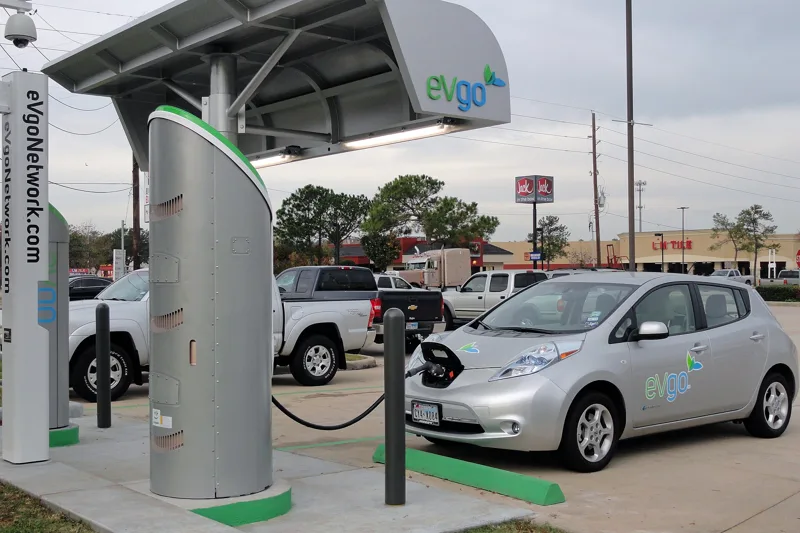
Better Place opened its first station at Kiryat Ekron, near Rehovot in Israel, in March 2011, and filed for bankruptcy in Israel in May 2013. Tesla announced its own swap plan a month later, in June 2013, and abandoned its only station, at Harris Ranch, in 2015 for lack of customer interest.
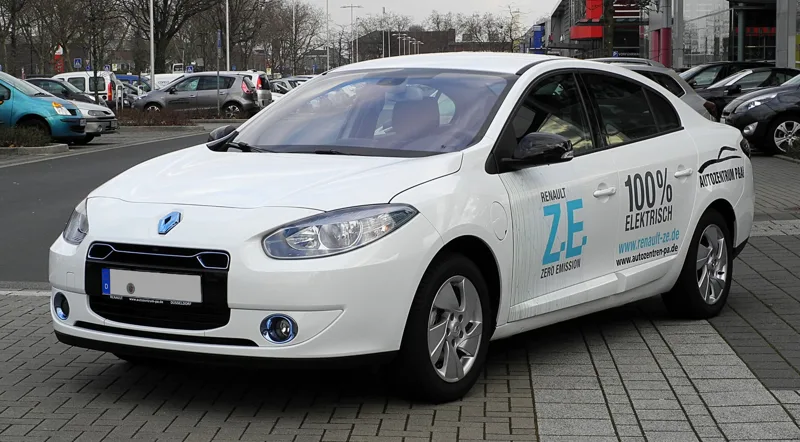
Better Place was the first modern attempt to make switching mainstream. Its car was the Renault Fluence Z.E., which was sold in several countries, including some where no swap stations had been planned. Each swap took five minutes. After Israel, further stations were built in Denmark.
Tesla's route was different. It had begun building its own Supercharger network in 2012, and in June 2013 announced that it would offer swapping too. A Model S swap took just over 90 seconds. According to Elon Musk the service would cost around US$60 to US$80 at June 2013 prices. A car purchase included one pack, and after a swap the owner could return later for the original pack, charged. The second option was to keep the swapped pack and pay or receive the difference in value between the two. No price was announced for that choice.
Critics spoke up early. In 2013 the CNET reviewer Wayne Cunningham called swapping systems proprietary, and he was uneasy about the promotion of the Model S alongside talk of Tesla stations. His argument was that when one company owns the batteries and the technologies are incompatible and patent-protected, rival firms could carve up the market and make wide adoption less likely.
How does a Nio swap station work?
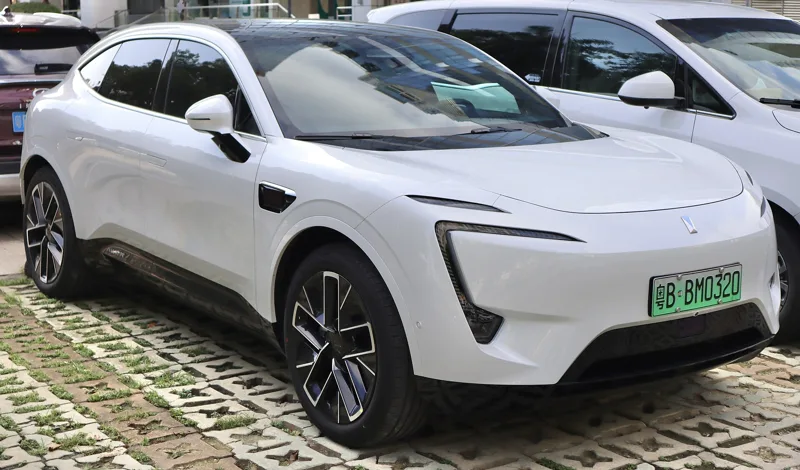
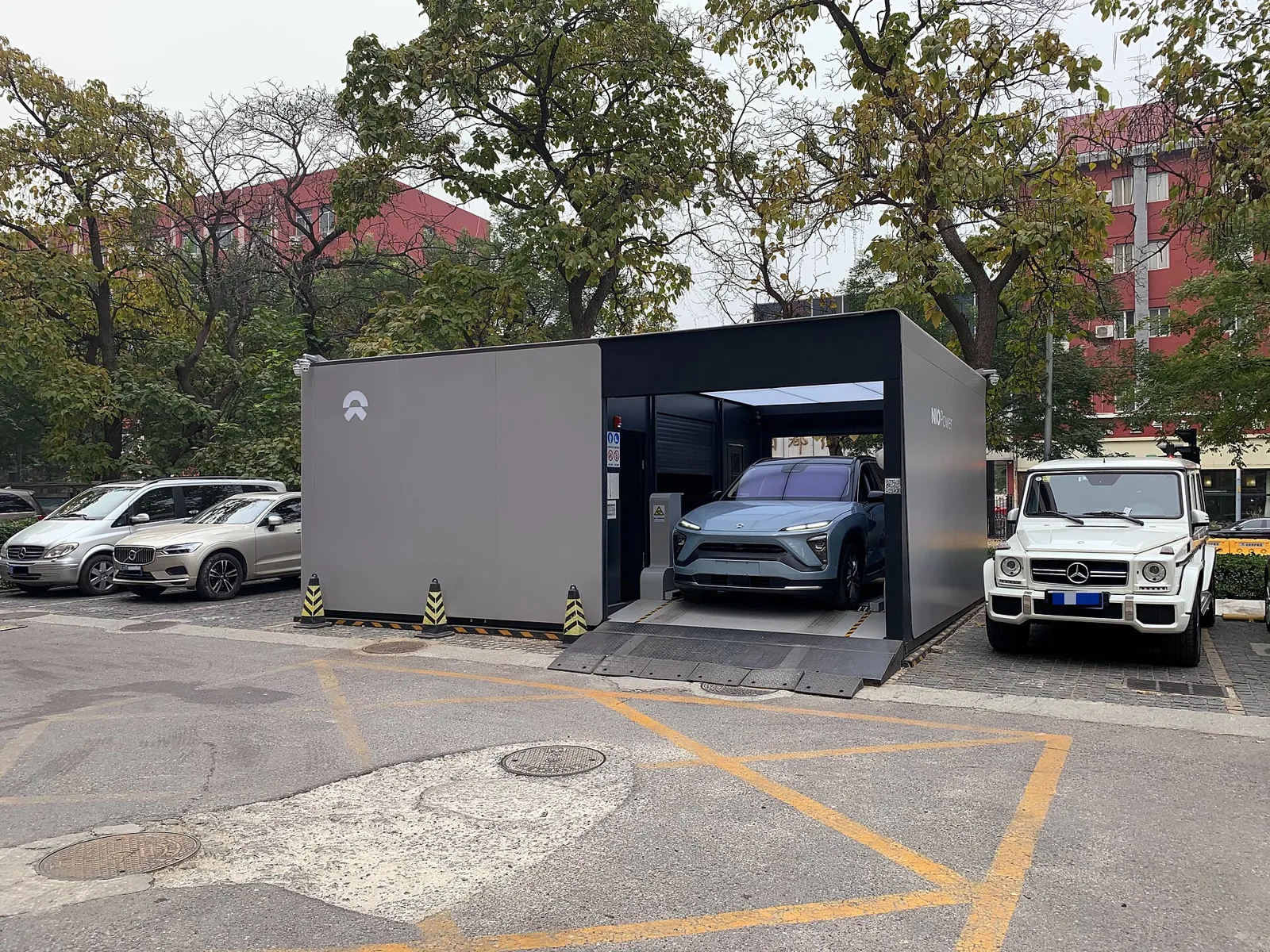
A Nio station is automated. The car parks on a platform, the system removes the depleted pack and fits a charged one while the driver stays in the car, and the whole process takes under five minutes. Later versions add energy storage and grid-interaction functions, aimed at highway service areas.
Nio opened its first station, called the Power Swap Station, in May 2018 in the Nanshan District of Shenzhen, and at first it served only the ES8. The first phase of the network was completed in November 2018, with 18 stations spread over 14 sites on the G4 Beijing-Hong Kong and Macau Expressway, a route of 2,273 km (1,412 mi). In January 2019 a second phase put eight more stations on the G2 Beijing-Shanghai Expressway, which is 1,212 km (753 mi) long.
A station in China can cost about $772,000 to build. By March 2021 the swap stations sat alongside 134 supercharging stations and 327 destination stations across China, so swapping was one part of a wider energy network.
Who pays for the battery when you swap?
Nio introduced Battery as a Service in August 2020, and the scheme lowered the purchase price of its vehicles by roughly 25%. The same month it created a joint battery-asset company with CATL and other investors, each partner putting in 200 million yuan.
The joint battery-asset company has four partners: CATL, Hubei Science Technology Investment Group, a subsidiary of Guotai Junan International Holdings, and Nio. Each partner contributed 200 million yuan, about US$32 million, for a 25% share. Drivers can use the swap service for a lasting upgrade or a temporary rental, so a driver can move to a different pack for good or borrow one for a while.
Others charge in their own ways. Gogoro riders pay a monthly subscription fee to swap at its GoStations. In Southeast Asia, Oyika and Volta offer quick swaps for electric motorcycles under a Battery-as-a-Service model in Indonesia, Malaysia and Thailand. Tesla's 2013 plan built one pack into the price of the car, with a swap priced at US$60 to US$80.
Swap networks compared
| Operator | Vehicles | What the figures say |
|---|---|---|
| GeVeCo (Hartford Electric) | Electric trucks, 1910 to 1924 | More than 6 million miles; per-mile charge plus monthly fee |
| Better Place | Renault Fluence Z.E. | Five-minute swap; first station March 2011; bankrupt in Israel, May 2013 |
| Tesla | Model S | Just over 90 seconds; one station, abandoned in 2015 |
| Nio | Nio cars | Under five minutes; 3,989 stations and over 119 million swaps by July 2026 |
| Gogoro | Scooters and mopeds | 2,000 GoStations and more than 175 million swaps by April 2021, per the company |
| ZEWAY | Electric scooters in France | 50-second swap; 1,000,000 swaps in 2024 |
How big are the Nio and Gogoro swap networks?
Nio had 3,989 swap stations worldwide in July 2026, most of them in China, and had performed over 119 million swaps. Gogoro reported 2,000 GoStations and more than 175 million swaps in April 2021, serving 370,000 riders in Taiwan.
Nio's climb came in steps. In March 2021 it had 193 swap stations and had made its two-millionth swap, in Suzhou. By December 2021 it hit its 700-station goal ahead of schedule after more than 5.3 million swaps. By December 2022 there were 1,305 stations in every provincial region of China, averaging 40,000 swaps a day, with 15 million swaps in total. Its first European station opened in Norway in 2022, and seven were running in Germany by August 2023. The network completed its 100 millionth swap by February 2026.
Gogoro's Smartscooter was revealed at CES in January 2015, together with its swap network, in Taiwan, where scooters are packed more densely than anywhere else on Earth. More than 4,000 had sold by the end of that year, taking 33.94% of Taiwan's electric scooter market. In 2016 there was a GoStation less than every 1.3 km in Taipei. By February 2021 the network had more than 764,000 battery packs, and 66 of the stations were larger Super GoStations able to serve up to 1,000 riders a day. Some stations carry grid batteries so that they keep charging scooter packs during a power failure.
Which batteries can be swapped, and what is inside them?
For swapping to work across several models, the packs must be interchangeable. At Nio, all swap-compatible batteries share standardised external dimensions, which lets one station serve different cars. Inside, the chemistry has been changing, from a 70 kWh NMC pack to a 75 kWh dual-chemistry design in 2021 and an all-LFP pack in 2024.
The 2021 pack combined two types of cell. NMC brings higher energy density and better cold-weather performance, while LFP offers safety and a longer lifespan. A 2024 revision made the 75 kWh pack all-LFP, without modules, and able to take 170 kW DC fast charging. In mid-2024 Nio also began taking delivery from WeLion of a semi-solid-state NMC pack of 150 kWh, rated at 360 Wh/kg. That pack is about 20 kg heavier than the liquid-cell 100 kWh version, and at first it could only be rented briefly at swap stations.
To spread the standards beyond one brand, Changan, Geely, JAC and Chery all agreed between late 2023 and early 2024 to cooperate with Nio on swapping standards, station technology and network growth. In March 2024 the Nio Power arm also teamed up with Anhui's Zhongan Energy on battery standards, charging technology and building out the network.
What does swapping mean for someone buying or driving an EV?
Swapping only helps if the car is built for it and a station is near. At Nio the gains are a purchase price lowered by roughly 25% under Battery as a Service, a swap in minutes, and the option to upgrade or rent a different pack. Elsewhere the examples are scooters, taxis, trucks and a canal barge.
The two-wheeler world shows the model at scale. Gogoro's Powered by Gogoro Network programme lets other manufacturers build scooters for its stations. In October 2021 the network launched in Hangzhou under the Huan Huan brand with 45 stations in partnership with Yadea and Dachangjiang Group, and it reached 250 stations in China by September 2022 before the company delayed further expansion in November 2022, citing economic and geopolitical uncertainty. In France, ZEWAY scooters swap in 50 seconds, and the firm reached 1,000,000 swaps in 2024. In the Netherlands, a converted canal barge has been powered since 2021 by a swap system in which each 20-foot (6.1 m) shipping container holds 2 MWh of batteries.
Where this goes next
Gogoro has announced expansion plans with dated milestones. In January 2023 it said Belrise Industries and the state of Maharashtra would join it in putting $2.5 billion into charging and swapping infrastructure in India, after a Delhi pilot with Zypp Electric that began on 8 November 2022. A Nepal launch with Nebula Energy was planned for April 2024, and in Colombia the first four stations were to sit at Terpel service stations in Bogota from June 2024, with Medellin named as a possible later city.
Nio's plans centre on partners and chemistry. The agreements with Changan, Geely, JAC and Chery cover shared swapping standards, and the 150 kWh semi-solid-state pack, available at first only as a short-term rental, is a test of heavier, higher-density packs inside the same system. In 2021 the company also announced plans to reach 25 countries and regions by 2025.