How hysteresis, tread design, slip and load turn the energy of a rolling wheel into heat, and why steel on steel rail beats rubber on asphalt.
Rolling resistance is the force opposing a wheel as it rolls, mostly from energy lost as materials deform and recover. In tyres the main cause is hysteresis in the rubber, while steel wheels on rail experience far less, which is why trains can move freight so efficiently.
Rolling resistance is the force that opposes the motion of a body rolling on a surface, such as a ball, tyre or wheel. Most of it comes from non-elastic effects: part of the energy used to deform the wheel, the road or the ground is never returned when the pressure is removed. Tyres lose the most energy through hysteresis, which turns motion into heat, and steel wheels on steel rail lose far less than rubber on asphalt.
What is rolling resistance?
Rolling resistance is the force that resists a wheel or ball rolling across a surface. Its two main sources are hysteresis losses and permanent, or plastic, deformation of the wheel or the surface, such as soft soil. Slip between the wheel and the surface also dissipates energy, and some researchers treat that as a separate term called slip loss.
Any coasting vehicle slows down because of rolling resistance, including the drag of its bearings. Rubber tyres on tarmac have more of it than steel railway wheels on rails, and sand produces more than concrete. Rolling resistance is often expressed as a coefficient multiplied by the normal force, and that coefficient is generally much smaller than the coefficient for sliding friction.
Every rolling wheel loses a little energy as its material deforms and recovers, and that loss grows quickly when the wheel slips.
What causes rolling resistance in tyres?
In a pneumatic tyre, the main cause is hysteresis. Rubber stores some deformation energy and then gives back less of it than it took in, so the rest turns into heat as the tyre cycles through the contact patch. The energy loss comes from the viscoelastic behaviour of the rubber compound.
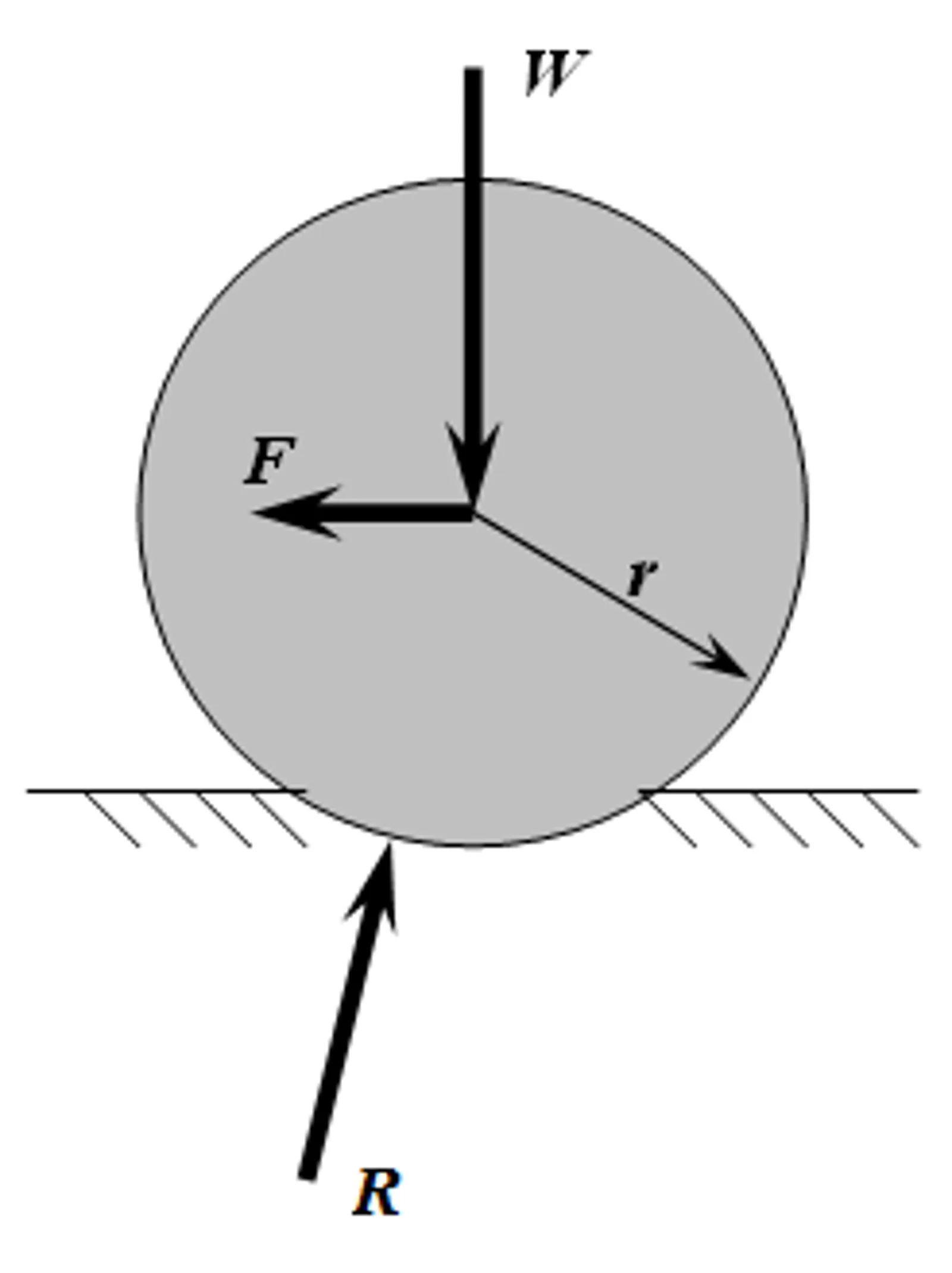
As a point of the tyre enters the contact area it is pressed in, and the hysteresis effect resists that, adding pressure. As it leaves, the rubber is still recovering, and the effect now reduces the pressure needed to keep the surfaces apart. The pressure distribution becomes asymmetrical and shifts forward, so the vertical force no longer passes through the centre of the wheel. That creates a moment which retards the rolling.
Materials that bounce back slowly, such as rubber, lose more energy than those that recover quickly and completely, such as steel or silica. Low-resistance tyres therefore use silica in place of some carbon black in the tread, which cuts low-frequency hysteresis without sacrificing traction. Railroads also suffer hysteresis in the roadbed structure.
How is rolling resistance measured?
The rolling resistance coefficient, written Crr, is the force needed to push or tow a wheeled vehicle at a constant slow speed on level ground, divided by the vehicle's weight. A Crr of 0.01 means that it takes 0.01 pounds of tow force to move one pound of vehicle, or 10 pounds for a 1000-pound vehicle. Multiply Crr by 100 to get a percentage of the vehicle's weight.
Engineers use several standards. The Society of Automotive Engineers tests, SAE J1269 and SAE J2452, are usually run on new tyres, and most new passenger tyres have Crr values from 0.007 to 0.014. Bicycle tyres reach 0.0025 to 0.005. Europe uses ISO 18164:2005. Values are measured on rollers, with power meters on the road, or with coast-down tests, and air resistance must be removed from the last two.
| Example | Typical value | Note |
|---|---|---|
| New passenger tyre | Crr 0.007 to 0.014 | SAE J1269 and J2452 tests |
| Bicycle tyre | Crr 0.0025 to 0.005 | Measured on rollers or on the road |
| Car of 1000 kg on asphalt | About 98.1 N of force | Using a Crr of 0.01 |
| Empty freight car on rail | Crr 0.002 | Loaded car comes down to 0.001 |
| Railway bearings, 21 tonne axle | Crr 0.00013 | Bearing losses only, at intermediate speeds |
A second measure, b, has units of length. It equals Crr multiplied by the wheel radius, so the force becomes the normal load times b divided by the radius. Sources that give a dimensionless coefficient can be converted to b by multiplying through by the wheel radius.
Does wheel diameter change rolling resistance?
Opinions have differed for two centuries. Dupuit reported in 1837 that resistance for carriages with wooden wheels and iron tyres is roughly inversely proportional to the square root of wheel diameter, a rule later confirmed for cast-iron railway wheels between 8 and 24 inches in diameter. Coulomb had reported in 1785 that it was inversely proportional to diameter, and that rule still appears in some handbooks, although it is disputed.
For pneumatic tyres on hard pavement, however, the effect of diameter is reported as negligible across a practical range. Diameter also interacts with sliding and slip, which is why results from different studies can conflict. The formulas for cast-iron mine wheels show how strongly the load also matters.
How does driving torque change rolling resistance?
Applied torque, from a motor or brakes, dissipates energy beyond basic rolling resistance. Slip between wheel and ground is inevitable whenever a driving or braking torque is applied, which means the vehicle moves slightly slower than the wheel's circumference suggests. A 2 percent slip means the driven wheel's circumferential speed is 2 percent higher than the vehicle speed.
Small slips matter a great deal. For pneumatic tyres, a 5 percent slip can raise rolling resistance by 200 percent, partly because the tractive force is many times the rolling force, and more power is consumed per unit of speed. For a passenger car, slip resistance roughly equals basic rolling resistance when tractive force is around 40 percent of maximum traction, and at 70 percent it becomes about 10 times larger.
Driven wheels that receive no torque slip less, so their losses are mainly hysteresis. Drive wheels and axles also lose energy to slip, which is why traction and rolling losses add together. Railway wheels climbing a grade slip about 1.5 to 2.5 percent, and at high tractive effort the slip rises rapidly until the wheel spins.
How do load and inflation change rolling resistance?
For steel railway wheels, Crr falls as the load per wheel rises. An empty freight car had about twice the coefficient of a loaded one, 0.002 against 0.001, and mine rail cars show a similar pattern. Theory for a rigid wheel on an elastic roadbed makes Crr inversely proportional to the square root of load, so a 2 percent load increase adds only about 1 percent to the resistance.
Pneumatic tyres behave differently and depend on whether inflation rises with load. Reports suggest that if pressure is raised with load according to a schedule, a 20 percent load increase cuts Crr by 3 percent. Without a pressure change, the same load increase raises Crr by 4 percent, and the combined effect works out to a 24.8 percent rise in rolling resistance.
Inflation affects tyres in other ways too. Lower pressure causes more sidewall flexing and higher resistance, and it can overheat the tyre. Over-inflating a bicycle tyre can make it hop over the surface, which sacrifices traction without necessarily cutting the overall loss. Temperature also matters: for both solid and pneumatic tyres, resistance falls as the temperature rises within a range, and a rise from 30 C to 70 C cut resistance by 20 to 25 percent.
What else affects rolling resistance?
Curves add to the total. A vehicle travelling round a bend that is not banked to counter the centrifugal force feels an unbalanced sideways force, which increases rolling resistance. Railways call this curve resistance, while road engineers have sometimes called it rolling resistance due to cornering.
Tyre construction offers the largest practical lever. Fillers and polymers can improve grip while reducing hysteresis, and replacing some carbon black with silica bonded by silane is one common route. Nano-clay has also been shown to reduce resistance in high-performance tyres. A supple casing flexes less energy per revolution than a stiff one, and thick, heavily contoured treads raise resistance, which is why the fastest bicycle tyres have very little tread.
Rolling also makes noise. Most tyre noise on a highway comes from the percussion of the tread blocks and the compression and release of air trapped in the grooves. Speed records have almost all been set on narrow wheels, which give an aerodynamic advantage at high speed that matters far less at everyday speeds.
Why do trains need less energy than cars?
Steel wheels on steel rail have much lower rolling resistance than rubber tyres on road, which gives trains a clear advantage. That benefit can be lost, though, when a train is very heavy for the passengers it carries. In 1975 Amtrak trains weighed just over 7 tonnes per passenger, while an average car carried just over one ton per passenger, so much of the rail advantage was used up by the extra mass.
The N700 Series Shinkansen shows the other side of the picture. It weighs 715 tonnes and carries 1323 passengers, which works out to about half a tonne per passenger. Combined with the low resistance of steel on steel, that makes the train far more energy efficient than a typical car. CSX ran an advertising campaign in 2013 claiming that its freight trains move a ton of freight 436 miles on a gallon of fuel, while some sources say trucks manage about 130 miles on a gallon for the same freight.
Maglev trains avoid rolling resistance altogether, because they levitate on magnetic fields rather than running on wheels. Rolling resistance is still present in the wheel bearings of the rolling stock, though, and it rises or falls with axle load and speed.
How do railway bearings add to the total?
Bearing torque losses can be expressed as a rolling resistance measured at the rim of the wheel. Railways normally use roller bearings, cylindrical in Russia and tapered in the United States, and their resistance varies with both wheel loading and speed. Bearing losses are lowest at high axle loads and intermediate speeds, where the coefficient is 0.00013 for a 21 tonne axle.
For empty freight cars with 5.5 tonne axle loads, the bearing coefficient rises to 0.00024 at 20 km/h and to 0.00028 at 120 km/h, against 0.00020 at 60 km/h. These bearing values are added to the other components to give the total coefficient for the wheels, so bearing design is part of the rail efficiency story.