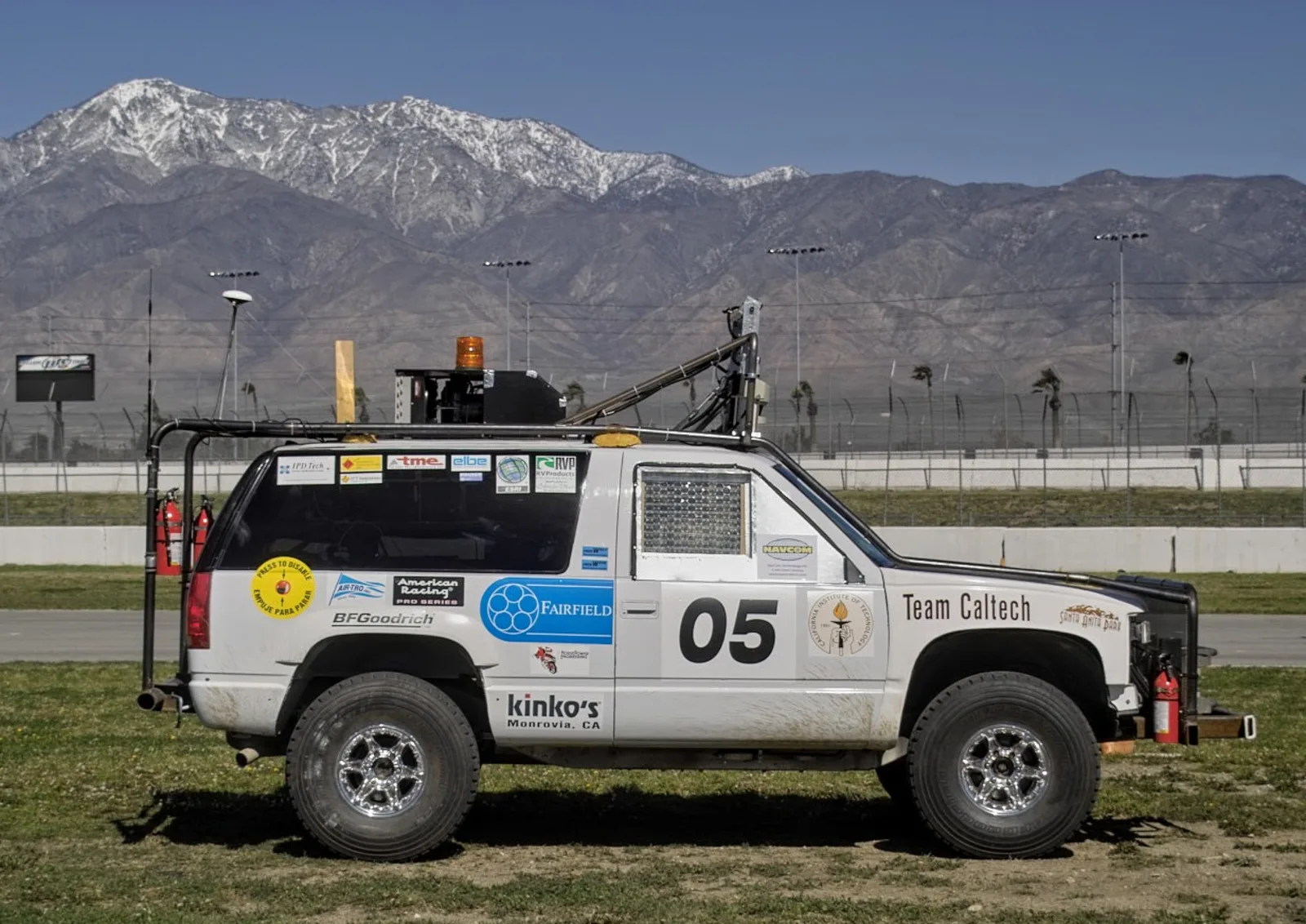
From a 2004 run through the Mojave Desert to a 2007 test in a mock city, how DARPA's prize competitions pushed autonomous vehicles forward and what came after.
The DARPA Grand Challenge was a prize competition run by the US Defense Department's research agency to develop driverless ground vehicles. Its first event in 2004 ended without a finisher, but the 2005 race saw five vehicles complete a 212 km course. The 2007 Urban Challenge added traffic rules and merging.
The DARPA Grand Challenge is a prize contest for American self-driving research, financed by the Defense Advanced Research Projects Agency, the research arm of the Department of Defense. Congress authorised DARPA to award cash prizes to advance its mission of high-payoff research that bridges basic discovery and military use. The first event, in 2004, asked teams to build driverless ground vehicles that could finish a long off-road course in a set time.
Why did DARPA start a driverless car race?
DARPA launched the Grand Challenge to spur the development of the technologies needed for fully autonomous ground vehicles. Driverless vehicles had been pursued internationally for many years, from programmes in Japan starting in 1977 to Germany's VaMP project led by Ernst Dickmanns.
The Grand Challenge was the first long-distance competition for driverless cars anywhere, and it took a prize-based rather than a purely commercial or academic approach.
The roots go back further. DARPA funded the Shakey robot project at Stanford Research Institute, now SRI International, from 1966. The first autonomous ground vehicle able to drive on and off roads followed as part of the Strategic Computing Initiative from 1984, which led to demonstrations by the Autonomous Land Vehicle and the Navlab.
The ultimate goal was ambitious. Congress authorised a prize of $1 million for the first event, with the aim of making one-third of ground military forces autonomous by 2015. The prize money was later raised to $2 million for the second event, which was claimed on 9 October 2005.
A desert race that no one finished became the proving ground for the driverless car.
Who could enter the competition?
The competition was open to teams and organisations from around the world, provided that at least one US citizen was on the roster. Teams came from high schools, universities, businesses and other organisations. More than 100 teams registered for the first year, and in the second year 195 teams from 36 US states and four foreign countries entered the race.
The 2007 prizes were $2 million for first place, $1 million for second and $500,000 for third.
What happened at the 2004 event?
The first competition was held on 13 March 2004 in the Mojave Desert, along a 150-mile (240 km) route that follows Interstate 15 from just outside Barstow, California, to just past the state line at Primm. No robot vehicle reached the finish, and no prize was paid.
The farthest any entry travelled was 11.78 km (7.32 mi), by Carnegie Mellon University's Red Team with Sandstorm, a converted Humvee, which became stuck on a rock after a switchback.
Because no winner was declared, DARPA scheduled a second event for 2005, and the cash prize was not paid out in 2004.
How did the 2005 race succeed?
The second event began at 6:40 am on 8 October 2005. All but one of the 23 finalists surpassed the distance covered by the best vehicle in 2004, and five completed the 212 km (132 mi) course. The route passed through three narrow tunnels.
It required more than 100 sharp left and right turns, and it finished through Beer Bottle Pass, a winding mountain road with a sheer drop on one side and a rock face on the other.
| Event | Date | Course | Result |
|---|---|---|---|
| First Grand Challenge | 13 March 2004 | 150 miles (240 km) through the Mojave Desert | No finisher; best run 11.78 km (7.32 mi) |
| Second Grand Challenge | 8 October 2005 | 212 km (132 mi) with tunnels and sharp turns | Five finishers |
| Urban Challenge | 3 November 2007 | 96 km (60 mi) of urban roads in under 6 hours | Six finishers; Tartan Racing won |
The 2005 field included some remarkable stories. Stanford's Stanley finished first, while the Carnegie Mellon entry H1ghlander was held back by mechanical problems before Stanley passed it. Gray Team, based near New Orleans, was caught up in Hurricane Katrina only weeks before the race. Terramax, a truck-sized entry from Oshkosh Truck weighing 30,000 pounds, took the fifth place on the second day after idling overnight on the route.
What changed in the 2007 Urban Challenge?
The third event, known as the Urban Challenge, took place on 3 November 2007 at the former George Air Force Base, now the Southern California Logistics Airport in Victorville. Its course covered 96 km (60 mi) of urban roads, which had to be completed in less than six hours.
Vehicles were required to obey all traffic regulations while negotiating with other traffic and obstacles and merging into the flow.
Earlier events had been tough physically, but the robots operated in isolation and met other vehicles only when passing them. The Urban Challenge demanded that vehicles detect and avoid other robots and make intelligent decisions in real time based on what those robots did. Maintaining precedence at a four-way stop intersection was a typical test of that software.
The organisers split competitors into two tracks, A and B. Teams in Track A received $1 million in funding, and 11 were chosen. They largely represented major universities and large corporate interests, such as Carnegie Mellon teaming with GM as Tartan Racing, Stanford teaming with Volkswagen, and Virginia Tech teaming with TORC Robotics as VictorTango. The Golem Group was one of the few independent entries in Track A, and DARPA did not publicly explain how it chose the Track A teams.
Tartan Racing claimed the $2 million prize with Boss, a Chevy Tahoe. The Stanford Racing Team, with its entry Junior, a 2006 Volkswagen Passat, took the $1 million second prize. VictorTango finished third with Odin, a 2005 Ford Escape hybrid, and won $500,000. MIT placed fourth, and Cornell University and the University of Pennsylvania with Lehigh University also completed the course. Six teams finished the whole route.
Teams used a range of software and hardware combinations to interpret sensor data, plan routes and execute them. At least one team, Tartan Racing, added extra waypoints to the sparse maps DARPA supplied, which improved its navigation. A debriefing paper from Team Jefferson illustrated the contrast between the course map it received and the richer map Tartan Racing used.
What came after the Urban Challenge?
The Grand Challenge format then widened to other kinds of robotics. The DARPA Robotics Challenge, launched in October 2012, focused on humanoid robots able to carry out complex tasks in dangerous, degraded and human-engineered environments. Unlike earlier events, the vehicles themselves were not part of the scope.
In August 2012, DARPA named Boston Dynamics as the sole source of the robots, awarding a contract of $10,882,438 on a cost-plus-fixed-fee basis to build eight identical robots based on the PETMAN project.
The FANG Challenge, short for Fast Adaptable Next-Generation Ground Vehicle, focused on design rather than driving. On 22 April 2013, DARPA awarded a $1 million prize to Ground Systems, a three-person team with members in Ohio, Texas and California. More than 1,000 participants in over 200 teams used design tools and the VehicleFORGE collaboration platform, developed by Vanderbilt University, to simulate thousands of potential mobility and drivetrain subsystems.
How did the subterranean challenge work?
The DARPA Subterranean Challenge, which ran from 2017 to 2021, asked teams of universities and companies from around the world to build robotic systems that could map, navigate and search underground environments. Those spaces are dangerous for people and can lack light, carry dripping water and thick smoke, and cut robots off from GPS and their handlers.
The challenge began in September 2018 with a Systems Competition using physical robots, and a Virtual Competition in the ROS Gazebo simulator. The four events were the Tunnel Circuit in August 2019, held at an experimental mine in Pittsburgh, the Urban Circuit in February 2020 at an abandoned nuclear power plant in Elma, Washington, the Cave Circuit in November 2020, which was held virtually because of the COVID-19 pandemic, and the Final Event in September 2021 in Louisville, Kentucky. Teams came from 11 countries and 20 universities.
Team CERBERUS won the Final Systems Competition on 24 September 2021 using four ANYmal C legged systems. Australia's Commonwealth Scientific and Industrial Research Organisation (CSIRO) finished second with an equal score but a slightly slower time, and Team Dynamo won the Final Virtual Competition.
Successful teams built fleets with a range of capabilities. Walking robots handled stairs and piles of rubble, while wheeled or tracked robots carried heavier payloads, including large batteries, and worked for longer. Marsupial robots carried small flying robots with short battery lives, which could then be deployed to map large or hard-to-reach spaces. Several detection instruments, including lights, radar, sonar and thermal imaging, gave teams a wider view of conditions.
Communication was often unreliable underground, so the teams whose robots had some autonomy did best. Those robots could explore on their own and then return to radio contact to share what they had found. CSIRO's robots even made cooperative decisions. A robot too large for a corridor could tell others that it existed, so that a smaller robot could explore there, and a robot deep in a cavern could relay information back toward the surface.
Did the launch challenge ever produce a winner?
The DARPA Launch Challenge, announced on 18 April 2018, asked teams to launch a small satellite payload into orbit at short notice from two different sites, one soon after the other. Every qualifying team would receive $400,000, and each team completing an orbital launch would earn $2 million.
A second launch was scored on time, mass and orbital accuracy, with $10 million, $9 million and $8 million for the top three. The finalists were Virgin Orbit, Vector Launch and a company then known only as a stealth startup, which was Astra. Vector dropped out because of financial problems, and Virgin Orbit left to focus on other customers.
Astra attempted to launch its Rocket 3.0 from the Pacific Spaceport Complex in Alaska in late February and early March 2020, but weather and technical problems called off several attempts. DARPA cancelled the challenge on 2 March 2020 without a winner, so the $12 million prize pool was never paid out. No contender ever launched a rocket.