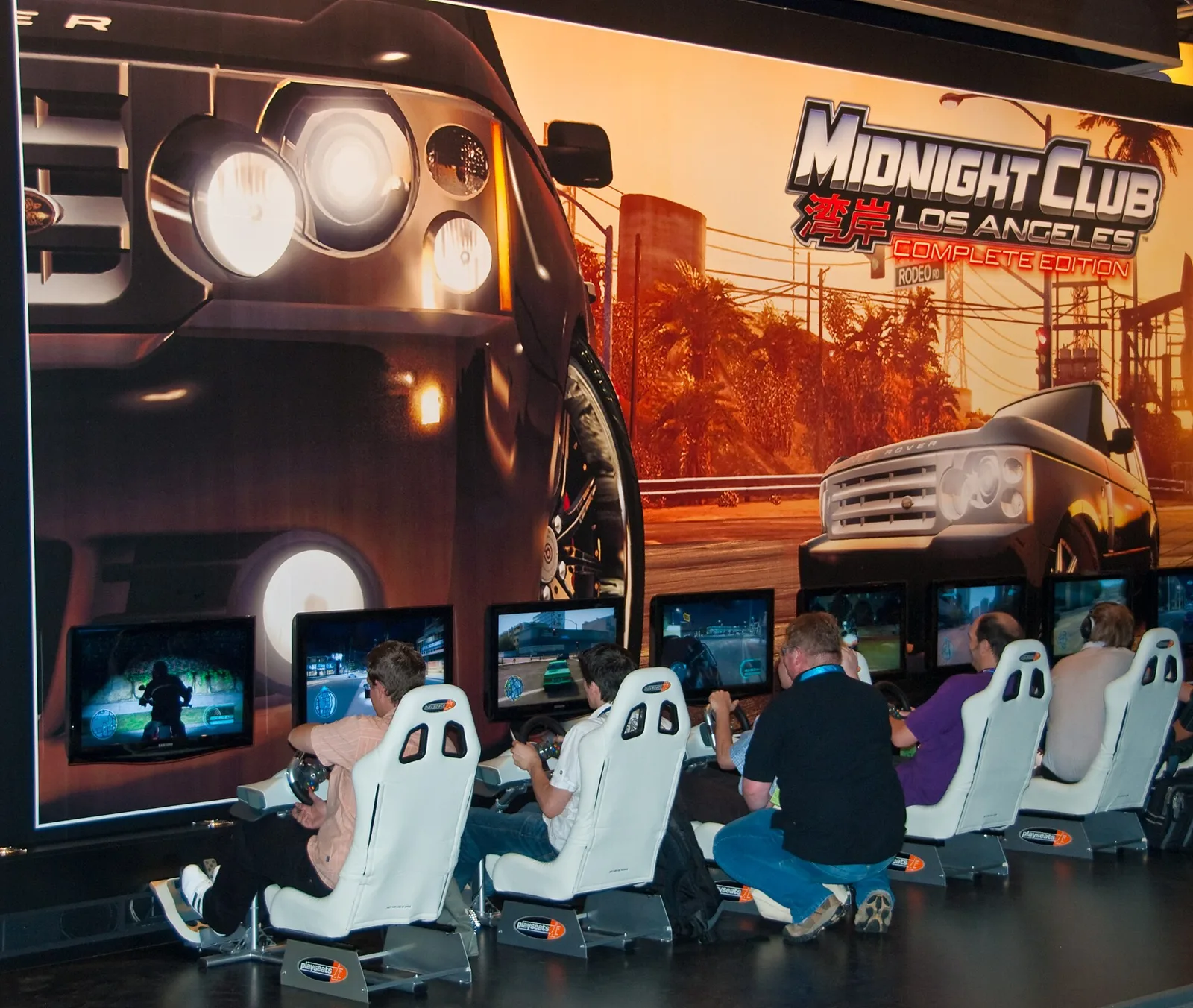

Rockstar San Diego's 2008 open-world street racer put a 24-hour city, traffic and police pursuits under the wheel, and its story ended the Midnight Club line in 2010.
Midnight Club: Los Angeles is a 2008 street racer from Rockstar San Diego. It offers a free-roam map the size of three earlier cities, a 24-hour cycle, police pursuits and sixteen-player online races, and it was followed by the end of the series in January 2010.
Midnight Club: Los Angeles is a 2008 street racing game from Rockstar San Diego, published by Rockstar Games. It was the fourth instalment in the Midnight Club series, which ended in January 2010, and it gave players a full open city to roam, with licensed traffic, real weather and a police force that reacts to ordinary driving.
What is Midnight Club: Los Angeles?
The game is a street racer set in Los Angeles, offering a free-roam world in which players can race, explore and find challenges at their own pace. It arrived in October 2008 for PlayStation 3 and Xbox 360, and a portable version followed in the same season.
Its map is larger than the one in the previous instalment, Midnight Club 3: DUB Edition. The map covers as much ground as all three cities of that earlier game combined, and it gave the developers room to build a city that felt lived in.
A Los Angeles street racer built around police pursuits, a living traffic system and a city that never fully goes quiet.
How does the open city work?
The world runs on a 24-hour day-to-night cycle, with weather effects and traffic made up of licensed vehicles. Rain and slick surfaces make cars more prone to sliding, so the same route can feel quite different from one hour to the next.
Traffic is shaped by the RAGE system, which makes levels rise and fall through the day. Roads are quiet at night, busy during the morning and afternoon, and at their heaviest in the evening. That rhythm matters for racers, who must plan routes around the crowds.
Developers put great effort into removing load screens. The aim was to let players hop from the career into an online race in less than ten seconds, which kept the open world feeling continuous.
How did damage and repair work?
After races, damage does not always send the player back to a garage. The Quick Fix option patches the car with old, junkyard-style parts. To get back the new look, the player has to drive to a garage or gas station for a proper repair.
Because of this rule, a vehicle can only be completely destroyed within a single race or event. The system keeps damage meaningful without making a wrecked car a permanent problem.
What special abilities did the game include?
The game brought back special abilities from the previous instalment. An EMP knocks out the electronics of all nearby vehicles, while Agro makes the player's car indestructible, so it can plough through traffic without losing speed.
Roar sends out a sound wave that pushes traffic aside to clear a straight path, and Zone slows time and gives a temporary boost in handling. The previous game limited these abilities to specific cars, but here every vehicle can use any one of them, and players can change the ability at garages.
How do the police work?
Police are no longer tied to particular races. They notice everyday infractions such as running red lights, speeding, burning out, hitting cars and driving off-road. A caught player can pull over, which triggers a cutscene, or lead the police into a chase.
After a stretch of time, or once the police lose sight of the player, the game switches to Pursuit Mode. Fleeing during the pull-over cutscene also triggers it. Speeding and badly damaging a police car send the game straight into pursuit, and every extra minute on the run raises the fine owed if the player is eventually caught.
A vehicle that takes too much damage during a chase is totalled, and the player is arrested as well. The system makes the pursuit a real cost rather than a minor nuisance.
What collectibles and modifiers were hidden in the city?
Sixty collectibles are hidden around Los Angeles. They look like yellow oil barrels with the Rockstar logo printed on them, and finding them is a reward in its own right. Every ten collectibles unlocks one of six game modifiers, which the game calls cheat codes.
Finding half of the collectibles and all of them unlocks achievements. Turning on most modifiers stops the player from earning money, rep and career progress, although the modifier that unlocks an overhead camera is an exception.
How do races and difficulty work?
Los Angeles offers over ten race formats: series events, tournaments, pink slip contests and freeway runs. For most of them, the player must first beat an opponent to the start line to earn extra rep, which is the leveling system that measures skill. The step can be skipped.
Races come in four difficulties, colour-coded from green for the easiest to yellow, orange and red for the hardest. Each step up brings bigger rewards, so the colour scheme doubles as a guide to how much a race is worth.
How did online play work?
Online play supported sixteen players at once. New modes included Keep Away, in which a flag holder has to keep possession for as long as possible, and Stockpile, which features numerous flags to capture.
Online power-ups added more variety. Mirror bounces back any power-up aimed at the player, Agro works as it does offline and lets the player crash through other vehicles without damage, and Random hands out a random power-up. A Race Editor let players build their own online tracks, and the same mode allowed free roaming without traffic, police or damage.
Rate My Ride let players browse, score, trade and purchase player-modified cars online. There were also 46 PlayStation Network trophies to win. Many of these online features were removed after the closure of GameSpy in 2014.
What was the Social Club?
Midnight Club: Los Angeles was part of Rockstar's Social Club. The club tracked the player's driving stats and could unlock extras like hydraulics, TIS rims and an Audi R8.
Rewards depended on earning the C-License, B-License and A-License. Each licence unlocked a new reward, and players could compare their statistics, view online leaderboards, upload photos and enter tournaments that offered prizes to the winners.
What is the story?
A newcomer from the East Coast arrives in Los Angeles and takes on the city's street racing scene as a character known only as Player. The story opens with a phone call from Booke, the L.A. City Champ, who asks the player to meet at Carney's Express Limited.
At the start, the player picks one of three cars: a 1998 Nissan 240SX, a 1983 Golf GTI from Volkswagen or a 1988 Scirocco. As reputation builds, the player can take the Champ of the City title and the crowns for each car type. Winning the City Champ race against Booke at the Standard Hotel opens the other championship races.
After winning 35 races with vehicles from the fourth group, the Champs of all five vehicle classes challenge the player. They are Oswaldo for motorcycles, Julian for tuners, Lester for luxury cars, Pete for exotics and Marcel for muscle cars.
Karol, a contact with garages of his own, later offers a deal. The player is asked to raise $1 million to co-own his two garages, and in return the player gets anything in those garages for free. The game does not mention that this deal also affects Doc's South Central garage.
When the player reaches 100% completion in the PSP Remix, an unidentified caller phones and asks to meet at the airport for a flight to Tokyo. The call unlocks the Tokyo career and map in Midnight Club: L.A. Remix.
How was the game developed and delayed?
The game ran on the RAGE engine, which came from the studio's own technology team. The engine went on to underpin Rockstar's seventh-generation releases. Producer Jay Panek of Rockstar San Diego said the team chose Los Angeles for its street racing ties.
The team licensed several real locations to make the city feel authentic. Release slipped several times. It was first set for early 2008, moved to September, and in July 2008 Rockstar Games pushed it again to early October. It finally shipped in late October 2008.
| Version | Release | Key difference |
|---|---|---|
| PlayStation 3 and Xbox 360 | October 2008 | Full open city, online play and licensed traffic |
| L.A. Remix (PSP) | 21 October 2008 in North America; 24 October in PAL regions | Part of Los Angeles plus a playable Tokyo map and no cutscenes |
| Complete Edition | 12 October 2009 | All map, vehicles and music, with downloadable content and bug fixes |
What updates and downloads followed?
The first update arrived on 9 December 2008. It improved the AI balance to match player skill, made the cops tougher, and added leaderboard support for tournaments on the Xbox 360. It also introduced a Modes lobby that let players choose from several race and flag modes.
The largest later addition was the South Central Upgrade and Content Pack. It added South Central Los Angeles as a free area, roughly a third of the current map. A paid pack bundled new character competitions, races, music and cars, and it included the first SUVs in the game.
The release did not run smoothly. The content was first scheduled for 12 March, moved to 19 March and was delayed again after problems on Xbox Live. On 14 January 2009 the content pack was released on Xbox Live by accident during Microsoft's testing and approval, then removed with a request that anyone who had it delete it.
A second vehicle pack arrived on 23 April with four new cars, including the Aston Martin DB9 and the Ducati 1098R, the fastest motorcycle available. In October a free police car pack followed, letting players race in five police vehicles dressed in paint schemes from the LAPD, the California Highway Patrol and the U.S. Customs and Border Patrol.
What was L.A. Remix?
The PlayStation Portable spin-off, Midnight Club: L.A. Remix, was made by Rockstar London. It covers only part of Los Angeles, using a modified version of the map from Midnight Club II, but it adds Tokyo as a second playable city.
Some of the console version's features were changed. Police leave the player alone in Cruise mode, and a chase happens only during one scripted event. In some races, police vehicles are present only as static scenery, and the game lacks cutscenes. The cars are split between the two cities, while all three motorcycles work in both.
What was the soundtrack?
The original release includes 97 tracks from Nas and Snoop Dogg to Beck and The Chemical Brothers, with Kid Cudi and Deadmau5 among the names. The South Central pack added nine more, with fresh Kid Cudi material among them, so the count reached 106.
How did critics respond?
Midnight Club: Los Angeles was received positively on release. Metacritic gave the PlayStation 3 version 82 out of 100, the Xbox 360 version 81 out of 100 and the PSP version 79 out of 100, with GameRankings figures close to those scores.
Most reviews praised the detailed depiction of Los Angeles, the depth of the game and its multiplayer options. Reviewers also liked the consistent frame-rate, the stylish presentation and the varied soundtrack.
The criticisms focused on the characters, which were seen as cliched, slow texture loading when the game starts, and difficulty that was unbalanced from race to race.