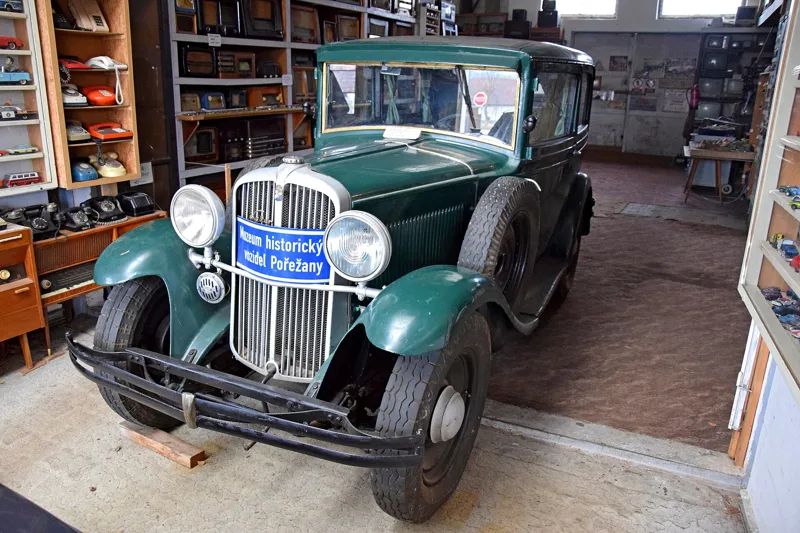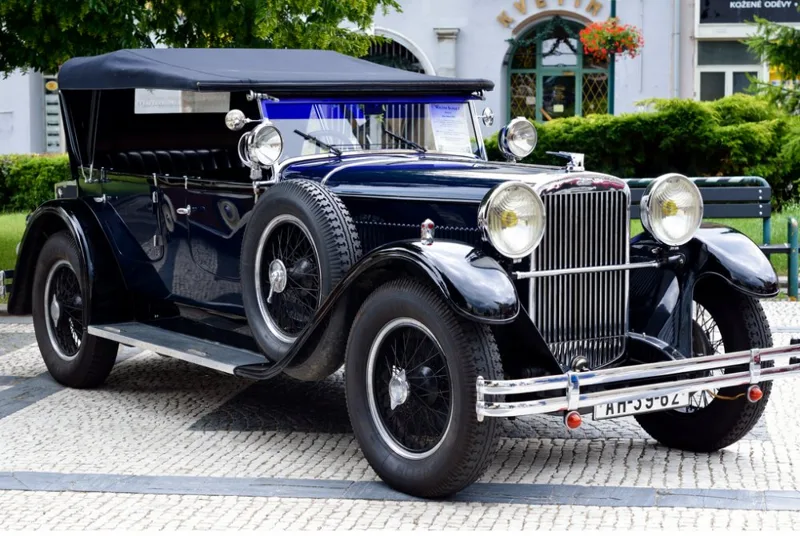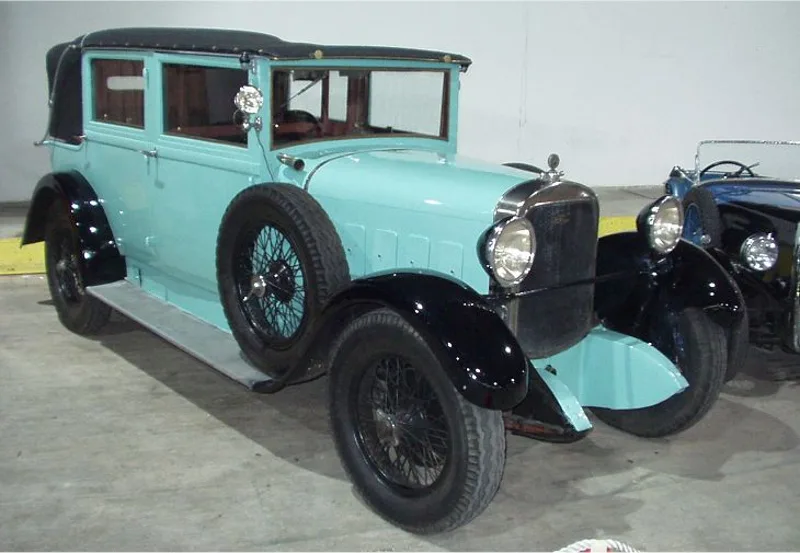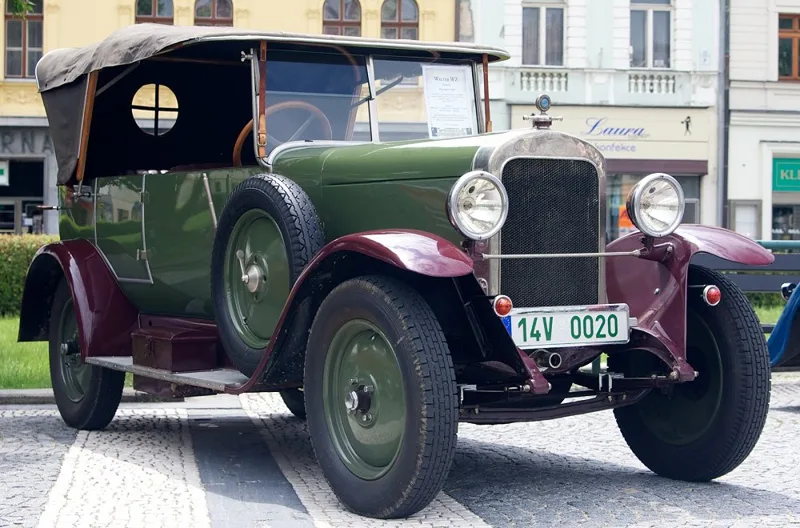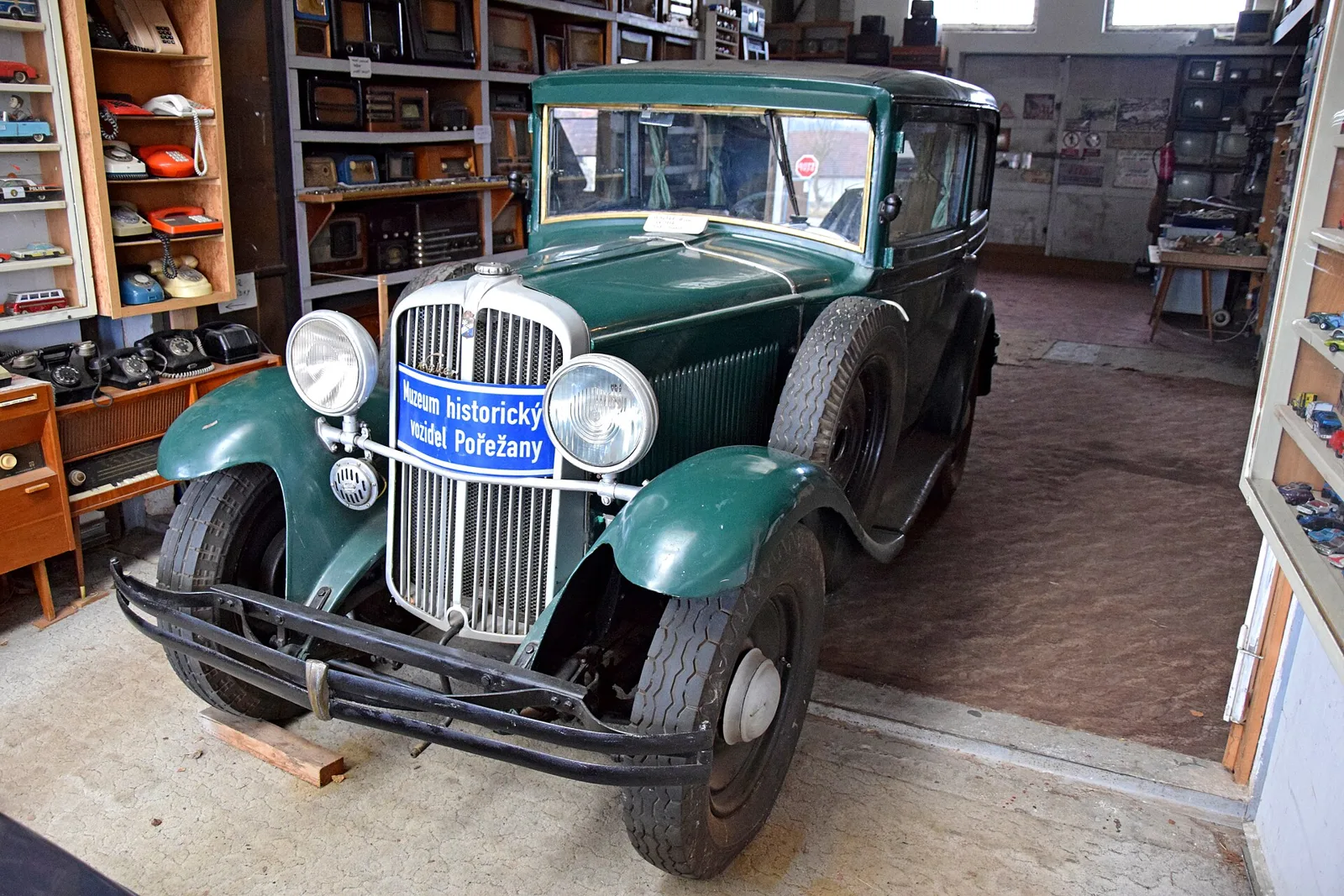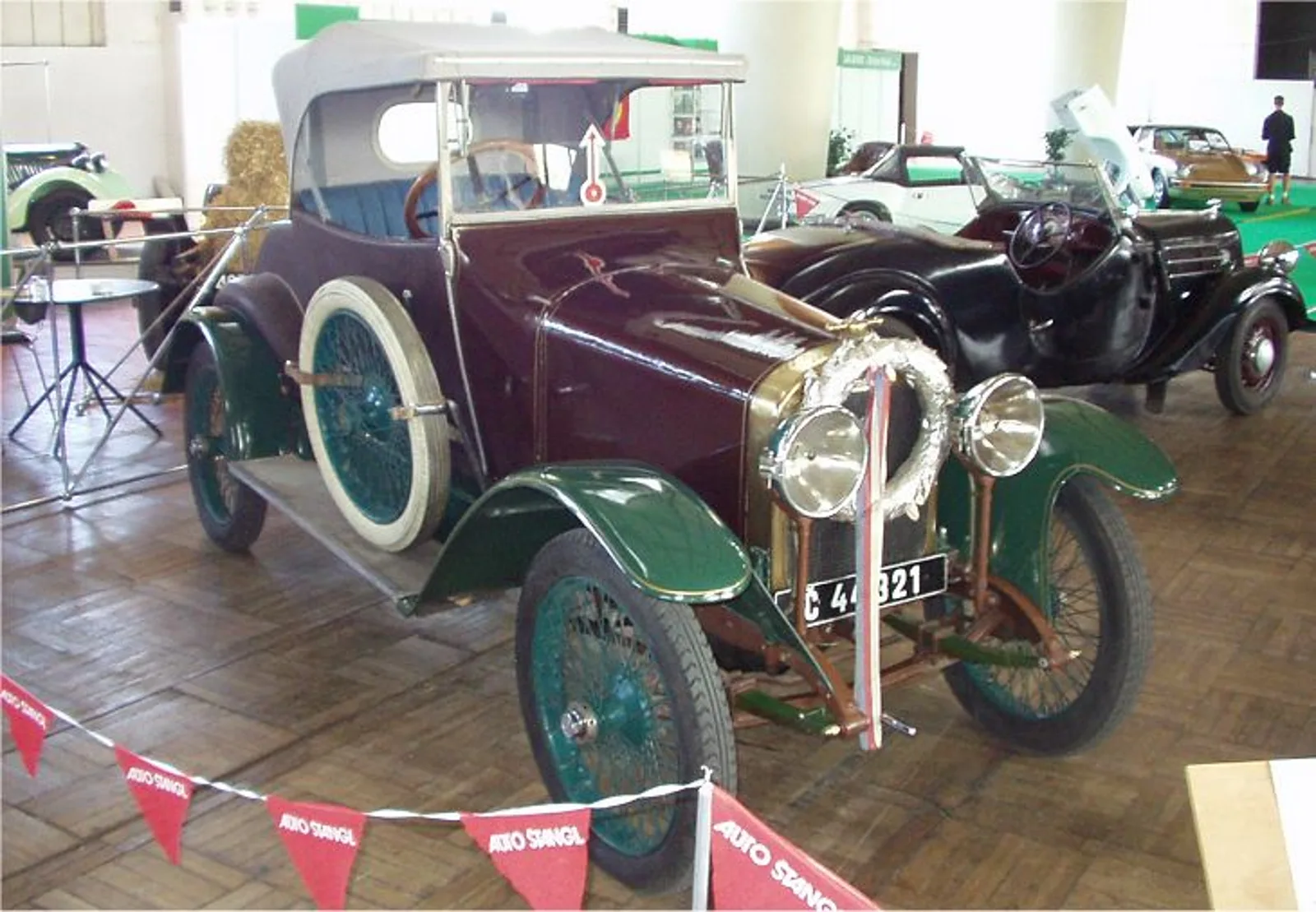
Three in-line four-cylinder cars from Walter a spol., their Jinonice factory, the Stelvio Pass run and the hill climbs and races that tested them before the war.
Built by a Prague firm before the First World War, these three cars carried in-line four-cylinder engines of 14 to 30 PS. The W-III was the largest, with six seats and a 30 PS engine, and it was tested on the Stelvio Pass in 1913.
The Walter W-I, W-II and W-III were passenger cars from the Czech firm Walter a spol., built at Jinonice near Prague. The three models shared one engine design, which produced 14 to 30 PS, and the W-III was the largest, a six-seat car that the company showed at the 1913 Prague motor show.
Where did the Walter cars come from?
Walter a spol. was founded on 1 February 1911 by Josef Walter, who left the firm's first premises at Na Zatlance 6/1120 in Praha-Smichov. Its motorcycles and three-wheelers, and later its cars, were all sold before they were finished.
The first test cars were built in the Na Zatlance workshops. A prototype small voiturette took its engine from the type D three-wheeler, and the same chassis was used to try the German air-cooled twin Fafnir of 1909.
The W-III was modelled on a Renault bought by the builder Simek, a shareholder in the new firm and its first board chairman. Engineer Ludvik Simek, who later sat on the board and was a professor at CVUT, proposed setting up the new firm.
Four-cylinder cars from Prague that won classes and reached the Stelvio Pass before the First World War.
Why did Walter move the factory to Jinonice?
By 1911 the Na Zatlance workshops were so crowded that new premises had to be found. On Ludvik Simek's proposal the company bought land and began a large factory at Jinonice, on a site where a works had stood for almost 100 years until recently.
The Jinonice works was built by the firm of Antonin Simek. Its departments covered casting, coachbuilding, varnishing, enamelling and a testing bay for brakes. The W-III was finished there, and the W-II and W-I left the same site.
What engine did the W-I, W-II and W-III share?
All three cars used an in-line four-stroke, four-cylinder, liquid-cooled engine of identical design. The output depended on size: 14 PS (10.4 kW; 14 hp) for the W-I, 20 PS (14.9 kW; 19.7 hp) for the W-II and 30 PS (22.4 kW; 29.6 hp) for the W-III.
Each engine had side valves, two valves per cylinder, a vertical Zenith 30 carburettor and no supercharging. The carburettor sat on the opposite side from the exhaust pipe, and a Bosch high-tension magneto provided the ignition.
Lubrication came from a pump whose output could be adjusted, which pushed oil from the sump into the bearings. Drilled passages in the crankshaft carried it on to the connecting rods, and oil that had passed through all the bearings was led to a pressure gauge on the instrument panel.
Light alloy went into the crankcase, grey iron into the block and pistons. The crankshaft ran in three broad main bearings lined with cast compound, and each piston carried three sealing rings.
Cooling was by thermosiphon. An unusually large radiator and a powerful fan on the cast iron flywheel drew air under the engine cover, and the four cylinders were cooled evenly.
How did the Walter drive and brakes work?
The gearbox was a four-speed in the 4+Z layout, fed from the clutch through a universal joint, with a propeller shaft taking the drive back to the rear wheels. The clutch could be taken out without dismantling the engine, and the gears shifted on grooved shafts by three forks, each locked against sliding out by itself.
Right-hand steering used a steel worm and a bronze worm wheel. Both axles were rigid and sprung on semi-elliptic leaf springs. The front axle was pressed from chrome-nickel steel and the rear axle was forged, and the bevel gears in the rear axle gave a ratio of 1:4.
The propeller shaft used a joint at its front end and a cross at its rear end, and both sat in sealed housings to keep grit away from the rubbing surfaces. It could be removed without taking out the gearbox or the rear axle.
The front axle was not braked. An equalising emergency foot brake worked on the rear wheels, which had mechanical internal-shoe drum brakes, and the handbrake acted through bevel gears on a brake drum in the gearbox casing.
What bodywork did the Walter cars wear?
The W-I and W-II had four seats, while only the largest W-III carried six. The six-seat phaeton and limousine had two emergency seats in front of the rear seats, which folded flush into the partition between the front and rear seats when not in use.
The rear seats were sliding club seats. The limousine was richer still, with inlaid marquetry, folding tables, a table lamp, silk curtains and a key lock. The phaeton's patent folding roof was stowed in a leather case behind the rear seats.
Length followed the wheelbase, from the W-III down to the W-I. The two-seat Walter W-I sports car measured 3600 mm (141.7 in) long, and buyers could get the little car for 7,500 K. Weight rose with size, from 750 kg (1,653 lb) for the W-I to 950 kg (2,094 lb) for the W-II and 1,400 kg (3,086 lb) for the W-III.
How many Walter cars were built, and how did they sell?
In 1913, 20 W-III cars were built, and in 1914 a further 60 were made, always in batches of ten. At the motor shows, every exhibited vehicle carried a sold sign by the first day.
The tenth Prague motor show ran from 20 April to 1 May 1913, and the W-III was the highlight of Walter's collection there. A year later, at the eleventh show from 12 to 19 April 1914, on stand number 4, the W-III was shown alongside the W-II and W-I.
In 1914 Walter showed three types of one design in three sizes. The cars were W-I and W-II bodies with two or four seats, an elegant six-seat tourer and a six-seat luxury limousine. The lighter products on the stand were a four-seat D, two C2 twoseaters and the CN4 goods three-wheeler.
The two-seat W-I now survives in the collections of the Auto-Moto Museum in Pardubice.
Did the Alpine run prove the W-III?
In August 1913 a W-III owned by shareholder Vitezslav Kumpera completed a four-day journey of more than 1800 km to the Stilfserjoch, a pass at 2758 m above sea level, without a penalty point. Josef Walter accompanied the run.
The summit sat on the frontier between the Italian kingdom and Tyrol, which belonged to Austria-Hungary, about 20 km from Bormio in the Dolomites. The car reached the summit and returned to Prague without serious trouble, and the procurist Fort and an unnamed chauffeur made up the crew.
The only real problem came at the German border. A customs officer would not let the car through, because the engine had no machine number stamped on it. Josef Walter wrote in Narodni listy that the factory had simply forgotten to stamp the number, which was 1.
How did the Walter cars race before the war?
At the Zbraslav to Jiloviste hill climb on 5 April 1914, a four-seat W-I won the touring car class up to 1.25 litres. Dr Jaroslav Zatka drove it with start number 43. He owned a factory and had raced Walter motorcycles and three-wheelers with success.
Klement Adamec, start number 44, was quicker in essentially the same car, but in the two-seat W-I. The regulations added 10% to his time for the two-seat body, which dropped him to fourth place in the class even though his time was better. The formula was later cut to 3% and then removed from the rules altogether.
Josef Walter always insisted that Walter entered catalogue types rather than special racing machines. He stressed that these were price-list models.
On 28 June 1914, the day of the Sarajevo assassination, cars raced on the Plzen to Tremosna course. The Walter works took the first two prizes, and the local sportsman Mr Cisar won the three-wheeler class on a Walter. Adamec took a W-I to first place in the smallest touring class, with a net average of 72 km/h even after his penalty.
What happened to the Walter works during the war?
A fire on 27 August 1914 destroyed a third of the production space. It began at lunchtime, when the workers were away, after a glue-boiling drum exploded in the wheelwright's shop and the wooden parts of the machines caught fire.
Firefighters needed three hours to save the machine house, but the damage to the wheelwright's shop and roof trusses reached 200,000 K. The war followed soon after, and it set the factory on new work.
The Austro-Hungarian ministry of war assigned the works artillery shells and fuzes for shrapnel. The work later widened to air-cooled Daimler engines for locomotives on narrow-gauge field railways, generators for lighting the battlefield, and parts for field radio stations. At the war's end an engineer named Zubaty's military motorcycle, an air-cooled horizontal twin of 706 cc, was added.
Vitezslav Kumpera had been a dealer in leather goods and handmade gloves before he became a partner in the company in 1911. He held a driving licence from 1908 and bought the first W-III built in 1912. Called up at the age of 38, he trained military drivers and used his private car for the army, once driving a seriously wounded senior officer to a field hospital.
The grateful officer offered Kumpera a lucrative contract for field generators, and he chose his own company to build them. The contract helped keep skilled workers at home, and the Walter-Kumpera link that it created later proved fatal for the first-named partner.
After the war the company reorganised its production and built a car with a single chassis type, the Walter WZ.
What were the Walter W-I, W-II and W-III specifications?
| Specification | Detail |
|---|---|
| Engine | In-line four-cylinder, side valves, liquid-cooled |
| Output, W-I | 14 PS (10.4 kW; 14 hp) |
| Output, W-II | 20 PS (14.9 kW; 19.7 hp) |
| Output, W-III | 30 PS (22.4 kW; 29.6 hp) |
| Carburettor | Vertical Zenith 30, no supercharging |
| Gearbox | Four-speed, 4+Z layout |
| Drive | Rear wheels |
| Weight | 750 kg (1,653 lb) W-I, 950 kg (2,094 lb) W-II, 1,400 kg (3,086 lb) W-III |
| Fuel use | 10-14 litres per 100 km (28.2 to 20.2 mpg-imp) |
| Fuel tank | 45 litres |
| Built | 20 W-III in 1913, 60 cars in 1914 |