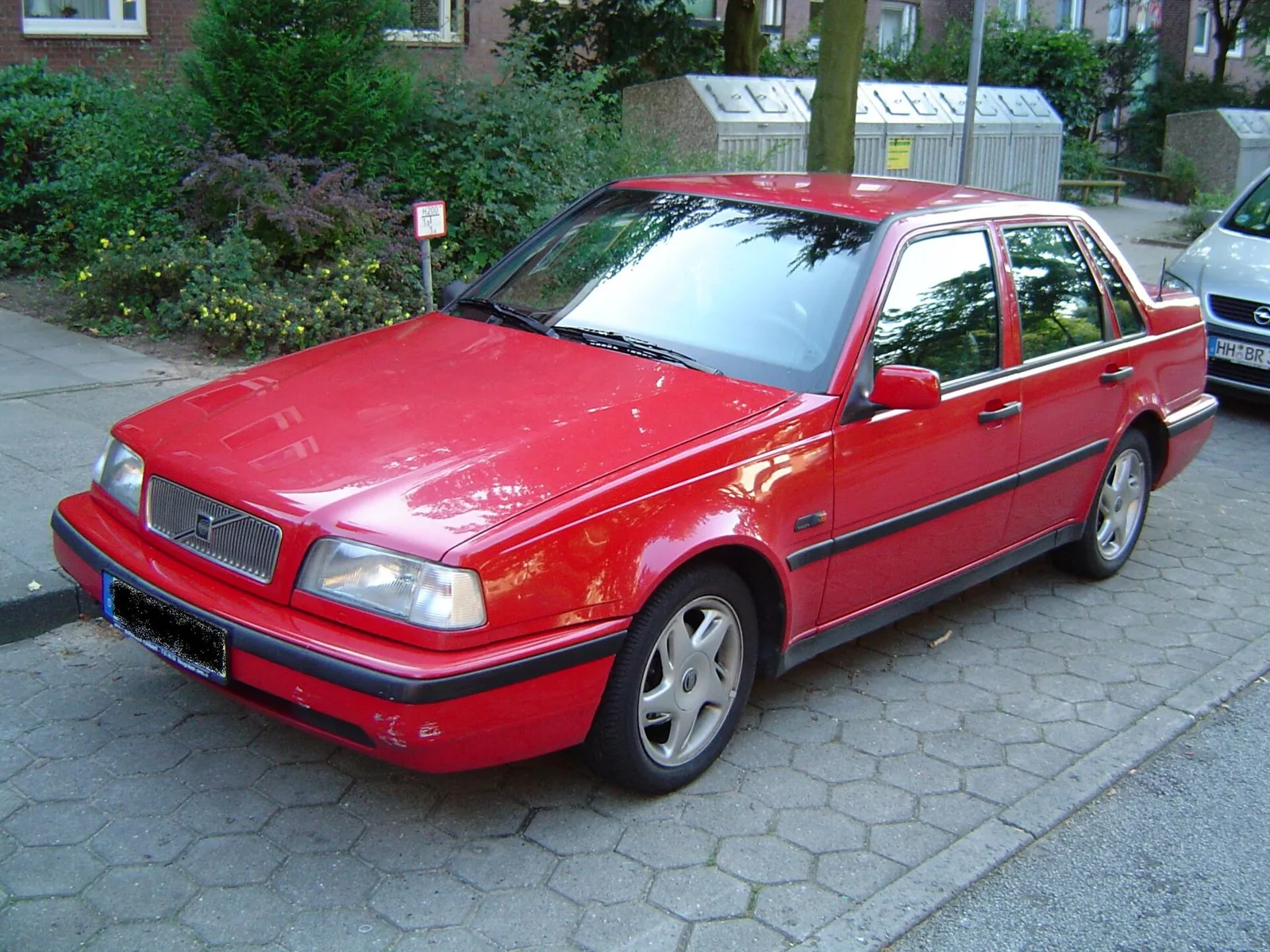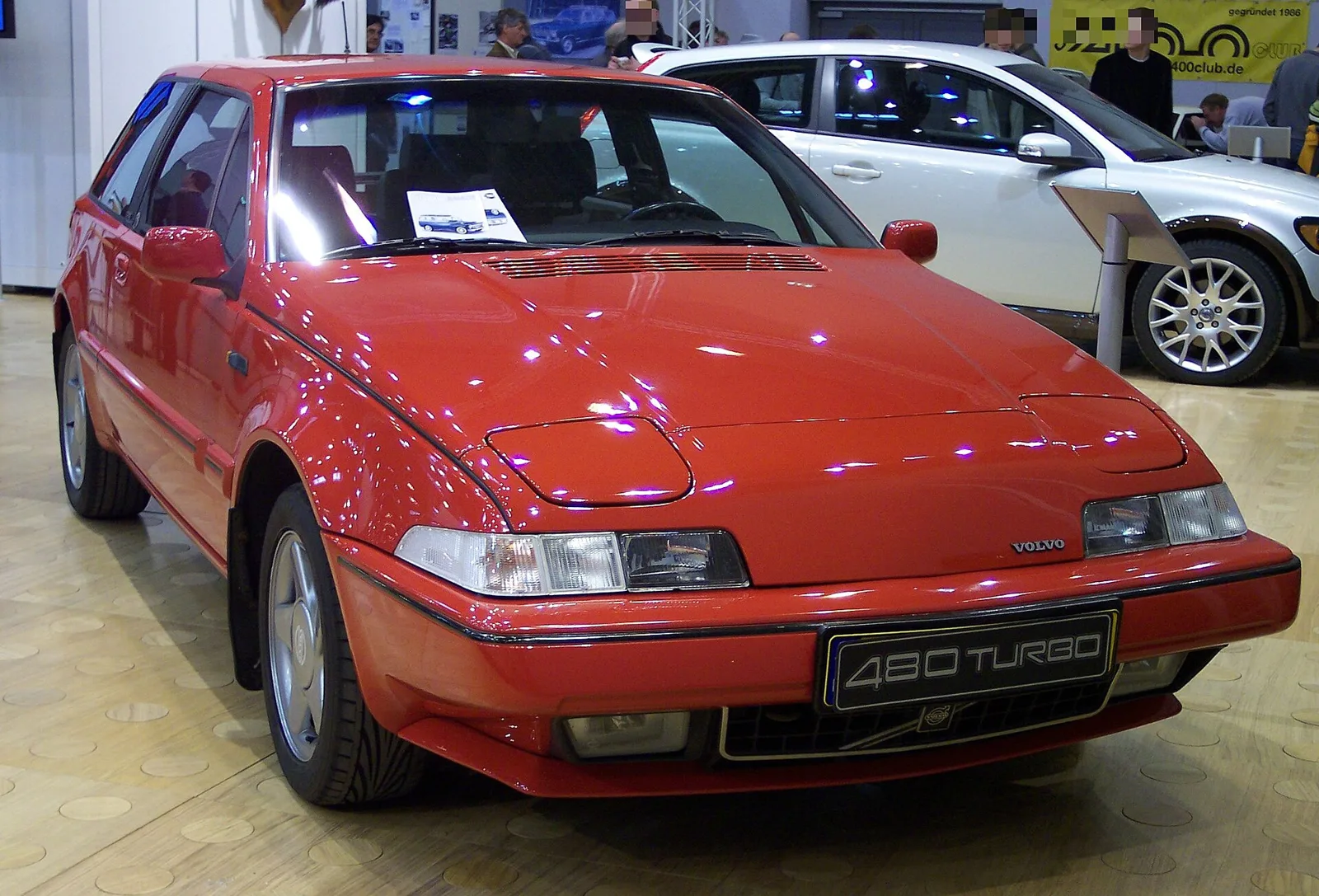
A 1986 to 1995 Volvo hatch with pop-up headlights, a Turbo option, a cancelled American launch and a run of named special editions.
The Volvo 480 was a compact front-wheel drive hatchback coupe built by Volvo in Born, Netherlands, from 1986 to 1995. It was the first front-drive Volvo, had pop-up headlights, and was offered with 1.7 and 2.0 litre engines plus a 120 PS Turbo.
Volvo's 480 was a sporty compact that was built at Born in the Netherlands between 1986 and 1995. It was the brand's first front-wheel drive car and its only model with pop-up headlights, and production ended on 7 September 1995 after 76,375 examples had been built.
The car paired a three-door hatch body with a coupe face. Its unusual look came from a new marketing aim and a set of American safety rules that shaped the nose.
Where and when was the Volvo 480 built?
Volvo built the 480 at Born in the Netherlands, in the factory that also built DAF cars. Production ran from 1986 to 1995, and the car was the forerunner of the 440 and 460 models, which shared its platform. Volvo's Dutch subsidiary designed the 480, which was marketed as a coupe in Europe from 1986.
Development took six years, from the first concept to a car ready for production. The press launch came on 15 October 1985, but the 480 first appeared in public at the 1986 Geneva Motor Show in March. Mainland European buyers could purchase it from May 1986, and the UK and Ireland followed on 11 June 1987.
The only Volvo with pop-up headlights, and the first front-wheel drive car the brand made.
What kind of body did the 480 have?
The 480 had four seats and three doors, with a hatchback body that sat somewhere between a liftback and an estate. It was the first Volvo of this style since the 1800ES, and a frameless glass hatch gave access to the luggage space.
Commentators often call the design a shooting brake, although Volvo did not use that term. The press contrasted the sleek hatch with the brand's traditional boxy look. Volvo described the styling as sporty and aimed the car at buyers aged 25 to 40 who were well educated and building careers, with the aim of shedding a dated image and reaching the yuppie segment.
How did Volvo meet US safety rules without spoiling the shape?
Volvo designed the bumpers to shrug off a 5 mph (8 km/h) front impact, leaving the engine, lights and safety gear undamaged, in line with US NHTSA rules. The pop-up headlights were a response to the NHTSA minimum headlight height rule, which let the nose keep its aerodynamic shape.
Volvo also claimed the car was one of the first sold in Europe with bumpers built to that standard. Composite panels, including the nose-cone and bonnet, cut weight and were chosen for pedestrian safety.
What engineering did the 480 use?
The 480 combined a Lotus-developed rear axle with naturally aspirated Renault engines, which were reliable but not especially powerful. Its electronics were advanced for the time, including daytime running lights and follow-me-home headlights with a 30-second delay. Volvo itself highlighted the electronics in its press release.
The fully electronic Info Centre was standard on most models and showed the fuel gauge plus seven other readings, covering projected range, instantaneous MPG and average speed. An automatic rear wiper engaged when reverse gear was selected, and anti-lock braking became an optional extra in 1987.
The naturally aspirated 1.7 suffered from a lack of torque, partly because emission controls sapped power. A larger 2.0 engine therefore arrived for the 1993 model year, and the ZF four-speed automatic was offered with it.
How powerful was the 480 Turbo?
The 1988 Turbo used a Garrett AiResearch turbocharger to raise output from 109 to 120 PS (80 to 88 kW; 108 to 118 hp). Maximum torque rose to 175 Nm (129 lb ft) from 140 Nm (103 lb ft), and every Turbo came with ABS as standard.
Catalytic converters were fitted to nearly every model in 1991 to meet upcoming EU emissions rules, and the fuel tank grew from 48 litres to 60 litres that year. Uncatalysed engines of that period were rated at 106 hp (78 kW) for the naturally aspirated B18 and 122 hp (90 kW) for the Turbo.
The federalised engine allowed Volvo to export the Turbo to Japan in 1989. It sent 300 examples: 295 left-hand drive manuals and five right-hand drive automatics. Those cars produced 115 hp (85 kW) at 5400 rpm and 175 Nm (129 lb ft) at 4200 rpm, and they kept narrower side trim so the width stayed under the 1.7-metre limit for the compact car tax class.
Why did the American launch never happen?
Volvo planned to sell the 480 in the United States as a 2+2 sports wagon from autumn 1987, and it expected to sell 25,000 cars overseas. A weak US dollar was one reason those plans were cancelled, and in February 1988 the introduction was postponed indefinitely because of unfavourable market conditions and exchange rates.
The American plan never went ahead, and no US sales followed. The one overseas shipment it describes is the Japanese export run of 1989, which used the federalised engine.
Which special editions did Volvo sell?
Volvo sold a run of named special editions: the 1991 Limited Edition in Paris blue, the 1992 Two-Tone, the 1994 GT limited to 250 UK cars, and the 1995 Celebration with 480 numbered UK examples. Enthusiasts call the first one the Paris Edition, and it is the rarest of them.
Paris Edition (1991)
The Paris car had turquoise bumpers and trim inserts, a two-tone turquoise and grey leather interior and a MOMO leather steering wheel with a grey and turquoise strip. It also gained a front chin spoiler and 14-inch Atlas 5-spoke alloy wheels, and it used the naturally aspirated 1.7 engine. One 1.7 turbo car was displayed at the 75th anniversary of the Paris Motor Show in 1992.
Two-Tone (1992)
The Two-Tone wore Peacock Green over Smoke Silver metallic paint and had a split-vinyl and velour interior, a leather steering wheel and 15-inch Taurus 5-spoke alloys. Unlike the others it was offered with every engine, in S, ES or Turbo specification depending on the market, and it had no fixed production number. It was discontinued in 1993.
GT (1994)
The GT arrived in the UK on 1 June 1994, limited to 250 cars and priced at 16,245 pounds sterling. It came in Racing Green Metallic or Burgundy Pearl Metallic, with air-conditioning as standard, 15-inch Vesa alloys and only the 2.0 engine. Its hand-painted leather interior was designed by the German artist Wolf Cieciersci, and no two sets of seats were the same.
Celebration (1995)
The Celebration went on sale in the UK in May 1995 as 480 specially equipped, numbered cars, in Dark Grey Metallic, Burgundy Metallic or Satin White. It had a ruched leather interior, 15-inch Cetus alloys and air-conditioning in place of a moonroof. Mainland Europe sold it as the Collection, limited to another 480 units.
What changed through the production run?
The changes were modest, and most of them came in the form of equipment and emissions updates rather than a new car. The list below sets out the main steps year by year.
- 1987: anti-lock braking became available as an optional extra.
- 1988: the Turbo arrived, with ABS standard on every Turbo model.
- 1991: new mirrors, rear headrests and body-coloured bumpers on the ES; catalytic converters on most models; fuel tank up to 60 litres.
- 1992: the S trim was added as the entry model, and a total closure system was introduced.
- 1993: the 2.0 engine and the ZF four-speed automatic arrived.
- 1994: clear front indicators, a third side bar in each door, a driver airbag and black half-leather upholstery.
- 1995: no major change in the final year, and production ended on 7 September 1995.
How did critics receive the 480?
Reviewers were largely positive about the 480's driving manners and comfort. What Car? named it overall winner against the Honda Accord Aerodeck in 1987, and Motor Sport praised its obedient handling. Build quality and reliability at launch drew harsh criticism, and one Dutch magazine called it the coupe from hell.
Richard Bremner, writing in Car Magazine about the car's demise, praised its balance of power and low weight. He criticised the final UK cars as underpowered and overpriced at a 16,500 pound asking price, and he said collectors could pick up late examples at rock bottom prices.
What prototypes did Volvo build?
Volvo built several prototypes, including a supercharged G-Lader and an engine variant with more valves. A one-off electric 480 from 1986 claimed a range of 120 km on a full charge, and a convertible was planned for early 1991 but never reached production.
The electric car used a nickel cadmium battery and a separately magnetised DC motor producing 42 hp, reaching 0-30 mph in around 9 seconds. Its 300 kg battery replaced the rear seats, and the spare wheel moved to the engine bay. Volvo never intended to sell it.
The convertible was dropped after a supplier went bankrupt and concerns about rollover protection arose. Several convertible prototypes survive, along with aftermarket conversions. The American Sunroof Company of Detroit also proposed a Targa top that stayed at prototype stage.
What were the Volvo 480 specifications?
| Specification | Detail |
|---|---|
| Production | 1986 to 1995, Born, Netherlands |
| Body | Four-seat, three-door hatchback |
| Naturally aspirated engine | 1.7 litre, catalysed; 2.0 litre introduced for 1993 |
| Turbo (1988) | 120 PS (88 kW; 118 hp); 175 Nm (129 lb ft) |
| Naturally aspirated torque | 140 Nm (103 lb ft) |
| Uncatalysed power (1991) | 106 hp (78 kW) naturally aspirated; 122 hp (90 kW) Turbo |
| Fuel tank | 60 litres from 1991, up from 48 litres |
| Japanese Turbo exports | 115 hp (85 kW) at 5400 rpm; 175 Nm (129 lb ft) at 4200 rpm |
| Total built | 76,375 |
| Final car | Storm Grey 2.0 ES, 7 September 1995 |