A Golf convertible launched with a roll bar many early buyers disliked, dropped in 2002, revived in 2011 and discontinued in 2016.
The Volkswagen Golf Cabriolet was an open Golf launched in 1979, built by Karmann in Osnabrueck and first fitted with a fixed roll bar. It was produced in several generations until VW announced its end in February 2016.
The Volkswagen Golf Cabriolet was the open version of the Golf, which reached the market in 1979, paused in 2002 and returned in 2011, with its end announced in 2016. Its fixed roll bar, added for safety, was a feature many early buyers disliked, and the car later became a sought-after classic.
When did the Golf Cabriolet start production?
Karmann in Osnabrueck began building the open Golf in February 1979. Karmann built every Golf Cabriolet generation up to 2002, having also helped develop the open Golf.
Once the Kaefer Cabriolet had gone in early 1980, the open Golf turned into a best-seller. Demand for convertibles climbed through the 1980s, and the Golf Cabrio also featured in several television series, including Die Schwarzwaldklinik and Remington Steele.
That exposure helped it gain a cult following. Today the first Golf Cabriolet is a sought-after classic.
A convertible launched with a roll bar some buyers disliked, and that the market later came to prize.
Why did the roll bar matter?
Volkswagen fitted a roll bar to the open Golf after a debate in the 1970s in the USA about convertible safety. Convertibles were judged weak in side impacts and rollovers, giving little resistance or protection. In production form the Golf Cabriolet became the first open car with a fixed roll bar.
The first prototype, built in December 1976, had no roll bar at all. The bar then brought practical benefits. The front safety belts were anchored higher on it, which improved protection in rollover accidents, and it added torsional stiffness to the body.
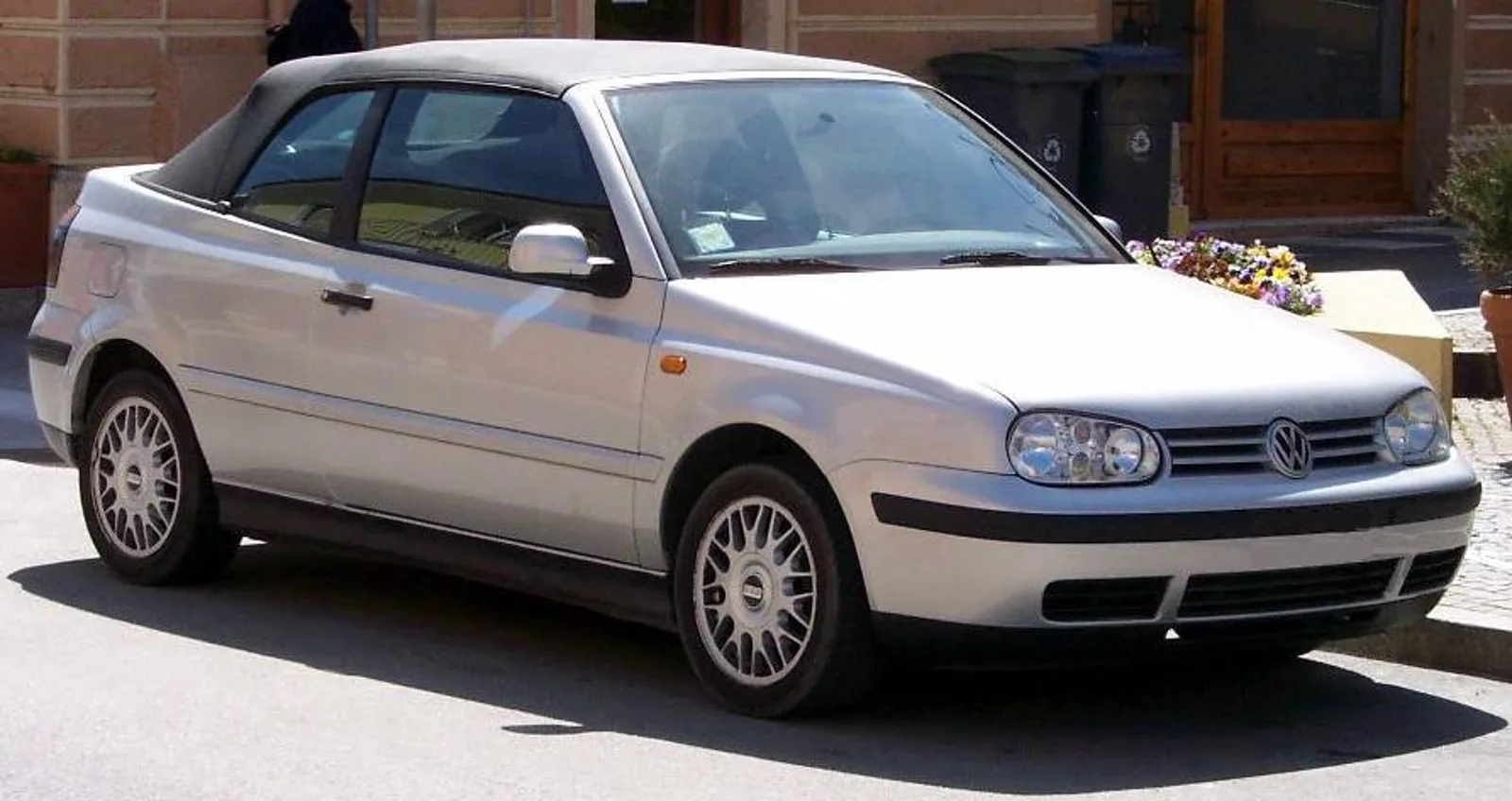
Buyers were less enthusiastic. Used to the Beetle, many did not take to the new model, and in red paint the roll bar earned the nickname strawberry basket. Critics said the open-air feeling suffered because the rear side windows could not be fully lowered and the bar got in the way.
Other makers followed. Among the convertibles that later adopted roll bars were the Escort from Ford (1983), the 205 from Peugeot (1986) and the Kadett from Opel (1987). Later the bar fell out of favour, as modern convertibles relied on automatically rising supports and sturdy A-pillars instead.
How was the body stiffened and the roof built?
Against the Kaefer Cabriolet, body flex was 10 percent lower and torsional twist 40 percent lower. The roof was built from five layers, running from the outer cover down to a plastic headlining, with a 20 mm padding layer of rubber hair.
Drag tells the cost of an open roof. The cW value rose from 0.48 with the roof shut to 0.55 with the roof open and all windows down.
What engines did the first Cabriolet use?
At launch the first Golf Cabriolet came as the GLS, powered by a 1.5-litre (91.5 cu in) unit making 51 kW (70 PS; 69 hp), or as the GLi, with a 1.6-litre (97.6 cu in) unit rated at 81 kW (110 PS; 108 hp). From September 1992 only a 1.8-litre unit remained, rated at 72 kW (98 PS; 97 hp) and fitted with a controlled catalytic converter. It met the Euro 1 emissions standard.
The GLI version used the GTI engine, 81 kW (110 PS; 108 hp) with K-Jetronic fuel injection, and it had firmer shock absorbers and slightly wider tyres. Its body was heavier than the regular Golf I, since the Cabriolet shell alone added 90 kg. The GLI Cabriolet came out 140 kg heavier than the Golf I GTI.
Engine updates generally followed the current petrol units of the Golf. A driver's airbag could be ordered from 1992, making it the first Volkswagen with an available airbag.
Key specifications
| Item | Detail |
|---|---|
| Golf I Cabriolet GLS | 1.5 litres (91.5 cu in), 51 kW (70 PS; 69 hp) |
| Golf I Cabriolet GLi | 1.6 litres (97.6 cu in), 81 kW (110 PS; 108 hp) |
| Golf I Cabrio from September 1992 | 1.8 litres (109.8 cu in), 72 kW (98 PS; 97 hp) |
| Golf IV Cabriolet top petrol | 2.0 litres (122.0 cu in), 85 kW (115 PS; 113 hp) |
| Golf VI petrol range | 105 to 265 PS (77 to 195 kW; 104 to 261 hp) |
| Golf VI diesel range | 105 to 150 PS (77 to 110 kW; 104 to 148 hp) |
| Roof cW (closed, open with windows shut, fully open) | 0.48, 0.53, 0.55 |
| Body weight added | 90 kg over the normal Golf I |
| Euro NCAP, Golf VI | Five stars |
| Last limited edition | 200 examples, from 46,500 euros |
Did the first Cabriolet get a facelift?
The first Cabriolet was updated in May 1987 with a facelift VW dubbed the all-round spoiler kit, adapting its looks to the taste of the time. Production of that car had continued after the Golf II replaced the Golf I in August 1983.
The one-piece radiator grille received coarser ribs, and bigger plastic bumpers, with wheel arches attached and sills widened, gave the car a broader, more solid form. Across the whole production run the engines tracked whatever petrol units the Golf was using at the time.
How many Golf Cabriolets were sold?
The Golf Cabriolet was among the most popular open cars in Germany and Austria from spring 1979 until production stopped in mid-2002. The first generation had reached 389,000 cars by August 1993, and the next, based on the Golf III, reached 171,000 between September 1993 and April 1998.
The Golf III model was then given a facelift that ran from April 1998 to June 2002, adopting the look of the Golf IV. Production of that facelifted car ran until mid-2002.
What changed with the Golf III and Golf IV Cabriolets?
The Golf III Cabriolet arrived in late summer 1993 and was one of the first open cars with a TDI diesel option. The Golf IV Cabriolet of spring 1998 was not based on the Golf IV at all; it was a facelift of the Golf III with new front and rear sections.
Special models were a regular feature of the Golf III Cabriolet. They carried names such as Pink Floyd, Rolling Stones Collection and Bon Jovi, along with Joker, Highline, Classic Edition and Colour Concept.
The facelift kept the engines of the Golf III, including the 1.6, 1.8 and 2.0-litre petrol units and the 1.9-litre TDI diesels. From autumn 2000 the 85 kW petrol and the 66 kW diesel were the only engines left. The interior gained blue and red instrument lighting and new surfaces.
Why did production stop, and what came next?
Karmann's Osnabrueck works built every generation up to 2002.
Production stopped in mid-2002 without a direct successor. The VW New Beetle followed as a convertible in spring 2003. Volkswagen returned to the open Golf in 2011 with the Golf VI Cabriolet, presented at the Geneva show in March 2011 and on sale from June 2011.
In late 2009 Volkswagen took over the bulk of the insolvent Karmann company. A newly created Volkswagen Osnabrueck GmbH then started production from March 2011, among other models the Golf VI Cabriolet.
In mid-2012 the GTI Cabrio joined the line-up, and in spring 2013 came an R-badged version rated at 195 kW (265 PS; 261 hp). VW said in February 2016 that production of the Golf Cabrio would stop.
The capacity freed up in Osnabrueck was to be used for the run-out of the Tiguan I. As a farewell, VW produced a GTI-based last edition limited to 200 examples, each with a numbered plaque, priced from 46,500 euros.
How safe was the Golf VI Cabriolet?
The Golf VI Cabriolet earned the maximum five stars in Euro NCAP's crash testing. Its ADAC rollover test was less kind, showing strong deformation of the A-pillar and a poor rating for the front occupants.
The rear occupants fared better. Their survival space was rated very good, and head loading was rated satisfactory.
The Golf VI Cabriolet no longer has a fixed roll bar.