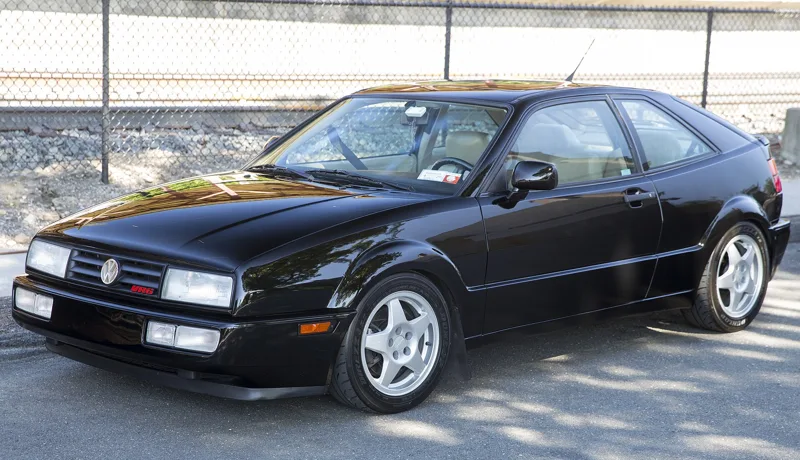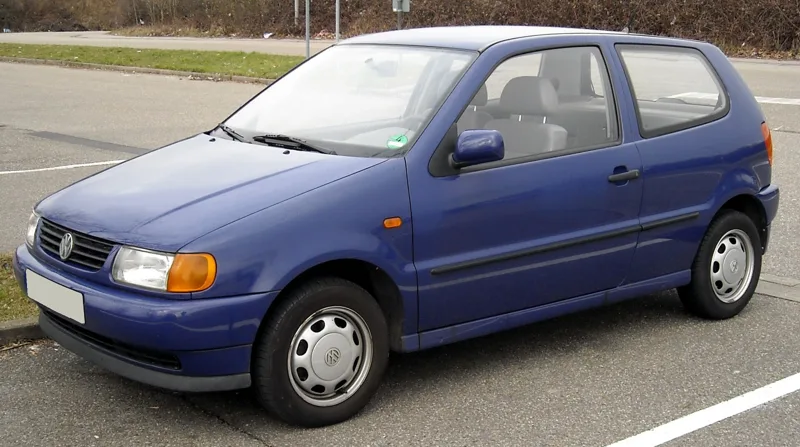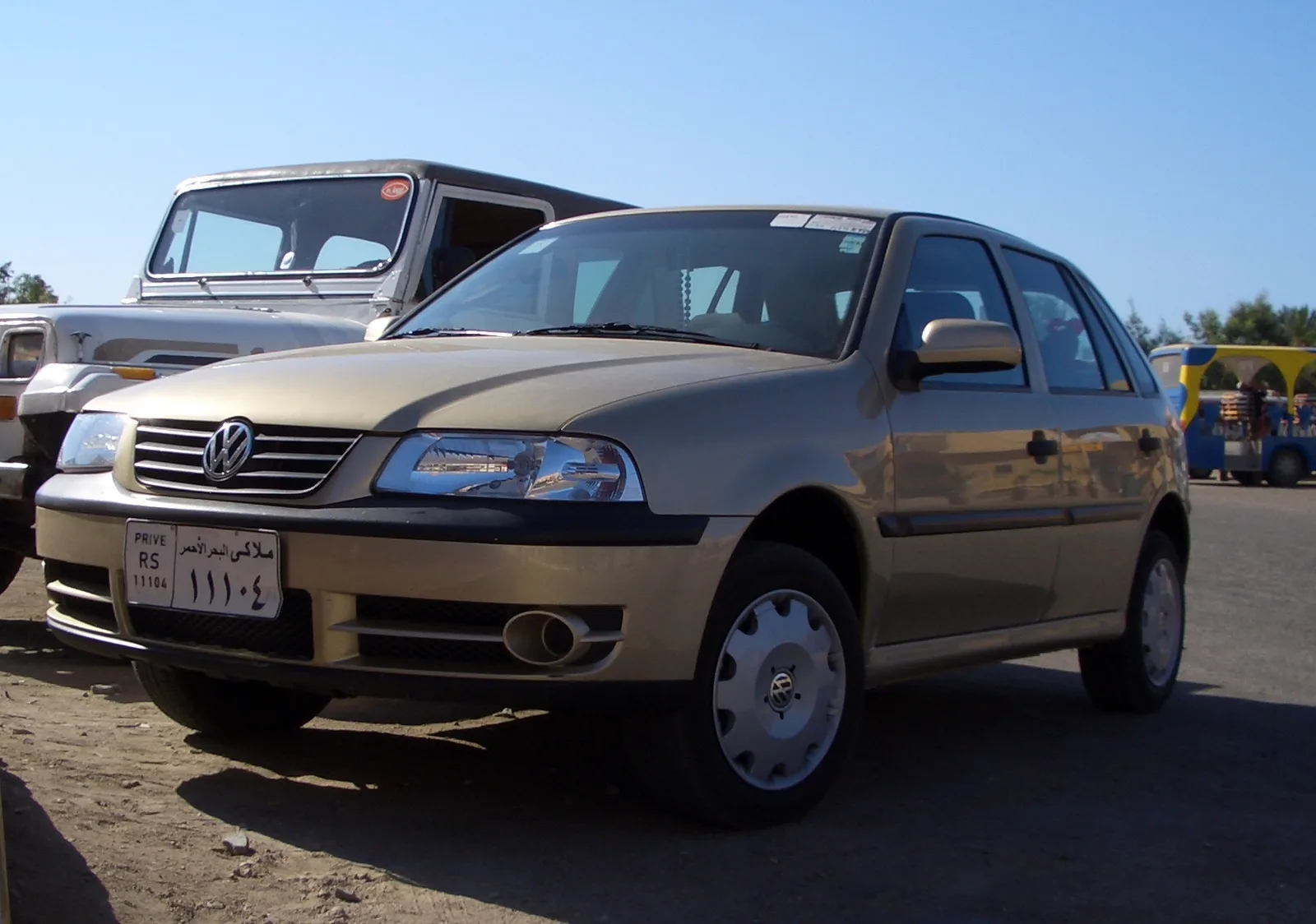
Brazil's second-generation Gol, from its 1994 launch and longitudinal engine to the five-door versions and the Pointer badge in Mexico.
The Volkswagen Gol AB9 was the second generation of the Gol, built in Brazil and launched in 1994. It kept the longitudinal engine of its predecessor in a wider body, and it was discontinued in 2014 after three sub-generations.
Volkswagen's Brazilian subsidiary gave the Gol a radical change of appearance with this generation: a larger, roomier body on an improved BX platform. Sales ran from the 1994 launch to the 2014 end of the line, through three sub-generations.
Its story spans Brazilian engineering, Argentine production and a Mexican range that carried the car under the Pointer name.
Where did the AB9 Gol come from?
The AB9 was designed on an improved version of the first-generation Gol's BX platform, and it carried the AB9 code. Despite a wider body in width, height and wheelbase, it was a few centimetres shorter than its predecessor, and its renewed design brought greater aerodynamics. The model was launched in September 1994.
The engine stayed longitudinal, which was unusual at a time when every rival already had a transverse engine. The space problem of the earlier car was tackled with a longer wheelbase, which let the interior grow.
The new body cut the drag coefficient Cx by 25%, from 0.45 to 0.34. Five-door versions of the Gol and Parati arrived in 1997, the first time these cars could be bought with direct access to the rear seats through doors.
A longitudinal-engined B-segment car that reached five-door bodies, a turbo built in Brazil, and a Mexican life as the Pointer.
What engines did the Gol AB9 use?
Launch engines were the 1.6-litre AP1600, rated 78 PS (57 kW; 77 hp), and the 1.8-litre AP1800, rated 94 PS (69 kW; 93 hp). Both relied on single-point electronic injection. Multi-point injection arrived in 1997, taking the 1.6 Mi to 92 PS (68 kW; 91 hp) and the 1.8 Mi to 105 PS (77 kW; 104 hp).
In 1998 the diesel 1.6 of the first generation gave way to a 1.9-litre unit rated at 64 PS (47 kW; 63 hp), and that engine survived into the G3 years.
Sporting versions
In 1995 Volkswagen Brasil developed the Gol GTI 2000, rated at 112 PS (82 kW; 110 hp). Its spoiler flowed out of the glass as an extension of the roof and carried a brake light. Alloy wheels and sports seats completed the look, while air conditioning, hydraulic steering and electric windows and mirrors came as part of the package.
In 1996 the German 2.0-litre sixteen-valve petrol engine, with 145 PS (107 kW; 143 hp), was taken to create the Gol GTI 16V. A short-lived Gol and Saveiro TSi, with power and equipment between the GLi and GTI, was also built.
In 1997 the Gol 1.8Mi and the Gol 1.8Mi High Torque arrived. The High Torque variant used the AP1800HT engine with a G47 "Brava" camshaft, delivering 117 PS (86 kW; 115 hp) at 7,300 rpm, with compression at 9.9:1. That was 2 PS more than the 115 PS (85 kW; 113 hp) of the second-generation GTI and only 8 PS less than the 125 PS (92 kW; 123 hp) of the first-generation GTi.
Gol G3, 1999 to 2005
The G3 was a deep restyling of the second generation. The exterior was rounded further, the seats, interior panels, headlamps and instrumentation were replaced, and the dials now had blue numbers, apart from the 1999 Gol Lammy, which had green lighting.
Improved petrol engines pushed outputs to 55, 93, 100 and 145 PS across the 1.0, 1.6, 1.8 and 2.0 16-valve GTI units, and the 1.9-litre diesel stayed at 64 PS. Tax increases then pushed Brazil toward 1.0-litre engines with more power. A sixteen-valve version giving 76 PS arrived in 2000, with a top speed of 164 km/h (102 mph).
Brazil's first turbocharged production car was the 1.0 16V Turbo, rated 100 PS (74 kW; 99 hp), and it could reach 193 km/h (120 mph). In 2003 the Total Flex, the first biofuel engine, went on sale in Brazil and ran on ethanol or petrol interchangeably. That year a Gol also covered 25,000 km at the Jose Carlos Pace Autodrome without stopping, a notable world mark.
How did the sales crisis change the range?
The Mercosur economic crisis, which began in 1999 with the devaluation of the Brazilian real, hit sales across every country. The response was a wider range of economy versions. By 2002 the GTI 2.0 16V had been discontinued, the 1.8-litre petrol engine had been withdrawn from some markets, and the restyling was very superficial, except on the Parati, which received an entirely new rear end.
The following year production of the Gol in Argentina was halted, and the cars sold there after that came from Brazil.
What changed in the G4 restyling of 2005?
The G4, launched in July 2005, was a third restyling of the second generation. Its lights and grille resembled those of the Volkswagen Fox, the bumpers were modified, and the instrument panel was redesigned with elements taken from the Fox. In 2011 a 1.4-litre engine with 83 PS (61 kW; 82 hp), meeting European emissions rules, was introduced.
The Gol in Argentina
Exports of the Gol to Argentina began in August 1991, with advertising aimed at young middle-class buyers of a first car. The GL and GTi became sales hits within months. Production of the CL and GL versions began at General Pacheco in May 1993, using the old AP1600 with 82 PS.
The G2 was presented in Argentina in July 1995 with CLi, GLi and GTi versions. Diesel versions, the CLD and GLD, were added and sold well, along with some 1.0-litre cars that sold less well. Sporting versions of the Gol and the Parati, which was sold there as the Gol Country, were never built in Argentina.
Production of the three-door and five-door versions ended at the end of 2003, freeing capacity for the Volkswagen Polo Classic and the Caddy. The G4 was offered in Power and Trendline levels. Power became the identifying badge of this generation, even after the third generation, the Gol G5, arrived with Trendline equipment and was marketed as the Gol Trend. Sales of the Gol Power G4 ended at the end of 2013.
Why was the Gol sold as the Pointer in Mexico?
Volkswagen used the Pointer name in Mexico from 1998 to introduce the second-generation Gol, which came from Brazil. It offered a modern alternative to the old Volkswagen Sedan, nicknamed the Beetle or Volcho, which was still common as a taxi. It also aimed to compete directly with the Opel Corsa B, which General Motors Mexico sold locally as the Chevy.
In 1998 the only Mexican version was a three-door fitted with a 1.8-litre engine of 98 PS (72 kW; 97 hp) and a five-speed manual. In 1999 the range was relaunched as the Pointer gama 99, adding the five-door, the Parati-based estate sold locally as the Pointer Station Wagon, and the Saveiro pickup, known as the Pointer Pickup. Three equipment levels were offered: Base, Comfort and Lujo.
In 2000 the G3 arrived in Mexico as a strong restyling of the G2, advertised as "Nuevo Pointer 2000: Un signo de admiracion", meaning a sign of admiration. The sporting Pointer GTI joined the range with a 2.0-litre 122 PS (90 kW; 120 hp) engine, alloy wheels, disc brakes on all four wheels, black sports seats and an AM/FM cassette stereo.
In 2002 the entry version was renamed Pointer City and offered only as a three- or five-door. It was aimed at low cost and mass sales to fleets, and its bumpers came in matt black plastic instead of body colour. That year also brought the Pointer Wolfsburg Edition, for the Station Wagon and Pick Up only, with alloy wheels in the Long Beach design and double-projector headlamps.
At the end of 2005 the GTI and Station Wagon were dropped from the Mexican range. The Station Wagon was replaced in 2007 by the Volkswagen SportVan, built in Argentina and known in South America as the Suran or SpaceFox, the family version of the Volkswagen Fox. The Pointer stayed on sale alongside the G4 redesign until 2014, when Volkswagen de Mexico dropped the name and introduced the new Gol G5, based on the Brazilian Fox platform.
What were the Gol AB9 engine figures?
The GTi used a 2.0-litre engine of 1,984 cc that made 115.5 PS (85 kW; 114 hp) at 5,600 rpm and 17.6 mkg at the same speed, and it reached 0 to 100 km/h in 10.3 seconds, topping out at 195.3 km/h (121.4 mph). Its braking distance from 80 km/h to zero was 29 m (95 ft).
| Specification | AP-1600i (City) | AP-1800i (MI) | AP-2000i (GTi) |
|---|---|---|---|
| Displacement | 1,596 cc (97.4 cu in) | 1,781 cc (108.7 cu in) | 1,984 cc (121.1 cu in) |
| Compression ratio | 9.5:1 | 8.5:1 | 10.0:1 |
| Power | 89.0 PS (65 kW; 88 hp) at 5,500 rpm | 98.6 PS (73 kW; 97 hp) at 5,500 rpm | 115.5 PS (85 kW; 114 hp) at 5,600 rpm |
| Torque | 13.4 mkg at 3,000 rpm | 14.5 mkg at 3,000 rpm | 17.6 mkg at 5,600 rpm |
| Fuel system | Single-point injection | Multi-point injection | Digital multi-point injection |
Gol AB9 performance and running costs
At 90 km/h the car used 6.5 L/100 km (36.2 mpg-imp; 43.5 mpg-US), and the figure at 120 km/h was 8.0 L/100 km. In town the figure rose to 12.9 L/100 km, with a 64-litre (16.9 US gal) tank and an estimated weight of 1190 kg (2,624 lb).
These consumption levels sit in the middle of the comparison table.