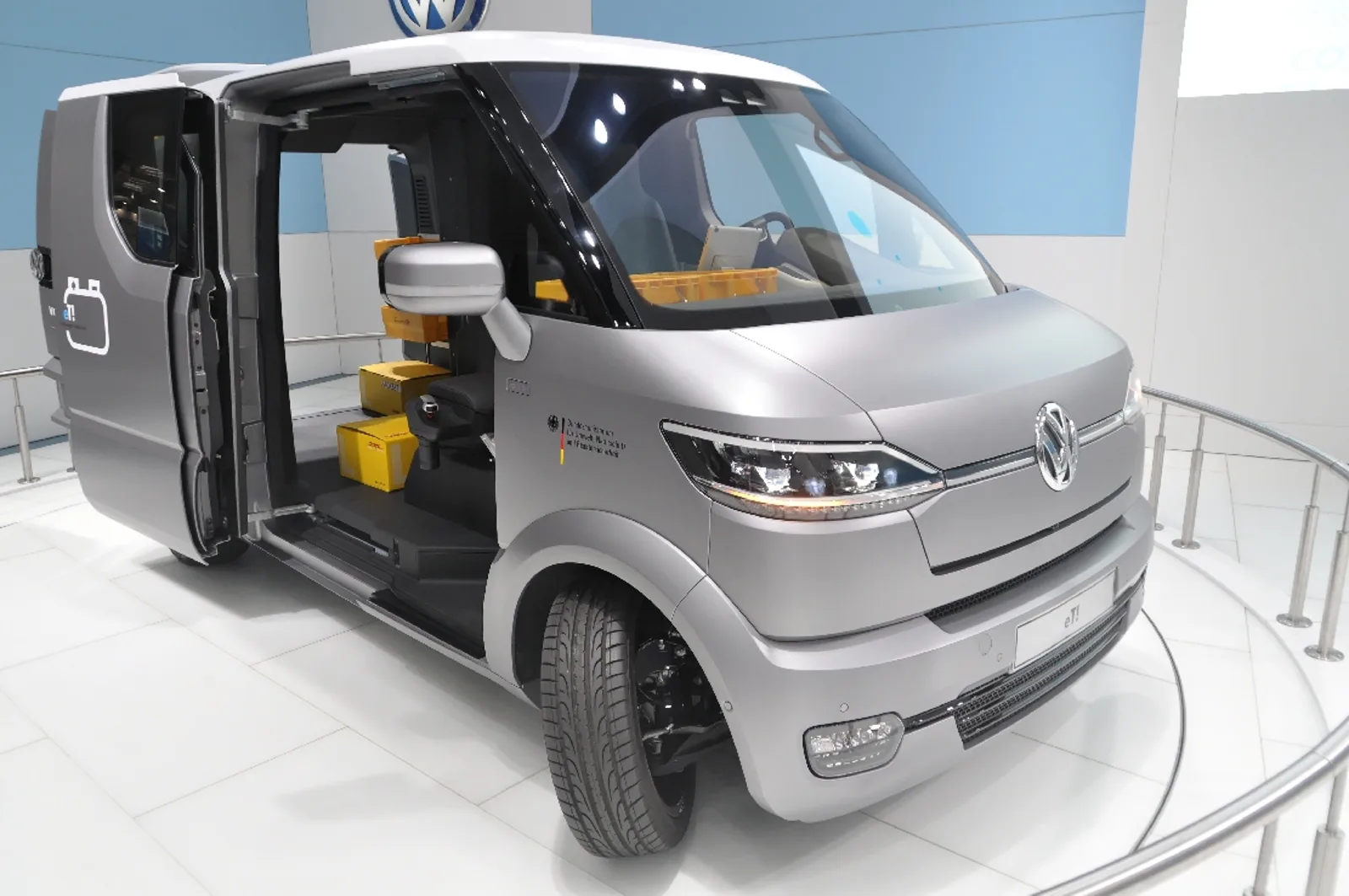
A 2011 electric concept built after a Caddy trial, with a joystick steering unit, a sliding door and a vehicle that could follow its courier.
The VW eT! was an electric concept vehicle from Volkswagen, shown to the press in Potsdam in November 2011 and at the Hanover Fair in April 2012. Built for urban parcel delivery, it had two rear-axle wheel-hub motors, a sliding door and a Follow me function driven by an iPhone.
Volkswagen's eT! was an electric concept vehicle, first shown to journalists in Potsdam in November 2011. Volkswagen presented it to a wider audience at the Hanover Fair in April 2012, as a demonstration of what light electric delivery vehicles could do with the technology available at the time. State subsidies taken up by Volkswagen AG for the project have drawn some press criticism.
Why was the eT! built?
The eT! grew out of EmiL, a project backed by the German government in 2010 and 2011 to test electric commercial vehicles. Deutsche Post DHL and the Braunschweig University of Art took part as project partners, and the study concerned an everyday van for businesses running inner-city distribution routes. Beyond the hardware, the car was meant to enable improvements in delivery and courier processes.
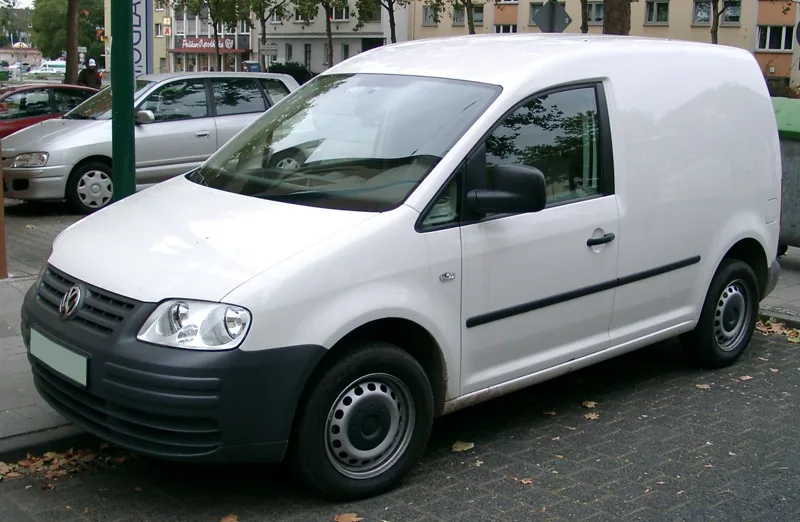
Testing began with ten electrified VW Caddy (2K) panel vans. For three months they ran on Deutsche Post rounds around Potsdam and the Stahnsdorf area of Brandenburg. Lessons from those rounds shaped a completely new vehicle, which combined new drive components with changes to the way drivers and couriers worked on their routes.
A van built around a joystick and a sliding door, able to follow its courier at walking pace.
How do the eT!'s doors work?
Access comes through three doors. The driver uses a regular hinged door, while the passenger side carries a powered slider. That slider works in two steps: after three seconds a first gap lets someone reach the passenger seat from outside, and a second movement opens the full route to the load bay.
The sliding door can be operated from a switch on the car or from a remote control running on an Apple iPhone. At the rear, a two-part wing door opens from a handle built into the VW emblem. Wing doors lose out to tailgates in rain and snow, so an extendable auxiliary roof sits in the upper rear section. Once out, it shelters both the courier and the load while the back is open. A simple foot movement beneath the bumper, a so-called virtual pedal, or the iPhone can bring it out.
A joystick steering unit sits on the passenger side, within easy reach from the pavement. Electric wheelchairs and construction machines use similar controls. Here it lets the driver steer and brake, and standing beside the car he can also creep it forward, at a maximum of six kilometres per hour (about 4 mph). The steering unit lets very short routes be covered without repeatedly getting in and out.
What could the partly autonomous system do?
The car could be started with the iPhone and sent after its driver at walking pace, a feature called Come to me. The name matches the job: the van comes to the courier rather than the other way round. Volkswagen intends it to speed up and ease the courier's working day, and it argues that autonomous vehicles are safe. The company points to the 2005 success of the fully autonomous Touareg Stanley in the DARPA Grand Challenge, a competition run by the US military research agency.
The scenario is simple. A courier, still sorting letters or parcels, walks on ahead; the driver starts the van from the iPhone, and it follows him at walking pace. Volkswagen presented this as a way to speed up and ease the working day.
How the camera, sensors and iPad worked together
A camera near the interior mirror detects the road ahead, including the roadside, and passes what it sees to an onboard computer. It can tell road markings from surfaces such as pavements and grass verges, but only for patterns that were loaded beforehand.
Bins standing in the road are spotted and steered around. Anything reaching more than a metre into the lane brings the car to a halt rather than a detour. It also stops when the system detects a junction ahead.
Six transceivers talk over WLAN to a matching unit inside the iPhone that the courier keeps strapped to an arm. Positioning runs without GPS or GSM, so the van constantly knows where its courier is and can keep pace on the pavement. The company names the function Follow me.
The research project worked out how much time these technologies could save. According to its result, the time needed per delivery district and employee could be cut by around 40 minutes a day.
How did the iPad guide each delivery?
Before setting off, the courier collects a pre-programmed iPad from the depot and slots it into a holder near the centre console. It gives precise information about the delivery route to be driven. As the car nears a delivery address, the iPad displays the exact address, the best place to stop and the type of item, whether a letter, registered mail or a small parcel.
Heavier parcels above 20 kg (44 lb) trigger a tip to use the trolley carried aboard. The screen also flags route stretches that suit joystick steering or Follow me.
The eT! was therefore a three-door vehicle built around a courier's working day. It combined a hinged door, a powered slider, a rear wing door with its own weather roof, a joystick for short moves, an iPhone for remote functions and an iPad for route guidance.
How was the chassis arranged?
Two wheel-hub electric motors drive the rear axle, each with its own commutation electronics. Without a central motor, a manual gearbox, a propshaft, an exhaust system or a mechanical drivetrain link, the loading floor could be placed very low.
Continuous power is 35 kW (48 PS; 47 hp), rising to 48 kW (65 PS; 64 hp) at peak for 10 seconds. The design alone would reach 140 km/h (87 mph), yet the car is held to 62 km/h (39 mph), a safety step typical of concept cars. The vehicle was intended for city traffic in any case, so the cap suited its job. German motorway rules, section 18 of the Road Traffic Regulations, admit only vehicles above 60 km/h.
Climbing proved harder. A 12 per cent gradient ability sufficed for the test area, though in hilly places it can be improved with other electric motors.
Did the eT! resemble an older Volkswagen?
Soon after the presentation, the specialist press drew attention to the eT!'s resemblance to the Volkswagen Fridolin, a van built between 1964 and 1974. Length, a similar outline, a small extra cargo bay beside the driver and a pavement-side slider are common to both.
Only the Fridolin had a second slider, on the driver's flank. The Bundespost's safety requirements for drivers stepping out toward traffic, plus cramped city-centre parking, explained that layout. Volkswagen did not comment on the resemblance, so the comparison stayed with the press.
How was the project funded?
The grant belonged to the project Testing of Electric Mobility for Commercial Vehicles, short name EmiL, which the German federal government funded in 2010 and 2011.
From 2009 the federal government ran a string of grant schemes under its second stimulus package, meant to cushion the financial crisis. Under the electromobility research strand, Volkswagen AG drew 9,913,795 euros for EmiL. Its own funds, of unknown size, were also used.
Public money covered only part of the total cost. Planned duration ran from 1 June 2010 through 30 September 2011. That was a tight schedule compared with other new developments, but it was largely kept, because extra capacity was brought in during the final phase, above all in design.
What did critics say?
Parts of the press criticised Volkswagen AG for taking state money. Critics argued that a group posting the top turnover and the biggest operating profit among the world's car makers had no need of tax money. They also regretted that the subsidised concept was not to lead to series production.