From the 1984 Land Cruiser II to the 2023 Land Cruiser 250, the Prado grew from a light-duty off-roader into a family four-wheel drive sold across dozens of markets.
Sold under the Prado name since April 1990, the light-duty Land Cruiser has gone through five generations, from the J70-based first car to the 2023 J250. It has been sold across dozens of markets under several Land Cruiser names.
The Toyota Land Cruiser Prado is the light-duty member of the Land Cruiser family, a full-size four-wheel drive that Toyota has sold under the Prado name since 1990. Its name means meadow or field in Spanish and Portuguese, and it has been sold under several other Land Cruiser names around the world.
Where did the Prado come from?
The Prado grew out of the Land Cruiser II, a light-duty version of the 70 Series first developed in November 1984. That car used a coil-sprung suspension and lighter axles than the heavy-duty J70, and it was also sold as the Land Cruiser or the Bundera depending on the market.
The Bundera was a short-wheelbase model, 2,310 mm (90.9 in) long, with a pair of doors, a plastic top and barn doors at the back. Its petrol engines were the 2.4-litre 22R, which was carbureted, and the 22R-E with fuel injection. The diesel options were turbocharged and non-turbocharged 2.4-litre units.
The Prado name arrived in April 1990, when the car was introduced in Japan. It was still largely based on the heavy-duty J70, with the coil-sprung suspension carried over from the Land Cruiser II, and its body-on-frame design made it highly capable off-road.
A light-duty Land Cruiser that became a family four-wheel drive, from the 1990 launch to the 2023 Land Cruiser 250.
How did the first-generation Prado drive?
The first-generation Prado was marketed toward on-road users in a way the core J70 range was not. Japanese buyers could choose a four-speed automatic or a five-speed manual, and the only engine in home-market cars was the 2.4-litre turbocharged 2L-TE diesel, making 71 kW (97 PS; 95 hp) with 240 N m (177 lb ft) of torque.
The 22R became the 22R-E with fuel injection, and the diesels were replaced by a 2.8-litre engine. In 1993 the 2L-TE gave way to the 3.0-litre 1KZ-TE turbodiesel with an aluminium cylinder head, which Toyota said could reduce NOx and soot.
A four-door version with the carbureted 22R was only sold in some Middle Eastern countries, and it was rather underpowered. In Japan the range had two-door and four-door bodies in SX, LX and EX trims, and EX was offered on four-door bodies only.
What changed with the second-generation J90 in 1996?
The second-generation Prado arrived on 8 May 1996 as an independent series rather than a J70 derivative. Toyota positioned it as a more passenger-oriented four-wheel drive, and it was built at the Honsha and Tahara plants and sold through Toyota and Toyota Vista dealerships.
Both body styles were larger than their predecessors and fell into the Japanese three-number registration class. The short-wheelbase three-door five-seater had a sportier look, while the five-door long-wheelbase eight-seater looked more rugged.
The drivetrain moved from part-time to full-time four-wheel drive. The front suspension used independent double wishbones with coil springs, while the rear was a four-link coil-sprung live axle with a lateral rod. Japanese three-door grades began with R and five-door grades with T.
At launch the range had a new 3.4-litre 5VZ-FE V6 producing 136 kW (185 PS; 182 hp), along with the 3.0-litre 1KZ-TE turbodiesel, whose output rose to 103 kW (140 PS; 138 hp) with an intercooler. A 2.7-litre 3RZ-FE petrol four producing 110 kW (150 PS; 148 hp) arrived in April 1997.
How did the D-4D diesel change the J90?
In July 2000 the turbo-diesel was replaced by the 3.0-litre 1KD-FTV, a common-rail direct-injection unit that Toyota marketed as D-4D. Peak figures were 170 PS (125 kW; 168 hp) at 3,400 rpm, with 352 N m (260 lb ft) of torque between 1,800 and 3,400 rpm.
Toyota credited four-valve cylinder heads, an intercooled variable-nozzle turbocharger and a combustion process called UNIBUS with lower fuel use and less diesel vibration and noise. Manual cars, and heavier automatics at 2,020 kg (4,453 lb) or more, cleared Japan's 2005 diesel economy rules early, and an immobiliser arrived at the same moment.
What did the 1999 revisions change?
On 9 June 1999 the J90 was lightly revised. Both bodies gained large multi-reflector headlamps, clear-lens combination lamps and a redesigned grille and bumper. An Optitron instrument cluster was newly offered, and the Field Monitor became a colour display.
Toyota also added Active TRC, which aimed to help the car make progress on loose and muddy ground. A TX Limited edition arrived at the same time with a roof rail, wood-grain trim, an armrest console and an Optitron meter.
The revised range was given a monthly sales target of 3,000 units. Five-door bodies grew to 4,690 mm (184.6 in) overall.
What was the Crawler?
The Prado Crawler was announced on 22 October 1999 and sold from 1 November 1999 as a factory special-equipment vehicle under Toyota's TECS programme. Its four road wheels became triangular rubber-belted crawler units, aimed at carrying passengers and goods through snow.
Since the basic controls stayed the same, Toyota said an ordinary Japanese licence was enough to drive it, unlike tracked snow vehicles. The crawler units could be removed outside the snow season, and the base car gained dedicated bumpers and enlarged over-fenders.
The Crawler was based on the 3.4-litre 5VZ-FE petrol TZ grade and bodied by Araco. Its kerb weight rose from 1,980 kg (4,365 lb) to 2,420 kg (5,335 lb), ground clearance rose from 230 mm (9.1 in) to 330 mm (13.0 in), and it launched at 5,240,000 yen before consumption tax.
What was the third-generation J120?
The third generation appeared in 2002 with reworked front suspension for better reliability. Work started in 1997, design followed in 1998, and the proposal came from Lance Scott of Toyota's ED2 design studio in France in late 1999.
Engines were the 2.7-litre 3RZ-FE straight-four, the 3.4-litre 5VZ-FE V6 and the 3.0-litre 1KZ-TE turbodiesel. In August 2004 the 3RZ-FE gave way to the 2.7-litre 2TR-FE, and in July 2004 the 5VZ-FE was replaced by the 4.0-litre 1GR-FE V6 with a five-speed automatic.
Diesel models used the 1KZ-TE rated at 96 kW (131 PS; 129 hp) until November 2006, when Toyota introduced the 1KD-FTV D-4D to meet Euro IV emission standards. That unit delivered 127 kW (173 PS; 170 hp) and 410 N m (302 lbf ft) of torque.
A shorter three-door J125 was also offered, with two seat rows and an 87-litre fuel tank. North America never received the Prado nameplate, and the car was sold there as the Lexus GX 470 with a 4.7-litre V8 instead.
How did the Prado reach North America?
Until the J150 the Prado was not part of the Land Cruiser range in North America, and a rebadged Lexus GX occupied its position in luxury trim. The Lexus GX 470 used a 4.7-litre V8 with full-time four-wheel drive, and the fourth generation appeared there as the 2010 model year Lexus GX 460.
The Prado was introduced in North America in 2023 and marketed simply as the Land Cruiser. That car replaced the J200 as the model carrying the Land Cruiser name there.
What did the fourth-generation J150 bring?
The fourth generation became available in some markets from October 2009. The five-door was offered in TXL and VXL grades, and a three-door short-wheelbase J155 was sold in some markets. Fold-into-floor seats replaced the removable third-row seats of the J120, which reduced cargo room and seating.
Spare wheel placement varied by market. UK cars carried the spare under the floor, while Argentine cars had it on the rear door to leave space for an auxiliary fuel tank. The dual-tank car held 150 litres (87 litres main, 63 litres auxiliary), against 179 litres for the third generation.
Kakadu and three-door ZR models added six camera positions. The June 2015 update added 5 kW (7 PS; 7 hp), taking the petrol unit to 207 kW (281 PS; 278 hp) with dual VVT-i and 381 N m (281 lb ft) of torque. The diesel was replaced by the smaller 1GD-FTV, and both engines moved to a six-speed automatic.
The first facelift arrived in Japan on 10 September 2013 with LED headlights, and the second facelift launched in Japan, Europe, Turkey and Australasia on 12 September 2017.
How did the fourth generation sell in Japan and Australia?
Japan's monthly sales target for the fourth generation was 1,000 units. The three-door was discontinued there, and the 4.0-litre V6 gave way to diesel engines again after June 2015.
The fourth generation reached Australia on 16 November 2009, with GX, GXL, VX and Kakadu five-door models and SX and ZR three-doors. The three-door was dropped in the October 2013 facelift because of poor sales, and Toyota Australia kept the 4.0-litre V6 until 2017.
In June 2015 the KD 3.0-litre turbodiesel was replaced by the 2.8-litre GD turbo-diesel, producing 130 kW (174 hp) and 450 N m (332 lbf ft). Since the August 2020 update, Australian Prados have been automatic only, with 150 kW (201 hp) and 500 N m (369 lbf ft).
What about China?
China received a 3.5-litre 7GR-FKS V6 on 24 September 2015 to replace the 4.0-litre V6. Power stayed at 206 kW (280 PS; 276 hp), and China became the only country to offer the Prado with the 3.5-litre V6 alongside a 2.7-litre inline-four petrol.
Production of the fourth-generation car in China ended in June 2020, and the fifth generation returned as a locally assembled model in April 2024.
What is the fifth-generation J250?
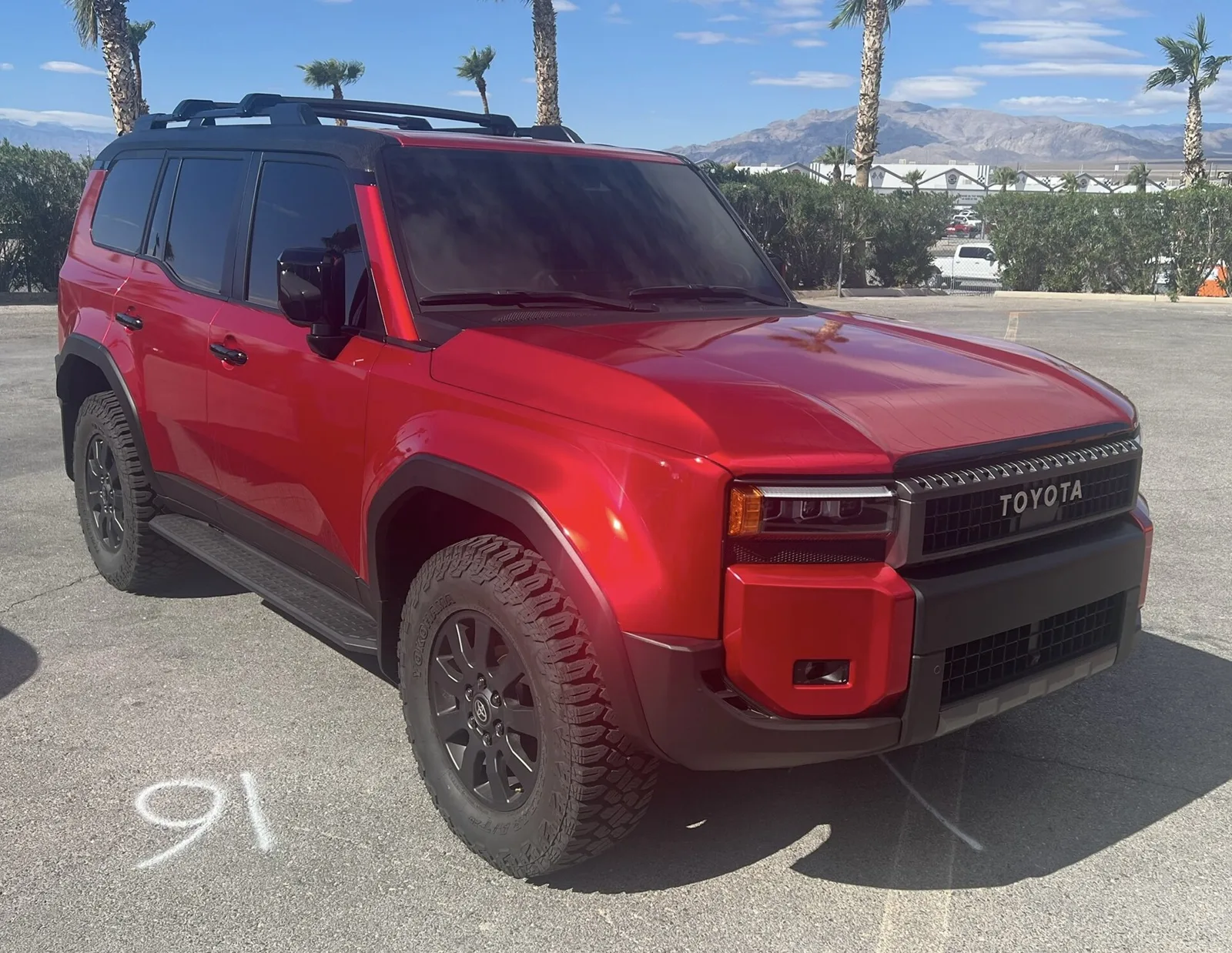
The J250 was revealed on 2 August 2023. Japan calls it the Land Cruiser 250, North America and some European countries use the plain Land Cruiser name, and Australia, China and the Philippines keep the Prado name.
Its retro, boxy exterior takes its inspiration from the 1980s J60. It uses the body-on-frame GA-F platform shared with the larger J300, and Toyota puts frame rigidity 50 per cent higher and overall rigidity 30 per cent higher.
It is the first Light Duty Series Land Cruiser with electric power steering. Approach and departure angles are 31.0 degrees and 22.0 degrees, breakover is 25 degrees, and ground clearance is 221 mm (8.7 in).
Full-time four-wheel drive comes with a Torsen centre differential and manual locking, plus an electronic two-speed transfer case with high and low range. Normal power distribution in straight-line driving is 40/60 front to rear, and an electronic locking rear differential can split power 50/50 to the rear wheels.
Where is the J250 sold and which engines does it use?
The J250 went on sale in Japan on 18 April 2024. The seven-seat VX used a 2.7-litre 2TR-FE petrol engine with a six-speed automatic, while the GX and ZX used a 2.8-litre 1GD-FTV turbo diesel with an eight-speed automatic. Launches followed in China in April 2024 and South Africa on 3 June 2024.
The US model offers a single powertrain, a hybrid powertrain marketed as i-Force Max, built around a turbocharged 2.4-litre T24A-FTS four-cylinder petrol engine. Its rated tow limit is 6,000 lb (2,722 kg). The US range has three trims, and the First Edition was limited to 5,000 units in its first year.
Other markets have followed: Brunei on 17 January 2025, the Philippines on 7 June 2024, Vietnam on 16 October 2024, Sri Lanka on 1 February 2025 and Taiwan on 10 July 2025, where the car came as a sole seven-seat variant with a 1GD-FTV diesel.
What are the Prado specifications?
| Model | Engine | Output or capacity |
|---|---|---|
| J90 at launch (1996) | 3.4-litre 5VZ-FE V6 | 136 kW (185 PS; 182 hp) |
| J90 diesel (July 2000) | 3.0-litre 1KD-FTV common rail | 125 kW (170 PS; 168 hp) at 3,400 rpm; 352 N m (260 lb ft) |
| J120 diesel (November 2006) | 1KD-FTV D-4D | 127 kW (173 PS; 170 hp); 410 N m (302 lbf ft) |
| J150 petrol (June 2015) | V6 with dual VVT-i | 207 kW (281 PS; 278 hp); 381 N m (281 lb ft) |
| J150 Australia (2015) | 2.8-litre GD turbo-diesel | 130 kW (174 hp); 450 N m (332 lbf ft) |
| Crawler (1999) | 3.4-litre 5VZ-FE petrol | Kerb weight 2,420 kg (5,335 lb) |
| J250 US hybrid | 2.4-litre T24A-FTS turbo petrol | Towing 6,000 lb (2,722 kg) |