A Hilux-based mid-size SUV built since 2004, with two generations, several facelifts and a Legender flagship that reached Thailand in 2020.
The Toyota Fortuner is a mid-size SUV that Toyota has built since 2004 on the Hilux pickup platform. It is also sold as the SW4 in parts of South America, comes with rear or four-wheel drive, and has been produced in several countries.
The Toyota Fortuner has been a fixture of Toyota's mid-size SUV line since it entered production in 2004. Built on the Hilux pickup platform, it offers two or three rows of seats and was produced with rear-wheel or four-wheel drive. Across two generations it has grown through facelifts, new engines and a flagship Legender grade.
Where did the Fortuner come from?
The Fortuner was unveiled in December 2004 at the Thailand International Motor Expo and went on sale in early 2005. Thai and Japanese engineers developed the first generation, which sat below the Land Cruiser Prado and above the RAV4. The name is derived from the English word fortune.
The Fortuner is one part of Toyota's IMV project for emerging markets, alongside the Hilux and the Innova. The first generation was developed in Thailand, but its facelift and the Hilux and Innova were designed in Australia by Toyota Australia, which also led the second generation.
A Hilux-based SUV that carried the Fortuner name from Thailand to markets across South America, Asia, Africa and Oceania.
Where does the Fortuner fit in Toyota's range?
In the range, the first generation was slotted beneath the Land Cruiser Prado and over the RAV4, giving buyers a body-on-frame option. In some Central and South American countries, Australia and New Zealand, Toyota sells it beside the 4Runner or the Prado.
Toyota's medium body-on-frame choices differ by region. Japan and North America have the Hilux Surf and 4Runner, while Europe and Australasia have the Land Cruiser Prado. Peru, Panama, Ecuador, Colombia, El Salvador, Guatemala and Nicaragua all sell the Fortuner alongside those rivals.
Naturally aspirated 5L-E diesel versions go to government bodies and the UN, alongside Toyota's other utility vehicles, from the Prado to the Land Cruiser 70 and 200 series.
How did the first-generation Fortuner perform?
The first-generation Fortuner, codenamed AN50 and AN60, came with a range of petrol and diesel engines, rear or four-wheel drive, and manual or automatic transmissions. In August 2012 its 2.5-litre diesel gained a variable nozzle turbocharger, and the car reached 100 km/h (62 mph) in about 11 seconds.
The turbo equipment was already fitted to the 3.0-litre 1KD-FTV from its 2005 introduction. Toyota said the upgrade lifted power and torque by about 60%, while fuel use fell by up to 30%. The 3.0-litre engine was the quicker diesel, getting to 100 km/h in under 10 seconds.
Engine options varied by country. They included the 2.7-litre 2TR-FE and 4.0-litre 1GR-FE V6 petrol engines with variable valve timing, plus the 2.5-litre 2KD-FTV and 3.0-litre 1KD-FTV common rail diesels with variable geometry turbochargers.
The car was launched to mark Pertamina's expedition, which used a group of Fortuners to travel from Jakarta, Indonesia to Rome, Italy, a distance of roughly 20,000 km (12,000 miles). Early Thai grades were G and G Luxury for rear-wheel drive, and V for 4x4.
Thai sales of the 4x4 petrol ended in 2007, and a two-wheel drive petrol took its place.
What changed in the 2008 and 2011 facelifts?
The 2008 facelift, launched in July 2008, brought new projector headlamps and grille, new rear lights and Bluetooth connectivity. It also added Electronic Brake Force Distribution, with Brake Assist replacing LSPV on some models.
The 2011 facelift debuted in Bangkok and revised the front fascia completely, with a new fender, hood, grille and bumper. The front end took cues from the J200 Land Cruiser, while the tail lamps adopted clear housings similar to the first-generation Lexus RX.
Inside, the centre console, steering wheel and audio system were upgraded, and the car later received a new VNT intercooled turbo engine. The sides gained sharper fender flares and LED integrated mirrors.
What changed with the second generation in 2015?
The second-generation Fortuner, codenamed AN150 and AN160, was unveiled on 16 July 2015 in Australia and Thailand. It shared the Hilux chassis, transmission and engine range, but gained a more distinct character of its own.
The design followed the Keen Look language used on the Hilux, though the Fortuner's exterior looks slimmer, with slim headlights and blacked-out D-pillars for a floating roof look. Designers took inspiration from the Land Cruiser and Land Cruiser Prado to set the car apart from body-on-frame rivals.
Hiroki Nakajima, executive chief engineer, led development. The interior was rebuilt rather than shared, with an upright dashboard, synthetic leather trim with stitching, a three-spoke steering wheel that it has in common with the Hilux, and a modern cluster with a large colour TFT display.
The ladder frame has larger cross sections, and the front uses double wishbones with a five-link rear and coil springs. The rear differential lock sits inside the differential housing for better protection off road. The second generation also moved from a full-time 4x4 system to a part-time one.
Front discs measured 17 inches, and rear drums stayed until 2017 except in Australia and India, where disc brakes were fitted all round. From 2017 every market had disc brakes at all four corners.
Standard equipment included ABS, EBD, dual airbags with a knee airbag, a follow me home light function, a sensor all round, a chilled glove box, digital climate control and power windows. Eco Mode and Power Mode adjusted throttle response. The 50:50 split third-row seats swing up against the body sides rather than dropping flat into the load area.
What engines does the second-generation Fortuner use?
The second generation uses two new GD series diesels with common rail direct injection and variable nozzle turbocharging, plus updated petrol engines. The 2.8-litre diesel gained auto start-stop in some markets, and the petrol engines received Dual VVT-i.
The 2.7-litre petrol weighs less, uses Dual VVT-i and runs with better combustion and reduced friction. It sits alongside the 4.0-litre V6, which was also updated with Dual VVT-i for this generation.
In Argentina the second generation came only with the 2.8-litre turbo diesel, while Brazil offered a 4.0-litre V6 petrol or the 2.8-litre turbo diesel at launch. The engine lineup has changed market by market, so buyers should check the specific grade.
Where is the Fortuner built and sold?
The Fortuner has been assembled in several countries, including Argentina at Zarate, Indonesia at Karawang, India at Bidadi and Vietnam from 2009. It has also been sold across Asia, Africa, the Middle East, South America and Oceania, with local content and CKD production in some markets.
South America
Argentina builds the car at Zarate, where it appears as the SW4 in petrol and diesel forms. Local content in the Argentine car was above 40% by 2020, with 60% of parts made regionally. The Argentine Fortuner is the only D-segment SUV built in that country.
Brazil also calls it the SW4. Sales began there in 2006 with three engine choices: a 3.0-litre 1KD-FTV diesel, a 4.0-litre 1GR-FE V6 petrol and a 2.7-litre 2TR-FE flex-fuel unit. Colombia unveiled the car in 2005 and launched it in 2007 as a replacement for the locally assembled Prado, which had been built for 9 years without changes.
Ecuador received the car in 2007, with versions coming from Venezuela and Thailand. A 2.7-litre engine option arrived there in 2010, and Venezuela built two grades for 2011, both with the 4.0-litre V6.
Asia
Indonesia introduced the Fortuner at the 13th Gaikindo Auto Expo in Jakarta on 8 July 2005, importing it from Thailand at first. Local assembly later moved to the Karawang plant, and exports go to the GCC. The 2.5-litre diesel, added in 2007, produced 75 kW (102 PS; 101 hp).
The Philippines introduced the Fortuner in 2005 to fill a gap in the lineup above the RAV4. In 2017 it topped the Philippine sales table, and the second generation launched there on 14 January 2016.
Pakistan saw the launch in 2009, and local manufacture began in February 2013. Vietnam started production in February 2009, and in 2012 the car sold 6,129 units there, holding a 64% share of the medium high SUV segment.
India received the Fortuner in 2009, assembled at Toyota Kirloskar's Bidadi plant in Karnataka from imported CKD kits. Output rose from 500 units a month to more than 950 vehicles.
Middle East and Africa
Saudi Arabia sold GX and VX grades, with the 4.0-litre V6 in the VX and four-wheel drive standard. The UAE added TRD body kits in 2015, and the Fortuner was launched across the GCC in March 2016.
South Africa launched the Fortuner in 2006, and it became the best-selling SUV there since launch. Egypt's second generation debuted in 2018, and the car is assembled at the Arab Organization for Industrialization.
Kazakhstan began CKD production in June 2014 at Saryarka AvtoProm, with plans for about 3,000 units a year and 100 extra jobs. Russia took the car from October 2017, imported from Thailand in 4x4 form only, before sales ended in 2022.
Oceania
Australian buyers first saw the car in July 2015, and showroom arrivals followed in October 2015. It came only as a 4x4 with the 2.8-litre turbo diesel, offered with a six-speed manual or automatic, in GX, GXL and Crusade grades.
The facelift arrived on 13 August 2020, and the manual was dropped. Toyota Australia announced in November 2025 that the Fortuner would end in mid-2026, citing poor sales.
What is the Legender grade?
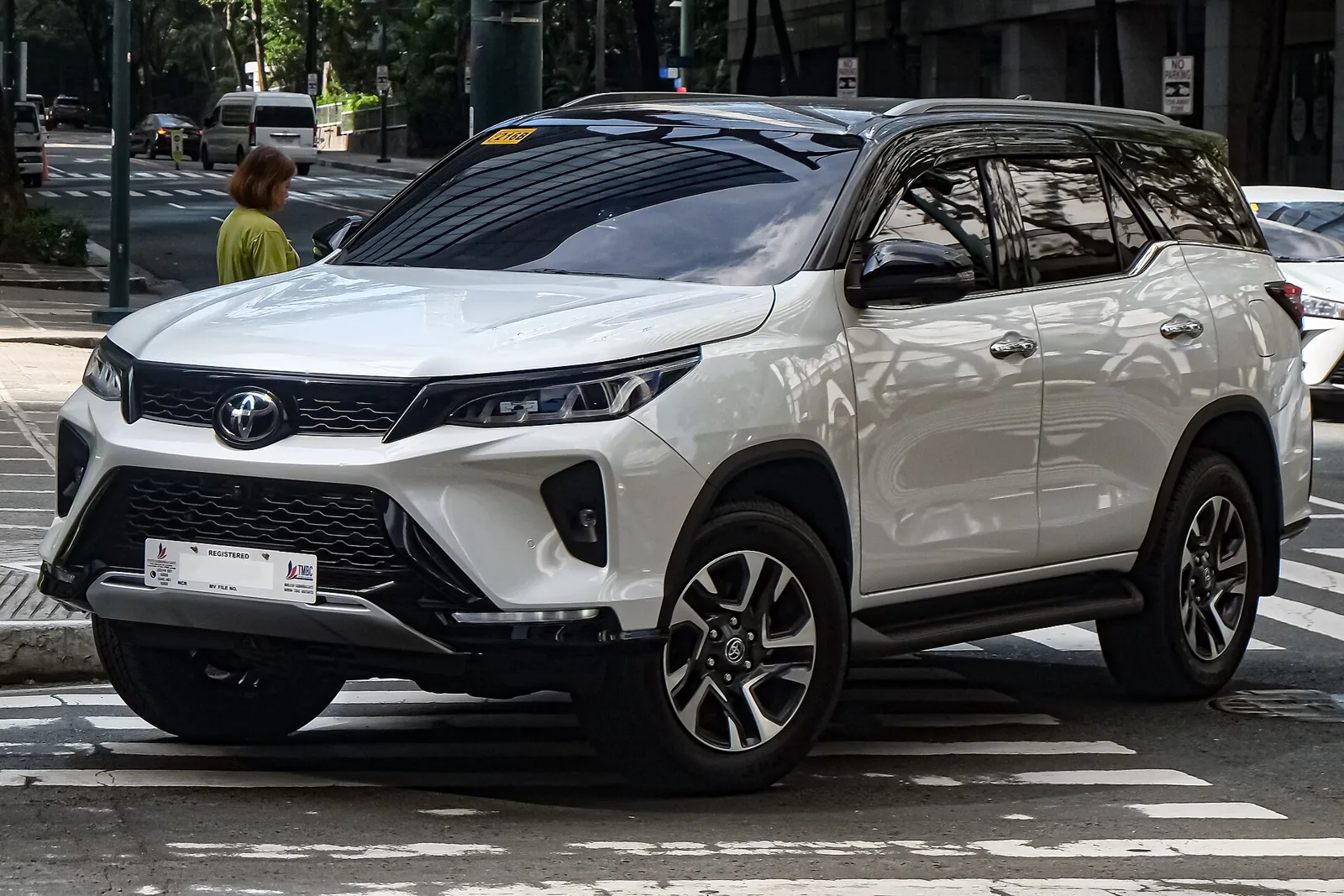
The facelift debuted on 4 June 2020 in Thailand alongside the facelifted Hilux. The Legender flagship replaced the TRD Sportivo in Thailand and carries 20-inch wheels, two-tone leather seats and a JBL sound system. Other markets know the same grade by different names, such as LTD in the Philippines and Diamond in South America.
Legender models use different headlight units and front and rear bumpers, designed to match Toyota's crossover SUVs. They also come with interior ambient lighting and a set of Toyota Safety Sense systems as standard.
The upgraded 2.8-litre 1GD-FTV diesel is rated at 150 kW (201 hp) and 500 Nm (369 lb ft) of torque. The Legender-based GR Sport reached Thailand on 26 August 2021, then the Philippines in October 2021, Brazil in December 2021, India in May 2022, Pakistan in March 2023 and Indonesia in September 2024.
What are the Fortuner specifications?
| Specification | Detail |
|---|---|
| Body and layout | Mid-size body-on-frame SUV with two or three rows of seats |
| Platform | Hilux pickup platform |
| First-generation launch | December 2004 unveiling; on sale early 2005 |
| Second-generation launch | 16 July 2015, Australia and Thailand |
| Early petrol engines | 2.7-litre 2TR-FE; 4.0-litre 1GR-FE V6 |
| Early diesel engines | 2.5-litre 2KD-FTV; 3.0-litre 1KD-FTV |
| Acceleration with VNT diesel | 0-100 km/h (0-62 mph) in about 11 seconds |
| Second-generation diesels | Two new GD series engines, common rail, VNT |
| Upgraded 2.8-litre 1GD-FTV | 150 kW (201 hp); 500 Nm (369 lb ft) |
| Second-generation petrol | 2.7-litre with Dual VVT-i; 4.0-litre V6 |
| Brakes | 17-inch front discs; disc brakes all round in all markets from 2017 |
| Legender wheels | 20-inch |
| Singapore height | 1.85 m |
| Alternative name | SW4 in Argentina and Brazil |