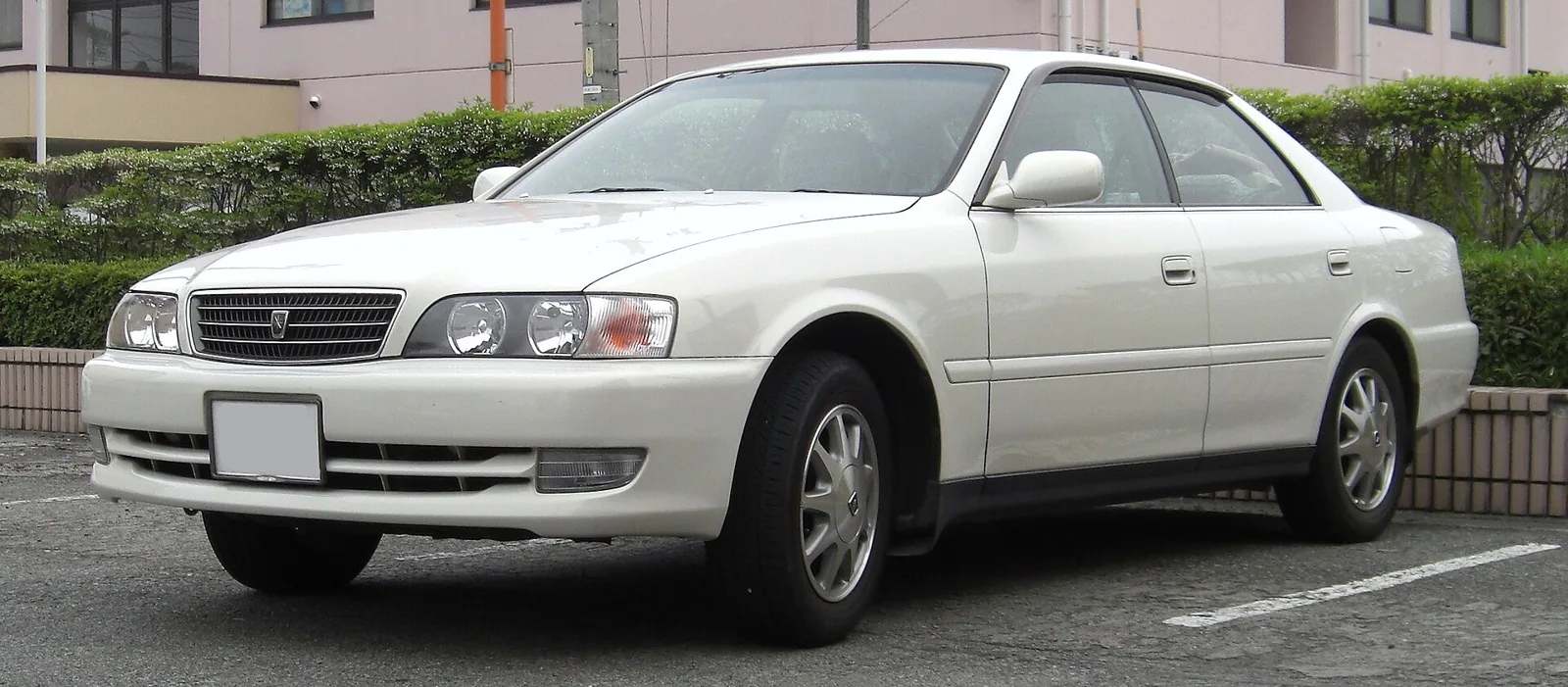
A pillared four-door built for companies, taxis and police forces, named apart from the frameless hardtop in 1974 and carried through to 2018.
Built mainly for companies, taxis and police, the pillared Toyota Crown Sedan carried its own name from 1974. Sales stopped in February 2018, after the name had covered six generations, from the 1974 four-door to the XS10 series of 2001.
The Toyota Crown Sedan was a pillared four-door sedan, built mainly for business and fleet use, that Toyota sold in Japan as the Crown's sedan version. Its name was first used in 1974 to separate it from the frameless four-door hardtop, and the original line ran until sales ended in February 2018.
How did the Crown Sedan get its name?
The Crown had been a four-door sedan from the start, with window frames and a basic body style that defined the range. Other variants existed, including an estate, a two-door hardtop and a light van, but the catalogue never singled out the sedan by name. That changed in 1974 when the fifth-generation Crown introduced a frameless four-door hardtop for private buyers.
To tell the two apart, the framed four-door became the Crown Sedan and was listed that way in the catalogue. The fifth-generation brochure presented the new hardtop as a third style, distinct from both the sedan and the hardtop, and called it a Personal Sedan. The hardtop was pitched at individual owners, while the framed car served companies.
Toyota gave the framed Crown its own name in 1974 so buyers could tell it apart from the hardtop.
Who bought the Crown Sedan?
Mostly organisations. The Crown Sedan was used as an official car and company car, a hire car, a private or corporate taxi, a police car and a driving school car. Private buyers could still purchase any generation of it, but the sedan was mainly a model for business use.
Police cars used the Crown Sedan up to the 150 series. From the eleventh generation on, police forces took the framed mainstream Crown instead. In the 150 series, corporate taxi versions of the Standard and Deluxe grades moved to the Crown Comfort and were dropped.
What did the first Crown Sedan look like?
The first-generation Crown Sedan, known in the series as the fifth overall, arrived in October 1974 in S80 and 100 series form. Its styling moved away from the spindle shape of the previous model towards straight lines. There were six grades, from Standard up to the Royal Saloon at the top.
Engines centred on a 2,000 cc six-cylinder M-type. A 2,600 cc 4M-type six and an LPG-fuelled four-cylinder 5R-type for taxis also featured. The Standard grade came with drum brakes on every wheel and a taxi-only dashboard, ready for a tachograph, fare meter and radio. Air conditioning was a hanging-type unit.
What changed in the second and third generations?
The second generation, the S110 series of September 1979, used rectangular quad headlamps on Deluxe and above, and round quad headlamps on the taxi and Standard grades. Engines were enlarged to a 2,800 cc 5M-EU six for the 2,600 cc car. A 2,000 cc turbo six and an LPG six arrived in 1980, and in 1982 a 2,446 cc turbo-diesel producing 96 hp followed.
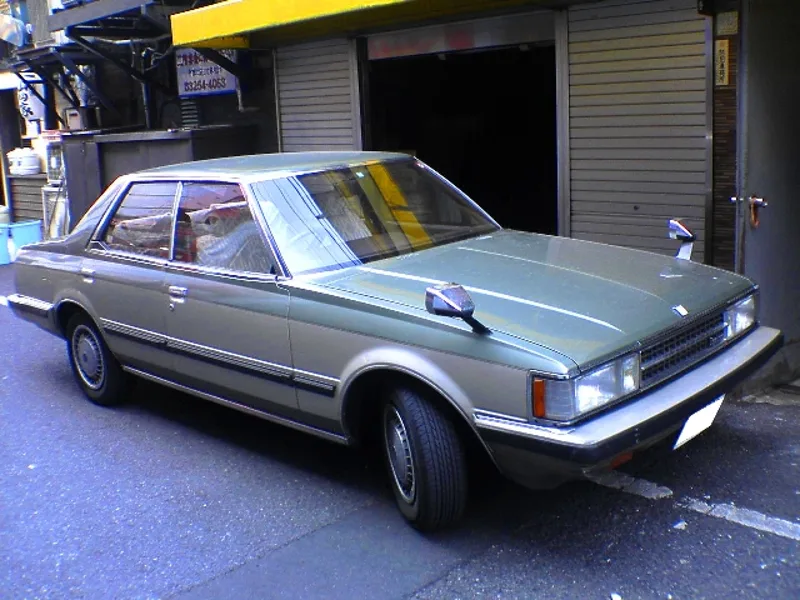
The third generation, the S120 series of September 1983, offered eight engines across LPG, petrol and diesel. They included a DOHC six, a turbo six and a diesel with a turbocharged variant. In August 1984 the 2,800 cc car gained a 3,000 cc 6M-GEU, and in September 1985 the 2,000 cc Royal Saloon received a supercharged 1G-GZEU. The Royal Saloon series used the Pegasus perimeter frame with four-wheel independent suspension.
How did the fourth generation hold on?
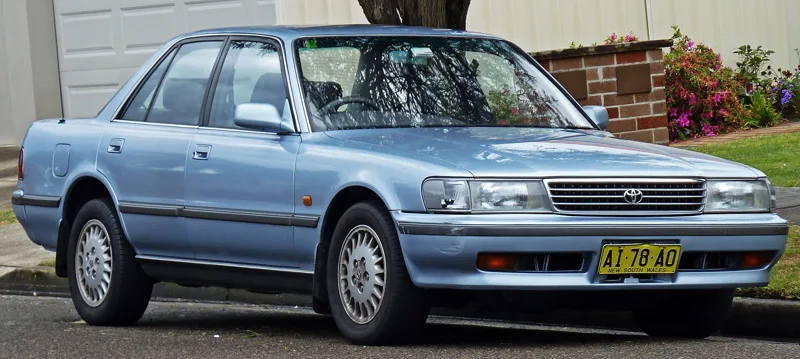
The fourth generation, the S130 series of September 1987, was the last frame chassis of the series. Its Standard and Deluxe grades, plus drum brakes on every wheel in Standard form, were offered for the last time in this generation. The door mirrors became electrically retractable, and fender emblems stayed until the early version of the 130 series.
The hardtop had a separate body for its three-number-plate cars, while the sedan's version simply added a wider bumper and protective mouldings to the five-number-plate body. The model was kept in production after the hardtop changed to the 140 series in November 1991. Power rose through a series of updates, and in 1989 a 4.0-litre V8 was offered on the sedan.
How did the 150 series change the Crown Sedan?
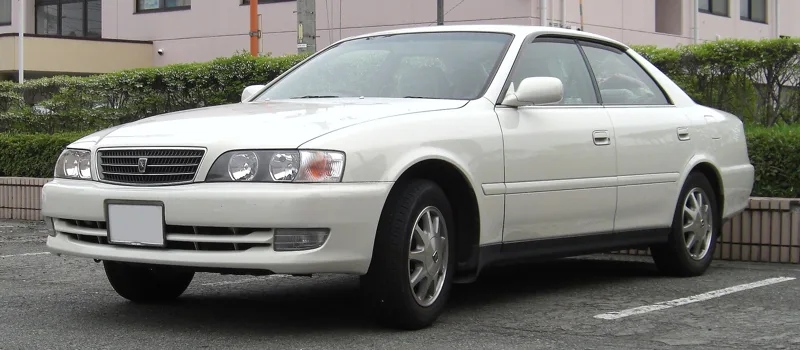
The fifth generation, the S150 series launched in December 1995, adopted a monocoque body. Both manual and automatic cars had only a floor-mounted gear lever, and fewer than 400 manual cars were built. Left-hand-drive examples were exported to China and the Middle East up to this generation.
The main grades were the Royal Saloon G, Royal Saloon, Super Saloon E and Super Deluxe. The Royal Saloon G had power seats for both front seats and a 2JZ-GE 3.0-litre engine (2,997 cc, 182.9 cu in). The Royal Saloon used a 2.5-litre 1JZ-GE (2,491 cc, 152.0 cu in) or an all-wheel-drive i-Four version, while the Super Saloon E used a 1JZ-GE or a 2.0-litre 1G-FE (1,988 cc, 121.3 cu in) in a five-number-plate body. All grades had independent suspension, four-wheel disc brakes, SRS airbags and ABS.
Several engines gained VVT-i during the run. The 1JZ-GE gained power in September 1996, climbing to 200 PS (197 hp) from 180 PS (178 hp). The 1G-FE followed in August 1998, rising to 160 PS (158 hp) from 140 PS (138 hp). Diesel engines were dropped in September 1999, and the manual gearbox disappeared apart from the 3.0-litre police specification.
Why did the 2001 model break with the past?
The sixth generation, the XS, BS and SS10 series of August 2001, was built on the chassis of the X80 Mark II, through the Crown Comfort. That meant the base of the Crown Sedan became older than that of the 150 series, which had shared a chassis with the X90 Mark II. The Crown Sedan was in effect repositioned as an enriched Crown Comfort with extra equipment and interior trim.
At launch, engines were limited to 2.0 litres: a six-cylinder petrol unit (1G-FE) and a four-cylinder LPG unit (3Y-PE). Police cars moved to the 170 series Royal instead. The difference between the 150 series and the XS10 series is widely recognised in the market, and the main practical differences from the Crown Comfort were the three-number-plate option and aluminium wheels.
Engine changes continued through the 2000s. In August 2008 the LPG engine became the 1TR-FPE, a DOHC unit that lifted output to 116 PS (114 hp) from 79 PS (78 hp). Toyota Stop and Start became standard that month, and in October 2013 VSC and TRC were fitted as standard for safety.
Which engines did the third generation offer?
The third generation, the S120 series, was offered with eight engines across LPG, petrol and diesel. LPG buyers had a 2,000 cc 3Y-PU, a four-cylinder OHV unit, or an M-P six with SOHC valve gear. Petrol buyers could choose a 2,000 cc 1G-EU SOHC six, a 1G-GEU DOHC six, an M-TEU SOHC turbo six, or a 2,800 cc 5M-GEU DOHC six with the MS123 code. Diesel versions came as a 2,400 cc 2L and a turbocharged 2L-T.
Police cars received a 2,800 cc six-cylinder SOHC 5M-EU, coded MS122Z, while the 2,000 cc carburettor M-U SOHC six was discontinued. The four-cylinder taxi cars moved from the 5R-PU to the 3Y-PU, and the instrument panels of all LPG cars became taxi-only dashboards.
What did the 1989 and 1993 updates change?
Two of the fourth generation's later updates brought many changes. In August 1989 a 4.0-litre V8 appeared on the sedan, and the diesel and LPG engines gained power. In August 1993 the air conditioning moved to a replacement refrigerant, and the Standard sedan narrowed to a single LPG engine.
In 1989 the 2.4-litre diesels were uprated. The 2L-THE went up to 100 PS (99 hp) from 94 PS (93 hp), the 2L-T to 94 PS (93 hp) from 85 PS (84 hp), and the plain 2L to 85 PS (84 hp) from 73 PS (72 hp). On LPG, the six moved from the M-P to the 1G-GP and rose to 110 PS (108 hp) from 82 PS (81 hp). The four became the 3Y-PE, an electronically controlled carburettor engine, with its output lifted to 82 PS (81 hp) from 79 PS (78 hp).
The 1993 changes also gave three-number-plate cars four vertical bars in the front grille. The 2400 EFI turbo-diesel was switched from the 2L-THE to the 2L-TE. The Standard sedan was then offered only with the four-cylinder LPG engine, while a floor-shift automatic was added.
What nicknames did the sixth-generation grades get?
Operators and others in the trade often shortened the grade names. Super Deluxe became Suderela, Super Deluxe G Package became G Pake, and Super Saloon became Suhsaru. Sometimes all of these were lumped together under the single name G Pake.
Two grades launched the line, the Super Deluxe and the Super Deluxe G Package, with woodgrain on the centre console and brushed jacquard on the seats. The Super Saloon followed in October 2002.
What did the 2002 and 2004 updates add?
In October 2002 the Super Saloon joined the range as a model based on the Super Deluxe G Package. It had enlarged bumpers and side mouldings and measured 4,830 mm by 1,710 mm overall. The Super Deluxe Mild Hybrid was also added that month, with G Package-level interior fittings as standard.
The LPG range was unified on the 3Y-PE, and the Royal Saloon with the 1G-GPE engine, offered since January 2002 as a special vehicle through TECS, was discontinued. In June 2004 the car met the 2005 emissions standard, and its designation changed from TA- to ABA-. Petrol cars did not comply. Manual headlight levelling and front fender turn lamps became standard, taken over from the first-generation bB, and the rear high-mount lamp changed to LED.
The number of brake and tail lamp bulbs in standard specification was also reduced to match the cold-region version. Brake lamps went from four bulbs to two on each side, and tail lamps from six to four.
How did the 2007 to 2010 changes reshape the line?
In August 2007 the 1G-FE petrol car, which did not meet the emissions rules, was discontinued, though the mild hybrid, which met the 2017 standard, carried on. The column-shift car with the 3Y-PE engine was also dropped that year. The mild hybrid itself ended in April 2008, leaving only the LPG version in the range.
In August 2008 the LPG engine changed from the OHV 3Y-PE electronically controlled carburettor unit to the 1TR-FPE, a liquid-injected DOHC VVT-i engine. The same unit was used in the Dyna and Toyoace. Output climbed from 79 PS (78 hp) to 116 PS (114 hp). It was then filed under TSS10, and every car gained Toyota Stop and Start plus freestanding rear seat belt buckles.
The front emblem switched to the gold-plated finish of the Crown Comfort, and the ashtrays became manufacturer's options. The Super Deluxe wheel covers kept their design but gained a high-gloss finish. In November 2010 an LPG fuel cooling device was added, the 1TR-FPE output fell from 116 PS (114 hp) to 113 PS (111 hp), and the cigarette lighter became a power socket.
What did the 2012 and 2013 updates add?
The July 2012 update added Plasmacluster to every car in place of the air purifier. To meet a new collision standard, the centre rear seat gained a three-point belt, and the rear left and right seats received ISOFIX child-seat anchor bars as standard.
All head restraints were enlarged. Front passenger head restraints on the Super Saloon and Super Deluxe G Package lost their folding action, and the rear head restraints lost front-to-back movement. Up-and-down adjustment was kept. In October 2013 VSC and TRC became standard, and the speedometer and tachometer gained a meter illumination control.
When did the Crown Sedan name come to an end?
Orders for the Crown Sedan closed on 8 June 2017, and the listing on the website ended at the same time. Vehicles already ordered were built until January 2018, with sales finishing a month later. The Crown Sedan name was therefore set aside for now, closing one chapter of Crown history.
Does the 16th-generation Crown Sedan count?
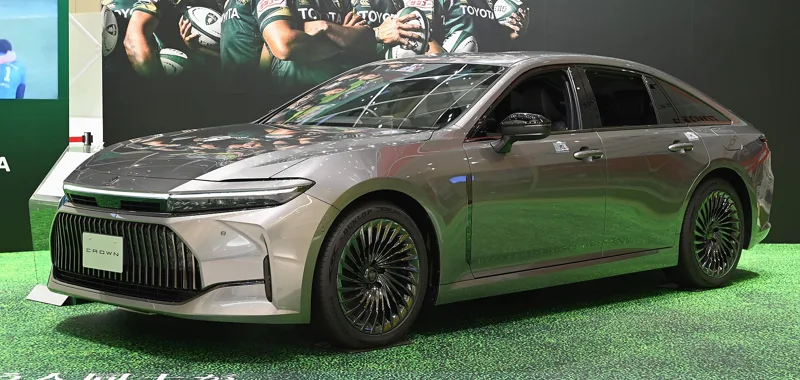
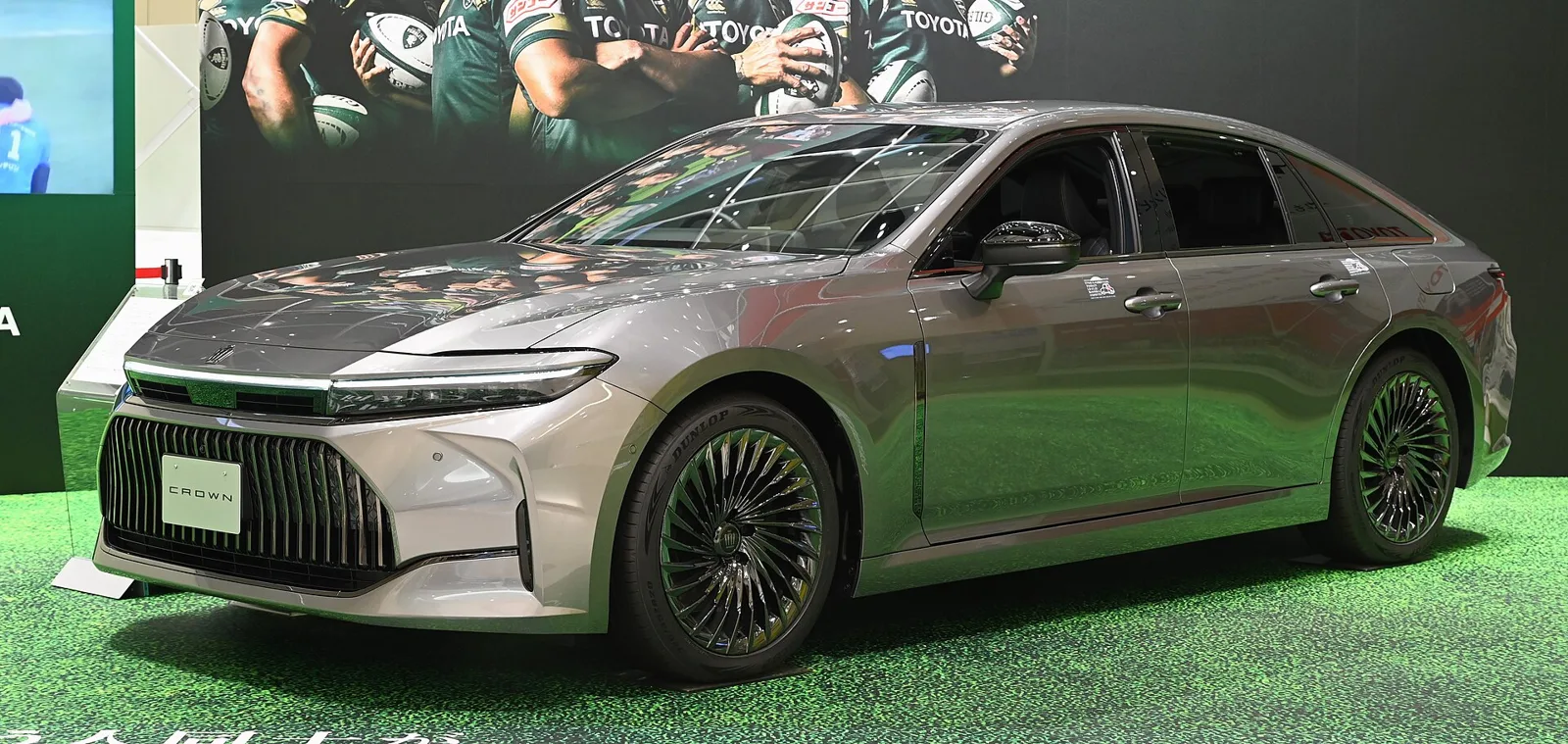
Only in outside usage. The 16th-generation Crown, sold since 2023, is made up of four types, after the range was merged with the Avalon for North America and falling demand in Japan. The types are the Crossover, Sport, Estate and the sedan, which stays on the traditional FR base.
Following Toyota's official view, the eleventh to sixteenth generations are not treated as Crown Sedans. Media outside the company, however, often apply the name to the 16th-generation sedan to distinguish it from the other types.
What were the Crown Sedan generations?
| Generation | Series | Years | Notable change |
|---|---|---|---|
| First (fifth overall) | S80 and 100 | 1974-1979 | Crown Sedan name introduced |
| Second (sixth overall) | S110 | 1979-1983 | Rectangular quad lamps on higher grades; 2,800 cc engine |
| Third (seventh overall) | S120 | 1983-1987 | Royal Saloon G, 3,000 cc engine in 1984 |
| Fourth (eighth overall) | S130 | 1987-1995 | Last frame chassis of the series |
| Fifth (tenth overall) | S150 | 1995-2001 | Monocoque body, floor shift only |
| Sixth (eleventh overall) | XS, BS and SS10 | 2001-2018 | Built on the Crown Comfort chassis |