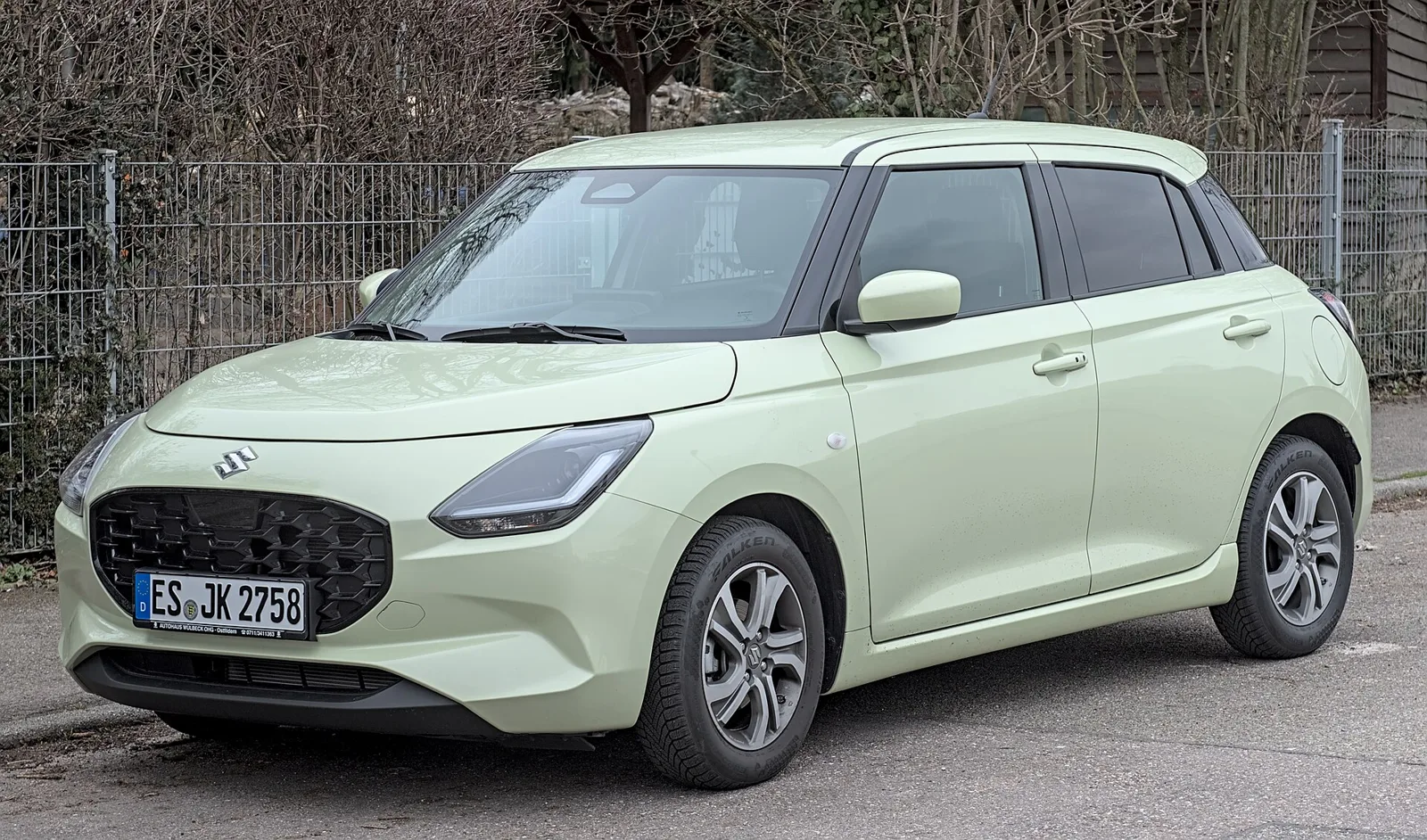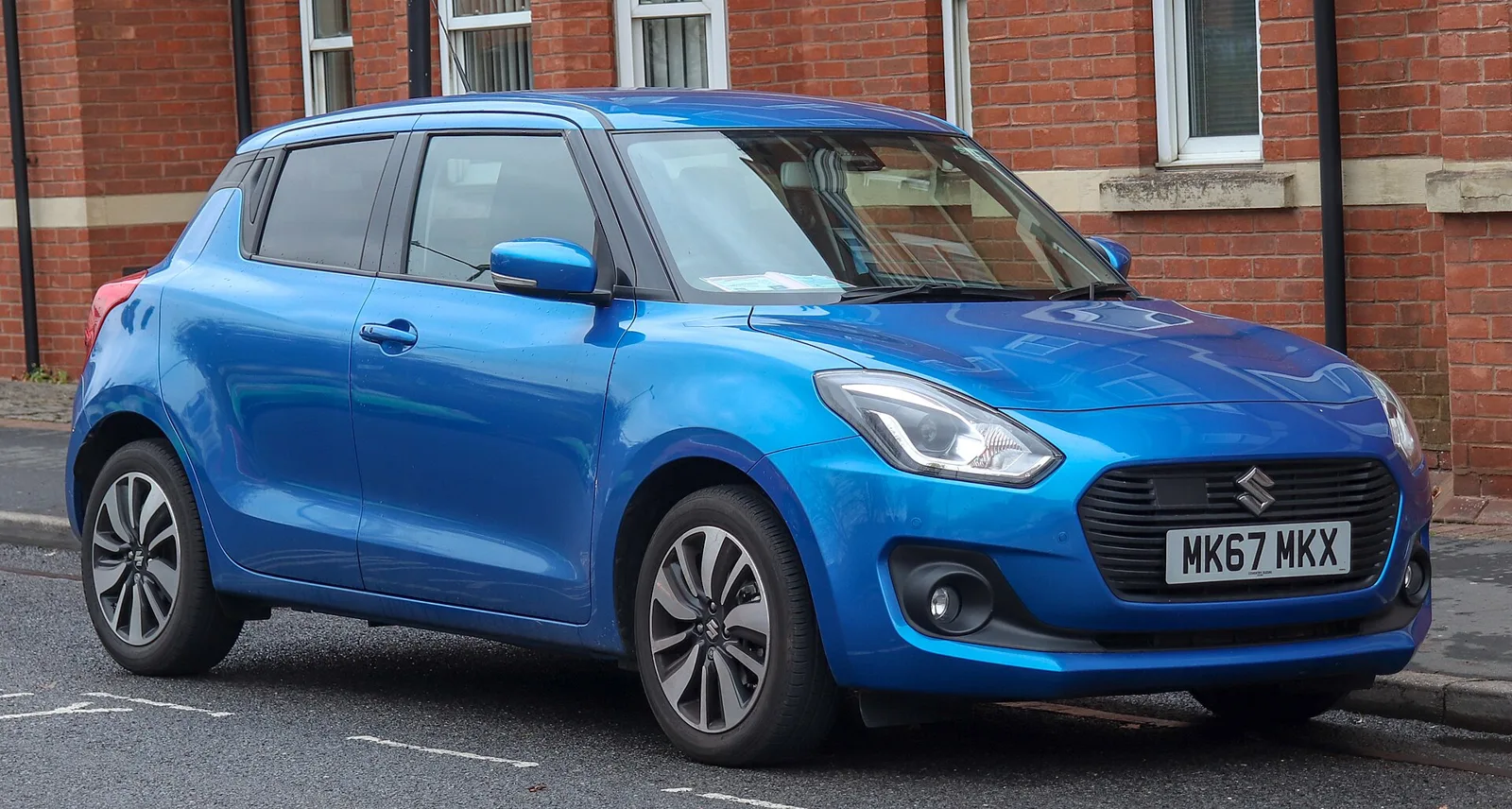
Suzuki's third-generation city car brought four-wheel drive, a simplified hybrid system and a turbocharged Sport version before its 2020 facelift.
The Suzuki Swift III (A2L) was a city car built from December 2016 and replaced by a fourth generation in 2024. It offered petrol engines, a simplified SHVS hybrid system, ALLGRIP four-wheel drive and a turbocharged Sport version, and it sold more than 745,000 units by the end of 2019.
The Suzuki Swift III, coded A2L, was a small five-door city car from the Japanese maker that went on sale in Europe in 2017. It set itself apart with a choice of four-wheel drive, a simplified hybrid system and a turbocharged Sport version, and it was still in its facelifted form when a fourth generation replaced it in 2024.
Where and when was the third-generation Swift built?
Production began in Japan in December 2016 at Suzuki's Sagara plant in Makinohara, Shizuoka Prefecture. The same plant supplied the European, Japanese, Oceanian and South American markets. India and Thailand had their own factories: the Indian plant in Gujarat supplied only the home market, while the Thai plant served the ASEAN region.
The car first appeared in Europe at the Geneva motor show in March 2017. European sales followed from 4 May 2017. Suzuki unveiled the facelift on 1 July 2020, and the updated car was sold in the second half of that year.
A city car that offered four-wheel drive when most of its rivals did not.
How big was the Swift III and how much did it weigh?
The Swift III measured 3.84 m (12.6 ft) long and weighed 120 kg (265 lb) less than the model it replaced. Unlike that predecessor, it was offered only with petrol engines, and it came exclusively as a five-door.
The car sat on the new Heartect platform, a structure that Suzuki shared with the Baleno and Ignis. The Sport version remained part of the range after the facelift.
What engines did the first-phase Swift offer?
Three engines were offered in the first phase. The 1.2 Dualjet was a four-cylinder with multipoint injection that produced 90 PS (89 hp). The alternative was a turbocharged three-cylinder with direct petrol injection, displacing 998 cc (60.9 cu in), which produced 111 PS (109 hp). The hybrid versions were available for both of these engines.
The two engines came with a choice of gearboxes. The one exception was the non-hybrid 1.0 BoosterJet, which could be had with a six-speed automatic in place of the five-speed manual.
How did the SHVS hybrid work?
SHVS stood for Smart Hybrid Vehicle by Suzuki. The system used an integrated starter-generator that acted as both alternator and electric motor. It recovered energy when the car slowed and gave extra power when accelerating, and it also powered the stop-start function. The whole arrangement was paired with a 12-volt lithium-ion battery.
In the facelifted Phase 2 car the battery grew in capacity from 3 Ah to 10 Ah. Only the 1.2 Dualjet, in a new form, remained in the engine line-up.
Which trim levels and colours were on offer?
The range offered two engines, three trim levels and two gearboxes. The trims were Avantage, Privilege and Pack, and the drivelines were front-wheel drive or the 4x4 ALLGRIP system. The SHVS hybrid added a further layer to that choice.
The 1.2 Dualjet came in Avantage and Privilege form, with the Privilege also offered with 4x4 drive. The hybrid SHVS version of the 1.2 was sold in Pack trim, with or without four-wheel drive. The 1.0 Boosterjet was offered in Privilege trim, as a hybrid SHVS Pack, and as a non-hybrid Pack with either an automatic or a manual gearbox.
Seven colours were offered in the first phase: Burning Red Pearl, Speedy Blue, Pure White Pearl, Premium Silver, Mineral Gray and Super Black Pearl, plus Fervent Red. Four two-tone So'Color versions paired a coloured body with a contrasting roof in black or silver.
What safety equipment came with the Swift III?
The 2018 catalogue listed active emergency braking, ABS with electronic brakeforce distribution, ESP and a set of six airbags covering the front, the front sides and the curtains. Two ISOFIX child-seat anchorages sat at the rear, and tyre pressure monitoring was standard.
The Privilege and Pack trims added a reversing camera and front fog lights. The Pack version went further, with lane departure warning, trajectory correction assistance, automatic headlight control, hill start assistance, adaptive cruise control and a speed limiter.
What was the Swift Sport III?
Suzuki presented the third-generation Swift Sport at the Frankfurt motor show on 12 September 2017. It was not naturally aspirated like its predecessor. Instead it used a 1.4-litre BoosterJet turbo with direct injection, an engine taken from the Vitara S, producing 140 PS (138 hp) with 230 Nm (170 lb ft) of torque.
The Sport weighed 970 kg (2,138 lb) and came with a six-speed manual gearbox and 17-inch wheels. Its styling set it apart from the standard car, with specific front and rear bumpers, carbon-finish sills and a spoiler that carried the third brake light. Chrome dual exhaust outlets completed the look, and the front seats were sports buckets.
What changed when the Sport went hybrid in 2020?
From April 2020 the Sport was offered only as a hybrid. The 1.4 BoosterJet Hybrid, coded K14D and taken from the Vitara Hybrid, produced 129 PS (127 hp), with a torque gain of 20 Nm (15 lb ft).
The 48 V synchronous motor gave 10 kW (13 hp) at 3,000 rpm, plus 53 Nm (39 lb ft) at 500 rpm, which made the lost power almost imperceptible. The Sport used this higher-voltage SHVS system where the standard car used 12 volts. The aim was to recover more energy on deceleration, with energy capture active below 80 km/h, and to deliver more power at a lower engine speed. The K14D also had a variable valve timing system.
What did the facelift change in 2020?
The front end was altered with a new grille crossed by a horizontal strip on each side. New wheels and colours appeared, while the rear was left alone. The Phase 2 range kept three trim levels and added colours such as Flame Orange Pearl and Rush Yellow to the So'Color options.
The facelift added three driver-assistance systems: traffic sign recognition, blind-spot monitoring and a lane departure prevention function. Suzuki did not say whether the Sport would receive the same modest changes.
What were the key specifications across the range?
| Version | Engine | Power |
|---|---|---|
| Swift 1.2 Dualjet | 1.2-litre four-cylinder | 90 PS (89 hp) |
| Swift 1.0 Boosterjet | 998 cc (60.9 cu in) turbo three-cylinder | 111 PS (109 hp) |
| Swift Sport III | 1.4-litre BoosterJet turbo (K14C) | 140 PS (138 hp) |
| Swift Sport hybrid | 1.4-litre BoosterJet hybrid (K14D) | 129 PS (127 hp) |
| Dzire diesel | 1.3-litre DDiS (D13A) | 75 PS (74 hp) |
What did the ALLGRIP 4x4 system add?
ALLGRIP was the four-wheel-drive option that set the Swift apart from most of its city car rivals. It was offered on the 1.2 Dualjet Privilege and on the hybrid 1.2 Dualjet Pack. In the facelifted range, versions with the automatic gearbox or the manual ALLGRIP were offered in Privilege and Pack trim.
The Swift was one of the few city cars to offer four-wheel drive.
Which colours did the Swift Sport come in?
The Sport was offered in Champion Yellow as its standard colour, coded ZFT. Six metallic options were listed in the catalogue: Burning Red Pearl Metallic (ZWP), Speedy Blue Metallic (ZWG), Pure White Pearl (ZVR), Premium Silver Metallic (ZNC), Mineral Gray Metallic (ZMW) and Super Black Pearl (ZMV).
From March 2020 the French market received three two-tone So'Color finishes on the Sport, each with a Super Black Pearl roof. They were Flame Orange Pearl Metallic (CFK), Burning Red Pearl Metallic (D72) and Speedy Blue Metallic (C7R).
What did the Dzire offer in the Indian market?
The Dzire was a three-box, four-door version of the Swift. It was built mainly for India and shipped to developing markets in Asia, Africa and Latin America. Its name changed for the first time, dropping Swift to become the Suzuki Dzire. The Swift name survived only in Guatemala and Colombia, where the car was sold as the Suzuki Swift Sedan.
The Dzire offered two engines: a 1.2-litre VVT petrol with 82 PS (81 hp), derived from the K12B petrol unit of the earlier Swift and modified for India, and a 1.3-litre DDiS diesel with 75 PS (74 hp).
How well did the Swift sell and who bought it?
Since its launch in 2017, the Swift had sold more than 745,000 units across 119 countries by the end of 2019. Suzuki revealed a driving-school edition in 2019, made with Drive Matic Legrand. At the launch of the fourth generation, the company said that two thirds of third-generation buyers had been women and that half of its customers were under 50.
Which awards did the Swift receive?
Japan's 2018 Car of the Year award, given by the Automotive Researchers' and Journalists' Conference of Japan, went to the Swift. In 2018 it also reached the top three of the World Urban Car Awards, and it was also placed in the 2018 World Car Awards, in the city car category, where the Ford Fiesta and the Volkswagen Polo stood alongside it.
The Swift III fitted with the Safety Pack earned five stars from the JNCAP in 2018. In 2019 the Indian award went to the model line, covering all three generations.
What came next for the Swift?
A fourth generation replaced the Swift III in 2024. Before that, Suzuki had shown a concept based on the Swift Sport at the Thailand Motor Expo in 2019, called the Swift Sport Extreme.