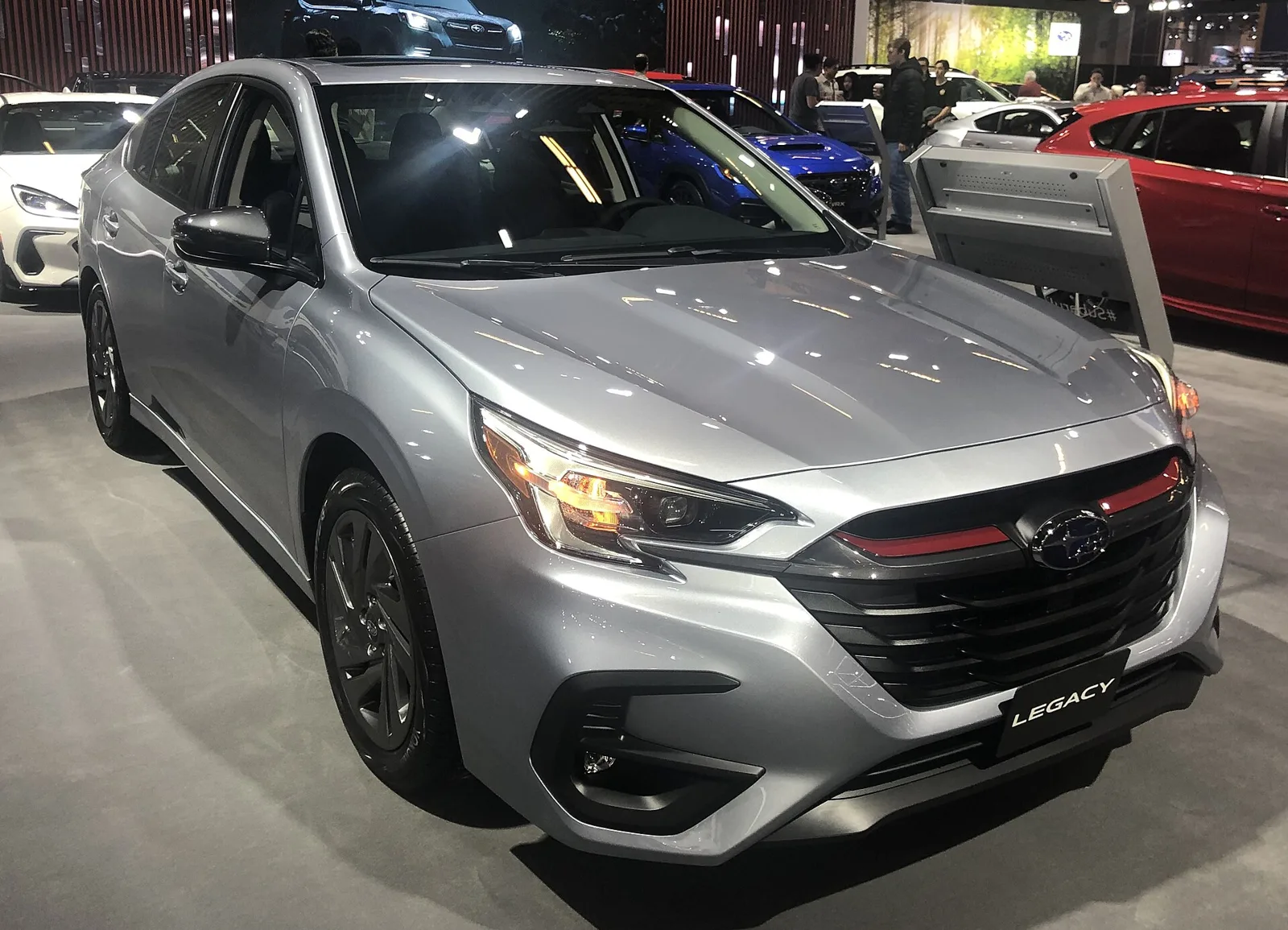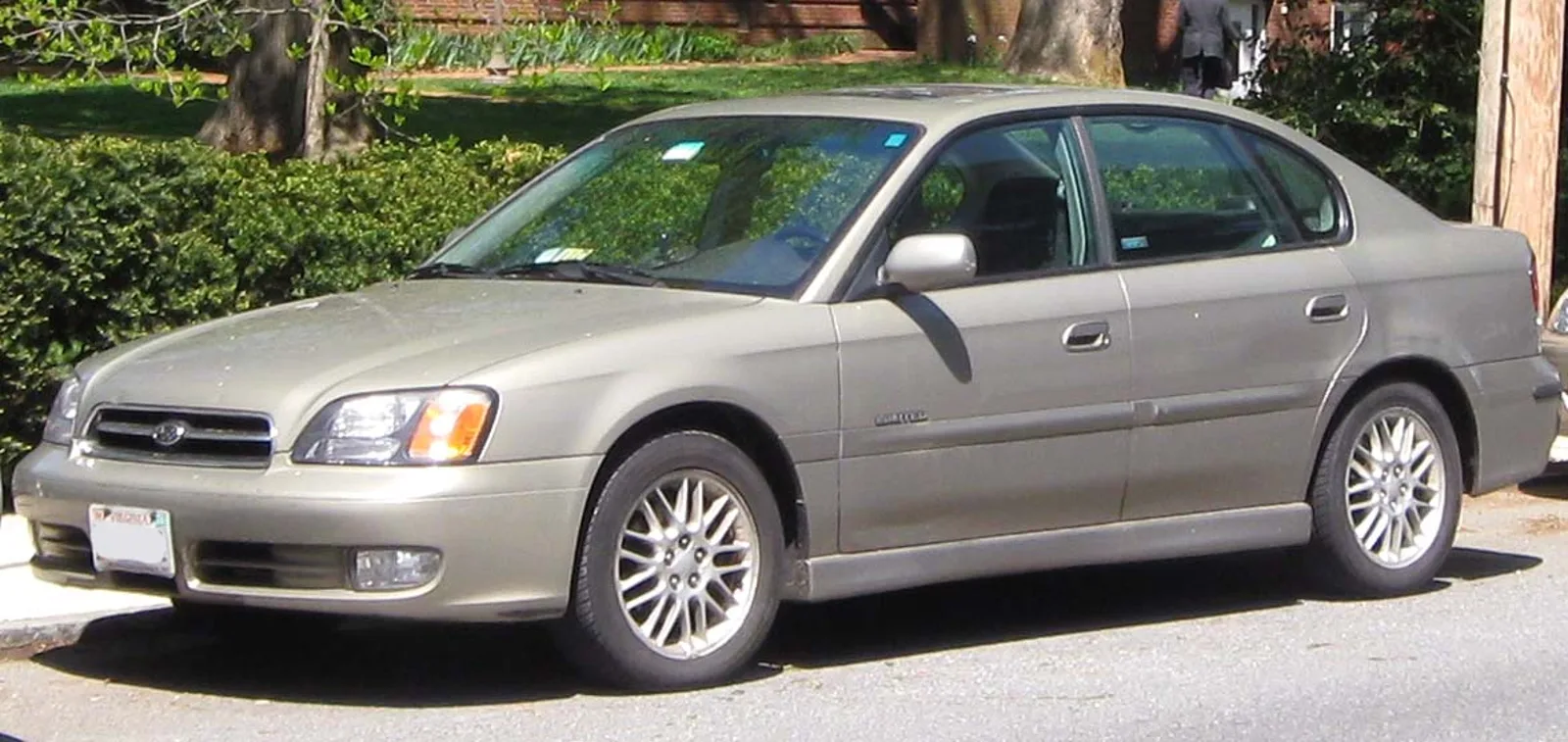
Standard all-wheel drive, a sequentially staged twin-turbo boxer and a sedan and wagon range that ran from 1998 to 2004.
The third generation Subaru Legacy was a mid-sized sedan and wagon sold from 1998. Standard all-wheel drive came with every model, and the flagship B4 used a sequentially staged twin-turbo boxer until the US range ended in 2004. Its symmetrical drive and boxer four set it apart in its class.
The third generation Subaru Legacy arrived in June 1998 with standard symmetrical all-wheel drive across a sedan and wagon range. The engine that defined the era was the B4's twin-turbo 2.0-litre boxer four, which staged its boost between two turbochargers. Production outside the United States stopped in 2002, while US cars were built until 2004.
When was the third generation Subaru Legacy launched?
Subaru introduced the third generation Legacy for Japan and other world markets in June 1998. The North American version followed in May 1999 as a 2000 model year car. Production outside the United States ended in 2002, and US production ran through 2004.
At its introduction in 1999, the Legacy also won the Car of the Year award in Japan from the Automotive Researchers' and Journalists' Conference.
A limited-production Blitzen reached Japanese buyers partway through the cycle as a 2003 model, and it is covered later in this guide.
A boxer four with two staged turbos, standard all-wheel drive and a chassis tuned on the Nurburgring defined the third generation Legacy.
How did the B4 turbo engine work?
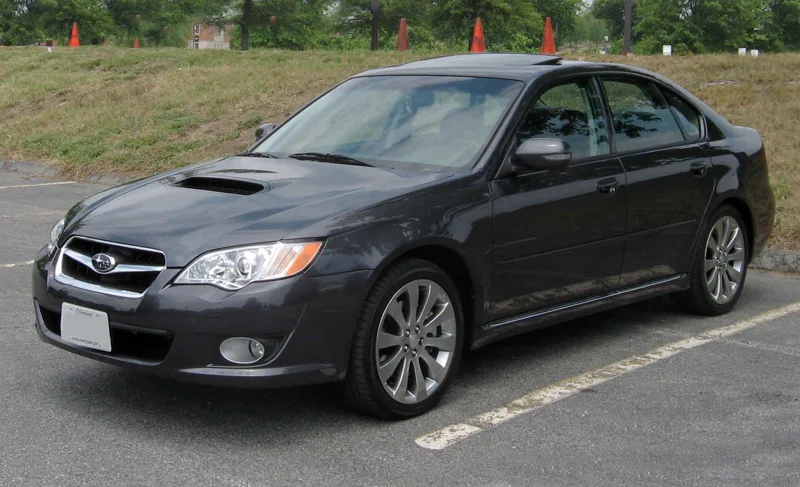
The B4 used an all-alloy DOHC 16-valve intercooled 2.0-litre boxer four with two turbochargers. Its primary turbo covered low engine speeds, and the secondary joined above 4000-4500 rpm to widen the torque band. Maximum power was 190 kW (255 hp) at 6000 rpm.
Subaru explained the boxer layout as a balance choice. Horizontally opposed cylinders balance the crankshaft, so no balance shafts were needed, which cut noise, vibration and power loss. The crankshaft ran on 5 main bearings, and the low, wide block lowered the centre of gravity.
The compression ratio was raised to 9.0:1, against 8.0:1 for the Impreza WRX, which improved torque off boost.
Sequential turbo staging
The primary turbo worked alone at low speeds and light load, with an ECU-controlled solenoid and internal wastegate holding boost. Between 4000-4500 rpm an exhaust control valve opened gradually to bring the secondary turbo up to speed, governed by a differential pressure sensor.
Once the transition ended, an intake control valve opened and let the secondary's boost reach the intercooler alongside the primary's output. Primary torque peaked at 278 Nm (205 lb ft) at 2000 rpm, and combined boost pushed torque to 320 Nm (236 lb ft) at 4800 rpm.
Subaru acknowledged the staging was not perfectly smooth. Its own torque curve shows a small dip in acceleration between the two phases, although careful turbo sizing removed most of the step.
Why did all-wheel drive matter so much?
Symmetrical all-wheel drive came as standard on every Legacy, which made it the only vehicle in its class to offer that as a standard feature. The centre viscous coupling apportions torque 50:50, but the static straight-line split sat at 60:40 front to rear.
The coupling senses the speed difference between the axles and sends torque to the end with more grip. A rear viscous limited-slip differential was added to improve stability at high speed and traction when cornering slowly.
Because real torque distribution depends on load and tyre grip, the actual split changes as the car moves. On ice and snow, the Japanese automatic offered a trick of its own: moving the selector down to the second position made the car pull away in second gear.
What changed in the D-Type revision?
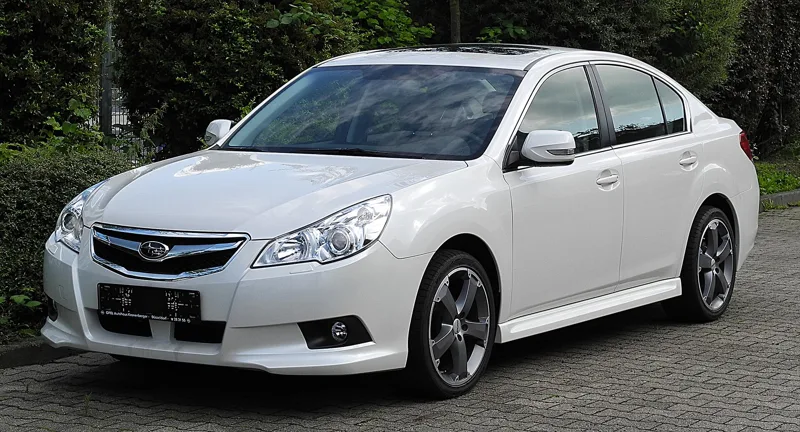
The D-Type arrived in 2001 as the fourth update to this generation. Its grille and headlights were redesigned, the bumper changed around them, and the bonnet became a lighter aluminium alloy. The ECU could also be tuned by Subaru or third-party workshops.
Headlights from earlier revisions no longer fit, and Japanese cars kept HID bulbs with a dashboard switch to aim them. Compression and timing were changed to soften the loss of boost during the switch between the two turbos.
Optional extras included a new body kit, headlight surrounds and four-pot brakes, and the stock wheels were designed to accept the larger brakes. Of all the Legacy revisions, the D-Type comes closest to the sequential twin-turbo character of the STI.
How did the B4 chassis and brakes perform?
The B4 used MacPherson struts at the front and a multi-link rear. A performance rod braced the front crossmember, which raised side-axis rigidity by 500 percent and longitudinal rigidity by 50 percent. Brakes were ventilated discs at both ends, with the front pair the larger of the two.
The inverted struts had larger damping tubes and bigger pistons, which reduced damping fade. Springs were offset so their centreline matched the pivot axis, which cut bump friction. The initial settings were devised in Japan and then tuned on the Nurburgring, with the aim of at least matching the BMW M3.
The brakes used twin-pot calipers at the front and single-pot calipers at the rear, with a larger vacuum-assisted booster that eased pedal effort. Front and rear pressure control valves balanced braking force to suit the weight distribution.
The standard ABS was a Bosch 5.3i system made under licence by Nippon ABS. It used four channels and three phases, with the rear wheels controlled together through a select-low method.
Security combined a remote key with an immobiliser transponder read by an antenna around the ignition barrel. Subaru Australia added a four-digit keypad, which guarded six points of immobilisation. The audio was tuned by McIntosh, which spent 12 months in Japan adjusting a system for the B4's acoustics.
What was the automatic transmission like?
The four-speed automatic could be told to start in second gear on slippery surfaces, which helped on ice and snow. It shared torque 50-50 across the axles, so neither end carried the whole load. Pressing the accelerator quickly held a gear up to 5000 rpm, and an over-rev rule shifted up at 6500 rpm.
Japanese versions with the twin-turbo engine also offered a Sportshift manumatic mode, letting the driver shift like a manual by pushing the selector to the side. That made the automatic a practical choice for buyers who wanted all-wheel drive without a clutch pedal.
How did Australian B4 models differ?
Australian cars were sold as the Liberty B4 and were detuned to run on 98 RON fuel. Manual cars made 258 PS (190 kW; 254 hp), and automatics 239 PS (176 kW; 236 hp). Acceleration to 0-60 mph took 5.6 seconds with the manual and 6.6 seconds with the automatic.
Every Australian B4 came with a 5-speed manual, paired with a 230 mm single-plate clutch whose higher torque capacity suited the engine's output.
How was the Legacy received?
The Legacy's most notable early honour came in Japan, where it won the 1999 Car of the Year award at its introduction. Japanese size legislation rewarded smaller engines with lower tax, so the 2.0-litre B4 gave buyers strong performance without the heavier bill that larger engines attracted.
Its engineering set it apart too, because the boxer layout, sequential turbos and standard all-wheel drive were rare in its class.
What trims were sold in North America and Japan?
North American trims ran from the Brighton, the 2000 entry model in the United States, through the L and GT to the GT Limited. Japan had a broader ladder, from the TX and 250T up to the twin-turbo GT and RSK.
The L was the lowest trim for most of the generation. From 2000 to 2002 it had unpainted plastic body moulding, and later it picked up features once reserved for the GT, including simulated interior wood trim and a CD player.
The GT added larger front brake discs, foglights, a sportier suspension and a viscous limited-slip rear differential. It kept the same 2.5-litre naturally aspirated engine as the L, while the GT Limited, sold as a sedan only, added heated seats and a factory all-weather package.
In Japan the TX used a 135 hp (101 kW) 2.0-litre lean-burn engine, and the 250T wagon had a 170 hp (130 kW) 2.5-litre DOHC unit. The GT wagon came as 265 hp (198 kW) automatic or 276 hp (206 kW) manual.
Special editions, concepts and the Baja
The Blitzen, built from 2000 to 2003, was Subaru's top-level luxury sport package. It came from a collaboration with Porsche Design, whose German group styled the wheels, body kit and interior, and it borrowed parts from the STI performance division.
The Blitzen also introduced Aisin Seiki's sequential automatic gearbox, the first sequential-shift transmission on a production Subaru. Its interior was redesigned for 2003 by Andreas Zapatinas.
The S401 was a 2002 sedan built by the STI division with a twin sequential turbo EJ208 engine and a 6-speed manual. The target was 400 units, but 286 were built, and they came with Brembo brakes and BBS alloy wheels.
The Baja was a four-door coupe utility built from 2002 to 2006 on Outback wagon mechanicals and sheet metal. It was sold in the United States, Canada and Chile, and production took place at Subaru of Indiana Automotive in Lafayette, Indiana.
The Avignon concept, shown at the 35th Tokyo Motor Show in 2001, was a cobalt blue wagon with a naturally aspirated 2.5-litre engine and clay-coloured seats.
What are the Subaru Legacy third generation specifications?
| Specification | Detail |
|---|---|
| Launch | June 1998 (Japan and world markets); May 1999 (North America) |
| Layout | Front-engined, symmetrical all-wheel drive on every model |
| Engine range | 2.0-litre turbo and naturally aspirated fours; 2.5-litre fours; 3.0-litre EZ30 H6 from 2002 |
| Australian B4 manual | 258 PS (190 kW; 254 hp); 0-97 km/h (0-60 mph) in 5.6 seconds |
| Australian B4 automatic | 239 PS (176 kW; 236 hp); 6.6 seconds to 0-60 mph |
| RSK (Japan) | 276 bhp (206 kW) manual; 265 bhp (198 kW) automatic; 5.2 seconds to 0-60 mph manual |
| Compression ratio | 9.0:1 on the B4 turbo |
| Gearbox | 5-speed manual (Australia); 4-speed automatic |
| Brakes | Ventilated discs, with the front pair the larger |
| Maximum braking | 39.4 m stopping distance from 100 km/h |
| Production end | 2002 outside the United States; 2004 in the United States |
Reading the table alongside the trim list shows how the range was divided. Naturally aspirated engines served the volume trims, while twin-turbo and performance-tuned cars were reserved for the enthusiast end of the line.