An all-new platform, a Japan Car of the Year win, the return of turbo power in North America and the limited STI S402 that topped the range.
The 2003 Subaru Legacy fourth generation brought an all-new platform, a Japan Car of the Year win for the B4 sedan and wagon, and an EJ255 turbo for North America. EyeSight arrived in 2008, and the limited STI S402 topped the Japanese line.
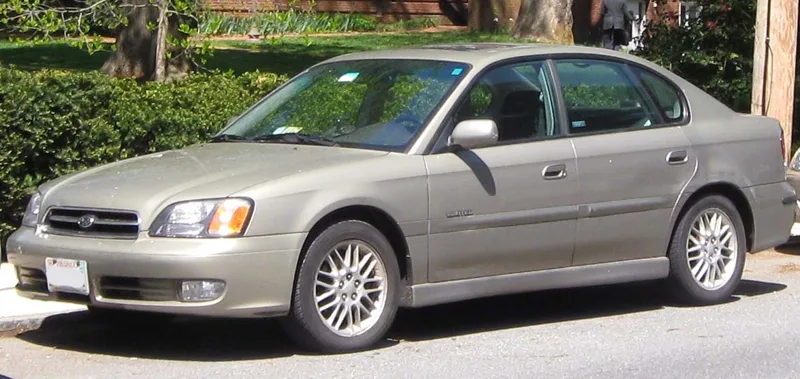
The fourth-generation Subaru Legacy arrived in 2003 on an all-new platform, after development that began in 1999. It won Japan's Car of the Year award and brought turbocharging back to the North American range. Its story runs from Japanese B4 specials and STI-tuned sports editions to the EyeSight safety system and a limited high-output S402.
What was the fourth-generation Subaru Legacy?
The fourth-generation Legacy was a complete redesign that debuted in 2003 on a new platform. Development began by early 1999, styling was frozen in early 2001, and engineering sign-off came in 2003. Japan and North America received sedan and wagon versions with different engines and trims.
The programme ran for roughly four years from first work to engineering sign-off.
An all-new platform in 2003 that won Japan's Car of the Year and brought turbo power back to North America.
What did the Japanese B4 launch involve?
Fuji Heavy Industries introduced the B4 sedan, the fourth-generation Legacy, to Japan on 23 May 2003 under the slogan Blood type: B4. The station wagon launched as Grand Touring Speciality, and the two body styles together won the 2003 to 2004 Japan Car of the Year award.
The sedan's advertising used a remixed Erik Satie piece, while the wagon's campaign used a track by Craig Armstrong, a Scottish composer, taken from his second independent album. The award was Subaru's first win in that contest, achieved by outpolling the Prius and the RX-8.
The instrument cluster was electroluminescent and glowed each time the engine turned over, whatever the state of the exterior lights.
Bruce Willis returned as a spokesman in 2005, the second time he had fronted the brand after the first generation's 1991 to 1993 campaign. His tagline was I feel LEGACY.
What engines did the home-market Legacy offer?
The base 2.0i used a SOHC EJ20 making 140 PS, while the 2.0R had a 165 PS DOHC unit. The 2.0GT turbo made 280 PS, and the 3.0R used the 250 PS six-cylinder EZ30. Trim levels also included spec.B versions of the 2.0GT and 3.0R, sold alongside the standard grades.
The turbo layout was revised as the generation matured. Better turbocharger technology and tighter emissions rules led Subaru to drop the twin-turbo setup in favour of a twin scroll turbo and AVCS, while the normally aspirated engines were revised for more power and torque.
Subaru marked 50 years of car making with a 50th Anniversary Legacy in January 2004. It was based on the 2.0R and 2.0GT.
Which special editions followed in Japan?
The Blitzen package in December 2004 added bright red paint, sports suspension and 18-inch alloys, while the WR-Limited editions of 2004 and 2005 used WR Blue Mica paint and gold wheels. The 2.0GT spec.B tuned by STI followed in August 2005.
Blitzen sat above the regular Legacy range, and each one carried B4 branding. The cars also had a unique grille and aero-style bumpers.
The WR-Limited 2004 arrived in July 2004 on the 2.0GT spec.B, and the 2005 version followed in August 2005 on the 2.0GT. Both wore gold alloy wheels, a front under spoiler and special blue and black seats.
The STI-tuned 2.0GT spec.B brought Bilstein suspension, a five-speed manual for 2005 and a six-speed from 2006, along with Brembo brakes and 18-inch STI alloys.
How did the 2006 facelift and EyeSight change the Legacy?
The Japanese Legacy got a cosmetic update in May 2006, with fresh bumpers and headlights, plus new front fenders, a grille and rear lamps, and the changes reached export models in 2007. In May 2008 Subaru introduced EyeSight, a stereo camera safety system.
EyeSight used two CCD cameras mounted either side of the mirror, judging distance through a stereo view similar to human sight. The system could help hold distance on the highway, warn of lane departure, warn the driver when traffic signals change, and detect pedestrians.
SI-Cruise was folded into EyeSight as a driver aid. The name was new, but the technology built on a system Subaru had first used in Japan in 1999 on the Lancaster, sold as the Outback, under the name Active Driving Assist.
EyeSight was offered on the Touring Wagon 2.0GT and 3.0R, the B4 3.0R and the Outback 3.0R. Every EyeSight model used the Sportshift E-5AT transmission.
What was the STI S402?
The S402 was a limited edition of 402 units for Japan, built from 2008 to 2009. Its 2.5-litre twin scroll turbo produced 285 PS, equal to 210 kW or 281 hp, peaking at 5,600 rpm, and 392 Nm (289 lb ft) of torque across 2,000 to 4,800 rpm.
The S402 came with Bilstein shocks, forged BBS wheels in 18x8-inch size wearing Bridgestone Potenza RE050A 235/40R18 tyres, and Brembo calipers with six pistons at the front and two at the rear. Vehicle Dynamic Control stability control was fitted as well.
Variable valve timing arrived, and the engine control unit was recalibrated for quicker acceleration. The S402 was offered in sedan and wagon bodies, and a special serial number plate sat in the centre console.
How did the North American Legacy differ?
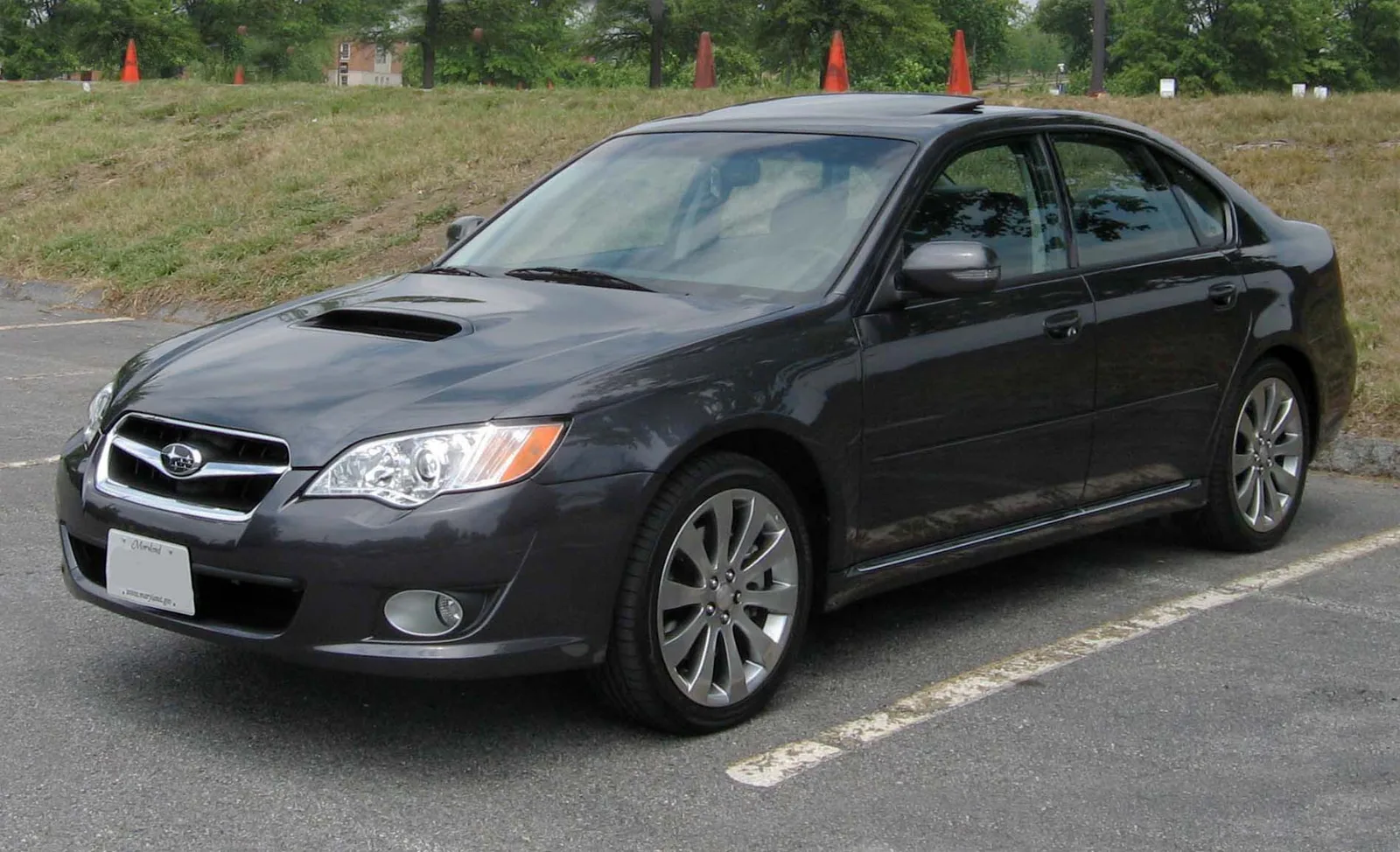
Subaru of America started making the BL sedan and BP wagon in January 2004, aimed at US and Canadian buyers. The North American range brought back turbocharging, using a 250 hp EJ255 that later won an engine award in its class.
Turbocharging returned with a new IHI VF40 single-scroll turbo, later swapped in 2007 for the VF46, which had slightly better flow and quicker spool. The EJ255 made 250 hp (186 kW) from a 2.5-litre unit derived from the US-market Impreza WRX engine, with 20 hp (15 kW) more.
Turbocharged models and the H6 engine offered Subaru's first five-speed automatic, with SportShift technology licensed from Prodrive. The suspension kept MacPherson struts at the front and a multi-link rear.
What trims and bodies did North America sell?
The 2005 Legacy was offered as a base 2.5i and 2.5GT, each with a Limited version, in sedan and wagon bodies. In 2006 the ordinary GT was dropped, and a 2.5i Special Edition joined the range. The 2.5GT spec.B came as a 500-unit special run.
The wagon shared its roof sheet metal with the Outback, which had raised humps under the roof rails, while the North American bumpers were longer to meet Canada's 5-mph specification. Those differences set the local car apart from the sleeker Japanese and European wagons.
The 2.5GT spec.B became a regular model after its limited start. It had Bilstein shocks, 18-inch alloys, Vehicle Dynamics Control and, from 2007, a six-speed manual with SI-Drive offering three modes: Intelligent, Sport and Sport Sharp.
For 2008 the sedan was refreshed with new bumpers, front fenders, tail lamps and alloy wheels, and the wagon was discontinued in the US, though Canada kept it. The 3.0R Limited gained the 3.0-litre EZ30 flat-six, which had been offered in the Outback since 2000.
For 2008 the 2.5i was certified PZEV, while other models met LEV2. The PZEV Legacy could be sold in all 50 states, unlike rivals whose PZEV cars were limited to states that had adopted California standards.
What was the European and Australian line-up?
Europe received a German-market Ecomatic Autogas Hybrid that ran on LPG, and a 2.0D diesel from March 2008. The diesel used a flat-four EE unit and came only with a five-speed manual. Australia sold the car as the Liberty BL sedan and BP wagon from 2004.
The 2.0D made its debut at Geneva in March 2008, and it appeared on both the Legacy and the Outback in sedan and wagon form.
Australian Liberty models launched with the 2.0i and 2.5i, plus the 2.0GT and the 3.0R, with the 3.0R spec.B on top. The 2.5i could be ordered with a Luxury Pack, a Safety Pack or a Premium Pack that combined both.
In 2006 the Liberty 2.0i became the 2.0R, and a Blitzen version of the 3.0R spec.B appeared with sport grille and aero bumpers. For 2007 the Liberty GT and the reworked GT spec.B both gained a larger 2.5-litre turbocharged engine, and manual and automatic gearboxes were both offered.
What were the Liberty GT tuned by STI models?
STI tuned a limited Liberty GT for 2006 to 2008, with 300 cars in the first two years and 250 in 2008. The modified EJ255 produced its 264 PS at 6,000 rpm, with 350 Nm (258 lb ft) of torque arriving at 2,800 rpm.
The 2008 car used black Brembo brakes, Enkei rims that weigh 2.5 kg (5.5 lb) less than stock units, and lower 5 mm (0.2 in) springs. It also had Bilstein shocks, a rear suspension kit, front and rear STI spoilers and leather and Alcantara front seats.
How was the Legacy's mechanical package laid out?
The Legacy used MacPherson struts up front with a multi-link rear, drive-by-wire throttle, and a centre differential on manual models. Automatic models used an electronically controlled clutch to send power to the rear wheels, and the fuel tank held 64 litres (17 US gal).
Trunk capacity was 459 litres in the wagon and 433 in the sedan, and the wagon's split-folding rear seats opened the load area to 1,628 litres. The bonnet, fifth door and steering column were made of aluminium to save weight.
Automatic models from model year 2005 had SportShift manual selection, and models from 2007 to 2009 added SI-DRIVE with three performance modes. Each mode gave the engine control unit and transmission control unit their own settings.
What awards did the Legacy win?
The Legacy B4 claimed the Japan Car of the Year title for 2003 to 2004, and the North American car won the 2005 Automobile All-Stars award for All-Star Family Car. It also took the 2005 International Car of the Year title for Most Dependable Sedan from Road and Travel magazine.
Automobile's editor-in-chief Jean Jennings said the B4 won because it could be all things to all people, combining a refined highway cruiser with a sporty back-road car. Its steering, brakes and 5-speed automatic were singled out in the same review.
The EJ255 also took an engine prize in 2006, winning the International Engine of the Year title in the 2.0 to 2.5 litre class.