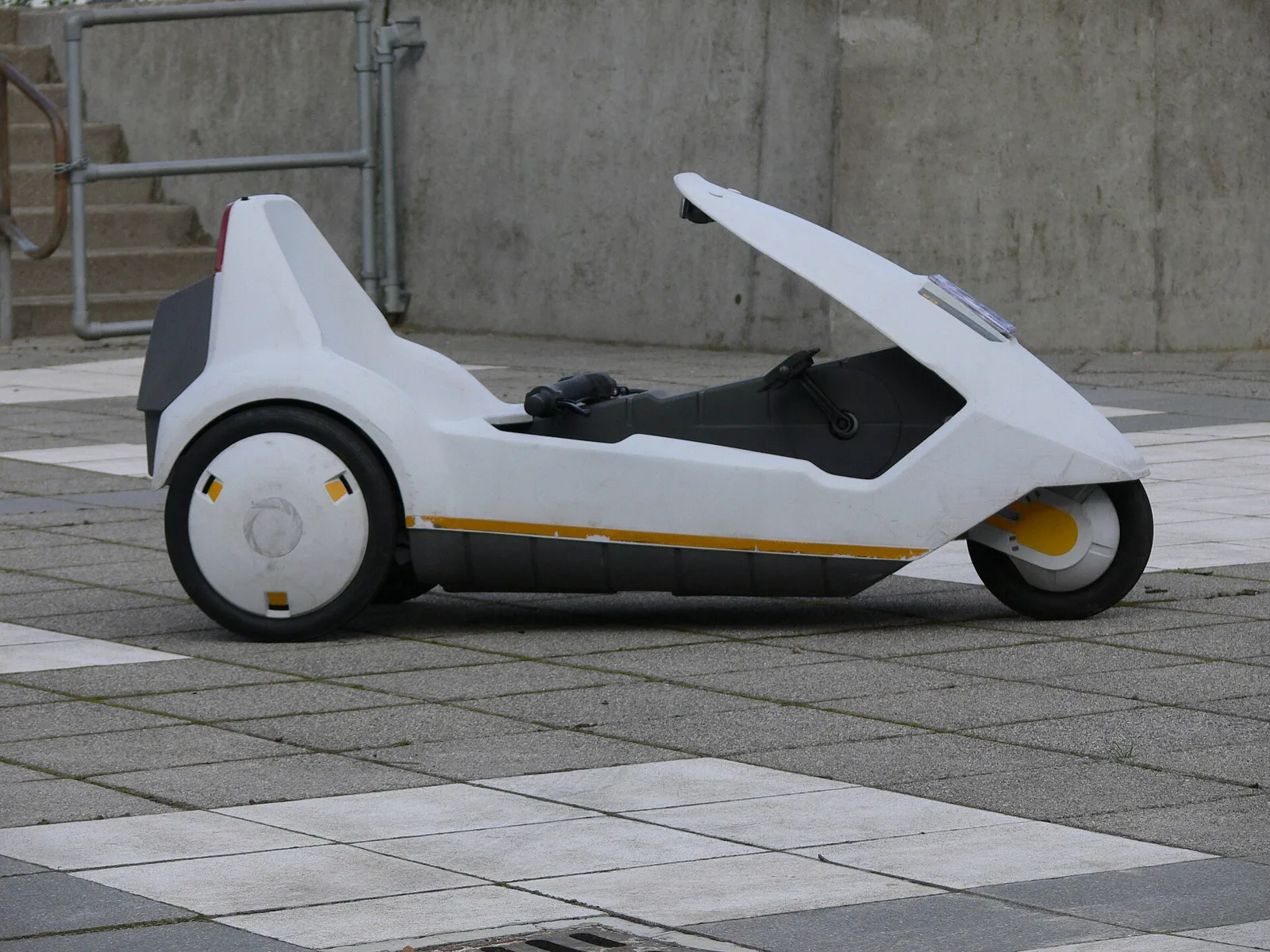
Clive Sinclair's one-rider electric vehicle reached showrooms in 1985, sold far below forecast, took its maker into receivership and became a collector's item.
Clive Sinclair's one-rider electric trike reached the market in January 1985 at GBP 399, with a 15 mph (24 km/h) cap. Sales fell well short of forecasts, the maker collapsed that October, and the machine later became a collector's item.
The Sinclair C5 was a one-rider electric trike that Clive Sinclair launched on 10 January 1985. It was sold as an electrically assisted pedal cycle and pitched as an alternative to both the car and the bicycle, but sales were so weak that its maker went into receivership within the year.
What was the Sinclair C5?
The C5 was a recumbent one-person tricycle with a polypropylene body, a 250 W motor and a top speed of 15 mph (24 km/h). Sinclair preferred to call it a vehicle rather than a car, and under the law of the day it counted as an electrically assisted pedal cycle, so no licence or helmet was needed.
Without its battery the trike scaled in at 30 kg (66 lb), and with one it reached 45 kg (99 lb). Three wheels carried it: a 317 mm (12.5 in) wheel at the front and a pair of 406 mm (16.0 in) wheels behind.
The driver sat semi-reclined in an open cockpit and steered with a handlebar that ran under the knees. The power switch and brake levers sat on the bar, and bicycle-style pedals at the front could supply power as well as, or instead of, the motor. There was no reverse gear, so going backwards meant climbing out and turning the front end around by hand.
Sinclair called it a vehicle, not a car, and the public never warmed to it.
How did the C5's motor and battery work?
A 12-volt lead-acid battery fed a 250 W motor, which drove through a two-stage gear drive that multiplied torque by 13. Without that gearing the motor could not move a rider on the level. The battery was designed to supply 35 amps for an hour, which on paper stretched to 20 miles (32 km).
The motor could draw as much as 140 amps at a stall, which would burn it out quickly. Electronics therefore cut it after 4 seconds at a full-load stall, and a sustained heavy load of 80 or 90 amps tripped it after two or three minutes. Inside the motor a heat-sensitive resistor warned of overheating, and a metal strip cut the power if the heat became excessive.
A display of green, amber and red LEDs showed the battery state, with the segments going out one after another as the charge fell. The last light meant about ten minutes of power remained, after which the rider was left to pedal. A second set of lights showed the current draw, and red meant the motor was overworked.
Sinclair launched the C5 at GBP 399, but to stay under the GBP 400 mark many items were sold as accessories. Options ran to indicator lights, mirrors, mud flaps and a horn, seat cushions, spare batteries, waterproofs and a reflective High-Vis Mast on a pole, which made the car easier to see in traffic.
Where did the C5 come from?
Clive Sinclair had earned a knighthood for the home computers his company sold in the early 1980s, and he hoped to repeat that success in electric transport. His interest in electric vehicles went back to the late 1950s, and in late 1979 he asked Tony Wood Rogers to look at a personal electric vehicle to replace the moped.
The first vehicle was called the C1, the C standing for Clive. The brief called for a top speed of 30 mph (48 km/h) and a range of at least 30 miles (48 km) from one charge, because official figures put the average daily car journey at 13 miles (21 km). The body would be injection-moulded plastic, and the target price was no more than GBP 500.
Sinclair deliberately avoided battery research and kept lead-acid technology, expecting battery makers to respond once demand grew. The market was thin: in 1978 only 45,000 electric vehicles were in daily use out of 17.6 million registered in Britain, and 90% of them were milk floats. Ogle Design of Letchworth styled the C1, but its version grew past 150 kg (330 lb), and the programme stopped in March 1983.
To fund a new company, Sinclair sold some of his shares in Sinclair Research. A GBP 12 million deal in March 1983 included GBP 8.3 million to set up Sinclair Vehicles, which Barrie Wills, a former DeLorean executive, ran as managing director. The company moved its head office to Coventry in 1984.
Why did the law change matter?
Vehicle Excise Duty had been abolished for electric vehicles in March 1980, and the government's new category of electrically assisted pedal cycle followed. Legislation passed in August 1983 exempted such vehicles from insurance and vehicle tax, and riders needed no licence or helmet. Raleigh and other bicycle makers had lobbied for the change because they wanted to sell electric bicycles.
The category came with limits that shaped the design. Top speed was capped at 15 mph (24 km/h), weight at 60 kg (130 lb) including the battery, and the motor at 250 watts. Sinclair saw the C5 as only the first in a family of more ambitious electric vehicles, yet no market research was carried out, and an advertising executive later said the project went ahead on Sir Clive's convictions alone.
How was the C5 designed and built?
Ogle Design worked on a three-wheeled body that bore a resemblance to its earlier Bond Bug. Wood Rogers insisted on handlebar steering, because a steering wheel would make it hard to get in and out. Lotus Cars was brought in during autumn 1983 to finish the detailing, build prototypes and carry the programme to production over 19 months of testing. A prototype was shown to 63 families, which was the only outside research on the car.
Gus Desbarats, a 23-year-old industrial designer, joined as the body was nearly settled. He thought the design had no instruments, no storage and no security features, and he asked for a redesign. He was given eight weeks instead of the four months he wanted. He refined the production styling and created the High-Vis Mast, because he felt uncomfortably low among other traffic.
Its body came from two moulded polypropylene shells made by three firms and joined by heated tape in about 70 seconds. One mould set could produce up to 4,000 parts a week. The motor came from Polymotor in Italy, a subsidiary of Philips, and Lotus provided the gearbox and rear axle. Oldham Batteries supplied a lead-acid battery that could manage more than 300 charge cycles.
The Welsh Development Agency approached The Hoover Company, the appliance maker, to assemble the car. Hoover built the C5 in a separate part of its washing-machine factory at Merthyr Tydfil in South Wales, with two production lines linked to the main plant by a tunnel. Each finished car was tested on a rolling stand with a mechanical arm simulating a 76 kg (170 lb) rider.
What were the C5's specifications?
The C5 was a 250 W electric trike limited to 15 mph (24 km/h) and rated for 20 miles (32 km) per charge on paper. It weighed 30 kg (66 lb) without its battery, carried 28 litres (1 cu ft) of luggage and sold for GBP 399 at launch. The table below sets out the core figures.
| Specification | Detail |
|---|---|
| Layout | One-person recumbent tricycle, open cockpit |
| Body | Polypropylene, two injection-moulded shells |
| Dimensions | Length 174.4 cm (68.7 in); width 74.4 cm (29.3 in); height 79.5 cm (31.3 in) |
| Weight | 30 kg (66 lb) without battery; 45 kg (99 lb) with battery |
| Wheels | One 317 mm (12.5 in) front; two 406 mm (16.0 in) rear |
| Motor | 250 W continuous, maximum 4,100 rpm |
| Battery | 12-volt lead-acid, 35 amps for one hour |
| Top speed | 15 mph (24 km/h) |
| Claimed range | 20 miles (32 km) |
| Gradient | 1 in 12 (8%) under power; 1 in 7 (14%) using pedals |
| Luggage | 28 litres (1 cu ft) |
| Launch price | GBP 399 |
How did the launch go?
Sinclair unveiled the car at Alexandra Palace in North London on 10 January 1985, backed by a GBP 3 million advertising campaign and sold by mail order at GBP 399. Six C5s driven by women in grey and yellow burst out of cardboard boxes, and guests were handed giveaways including hats, T-shirts and key rings.
The test drives went badly. The Sunday Times called the car a Formula One bath-chair after its demonstration model had travelled only five yards before stopping. The Guardian's car had a flat battery after seven minutes, and Stirling Moss ran out of charge on a cold, foggy London day. Your Computer found the motor could not climb even gentle slopes at the venue without help from the pedals.
Critics later questioned the timing. The Financial Times described the timing as the worst possible for a serious road vehicle, and Sinclair executives admitted privately that spring weather would have suited the car better. One account argued that the date was brought forward because development funds were running low.
Why did the C5 sell so poorly?
Reviewers and consumer groups were largely hostile. The Automobile Association found a typical range of about 10 miles (16 km), a battery that gave out after 6.5 miles (10.5 km) in cold weather and a usual speed of 12.5 mph (20.1 km/h). Its running costs compared badly with a Honda PX50 moped.
The Consumers' Association magazine Which? tested three C5s, and each of the three cars suffered a gearbox failure, and the masts snapped off. The best range on one charge was 14.2 miles (22.9 km), while a realistic figure was 5-10 miles (8-16 km). The British Safety Council, with 32,000 members, issued a critical report, and its chairman James Tye warned that 14-year-old children would be able to drive the car unlicensed and uninsured.
Production problems made matters worse. A fault in the plastic moulding on the gearbox halted the line for three weeks. When it resumed, output ran at 10% of the previous level, down from 1,000 a week to 100. Over 3,000 unsold C5s piled up at the Hoover factory, and Comet took 1,600 cars, most of which were still unsold nine months later.
The Advertising Standards Authority required changes to the C5 adverts in July 1985, because the company's claims about safety and speed could not be proved. Retailers then cut prices hard. Comet first reduced the car to GBP 259.90, and by the end of the year it was selling C5s with a full set of accessories for GBP 139.99, 65% less than the launch price.
How did Sinclair Vehicles collapse?
Hoover obtained a writ in June 1985 for more than GBP 1.5 million of unpaid debts, although it never served the writ and entered negotiations instead. Production stopped in August 1985 after 14,000 C5s had been assembled, and the Hoover line never restarted.
On 19 September 1985 Sinclair Vehicles renamed itself TPD Limited, but the business entered receivership on 15 October. The receivers said GBP 7.75 million was owed to creditors, GBP 7 million of it to Sinclair himself, who had also taken out a GBP 5 million debenture. Smaller creditors had little hope of getting back the GBP 1 million still owed, and the company was liquidated on 5 November.
Ellar (Surplus Goods) Ltd of Liverpool picked up the final stock at GBP 75 a car. Ellar marketed them as a sophisticated toy and sold nearly 7,000 at up to GBP 700 each, far more than Sinclair had managed. The approach showed that the car had a buyer base once it was sold as a novelty rather than as serious transport.
Why did the C5 fail?
Explanations have varied. The receiver John Sapte argued that the car was presented as serious transport when it should have been sold as a luxury plaything. Andrew Marks of Paisley College of Technology saw confused marketing that tried to appeal to two markets at once, and he added that mail-order sales left buyers unable to inspect the car first.
The design researcher Nigel Cross called the basic concept wrong and said the marketing research came after the concept had been decided. Gus Desbarats blamed Sinclair for working in a bubble, and for treating transport as if it were a new market like computing, when cars had far more benchmarks to measure against. The academic Stuart Cole, who works at the University of South Wales, pointed to roads and attitudes that were not geared to slower vehicles.
In 2005 Sinclair admitted the car had come too early for its time and blamed the press for piling on. He said it sat too low, which left people feeling insecure in it.
Did the C5 gain a cult following?
Yes. Collectors bought C5s as investments, and some were resold for many times their GBP 399 price. Adam Harper bought 600 from a film company in 1987 and sold all but four within two years, at up to GBP 2,500, more than six times the retail price. By 1996 a Special Edition kept in its box was valued above GBP 5,000.
Owners modified their cars well beyond anything Sinclair had planned. Harper adapted one to aim for 150 mph (240 km/h), while Adrian Bennett fitted a jet engine and Colin Furze built a monster trike with a petrol engine. In 1985 John W. Owen and Roy Harvey covered 919 miles (1479 km) between John O'Groats and Land's End in 103 hr 15 min, and Chris Crosskey once drove 103 miles (166 km) to Glastonbury.
What came after the C5?
Sinclair had planned a family of vehicles. The C10 was a two-seat city car capable of 40 mph (64 km/h), and the C15 a three-seater reaching 80 mph (130 km/h). The C15 would have used sodium sulphur batteries for more than 180 miles (290 km) of range, and its development was costed at GBP 2 million. Neither machine left the drawing board, because the batteries ran into thermal problems.
Sinclair later produced smaller electric vehicles, including the Zike in 1992. Writers kept comparing new electric cars with the C5 until the Toyota Prius, a serious and well-received vehicle, helped lay that jinx to rest. In 2017 Grant Sinclair presented an updated version called the Iris eTrike.