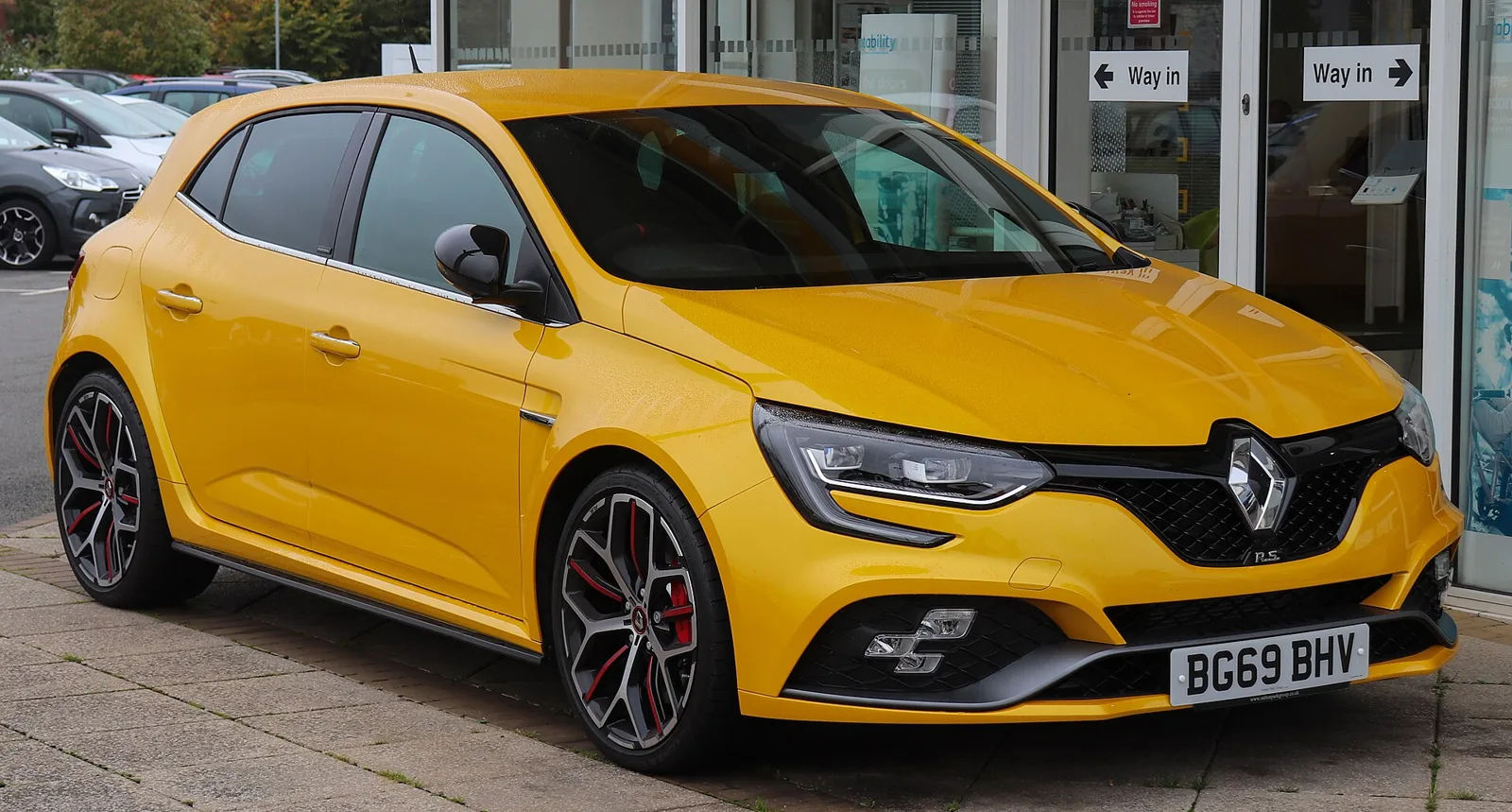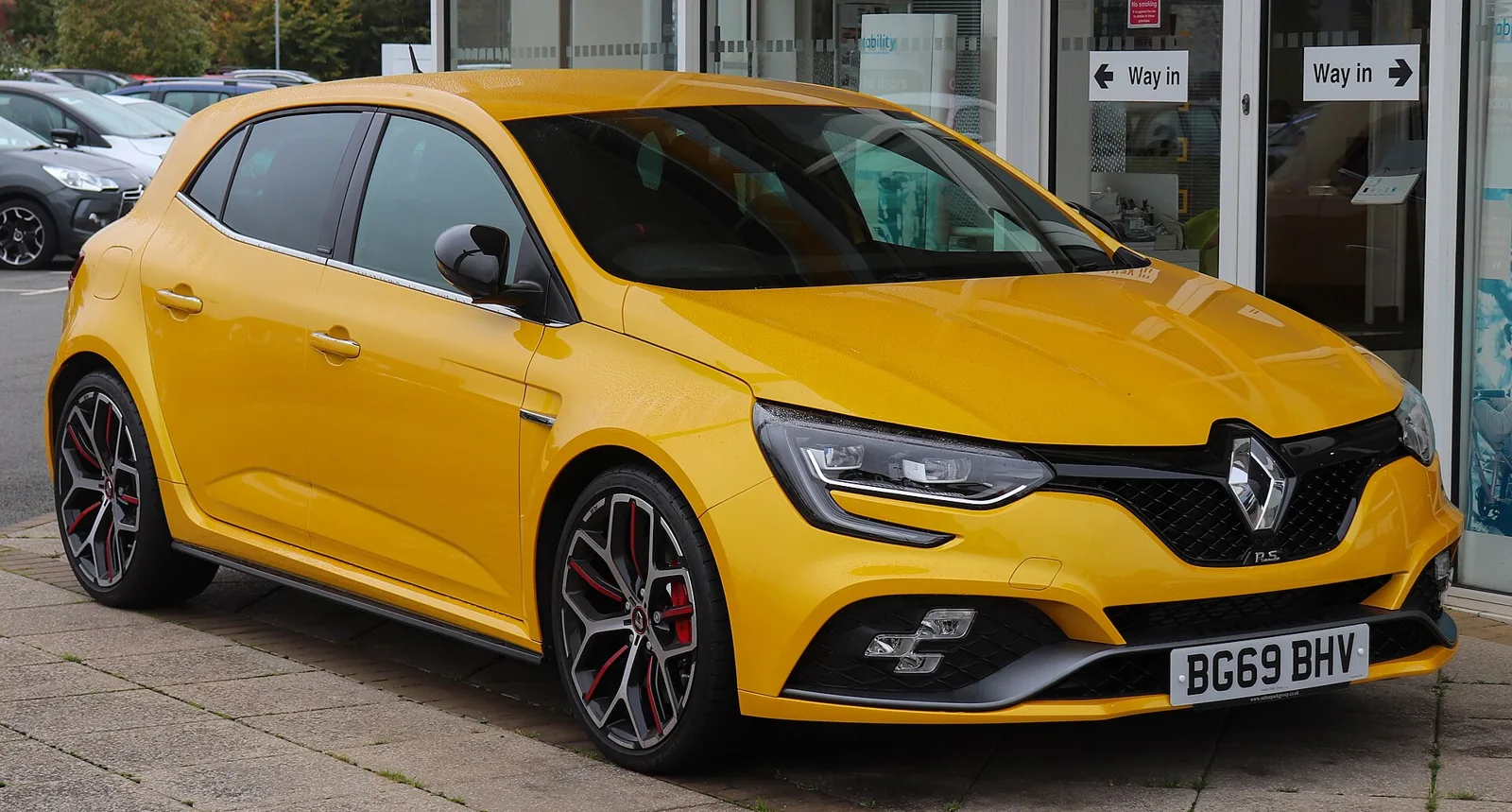
From the 225 of 2004 to the 300 Trophy, a family hatchback that collected awards, set Nurburgring times and never lost its track focus.
The Renault Megane RS is a series of high-performance hatchbacks built by Renault Sport from 2004. It started with the 225 PS Megane RS 225 and spawned Cup, Trophy and R26 editions, before a third generation arrived in 2017 with a 1.8-litre turbocharged engine.
Few hot hatches have collected awards as steadily as the Renault Megane RS. What Car? named it best hot hatch from 2010 to 2014, Evo ranked it the highest placed non-supercar in its 2011 Car of the Year test, and Top Gear gave it the same best hot hatch title. Behind those results sits a line of sharpened family hatchbacks built by Renault Sport since 2004.
What is the Renault Megane RS?
The Megane RS is the performance version of Renault's Megane hatchback, built by Renault Sport, the company's high-performance division. It began in 2004 on the Megane II, and every later generation pushed the same formula further with a turbocharged four-cylinder engine, a stiffer chassis and either a six-speed manual or a dual-clutch gearbox.
Standard equipment on the first car included eight airbags, xenon headlights with washers and Brembo brake discs, along with ABS with EBD and electronic stability control. The first cars came as three-door and five-door hatchbacks. The Cup version was also 10 kg (22 lb) lighter than the 225 Sport Hatch. Cup versions also carried drilled brake discs and red front and rear calipers. Their bodies were made from shells built in Palencia, Spain, and the cars were finished at Renault's Dieppe factory in France. The RS parts were fitted on top of that standard build, giving a Megane that behaved differently on a twisty road.
Each Megane RS rebuilt the family hatchback around one job: going fast on a road that bends.
How quick was the original Renault Sport 225?
The 2004 Renault Sport 225 used a 2.0-litre turbocharged engine with 225 PS (165 kW; 222 bhp). Renault quoted 0-100 km/h in 6.5 seconds and a maximum of roughly 240 km/h (149 mph). Ninety percent of its torque was on hand from 2,000 rpm upward, so the car pulled hard from low revs.
A twin-scroll turbocharger was chosen to limit turbo lag, and Renault claimed a combined economy of 8.8 L/100 km (32 mpg-imp; 27 mpg-US). Independent figures were less tidy. A 2004 road test by the Mexican magazine Automovil Panamericano recorded 247 hp (184 kW; 250 PS) from the same engine, a little above the factory number.
The 225 also carried double-axis strut front suspension with independent steering axis and electric power steering, the sort of hardware that a driver feels through the wheel rather than reads on a spec sheet.
What did the Renault Sport F1 Team R26 add?
The R26 was a 2006 to 2009 edition named after Renault's 2006 Formula One car. It celebrated the team's 2005 and 2006 championships with 227 hp (230 PS; 169 kW), a limited-slip differential and the Cup Chassis package. Each car carried a numbered plaque.
The R26 also used 18-inch Anthracite spoked alloys on Michelin tyres, Brembo calipers and a sport exhaust. Its kerb weight was 1,355 kg (2,987 lb). Renault built 450 vehicles, with 230 of them going to the UK, where the car went on sale in October 2008 at 22,990 pounds. The car was unveiled at the 2008 British International Motor Show.
The facelift of July 2006 had already given the RS tapered headlights, a revised grille and translucent taillights, along with new safety features. The R26 arrived on that updated body, so it was the most complete version of the first-generation design.
How light was the R26.R?
The R26.R was a 2009 edition of the R26 that lost 123 kg (271 lb) by stripping the interior. Renault dropped the rear seats, the radio and most of the soundproofing, and fitted a carbon fibre bonnet and polycarbonate tailgate. It was built for the track first and the road second. Stiffer lower arm bushes were fitted, and buyers could order optional Toyo tyres in place of the standard Michelin Pilot Sport 2s.
Renault also fitted new front and rear springs, recalibrated shock absorbers and grooved brake discs. The wheels were fitted with a different offset, which widened the track slightly. Owners could order an optional roll cage and an optional titanium exhaust.
Was there a diesel Megane RS?
The dCi 175 ran from 2007 to 2009 with a turbodiesel engine, giving buyers a way into the RS name without choosing petrol. It could be ordered with the Cup Chassis option, which brought retuned dampers, revised spring rates and a disconnectable stability system, and it was sold alongside the petrol cars rather than replacing them.
The dCi 175 is a footnote in the family history, but it shows Renault was willing to put the RS name on a diesel. That was a bolder choice than many performance brands would have made at the time, and it gave the range a second voice.
What made the 265 Trophy special?
The 265 Trophy was a limited edition unveiled in June 2011 and built to a limit of 500 units. It kept the 2.0-litre engine but raised turbo pressure from 1.15 bar to 1.35 bar, lifting output to 261 bhp (195 kW; 265 PS) and torque to 360 Nm (266 lb ft).
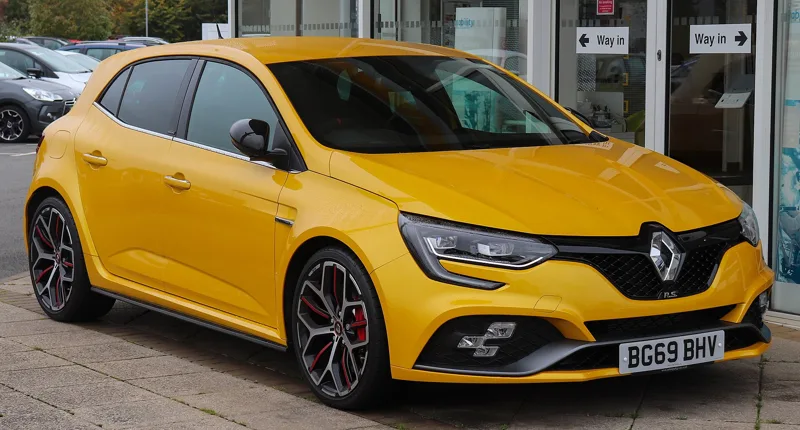
It was easy to pick out, with Trophy stickers on the doors, a new spoiler and 19-inch rims with RS centre caps. Renault offered it in a metallic yellow, with white, black and grey as the alternatives, so the car was hard to miss on a country road.
Renault later rolled the 265 into the standard range in 2012, and the same engine powered police cars after the company won a tender from the Gendarmerie National for a high-speed pursuit vehicle. The tender asked for 261 bhp, which the Trophy delivered directly.
How fast was the 265 Trophy around the Nurburgring?
The 265 Trophy lapped the Nurburgring in 8 minutes and 8 seconds, beating the R26.R's time by 9 seconds. That result moved the Megane's record on by a clear margin, and Renault later used the 2012 Trophy 8:08 edition to celebrate it.
Lap times are always open to argument, because tyres, temperature and the driver all change the number. Even so, 8:08 became the figure that enthusiasts quoted, and it remained the reference point until the next Trophy-R went out to beat it.
What changed with the Trophy-R?
The 275 Trophy-R was a 2014 to 2017 track-focused car that lost 101 kg (223 lb) and gained an Akrapovic titanium exhaust. Its output rose to 271 bhp (201 kW; 273 PS), and Renault kept the torque figure unchanged while the car got lighter.
To find the weight, Renault removed the sound deadening, the air conditioning, the stereo, the satellite navigation and the rear seats, fitting a brace where the seats had been. The front seats became Recaro fixed polycarbonate buckets trimmed in leather and Alcantara, with Sabelt race harnesses.
The final kerb weight was 1,280 kg (2,820 lb), and the combined economy was 7.5 L/100 km (38 mpg-imp; 31 mpg-US), with 174 g/km of CO2. The car also set track records at Suzuka, Fuji International Speedway and Tsukuba, which made it more than a showroom special. It rode on 19-inch Speedline Turini wheels fitted with Michelin Pilot Sport Cup 2 tyres, and its front brakes grew to a two-piece floating rotor.
What is the third-generation Megane RS?
The third generation was based on the fourth-generation Megane and was shown at the 2017 Frankfurt Motor Show. It came as the 280 Sport, the 280 Cup and the 300 Trophy, all five-door hatchbacks, and it used a 1.8-litre turbocharged four-cylinder engine that Renault shared with the Alpine A110.
Standard 4Control four-wheel steering turns the rear wheels up to 2.7 degrees opposite the front at low speed. The rear wheels swing into the same direction above 60 km/h (37 mph), and that changeover moves to 100 km/h (62 mph) in Race mode, which tightens cornering at speed.
The 300 Trophy made 300 PS (221 kW) with 420 Nm (310 lb ft) of torque, although manual cars were limited to 400 Nm (295 lb ft). A 2021 facelift brought 300 hp to the whole range and dropped the 280 Sport, leaving the Cup and Trophy as the choices.
Specifications
| Version | Years | Power | Kerb weight |
|---|---|---|---|
| Megane RS 225 | 2004-2009 | 225 PS (165 kW; 222 bhp) | Not given |
| Renault Sport F1 Team R26 | 2006-2009 | 227 hp (230 PS; 169 kW) | 1,355 kg (2,987 lb) |
| Megane RS 265 Trophy | 2011 | 261 bhp (195 kW; 265 PS) | Not given |
| Megane RS 275 Trophy-R | 2014-2017 | 271 bhp (201 kW; 273 PS) | 1,280 kg (2,820 lb) |
| Megane RS 300 Trophy | 2017-2023 | 300 PS (221 kW) | Not given |
Which race cars came from the Megane RS?
Renault Sport built the Megane Trophy for privateer teams from 2009. Its 3.5-litre V6 made 326 hp (243 kW; 331 PS), and the car weighed 980 kg (2,161 lb) dry. It raced in the Renault Eurocup, and other events included the Belgian Touring Car Series and the Dubai 24 Hour.
The earlier race Trophy used a 3.5-litre V6 at 325 hp (242 kW; 330 PS) and a Sadev six-speed sequential gearbox. The car was not road legal. The 2009 version used a composite body on a space frame chassis, keeping only a visual link to the road car.
The second-generation race car was shown at the 2008 Paris Motor Show and used in the Renault Eurocup from the 2009 season.
Which Australian special editions were built?
Australia received several special editions, including the 2011 Monaco Grand Prix Limited Edition and the 2012 Australian GP Edition, each limited to 50 units. The 2012 Trophy 8:08 was limited to 100 units and came only in Liquid Yellow or Pearl White.
The Monaco car had a panoramic roof, 19-inch wheels and red Brembo calipers. The 2014 RS Sport Limited Edition, also limited to 50 units, came in Pacific Blue with silver 18-inch alloys and a start/stop system on the 2.0-litre engine.
What did the Lux trim add?
The Lux trim added metallic paint, a hands-free card for entry, electronic folding mirrors, a tyre pressure monitor, electric windows at the front and rear, climate control and leather upholstery over the base car. Those models also took 18-inch alloy wheels as standard, and a rear spoiler was fitted to petrol models only.
The Lux models also had a CD and MP3 radio with six speakers, plus an electronic rear view mirror, so they were the more comfortable choice for longer drives.
Why did the Megane RS win over critics?
Critics liked the way the Megane RS balanced everyday use with sharp handling, and What Car? and Top Gear both gave it hot hatch titles. The car also earned the first five-star Euro NCAP rating in its segment, with six airbags and stability control fitted as standard.
The speed limiter, which can be set in the same way as cruise control, is a small detail that shows how the car was meant to be lived with. Renault's R-Link system, by contrast, drew complaints for its joystick control after the 2014 facelift, which kept the mechanical package unchanged.