Built outside France, the fifth-generation Clio pairs a digital cabin with small turbo engines, an E-Tech hybrid and a 2023 facelift.
Built since December 2018 outside France (in Turkey and Slovenia, and from the end of 2025 only in Slovenia), the Renault Clio V is Renault's fifth-generation city car. It has a digital cabin, small turbo engines, an E-Tech hybrid and a 2023 facelift, and it topped France's sales charts in 2023, 2024 and 2025.
The Renault Clio V is the fifth generation of Renault's city car, built since December 2018. It replaced the Clio IV with a new digital cabin, a family of small turbocharged petrol engines, diesel units and an E-Tech hybrid. At home it has been a hit, topping the French sales charts in three consecutive years.
The production story is less familiar to most buyers. The Clio V is the first generation of the model line whose production was moved entirely out of France. Turkey and Slovenia built it, and from the end of 2025 only Slovenia does. The Flins plant, historically one of the Clio's production sites, no longer makes it.
Where did the Clio V come from?
Renault showed the interior and instrument panel of the fifth generation on 28 January 2019, and the bodywork followed the next day. The car then appeared at the 2019 Geneva International Motor Show. Laurens van den Acker, the group's design director, used the car to launch a new styling direction for the brand.
The programme carried the internal code BJA. Its design brief pushed the brand towards less rounded forms and a plainer, more direct line, and the Clio V was the car that put that direction on the road.
A Japanese version followed in November 2020 under the name Renault Lutecia, fitted with the seven-speed EDC automatic. Its engine was the 1.3-litre TCe, rated at 130 PS (96 kW; 128 hp).
A city car that moved all its production out of France and still topped the French sales charts.
How was the Clio V styled?
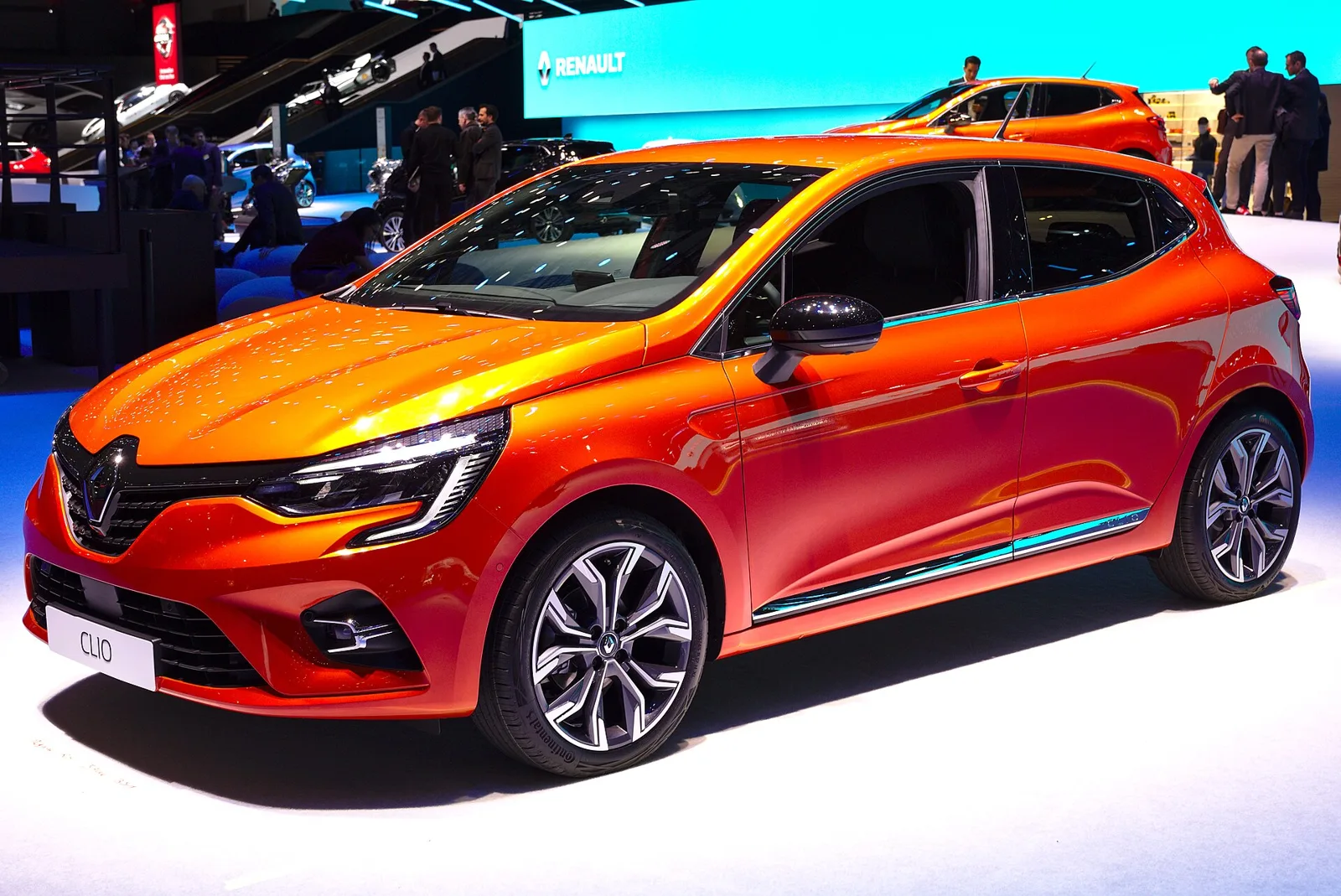
The Clio V looks very close to its predecessor, so much so that it could pass for a facelift of the fourth generation. Its side profile echoes the Clio IV and gets close to the Megane IV. Designers aimed to give the Renault range fresh energy while keeping the car in step with the Clio, which is why the profile barely moves even though every body panel is new.
Lighting carries much of the new identity. Full LED headlights are standard on every trim, sitting beside C-shaped daytime lights like those of the Megane. The pointed rear lights repeat the C-shape, which ties the rear of the car to its front.
The side view has its own details. The glass behind the rear doors has gone, leaving no side window there, and the thinner side trim strip now carries the CLIO monogram. Pierre Sabas designed the exterior and Magali Gouraud the interior. The window surrounds are fully chromed on the Intens trim, which was renamed Techno in 2022, and the centre door pillars are lacquered.
What is inside the Clio V?
The digital instrument cluster uses an 18 cm TFT screen as standard, apart from the base version, and top trims step up to 25 cm. The driver-facing multimedia tablet measures 18 cm on entry-level cars, while the best-equipped cars get a 24 cm unit running the Easy Link system.
Renault calls the whole digital cabin Smart Cockpit. Below the tablet, piano-style keys open the various menus, while the heating and ventilation controls stay on physical rotary switches. On the higher versions those switches carry a small digital readout in their centre.
The Start/Stop button has moved onto the dashboard, sitting between the tablet and the instrument cluster.
Which engines did the Clio V offer?
The petrol range started with a 1.0-litre three-cylinder TCe with 100 PS (74 kW; 99 hp) and a 1.3-litre four-cylinder unit at 130 PS (96 kW; 128 hp). Diesel came from a 1.5-litre Blue dCi with 85 PS (63 kW; 84 hp) or 115 PS (85 kW; 113 hp).
The 1.0-litre SCe three-cylinder came from the outgoing car, in 65 PS (48 kW; 64 hp) guise or with 75 PS (55 kW; 74 hp), so the entry end of the range kept its older unit. Taken together, the petrol choices spanned a wide range of outputs, from the 65 PS entry unit to the 130 PS four-cylinder. Changes followed as the car matured. From February 2020 the TCe 100 could be specified with a CVT gearbox or as an LPG version.
In 2021 the TCe 100 was reduced to 90 PS (66 kW; 89 hp), paired with a six-speed manual where the earlier car had five ratios, and it gained a particulate filter to meet tougher anti-pollution rules. Diesel output halted in December 2020, returning in mid-2021 with a Euro 6d Full unit of 100 PS (74 kW; 99 hp) that needs AdBlue. Weak sales led Renault to drop the 1.3 TCe 130 and 140 in 2023.
What is the E-Tech hybrid?
The E-Tech Hybrid arrived in January 2020. A 1.6-litre H4M engine of 91 PS (67 kW; 90 hp) runs on the Atkinson cycle, and it reaches a combined 140 PS (103 kW; 138 hp) once the electric side joins in.
A 1.2 kWh lithium-ion battery stores energy recovered during braking or generated by the engine, and it allows 3 to 4 km of all-electric driving. A starter-alternator of 20 PS (15 kW; 20 hp) and an electric motor of 48 PS (35 kW; 47 hp) are the two extra elements. The starter-alternator is wired straight to the combustion engine, where it can start it, assist it or generate electricity.
The main motor-generator sits at the far end of the gearbox. The gearbox is a robotised dog-clutch unit that Renault calls Locobox internally, and it is specific to the brand's hybrids. Its 4+2 gears plus neutrals give 15 possible combinations. The main motor-generator can be disconnected when the small starter-alternator is enough to save energy, or the engine can turn it to top up the battery while the car is stationary. A 2022 update to electric power management added 5 PS (4 kW; 5 hp).
What did the 2023 facelift change?
The facelifted Clio was presented on 18 April 2023 and went on sale on 17 July 2023. It gained a new front end in the new Renault style, while keeping the phase 1 engines, including the hybrid unit and the diesel, along with the SCe 65, TCe 90 and TCe 100 three-cylinder units.
The new front end, which introduces the new Renault style, is the facelift's headline change.
The facelifted version also became the basis for a close relative, the seventh-generation Mitsubishi Colt, which is a clone of the facelifted car.
The later chapter came at the end of 2025, when the sixth-generation Clio replaced the fifth at the Oyak-Renault plant in Turkey and the Colt built on that site stopped at the same time. The fifth generation kept being built at Novo Mesto in Slovenia, now its only production site.
How well did the Clio V sell?
The Clio V topped France's sales charts in 2023, 2024 and 2025. Worldwide the picture was less rosy. In the first nine months of 2022 the Dacia Sandero outsold both the Clio and the Captur, and the Clio finished third with 135,002 units sold.
The Clio had led the Renault group's sales worldwide for years, so its third place in 2022 stands out against that record. Renault set five trim levels at April 2019 prices. The Initiale Paris version left the line-up in June 2021, and in February 2022 the trim levels were renamed as part of a range overhaul.
A May 2022 price rise added 250 euros to the hybrid and 550 euros to the other versions. Special editions kept the range fresh. The First Edition, based on Intens, brought LED fog lamps, a rear camera, darkened rear glass and a 24 cm display. Others included Cool Chic, the Team Rugby edition with 1,300 examples, a Limited edition from March 2021 and a Lutecia edition from September 2021.
Was there a competition Clio V?
Renault presented three competition versions of the Clio V at the French Formula One Grand Prix: a Cup car for circuit racing, a Rally model and a rallycross car. All were developed from the Clio R.S. Line, and their 1.3-litre TCe engine was boosted to 170 PS (125 kW; 168 hp), or 180 PS (132 kW; 178 hp).
Torque sat between 280 and 320 N m (207 to 236 lb ft) across the family. Renault Sport Racing developed the customer cars, which were assembled at Dieppe. They used a limited-slip differential of ZF type, plus a sequential gearbox with five ratios.
Customers were not limited to a single discipline, since the conversion kit covered circuit, rally and rallycross entries alike. The Cup version can be entered in the one-make Clio Cup series.
For road buyers the competition cars matter less than the engine line-up, but they show what the family could do. The 1.3-litre TCe that powers the Cup, Rally and rallycross cars belongs to the same engine type as the road car's 130 PS unit, here tuned to 170 PS or 180 PS for competition work.
How did the Clio V compare with the Clio IV?
Against the Clio IV, length drops by 12 mm, height by 11 mm, while width grows by 7 mm. Boot capacity rises to 391 dm3, and the drag coefficient, SCx, is 0.64 m2, which ranks among the lowest in its segment. The car rides on the CMF-B platform, a modular architecture with a high-spec variant that the Renault-Nissan alliance uses for its compact cars.
Those dimensions are small changes on paper, but they add up. The wider body and lower roof sit alongside a larger boot and a cabin that leans on digital displays. The Clio V is therefore close to its predecessor on the outside, while its cabin and boot mark a clear step on the inside.
Clio V specifications
| Specification | Detail |
|---|---|
| Type | City car |
| Built | From December 2018 |
| Internal code | BJA |
| Platform | CMF-B high spec, Renault-Nissan alliance |
| Boot | 391 dm3 |
| Drag coefficient | SCx 0.64 m2 |
| Petrol engines | 1.0 TCe 100 PS (74 kW; 99 hp); 1.3 TCe 130 PS (96 kW; 128 hp); 1.0 SCe 65 or 75 PS (48 or 55 kW; 64 or 74 hp) |
| Diesel engine | 1.5 Blue dCi, 85 PS (63 kW; 84 hp) or 115 PS (85 kW; 113 hp) |
| E-Tech hybrid | 140 PS (103 kW; 138 hp) combined, 1.2 kWh battery |
| Competition | 1.3 TCe 170 PS (125 kW; 168 hp) or 180 PS (132 kW; 178 hp); 280 to 320 N m (207 to 236 lb ft) |