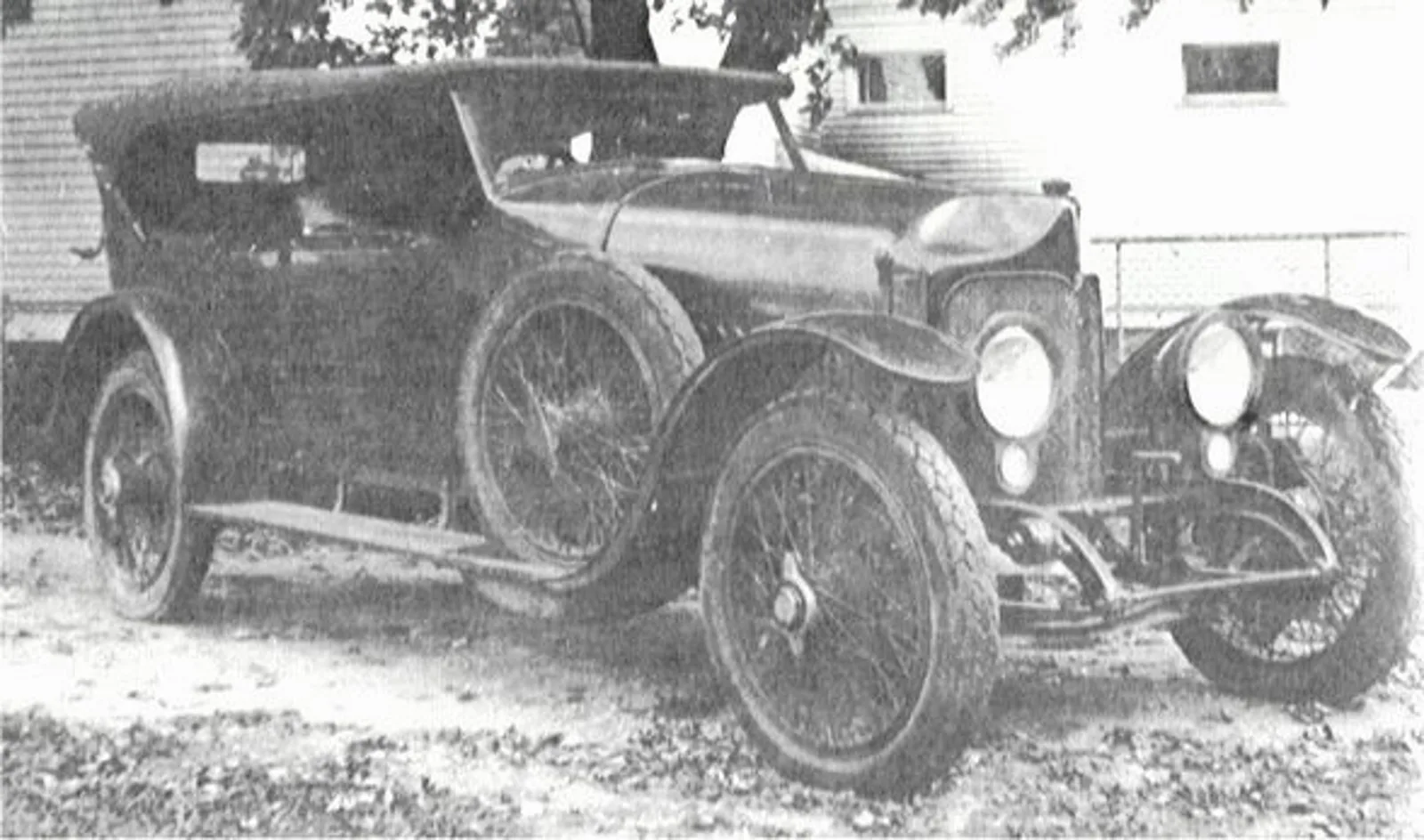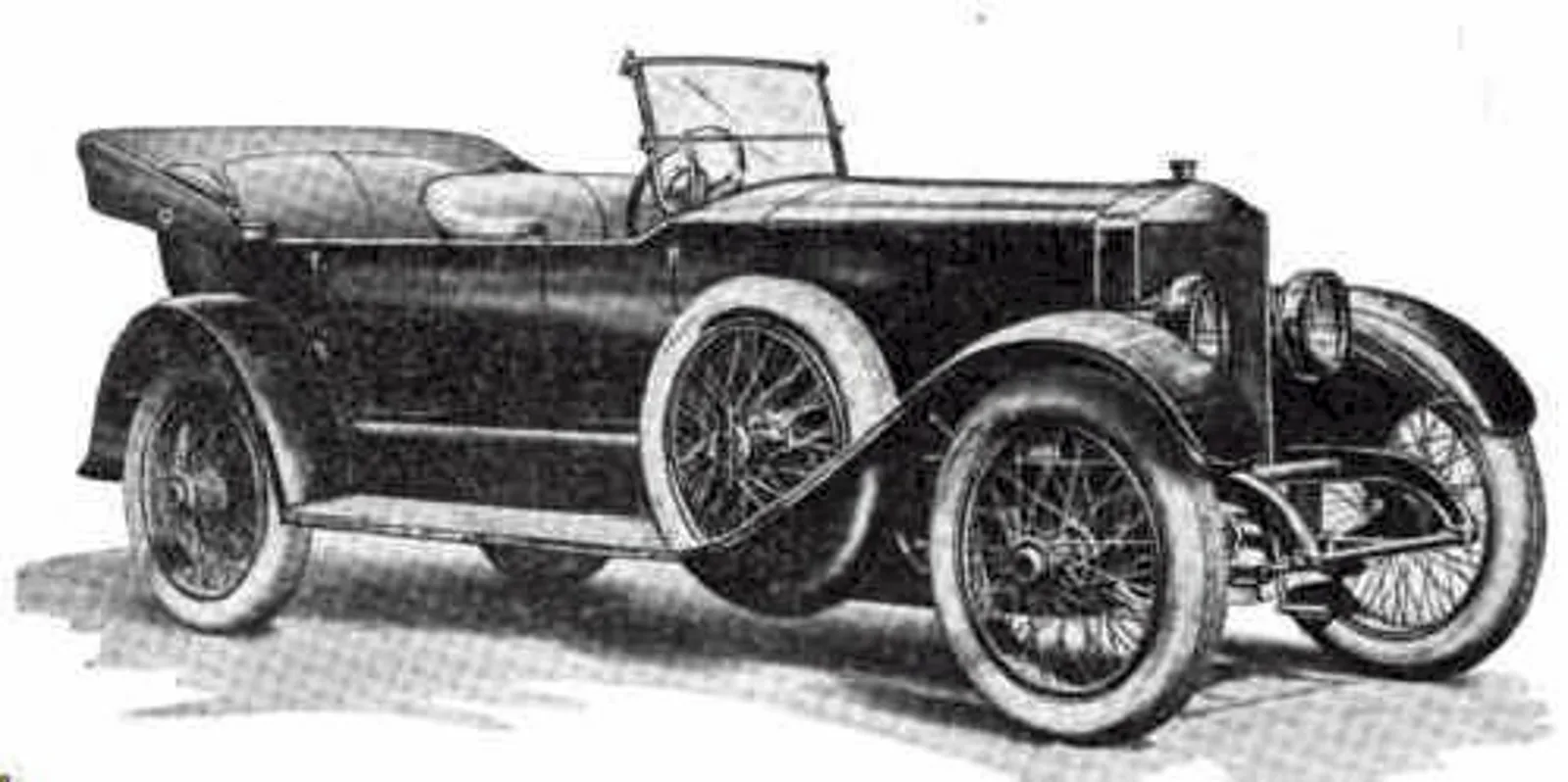
A top-price American car built from the F.R.P. design between 1919 and 1922, with an aluminium four-cylinder engine and a short, difficult life.
The Porter Model 45 and Model 46 were American cars built from 1919 to 1922 by the American & British Manufacturing Corporation. Their engine came from the earlier F.R.P. Model 45, a lightweight four-cylinder with overhead valves and aluminium construction. Counts range from 34 to 40 examples.
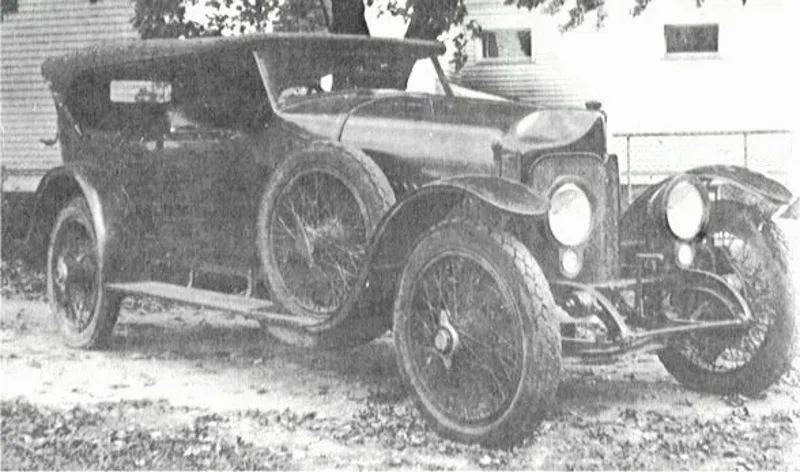
The Porter Model 45 was a top-price American car descended from a design Finley Robertson Porter had created as the F.R.P. Model 45. Between 1919 and 1922 the American & British Manufacturing Corporation sold it as a prestige car on a 142 in (3607 mm) chassis, powered by a 125 bhp four-cylinder. Only a few dozen were made, and no Porter seems to survive today.
Where did the Porter come from?
The Porter began as the F.R.P. Model 45, a top-class sports car built by a firm Finley Robertson Porter set up himself. That firm was short-lived: the US government bought it in 1916 and turned the works to war production. Only a small number of its cars could be made.
Porter had quit Mercer, where he ran the racing team, after a dispute over where the company's engineering should head. In 1914 he founded his own firm at Port Jefferson on Long Island, and he pursued the lightweight construction methods of the era with real rigour.
His reputation rested on earlier work. At Mercer he was responsible for the Type 35 Raceabout, which is likely to have been the era's most successful sports-racer, even though he never took a formal engineering degree.
The First World War changed his path. Porter worked as a test engineer on the team in Dayton, Ohio, that developed the Liberty aircraft engine. After his firm was wound up in 1918, he designed for Curtiss in Garden City, New York, and had no wish to return to motor cars.
Built for barely three years, the Porter carried one of the stronger American engines of its day.
How did the A&BMC come to build the Porter?
Nobody has recorded how the deal with the A&BMC was struck or on what terms. The likeliest explanation is that the Bridgeport firm acquired the design rights and the leftover parts of the F.R.P. and ran production itself. Robert B. Porter, Finley's son, became chief engineer.
A&BMC was an engineering company that made machinery, engines and armaments, including steam engines and guns. From 1905 it owned the Corliss Steam Engine Company, a well-regarded maker of beam engines built on the principle George Henry Corliss had developed. Between 1914 and 1922 the firm also made commercial vehicles, mainly technically interesting front-axle units with petrol-electric drive, which were sold as A & B and American & British.
For sales, the New York motor dealer Morton W. Smith Company was brought in.
What did the Porter's engine look like?
The engine the Porter took over from the F.R.P. was a large water-cooled four-cylinder with overhead valves, a one-piece aluminium block and hollow or drilled moving parts to save weight. It weighed about 260 kg (580 lb), and the camshaft was driven from the front of the crankshaft by a vertical shaft with a worm drive.
Each cylinder carried one inlet and one exhaust valve, worked by rocker arms. When shut, the valves enclosed a hemispherical chamber. The crankshaft was made of chrome-vanadium steel and ran in three bearings. Oil was supplied by a pump, with splash lubrication alongside it.
The F.R.P. version used a centrifugal water pump, and a Zenith carburettor prepared the mixture. The Porter engine came over from the F.R.P. design, and in 1919 it was still among the most potent car engines made in America.
How much power did the Porter make?
The Porter is put at 125 bhp (93.2 kW), while the F.R.P. is credited with 100 bhp (74.5 kW) One account says the output was raised further, but none of the material explains how.
Porter had drawn up a four-valve cylinder head for the F.R.P., but that version seems never to have been used. Whether the Porter ever received one remains unclear. A report in The Motor Age dated 31 March 1917, cited by The Old Motor, referred to a four-valve head being developed, but that report is not available and no such engine can be proven.
What was the bore and displacement?
Figures disagree on the bore and therefore the capacity. Most put it at 4.6 in (116.84 mm) by 6.75 in (171.45 mm), which yields 448.7 cu in (7353 cc). A bore of 4 5/8 in, or 4.625 in (117.475 mm), gives 453.6 cu in (7433 cc), a number several accounts also quote.
Neither figure can be verified directly. The N.A.C.C. rating, worked out from bore and cylinder count, is listed at 33.86 hp. For a 4 1/2 in bore the calculation table gives 32.40 hp, while a 4.625 in bore produces 34.23 hp, so the recorded rating sits between the two.
How was the Porter's chassis built?
The chassis was a solid conventional ladder frame. Both ends carried rigid axles, and semi-elliptic leaf springs sat at the back. The rear axle was full floating, so the half-shafts carried no side loads. The car was designed with right-hand drive and a four-speed manual gearbox.
The chassis is also said to be made of chrome-vanadium steel, an alloy of the kind Childe Harold Wills, Henry Ford's metallurgist, had developed for the Model T. The gearbox had a direct top gear, and a single-plate cone clutch sent power through a propeller shaft to a bevel-gear differential.
A foot brake acts on drums at the back axle, and the handbrake lever operates a second drum at the gearbox. Planned wheels measured 35 x 5 inches, and demountable rims were the norm in this price class.
Bodywork and coachbuilders
The long chassis suited prestige coachwork, and Brewster, Demarest and Fleetwood are all known to have bodied it. Holbrook made factory bodies, as it had for the F.R.P., one of them a speedster. The Blue Ribbon Body Company of Bridgeport built the largest share of Porters, twelve in all.
The body design was updated with a more severe outline, and the radiator shape now brought Rolls-Royce to mind.
How many Porters were built?
Nobody has an exact count. Estimates for the Porter run from 34 to 40 cars built between 1919 and 1922, and for the F.R.P. from 3 to 12, with the Seal Cove Museum giving nine. Material for ten F.R.P. cars was bought.
The F.R.P. figures are easy to explain: almost every component was produced in the works, and output stopped after the government takeover. Porter's small run had other causes, including a poor reading of the market, a difficult economy and a design that was no longer new as high-priced fours fell from favour.
Makers that used similarly exotic engines, such as Duesenberg walking-beam and Rochester-Duesenberg four-cylinders, shared the same fate. Among them were Argonne, Biddle, Kenworthy and Meteor, along with Revere, Richelieu and Roamer.
Racing history: the Porter-Knight cars
The Porter-Knight was a racer with a sleeve-valve engine. Its short development time and scarce resources suggest a technical kinship with the F.R.P., and three examples were built.
Each of the three started the 500 Miles at Indianapolis in 1915, and none of them finished. The car was judged a rather unsuccessful racer.
Comparable models of the period
| Model | Maker active | Maker | Engine | Capacity | Power |
|---|---|---|---|---|---|
| Argonne Model D | 1919-1920 | Argonne Motor Car Company, Jersey City | G-3 | 4.9 litres | 71 bhp |
| Kenworthy 4-80 | 1920-1921 | Kenworthy Motors Corporation, Mishawaka | G-3 | 4.9 litres | 71 bhp |
| Mercury Model H | 1920-1921 | Mercury Motor Car Company, Cleveland | G-3 | 4.9 litres | 71 bhp |
| Meteor Series K | 1919-1922 | Meteor Motors, Philadelphia | G-3 | 4.9 litres | 71 bhp |
| Meteor Series R | 1919-1922 | Meteor Motors, Philadelphia | G-1 | 5.6 litres | 81 bhp |
| Premocar 4-80 | - | Preston Motors Corporation, Birmingham, Alabama | G-3 | 4.9 litres | 71 bhp |
| Revere Model A | - | Revere Motor Company, Logansport, Indiana | G-1 | 5.6 litres | 81 bhp |
| Roamer D4-75 | 1916-1929 | Roamer Motor Car Company | G-1 | 5.6 litres | 81 bhp |
Most of these makers used Rochester-Duesenberg four-cylinder engines, in two sizes: the G-3 at 4.9 litres and the G-1 at 5.6 litres.
Is any Porter Model 45 still around?
Apparently none of the Porters survives. The F.R.P. is another matter: a Series B of 1915 was bought in October 1975, restored by 1977, and is now held by the Seal Cove Auto Museum on Maine's Mount Desert Island.
For years people assumed that no F.R.P. had survived, a belief that fed a legend around the strongest American car of its era. William F. Harrah, who built one of the largest collections of his day, searched openly from the 1960s and even offered a reward for any tip that led to a purchase.
The Series B came with a Brewster touring body and was restored by 1977. A Series A speedster from 1914 has also come to light.