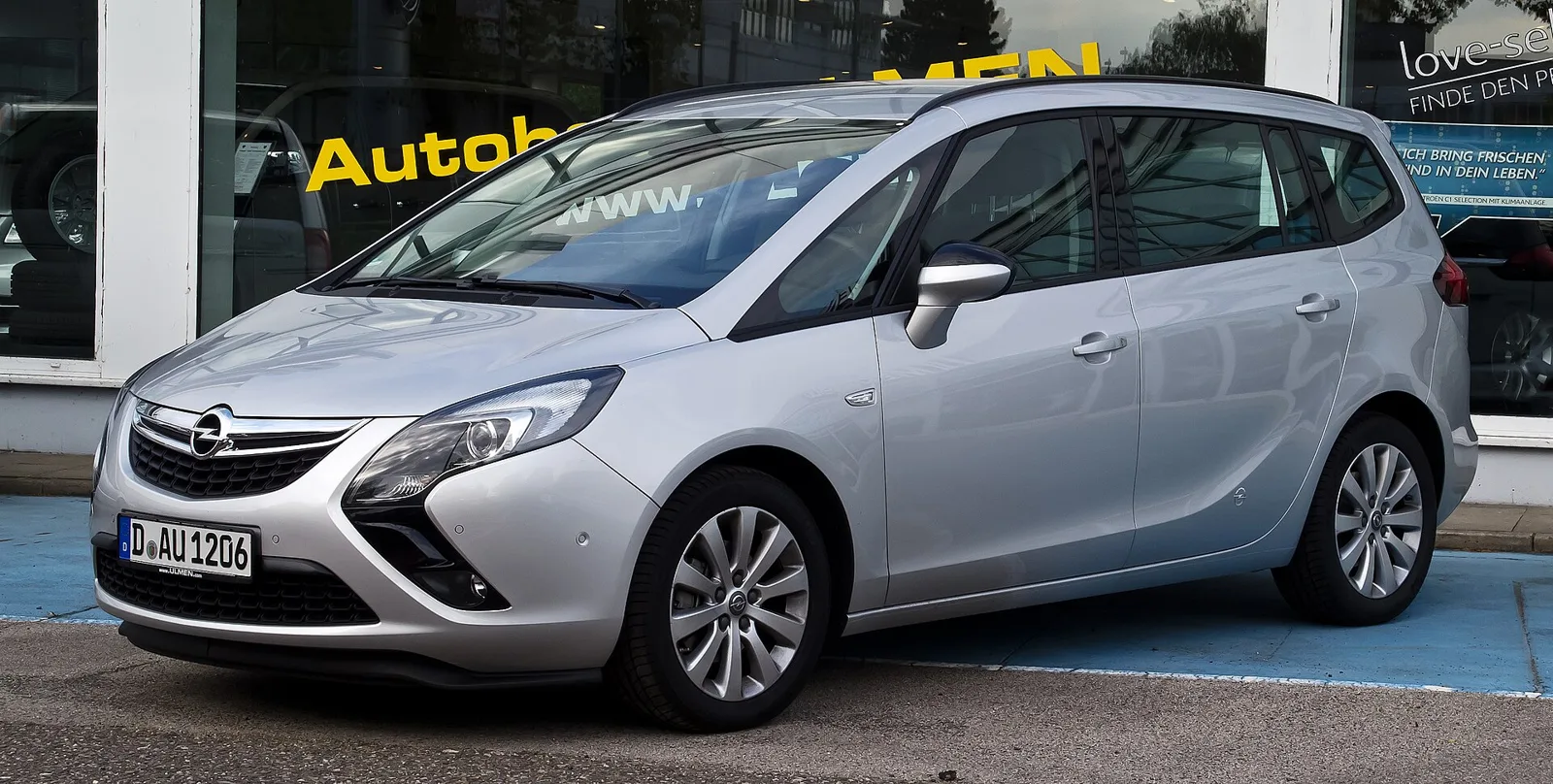
The third-generation Zafira shared the Astra J's underpinnings, offered a Flex7 seating system and ran from 2011 to 2019 before the Zafira Life took over.
Built by Opel from 2011 to 2019, the Zafira C, also called the Zafira Tourer, was a people carrier in the mid-to-upper bracket. It shared the Astra J's underpinnings, offered Flex7 seating and launched with 1.4 Turbo petrol and 2.0 CDTI diesel engines.
The Opel Zafira C, usually sold as the Zafira Tourer, was a mid-to-upper range people carrier built by the German maker from November 2011 to July 2019. It was the third generation of the Zafira name, and it sat a step above the Zafira B it followed. The Zafira name itself derives from an Arabic word meaning to succeed.
The car was positioned a step above the earlier model, roomier, more modern and refined, and it brought new technology into the Zafira range.
Where did the Zafira Tourer come from?
The third-generation Zafira received the Tourer name, and Frankfurt hosted its unveiling in September 2011. It was shown on its own stand, away from the rest of the Opel range, beside another new model, the Ampera. The Tourer reached showrooms on 14 January 2012.
The earlier Zafira was not retired. It stayed on sale under the name Zafira One, known as the Zafira Family in Germany, and it sat a rung below the new Tourer in the line-up. The two cars therefore ran side by side, with the Tourer aimed higher.
A people carrier that gained a Tourer name, a developed Flex7 seating system and a boot of up to 1,820 litres.
How much bigger was the Zafira Tourer?
Compared with the Zafira B, the Tourer adds 19 cm (7.5 in) in length, 12 cm (4.7 in) in width and 5 cm (2.0 in) in height. Those dimensions allowed Opel to position it not only against mid-size people carriers such as the Ford C-Max and the Mazda 5, but also against larger models such as the Ford S-Max.
The wheelbase grew as well, by 5.7 cm (2.2 in), which helped interior space.
How did the Zafira Tourer look?
Its light clusters had boomerang shapes that closely followed the styling of the Ampera. Between them sat a wide trapezoidal grille with rounded corners, crossed by a chrome strip, with a large air intake below. A rib in the sill area echoed those already introduced on the Insignia and Astra J.
The rear looked more imposing than the Zafira B's. A small spoiler topped the tailgate, and a black frame surrounded the rear window, with two horizontally shaped light clusters below it. Two ribs ran under the lights, and the bumper recalled the Zafira B's, though it was redrawn and more modern.
How was the Zafira Tourer's cabin arranged?
The cabin was brighter than the Zafira B's, thanks to larger glazed areas that also gave the driver a wider view of the road. The dashboard and centre console recall the design of the Astra J and the Insignia, so the interior looked related to those cars.
Seating used an evolved version of the Flex7 system. The three separate seats in the middle row could be slid, reclined or removed independently, and the centre seat could also be folded so that the two outer seats moved towards the middle, giving more room to two passengers. A FlexConsole, much like the FlexRide setup of the Meriva B, added further flexibility.
The boot was larger than the Zafira B's, offering 1,820 litres once the middle and rear rows were removed. With five seats in place the capacity was 710 litres, which is 65 litres more than the earlier car.
What mechanics did the Zafira Tourer use?
The Zafira Tourer shared its platform and mechanics with the Astra J. An auxiliary subframe at the front carried MacPherson struts, while the rear used a torsion-beam end located by a Watt's linkage. The steering was rack-and-pinion, and the braking system used four discs, with self-ventilated discs at the front.
The FlexRide system adjusted the suspension automatically. It was already fitted to the Astra J and worked as an active control, changing the stiffness of the dampers through three selectable modes: Standard, Sport and Tour.
Which engines did the Zafira Tourer launch with?
At launch the Zafira Tourer came with five engines: two petrol units and three diesels, all derived from just two basic engine blocks. The petrol engine was a 1.4 Turbo of 1364 cc (83.2 cu in), offered at 120 PS (88 kW; 118 hp) or 140 PS (103 kW; 138 hp).
Both petrol versions and the strongest diesel could be ordered in standard or EcoFlex form. EcoFlex cars had their engines revised to cut fuel use without losing performance, and they carried the Start&Stop system.
The diesel was a 2.0 CDTI common-rail turbodiesel of 1956 cc (119.4 cu in). Buyers could pick from three outputs, namely 110 PS (81 kW; 108 hp), 130 PS (96 kW; 128 hp) and 165 PS (121 kW; 163 hp). Every launch version was paired with a six-speed manual gearbox, so the choice of engine did not extend to the transmission.
How did the engine line-up grow after 2012?
In January 2012, as sales got going, the range gained a bi-fuel methane model, the 1.6 EcoM Turbo. Its turbocharged unit of 1598 cc (97.5 cu in) produced up to 150 PS (110 kW; 148 hp). The natural gas version had been announced in December 2011, and its CNG tank gave a range of 530 kilometres, with a 14-litre petrol tank for when no CNG filling station was available. A few months later came the Zafira Tourer 1.8, with a 1796 cc (109.6 cu in) engine of 115 PS (85 kW; 113 hp). It was the only version with a five-speed manual, and it was offered in some markets only.
In autumn 2012 a second bi-fuel model followed, this time running on LPG. Called GPL-Tech, it used the 1.4 turbo with 140 PS (103 kW; 138 hp). The following spring brought a 2-litre common-rail turbodiesel with twin turbochargers, rated at 195 PS (143 kW; 192 hp).
Summer 2013 introduced a 1.6 CDTI at 136 PS (100 kW; 134 hp), which took over from the 2-litre in the weaker versions. Autumn added a 1.6 SIDI direct-injection petrol at 170 PS (125 kW; 168 hp). In June 2014 the 1.6 CDTI was also offered in a cheaper 120 PS (88 kW; 118 hp) version.
At the end of 2014 the 2-litre diesels with 110 and 195 PS were dropped. Of the other two 2-litre versions, the less powerful saw no change in performance, while the 165 PS unit gained a little output and rose to 170 PS (125 kW; 168 hp).
What did the 2016 restyle change?
Two quiet years followed, with no updates until mid-2016. That year the car received a mid-cycle update, shown to the public at the Paris Motor Show. The focus was the front end, where the light clusters swapped their boomerang shape for a horizontal form in line with the newer design direction of the brand.
The grille kept its trapezoidal profile but now carried one chrome bar, joined to horizontal black plastic slats. The chrome bar ran into a row of LEDs in the front lights. The updated car also gained a new-generation interactive system with a touchscreen, which allowed many buttons to be removed from the centre console and dashboard.
The engine range was largely unchanged, apart from the removal of the 1.6 turbo petrol from some European price lists. The result was a cleaner, less cluttered dashboard than before.
Why did the engine range shrink in 2018?
Two more years of stability followed, until May 2018, when petrol choices were cut sharply. The 1.4 engines went, along with both bi-fuel petrol versions, and the 200 PS (147 kW; 197 hp) 1.6 SIDI was removed. Two 1.6 turbo direct-injection petrol engines remained: a revised unit of 170 PS (125 kW; 168 hp) meeting the Euro 6d-TEMP standard, and a de-tuned variant capped at 136 PS (100 kW; 134 hp).
On the diesel side, the smaller 1.6 CDTI and the larger 2-litre both stayed on sale. In June 2018 the version sold under the Vauxhall name was withdrawn because demand was weak. That was the final update in the Zafira Tourer's commercial life.
How did the Zafira Tourer end its run?
By then the brand was under the control of the PSA group. Opel planned to end production of the Zafira Tourer in the summer of 2019, with the Zafira Life as its successor. That new model was based on the Peugeot Traveller and Citroen SpaceTourer people carriers, and it is slightly larger than the Tourer. It was to be sold in England as the Vauxhall Vivaro Life.
Production had moved to the Ruesselsheim plant in 2015, once the Bochum site was permanently closed. Deliveries ran until the end of 2019, after which Opel removed the model from its European price lists.
Opel Zafira C specifications
| Specification | Detail |
|---|---|
| Type | Mid-to-upper range people carrier |
| Built | November 2011 to July 2019 |
| Also called | Zafira Tourer, Zafira C |
| Length | 19 cm (7.5 in) longer than the Zafira B |
| Width | 12 cm (4.7 in) wider |
| Height | 5 cm (2.0 in) taller |
| Wheelbase | 5.7 cm (2.2 in) longer |
| Boot | 1,820 litres, or 710 litres with five seats |
| Platform | Shared with the Astra J |
| Launch petrol | 1.4 Turbo, 1364 cc (83.2 cu in), 120 or 140 PS (88 or 103 kW; 118 or 138 hp) |
| Launch diesel | 2.0 CDTI, 1956 cc (119.4 cu in), 110, 130 or 165 PS |
| Gearbox | Six-speed manual |