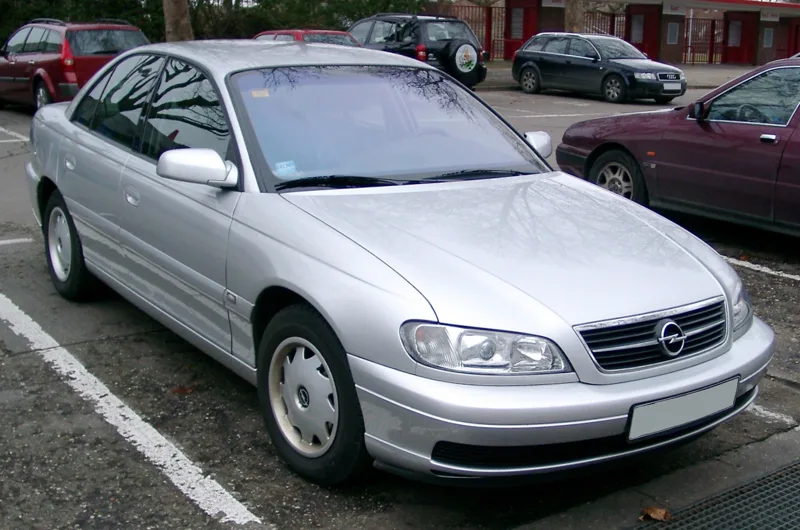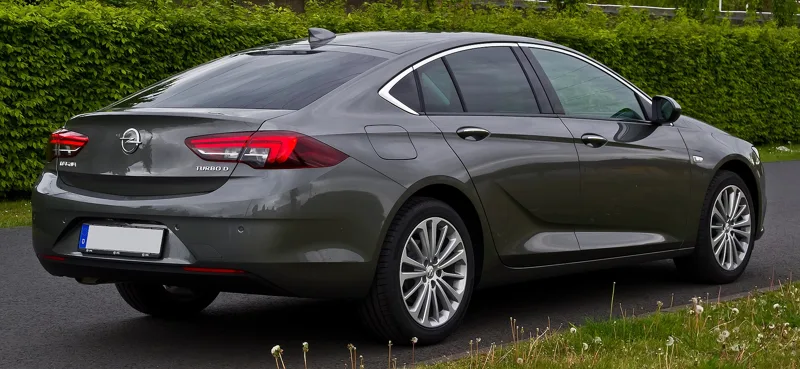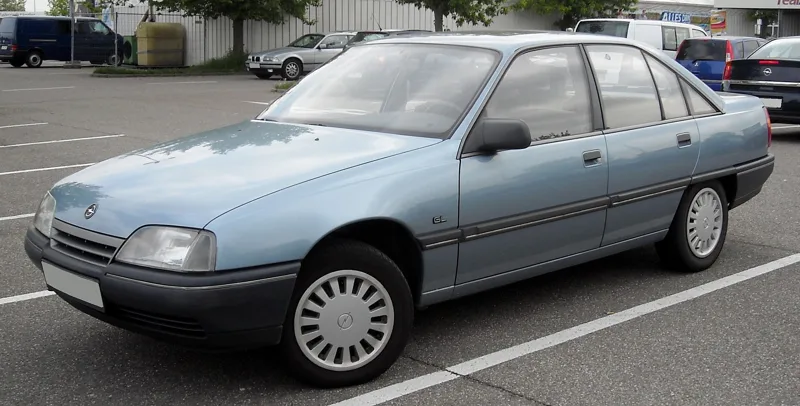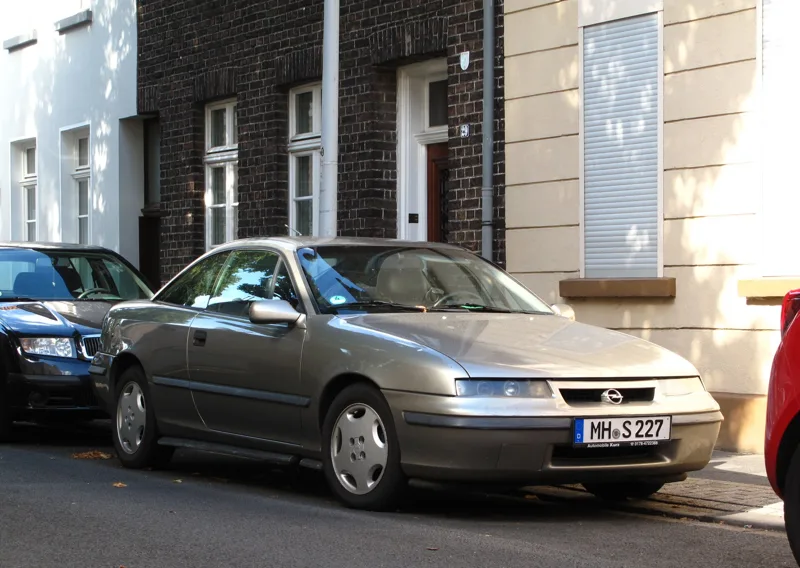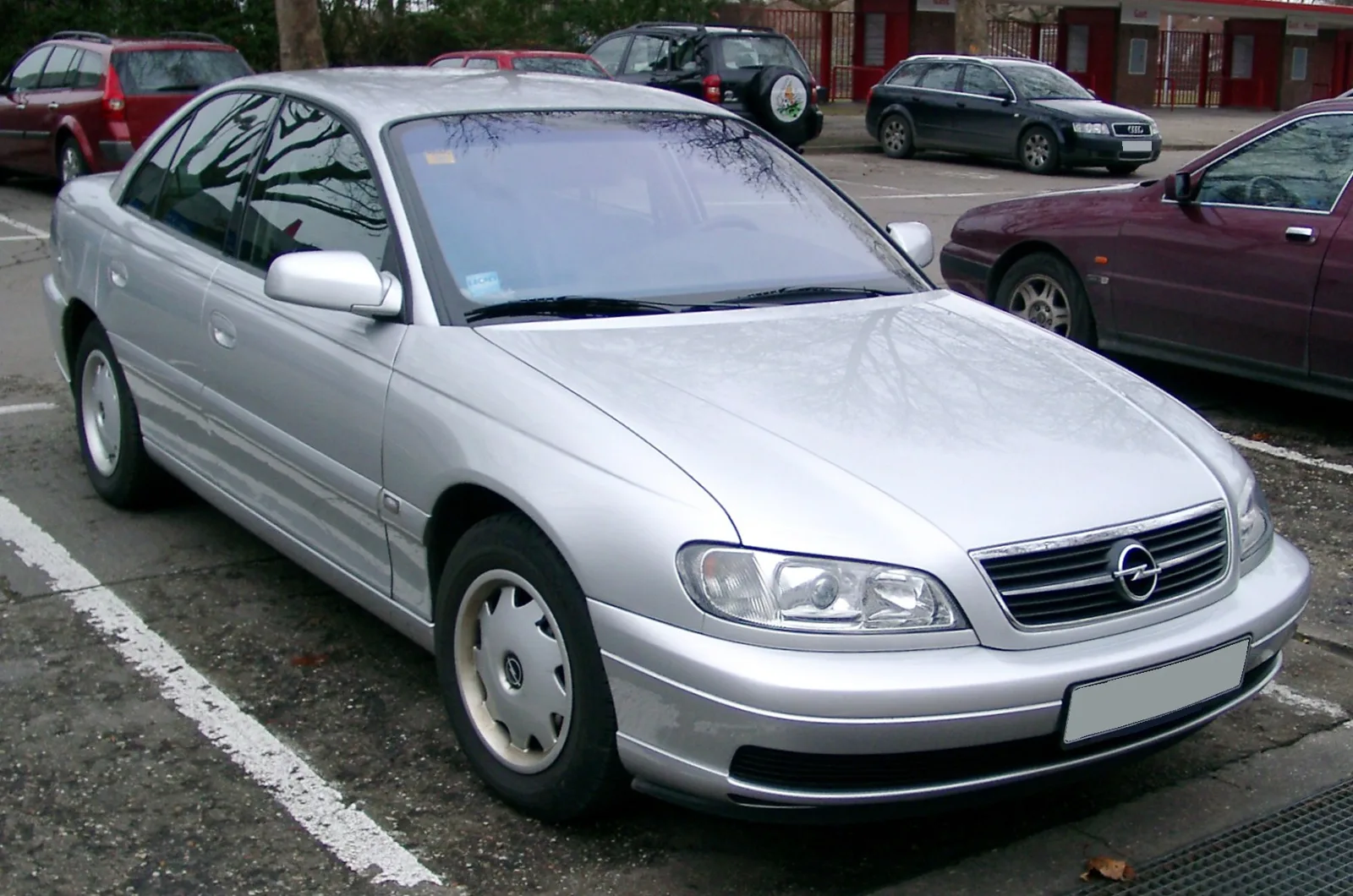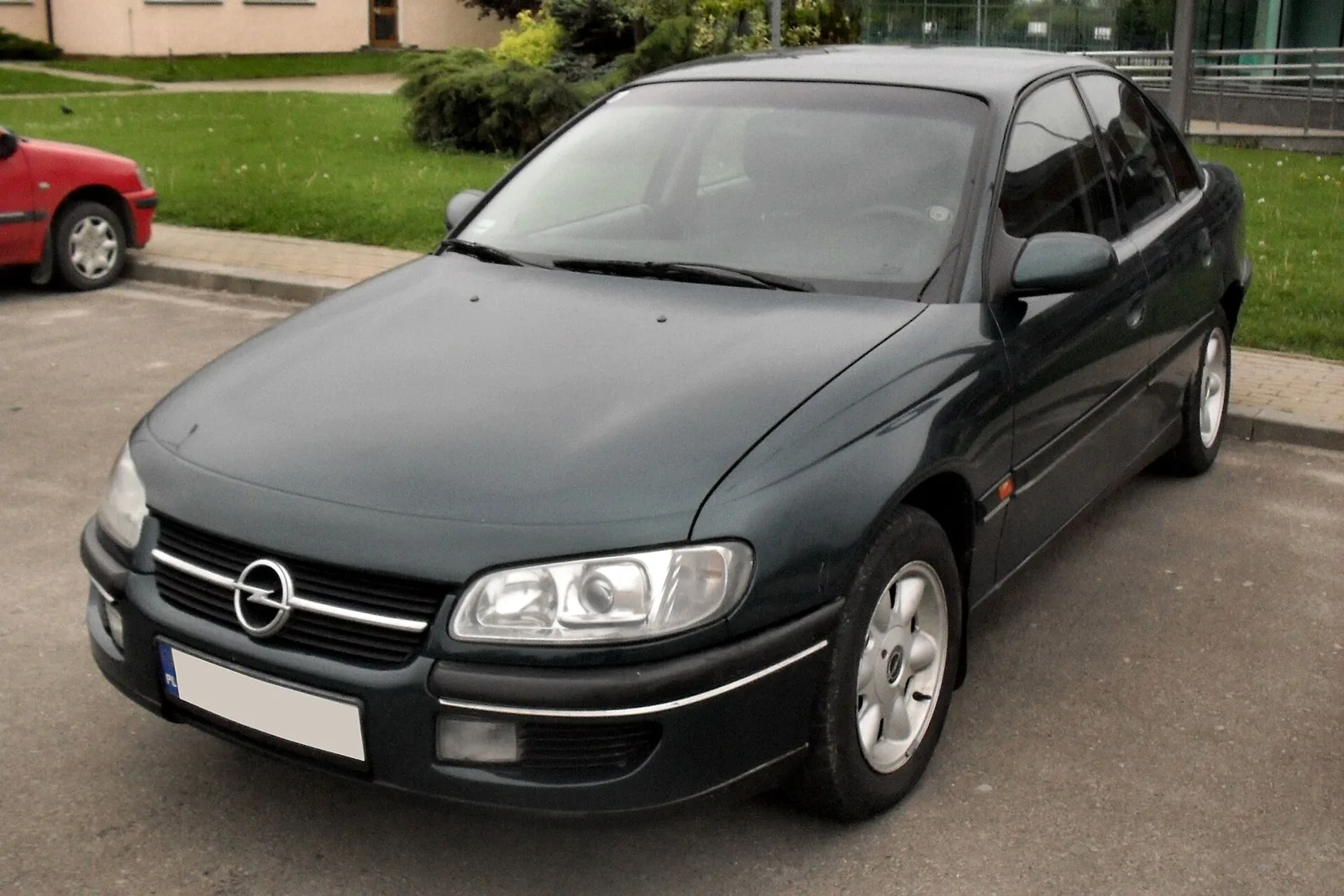
From its 1994 launch to the last car in June 2003, the Omega B carried V6 engines, a shape reminiscent of a Cadillac study and the last rear-wheel-drive layout Opel built.
Launched in 1994 to succeed the Omega A, this Opel kept rear-wheel drive to the end. It was sold in Britain as the Vauxhall Omega and in North America as the Cadillac Catera. Production ran until June 2003, when 797,011 cars had been built.
The Opel Omega B was an upper mid-size car that Opel built from early 1994 until mid-2003. It succeeded the Omega A, and its last example was a silver 3.2 V6 that left the line in June 2003. Over that run it moved from inline sixes to a family of V6 engines, and it was the final rear-wheel-drive Opel of its size.
Its history is useful for reading a changing class. The car kept the classic layout to the end, took some of its diesels from BMW, and was followed by the Signum, which the market saw as a new type of vehicle rather than a straight replacement.
When did the Omega B arrive and what did it replace?
The Omega B appeared on 29 April 1994 as the successor to the Omega A. Its rounded body echoed the Cadillac Aurora study that Cadillac had shown in 1990. The car also had an airbag system, and the chassis was reinforced.
Engineers kept the four-cylinder engine with a 2.0 l displacement as the basic unit, producing 85 kW (116 PS; 114 hp). A 16-valve version with 100 kW (136 PS; 134 hp) joined it. The inline six-cylinder petrol engines of the Omega A were replaced by newly developed V6 units, starting with the 2.5-litre and the 3.0-litre, which sat in the top MV6 model.
The last rear-wheel-drive Opel of its size, built from 1994 to a final silver V6 in June 2003.
Which engines did the Omega B offer?
The first diesel was a 2.5 l six-cylinder turbo of type M51-D25, sourced from BMW, rated at 96 kW (131 PS; 129 hp). BMW's own 325 and 525tds were rated at 105 kW. Later a 2.0 l 16-valve direct-injection diesel arrived with 74 kW (101 PS; 100 hp), and its single camshaft operated the valves via roller rockers that cut friction.
The new V6 engines had light-alloy heads with four valves per cylinder. A system named Multiram changed the length of the intake path in several stages according to engine speed, which helped torque at low revs. Every Omega engine sat longitudinally, but the compact V6 was also suited to transverse fitting. That is why the 2.5 l V6 found its way into the Vectra and Calibra as well.
Specifications at a glance
| Engine | Introduced | Output |
|---|---|---|
| 2.0 l four | 1994 | 85 kW (116 PS; 114 hp) |
| 2.0 l 16-valve four | 1994 | 100 kW (136 PS; 134 hp) |
| 2.5 l V6 | 1994 | 125 kW (170 PS; 168 hp) |
| 3.0 l V6 (MV6) | 1994 | 155 kW (211 PS; 208 hp) |
| 2.5 l turbodiesel six (M51-D25) | 1994 | 96 kW (131 PS; 129 hp) |
| 2.0 l 16-valve diesel | Added later | 74 kW (101 PS; 100 hp) |
| 2.2 l petrol engine | From the 1999 revision | 106 kW (144 PS; 142 hp) |
| 2.6 l V6 (Y26SE) | From autumn 2000 | 132 kW (179 PS; 177 hp) |
| 2.2 l diesel (Y22DTH) | From autumn 2000 | 88 kW (120 PS; 118 hp) |
| 3.2 l V6 (Y32SE) | From February 2001 | 160 kW (218 PS; 215 hp) |
| 2.5 l common-rail diesel (M57-D25) | Summer 2001 | 110 kW (150 PS; 148 hp) |
How did the 1999 facelift change the car?
In August 1999 the Omega received a larger facelift, and the revised car was called the Omega B2 internally. Both front and rear were redesigned, and the interior was largely reworked. Chrome strips mostly disappeared, while bumpers and side strips were painted in body colour, and the MV6 was dropped.
The most luxurious version became the Executive. Its equipment covered almost everything on the options list, including leather upholstery, electrically adjustable seats, xenon lights, cruise control, a CD changer radio, a honeycomb-style grille and a telephone. Almost the only paid extras left were the sliding roof, electrically folding mirrors and metallic paint.
The revision also brought a new 2.2-litre basic engine with 106 kW (144 PS; 142 hp), and both two-litre engines were dropped at the same time.
Why was the V8 super Omega cancelled?
A so-called super Omega, with a 5.7-litre LS-1 V8 rated at 228 kW (310 PS; 306 hp), was planned for autumn 2000. It was withdrawn a few weeks before its intended market launch because gearbox problems could not be solved. The engine, code Y57XE, had a maximum torque of 450 Nm (332 lb ft).
Unofficial information puts the number of production-ready Omega V8s at 32. They were used as test cars, and they are still said to exist at Opel.
What replaced the Omega B?
The Signum, on sale between February 2003 and July 2008, was supposed to succeed the Omega. Reportedly it gave buyers more usefulness and ease at cheaper prices, yet it was judged a new vehicle type, since its platform was larger and its profile resembled an estate.
In estate form, the Vectra C Caravan took the Omega's place. Like the Signum it had a wheelbase 13 cm (5.1 in) longer than that of the Vectra saloon, which put both models above it in the range. The KBA classifies the Signum and the Vectra Caravan as mid-size cars.
Opel also showed the Insignia study in autumn 2003 as another possible successor, but that idea was dropped as well. From November 2008 until December 2022 the name Insignia went to the successor of the mid-size Vectra. Its dimensions had also come close to the Omega in saloon form.
When did production end?
At the end of June 2003 Opel stopped building the Omega B. The Omega was the last Opel of its size in the traditional arrangement of front engine and rear-wheel drive, so its departure closed an era in the upper mid-size class. The traditional four-door notchback saloon was abandoned too, since there seemed little hope of success for it in that segment.
The last car was a silver Omega B 3.2 V6, which left the line at Russelsheim on 24 June 2003. Over nine years of production, 797,011 units were built.
How was the Omega B sold abroad?
In Great Britain the car was sold as the Vauxhall Omega, and Vauxhalls also came off the line at Russelsheim. In North America it was offered as the Cadillac Catera from summer 1996 to autumn 2001. Because it was also built in Russelsheim, the Catera was meant to benefit from the reputation of Made in Germany.
On the outside the Cadillac was mostly told apart by its grille, bumpers, tail lights and centre console insert, which housed a cassette radio and climate buttons. Under the skin the two were nearly the same. The Catera's only engine was the 3.0-litre V6, later replaced by the 3.2-litre.
In Australia the Omega was built under the Holden name, in a markedly changed form, with V6 and V8 engines until summer 2006. There it went by Holden Commodore, Berlina or Calais, depending on trim, rather than the Omega name.
Which body variants were offered besides the saloon and estate?
The Australian Holden range also included a saloon with a longer wheelbase, sold as the Statesman or Caprice, and an all-wheel-drive off-road estate called the Adventra. Two- and four-door pick-ups were marketed as the Ute and Crewman. The two-door Monaro coupe was available only with a V8.
The Monaro reached America as a lightly altered Pontiac GTO, and England as the Vauxhall Monaro. In 2006 the Holden models gave way to new designs on the GM Zeta platform.
How did the model years change the Omega B?
Model year 1995
As early as autumn 1994 anti-corrosion work was improved, and the bonnet's rear edge was lifted to cut wiper flutter. The air conditioning received an evaporator with an inner coating, and the sliding roof controls and floor mat mountings were revised.
The gearboxes changed too. On the large AR 35 automatic, fitted to the X30XE, the rear axle ratio went from 1:3.7 to 1:3.9 to sharpen acceleration. The manual version kept its 3.70 ratio. The AR 25 gained a larger torque converter, and vibration dampers were added to the manual gearboxes.
Model year 1996
From autumn 1995 new paint colours, sun-sensor air conditioning and a new radio generation were offered. Central locking and the alarm were now operated by radio remote instead of infrared. The variable wiper interval was set by a knurled wheel in the wiper lever, and the engine bay insulation and front seat backrest adjusters were improved.
Torsion-spring door checks were fitted to the rear doors, and a two-part aluminium oil sump was introduced for the X20XEV engine. Every car also received a gear lever 25 mm shorter.
Model year 1997
Starting in summer 1996, buyers could specify an adjustable steering column, a CD changer and steering wheel remote controls. Side airbags and belt tensioners became standard.
The centre console gained a wood veneer, a five-speed blower was introduced, and traction control with brake intervention arrived. A navigation system could be ordered from February 1997.
Model year 1998
From autumn 1997 the dashboard had a continuous ventilation slot for the windscreen, and the head restraints were fully padded again. The anti-lock system 5.3 and the instrument cluster with fog light warning lamps appeared in new versions, and clear-glass ellipsoid headlamps became standard. Xenon lighting was optional.
The OnStar service was introduced, and the on-board clock could set itself from an RDS signal. The 2.0-16V engine received balancer shafts. The 3.0-litre 24-valve engine was modified for more power and less noise.
Model year 1999
Buyers could now add the Opel Fix child seat security system, and Opel's own navigation unit became standard on the Omega MV6. From 1999 every petrol unit had four valves per cylinder, and air conditioning was standard. The 2.5 l V6 (X25XE) had its rear axle ratio shortened, and every V6 got a timing belt with altered geometry and material to cut noise.
Model year 2000
The revised car brought a V-shaped bonnet, an integrated grille, clear-glass headlamps and redesigned bumpers. Thicker sheet metal increased body rigidity in many places. Safety changes included active head restraints and a quick-power brake booster, and two-zone automatic climate control was fitted as standard.
The 2.0 l 16V engine was replaced by a 2.2 l 16V with an improved electronic immobiliser. Rust perforation was covered by a ten-year warranty from Opel.
Model year 2001
All six-cylinder models received rear brakes with internally ventilated discs, and an oil cooler for the automatic transmission fluid was added. The windscreen now reflected heat through seven metal-vapour layers. The coolant was silicate-free and sealed for life, and the engine control unit gained OBD-2 capability.
The 3.2 V6 (Y32SE) took the place of the 3.0 unit from February 2001. In October 2000 the 2.6 V6 had replaced the 2.5 V6, and the 2.2 l diesel had taken over from the 2.0 l.
Model year 2002
After a half-year gap, the BMW-sourced 2.5 l common-rail diesel (Y25DT) returned in July 2001 as a six-cylinder turbodiesel, declared as model year 2002. It was offered with a five-speed automatic, and the Audio-Vision DVD system became an option. From December 2001 every six-cylinder model came with ESP at no extra cost.
Model year 2003
On 24 June 2003 the last Omega B, a silver 3.2 V6, rolled off the line at Russelsheim. In nine years 797,011 cars had been built.