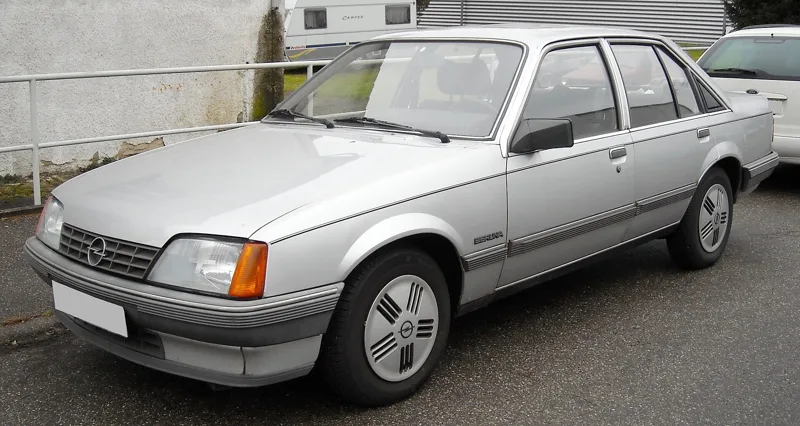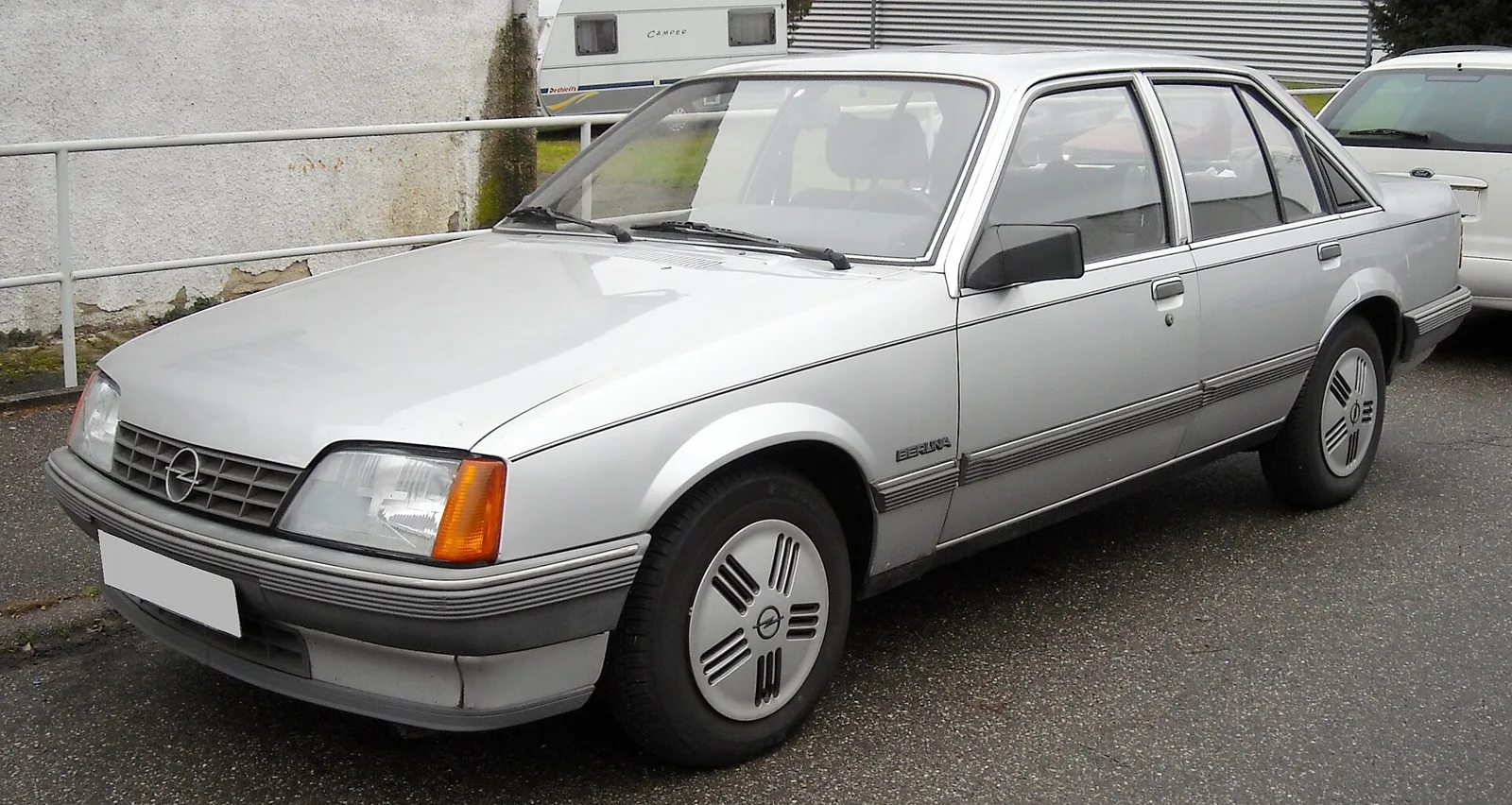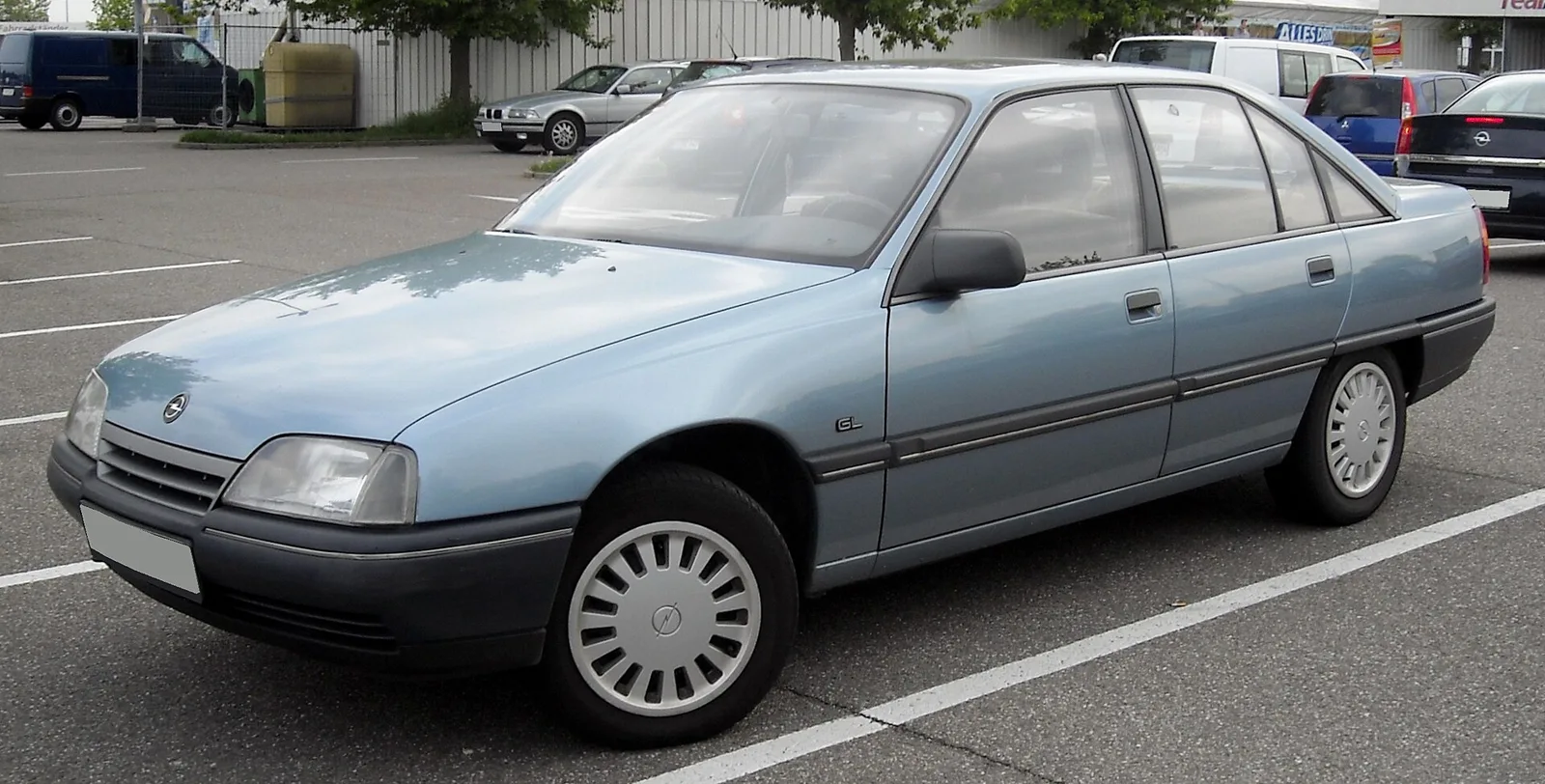
Opel's upper mid-size saloon of 1986 to 1993, with a 24-valve six, a Caravan estate and a small run of high-performance flagships.
The Opel Omega A was an upper mid-size Opel saloon built from August 1986 to August 1993 as the successor to the Rekord E. Its newly designed running gear, six-cylinder engines, including a 150 kW (204 PS; 201 hp) 24-valve, and the Car of the Year 1987 title defined the model.
The Opel Omega A took over from the Rekord E in August 1986 and stayed in production until August 1993. It arrived as a notchback with a fresh chassis and disc brakes on all four wheels, and it carried the Car of the Year 1987 title. Following the Commodore C, it was also sold with six-cylinder inline engines.
What did the Omega replace?
It succeeded the Rekord E, and a more richly equipped parallel model, the Senator B, sat beside it. The pairing followed an older pattern, much as the Senator and Monza A had accompanied the Rekord E and the KAD series. The Omega was also available as an estate, which Opel called the Caravan.
Production of the Omega A ended in August 1993, and remaining stock continued to sell until March 1994. In April 1994 the Omega B took over.
Opel's six-cylinder saloon wore a Car of the Year title, and its Caravan 3.0i could reach 220 km/h.
What was new in the chassis and body?
The Omega's chassis was newly designed around a rear semi-trailing arm axle, and every corner carried a disc brake. Its drag coefficient of 0.28, paired with a relatively low weight, gave it very good performance on modest fuel use.
The drivetrain itself was conventional. A longitudinal inline engine sat at the front, a propshaft carried power to the rear wheels, and the differentials varied by version, some of them self-locking.
Which engines did the Omega use?
The first engines were petrol fours of 1.8 and 2.0 litres (110 and 122 cu in). Depending on catalytic converter and tune, they produced anything from 60 kW (82 PS; 80 hp) to 90 kW (122 PS; 121 hp). The 2.0-litre unit was already known from the Kadett GSi, and the diesel and turbodiesel versions of the 2.3-litre engine were carried over from the Rekord.
The diesel outputs were 54 kW (73 PS; 72 hp) and 74 kW (100 PS; 99 hp), and the Rekord E diesel's bonnet bulge had gone.
Between August 1986 and August 1987 the 1.8i, with L3-Jetronic injection, produced 85 kW (115 PS; 114 hp) without a catalytic converter, while a 2.0i with Motronic 4.1 gave 90 kW (122 PS; 121 hp) in the same form without a catalytic converter. From July 1990 a 2.0i rated at 74 kW (100 PS; 99 hp) with G-Kat was listed for official vehicles only, until August 1993.
From September 1988 to October 1992 a 2.4-litre (146 cu in) fuel-injected four with 92 kW (125 PS; 123 hp) was also offered. It was a further developed CIH engine from the Rekord, while every other four in the Omega used the newer OHC layout.
Main engines at a glance
| Engine | Layout and management | Output | Period |
|---|---|---|---|
| 2.0i (C20NE) | OHC four, Motronic 4.1/1.5, G-Kat | 85 kW (115 PS; 114 hp) | 08.1986-08.1993 |
| 2.4i (C24NE) | CIH four, Motronic 1.5, G-Kat | 92 kW (125 PS; 123 hp) | 08.1988-08.1993 |
| 2.6i (C26NE) | CIH six, Motronic 1.5, G-Kat | 110 kW (150 PS; 148 hp) | 08.1990-08.1993 |
| 3.0i (C30NE) | CIH six, Motronic 4.1/1.5, G-Kat | 130 kW (177 PS; 174 hp) | 08.1988-08.1992 |
| 3.0i 24V (C30SEJ) | DOHC six, Motronic 1.5, G-Kat | 147 kW (200 PS; 197 hp) | 07.1990-08.1993 |
| 3000 24V (C30SE) | DOHC six, Motronic 1.5, G-Kat | 150 kW (204 PS; 201 hp) | 10.1989-08.1993 |
| Lotus Omega (C36GET) | DOHC six, double G-Kat | 277 kW (377 PS; 371 hp) | 1990-1992 |
How did the 3000 and 24V models develop?
The sporty saloon arrived in August 1987 as the Omega 3000, with a six-cylinder petrol engine known from the Senator A. It was offered at 115 kW (156 PS; 154 hp) with a catalytic converter, or 130 kW (177 PS; 174 hp) without one.
From spring 1988 a modernised 3-litre (183 cu in) unit, designated C30NE, took over at 130 kW (177 PS; 174 hp) with catalytic converter. It officially replaced the C30LE and the 30NE, although the older 30NE could still be ordered on special request until the end of the 1990 model year.
The Caravan received a 3-litre from October 1989, but the estate dropped the sporty appearance and was named simply Omega Caravan 3.0i. Its 220 km/h (137 mph) top speed made it the quickest production estate sold in Germany up to then.
At the same moment the saloon gained a new 3.0-litre 24-valve engine rated at 150 kW (204 PS; 201 hp). It had two overhead camshafts and a Dual-RAM switchable intake manifold, and it delivered strong performance at relatively low fuel consumption.
In autumn 1989 the last variant of the 1.8-litre engine, rated at 65 kW (88 PS; 87 hp), left the German market.
What changed with the 1990 facelift?
The July 1990 facelift revised the Omega both outside and in its engineering. Heavier bumpers with more chrome, protective strips and darker tinted tail lamps marked the new look, while a 2.6-litre six rated at 110 kW (150 PS; 148 hp) joined both the saloon and the Caravan.
The 2.6 was a modification of the 3.0i 12-valve, paired with the same switchable intake manifold as the 3.0i 24V.
With the facelift the Caravan finally received the powerful 24-valve three-litre. Its different exhaust system limited it to 147 kW (200 PS; 197 hp), which was 3 kW (4 PS) less than the saloon. The estate's strongest version became the Omega Caravan 24V.
The 12-valve C30NE stayed available on request until the 1992 model year, even though the 24V officially replaced it. In the final production year the most powerful notchback was simply called Omega 24V. All the '3000' add-on parts were removed, as Opel chose understatement for the model.
Was there a six-door Omega?
Yes. In 1988 the American body builder Armbruster and Stageway, based in Arkansas, produced a stretched six-door version of the Omega, whose sales ran through Earnhart and Johansen. Starting in 1989 the factory also listed a six-door Omega through its dealer network.
The factory six-door seated eight, measured 5.58 metres (18.3 ft) externally and weighed from 1,555 kg (3,428 lb) depending on equipment. Buyers could also specify a fixed centre bench seat and a remote control for unlocking the centre door.
What were the Evolution 500 and the Lotus Omega?
Two top models were built on the Omega A 3000 24V. The Evolution 500 was a homologation car for the German Touring Car Championship, while the Lotus Omega was a high-performance saloon meant to carry the image of the Opel and Vauxhall brand.
The engine list also carries an Irmscher group: a 3.6i with 153 kW (208 PS; 205 hp), a 4.0i-24V DOHC six rated at 200 kW (272 PS; 268 hp) and the 3.0i Evo 500 with 169 kW (230 PS; 227 hp) and G-Kat.
The Evolution 500 was built as a small series of 500 units from 1991 to 1992. The Lotus Omega followed as a small series of 1,100 units, produced from 1990 to 1992, with a six-cylinder DOHC engine with double G-Kat that produced 277 kW (377 PS; 371 hp).
Stock in Germany
The Federal Motor Transport Authority (Kraftfahrt-Bundesamt) publishes the Omega A stock broken down by manufacturer and type key numbers. Models with under 100 registered cars are left out. Before 2007 the count also covered temporarily deregistered cars, whereas since 2008 it has contained only vehicles in moving traffic, seasonal plates included.
What became of the Omega in Brazil?
The Omega had a second life in Brazil, where it was sold as the Chevrolet Omega from 1992 to 1998. It replaced the thoroughly outdated Chevrolet Opala, which had still been based on the Opel Rekord C.
The variants were the GL, GLS and CD, and the estate was known there as the Suprema. Its engines were the 2.0i and the 3.0i. When stocks of the German-built 3.0-litre six ran out, a 4.1-litre (250 cu in) six-cylinder inline engine from Chevrolet took over. That unit had already been used in the Opala.
The second Brazilian Omega generation was no longer built locally. From 2001 it was imported from Holden, as the Holden Commodore.