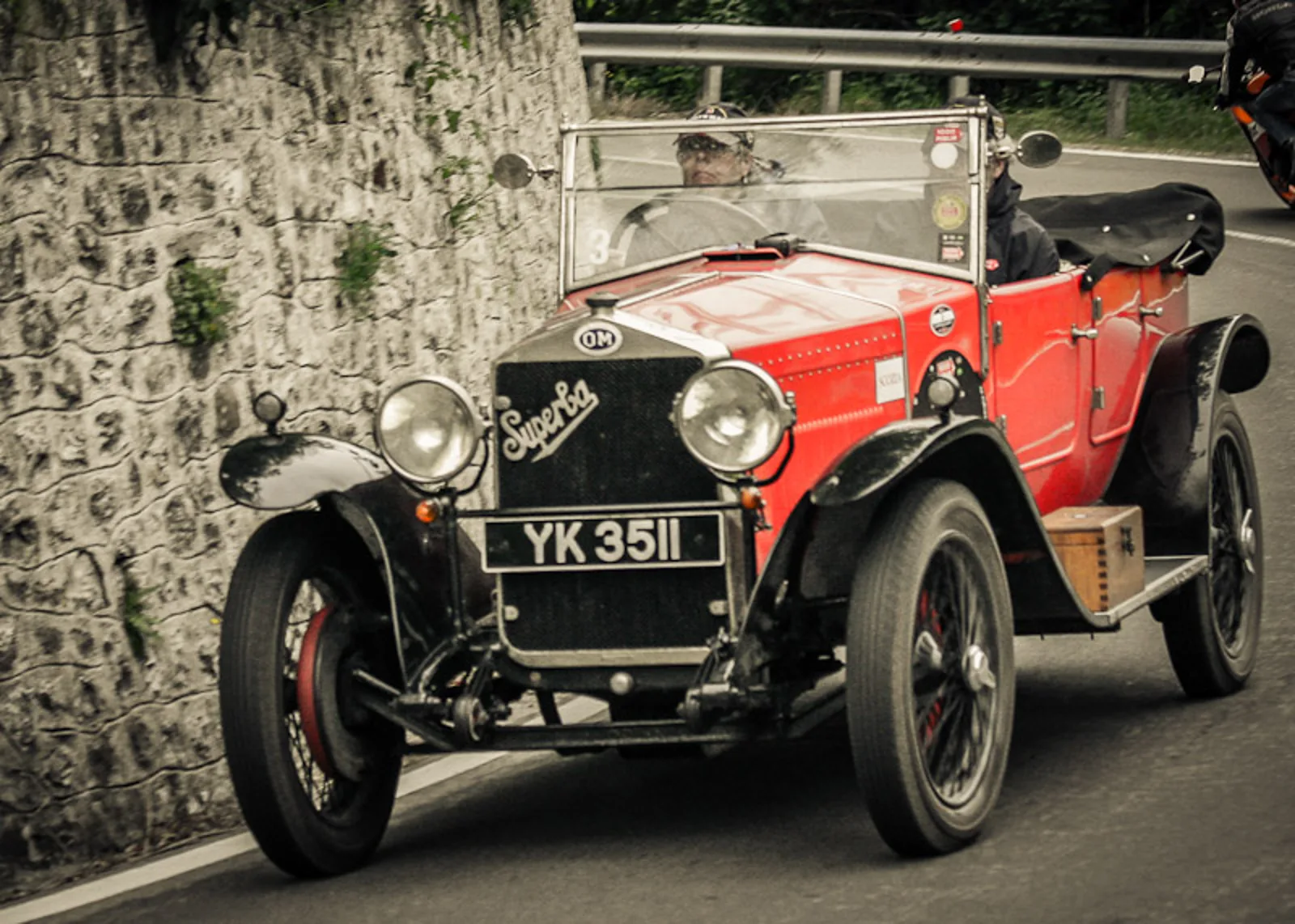
A side-valve six from Brescia with a light chassis, a supercharged English variant and a 1927 Mille Miglia podium sweep.
The OM 665 Superba was a six-cylinder car built by Officine Meccaniche in Brescia from 1923 to 1934. Its side-valve 1,991 cc engine and light chassis earned a reliable name, and the sporting S version carried the works team to the entire podium at the 1927 Mille Miglia.
The OM 665 Superba was the six-cylinder flagship that Officine Meccaniche built in Brescia between 1923 and 1934. Its side-valve engine and light chassis earned a name for reliability, and its sporting derivatives turned up at the Mille Miglia, Le Mans and English tracks during the middle of the decade.
Where did the OM 665 Superba come from?
The Superba was shown at the 1923 Milan Motor Show, a year after the smaller 469, and it took the top place in Brescia's range. Engineers built the six by adding a pair of cylinders to the four-cylinder block of the 469, which measured 1,500 cc, giving 1,991 cc (121.5 cu in). The name stuck, helped by the car's success with buyers and specialists.
The number in the designation carries meaning. The first digit gives the cylinder count, and the other two give the bore, which was 65 mm. The company's competition programme had a commercial purpose as well as a technical one. OM raced to publicise its cars and to test them, and because the 469 had already produced good results, a more sporting version of the Superba was devised: the S.
A side-valve six from Brescia known for reliability and light weight rather than outright power.
How was the Superba's chassis built?
The chassis came from the smaller 469 and used a relatively light ladder frame of pressed steel, with C-section side members and cross members. Rigid axles hung on semi-elliptic leaf springs, with friction shock absorbers at both ends. Two wheelbases were offered: 2,800 mm (110.2 in) for the S and 3,100 mm (122.0 in) for the N.
Steering was of the worm type. Drum brakes worked on all four wheels using the patented Perrot system, which was normal for the period. The N suited closed saloons, including Weymann-bodied cars, and torpedo tourers that could seat six. The S's shorter frame was aimed at the sporting bodies built for competition work.
Aluminium went into the sump, the clutch bell housing and the bulkhead to keep weight down, and close attention went into assembly and component quality across the whole car. With torpedo bodies the N could reach 100 km/h (62 mph) and the S 120 km/h (75 mph). Those figures were comparable with rival cars of the time.
What was the road car like inside?
The standard body was a four-door torpedo with two rows of leather-upholstered seats. Like most cars of its day, the steering wheel sat on the right. The dashboard carried the principal analogue instruments, set against white faces.
The car became famous for dependability and agility, along with lively acceleration that owed a good deal to the lightness of the structure. The car was valued for how dependably it ran.
What engine powered the Superba?
The 1,991 cc (121.5 cu in) six-cylinder was a side-valve design with its camshaft in the crankcase. The N used one 36 mm Zenith carburettor, while the S ran a pair of 30 mm units, and both gave 40 PS (39 hp) at 3,000 rpm. Later upgrades took the engine up to 4,500 rpm.
The new block and four-bearing crankshaft were designed from scratch so the engine could match the dependability that the Brescia company was already known for. A side-valve engine revving to 4,500 rpm was a notable achievement, and the car's light weight helped it feel quick off the line.
Overhead-valve engines of the period were more powerful and more advanced than the Superba's unit. Its appeal lay in durability and nimbleness rather than outright output.
How did the Superba change during the 1920s?
In 1925 the N2 and S2 arrived. They switched from magneto to coil ignition, the S gained a water pump, the friction dampers became Hartford units (later Houdaille), and the rear track was widened to 1,430 mm. In 1927 the N3/4 and S3/4 followed with larger 810 x 145 tyres and wider tracks at both ends.
The N3/4 had front and rear tracks of 1,420 mm and 1,410 mm, while the S3/4 measured 1,320 mm and 1,340 mm. The 1929 N5 2.0 gained a gearbox with bevel gears instead of straight-cut teeth. The S5 2.2 had a 2,221 cc (135.5 cu in) engine producing 55 PS (54 hp). It also had a 35 mm Memini carburettor, a water pump, and a shorter wheelbase of 2,790 mm (109.8 in).
Specifications at a glance
| Version | Year | Capacity | Power |
|---|---|---|---|
| S and N | 1923 | 1,991 cc (121.5 cu in) | 40 PS (39 hp) at 3,000 rpm |
| S5 2.2 | 1929 | 2,221 cc (135.5 cu in) | 55 PS (54 hp) |
| SMM 2.2 | 1929 | 2,221 cc (135.5 cu in) | 65 PS (64 hp) at 4,000 rpm |
| SSMM 2.35 | 1930 | 2,350 cc (143.4 cu in) | 95 PS (94 hp) |
Which early races did the Superba win?
Renato Balestrero campaigned the 665 S between 1924 and 1927 and scored several podium finishes at Italian Grands Prix. One of his results was a win in the Coppa Montenero, and another came at the Gran Premio di Tripoli. The car also took a class win at the 12 Hours of San Sebastian, and at the 1925 Targa Florio it came fifth overall with four Bugattis ahead of it.
At Le Mans in 1925, three Superbas started in the under-2-litre class although each displaced 2,005 cc (122.4 cu in). Nobody ever officially explained the anomaly. Tino and Mario Danieli came fourth overall, with the other Superba of Giulio Foresti and Aime Vassiaux behind them. Ferdinando Minoia and Vincenzo Coffani had a problem on lap 81 and still finished 25th.
The 1926 attempt won the 2-litre class, with Minoia and Foresti fifth overall followed by the Danieli brothers. Balestrero and Frederic Thelluson were classified 21st, but they did not complete the distance after being disqualified. The team did receive the Rudge-Whitworth trophy that year, a biennial prize for the Index of Performance.
How did the Mille Miglia results develop?
The 1927 Mille Miglia was the peak for the factory team. Its drivers filled the top three places: Ferdinando Minoia with Giuseppe Morandi came home first, Tino Danieli with Balestrero second, and Mario Danieli with Archimede Rosa third. The winning time was 21h 04' 48" 1/5, an average of 77.238 km/h (48.0 mph), which showed the design was sound and very dependable.
In 1928 Rosa and Franco Mazzotti were beaten by just 8 minutes by Giuseppe Campari in his Alfa Romeo 6C 1500 SS Spider Zagato. Eight OM cars, several of them already uprated to SMM specification, filled the first eight places in the 2-litre class. That result showed the depth of the OM entry.
Morandi and Rosa finished second overall again in 1929. Alfa Romeo's Scuderia Ferrari dominated the top end, however, and a small maker could not challenge for outright victory with a model several years into its life and an engine that had fallen behind. The final Mille Miglia podium for the Superba came in 1931, when Morandi and Rosa, now in the SSMM 2.2, finished third.
What were the SMM and SSMM sporting versions?
The SMM, short for S Mille Miglia, followed the 1927 success and was shown at the 1928 Milan Motor Show. Its two 36 mm Zenith carburettors gave 55 PS (54 hp) at 3,800 rpm. The body was a two-seat spider on a 2,790 mm (109.8 in) chassis, slightly shorter than the standard S.
By 1929 the SMM had grown to 2,221 cc (135.5 cu in). Twin 36 mm Memini Super carburettors and a finned overhead-valve cylinder head, derived from the English design, lifted output to 65 PS (64 hp) at 4,000 rpm. To lower the chassis, the leaf springs were moved below the rear axle, and 28 x 550 tyres were fitted to make the car more pleasant on the road. In that form the SMM 2.2 could exceed 120 km/h (75 mph).
Having come second in 1928 to a supercharged Alfa Romeo, OM chose to offer a Roots supercharger on its Superbas as well, copying what Rawlence had done in England. The SSMM 2.2 combined the SMM's naturally aspirated features with the blower, a special cast-iron block with dual ignition, and domed pistons. Race versions carried 12 spark plugs and a double magneto. It delivered 80 PS (79 hp) at 4,200 rpm and could reach 150 km/h (93 mph).
The sporting Superbas sold well among drivers and were entered in the Mille Miglia from 1930 onwards. That year 25 SMM and SSMM cars lined up at the start, in 2.0 and 2.2 litre form. The most advanced SSMM came in 1930, when the engine was enlarged to 2,350 cc (143.4 cu in) with a new crankshaft, connecting rods and pistons, reaching 95 PS (94 hp).
What went wrong for the works team in Ireland in 1930?
The factory sent three SSMM 2.35 cars to each of two big 1930 events: the Irish Grand Prix in July and the Tourist Trophy in August. Both were run at Phoenix Park in Dublin. Neither went well, because a braking system of a new type turned out to be a poor choice.
How did English tuners change the Superba?
L. C. Rawlence and Company Ltd., the English importer and dealer, asked the driver and engineer Richard F. Oats to make the Superbas competitive on English circuits. Oats was already known for notable wins at Brooklands. His work produced a special cast-iron block with two spark plugs per cylinder, a new finned overhead-valve head, and a Roots supercharger that reached 95 PS (94 hp) at its peak.
The chassis was revised too. Frames were shortened and lowered, the rear shock absorbers were mounted externally, the radiator was inclined, and the axle ratios were changed. A semi-automatic gearbox with a preselector and a Dewandre vacuum servo brake were also available, though less commonly fitted.
By 1929 the parent company had adopted the English changes for its works cars, and it pushed the importer to raise the tune further, to 95 PS (94 hp). Success on English tracks did not follow. Oats was relegated to the lower places in the results. Rawlence brought in about 350 OM chassis of all types during its official term, along with so many spare parts that it built some cars after Brescia had stopped producing them.
Which fuel system did the late Superba use?
In 1931 the Autovac vacuum fuel feed gave way to an electric Autopulse petrol pump. The change came late in the Superba's career.
What happened to OM?
Fiat absorbed OM, and the Brescia company's car production stopped as a result. Records are imprecise. Probably about 3,150 OM 665 cars of all versions were made, with the count running up to 1932, and deliveries from remaining stock were reported into early 1934. The exact date when the final Superba left the Brescia plant is not known.
The Superba's reputation rested on reliability, agility and a lively feel that its light weight gave. The sporting SMM and SSMM versions carried the name into the Mille Miglia and onto English tracks, and the 1927 podium remains the high point of its racing record.