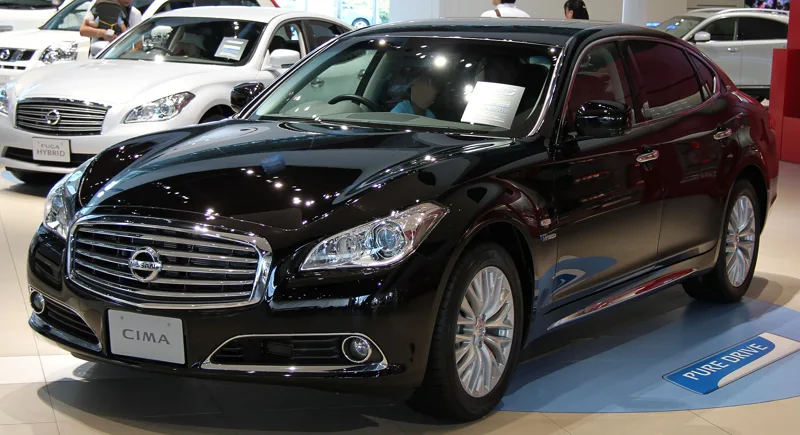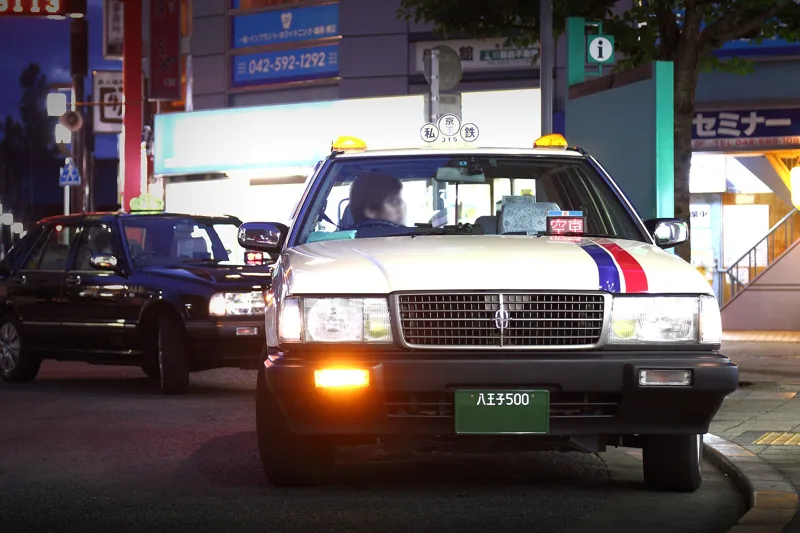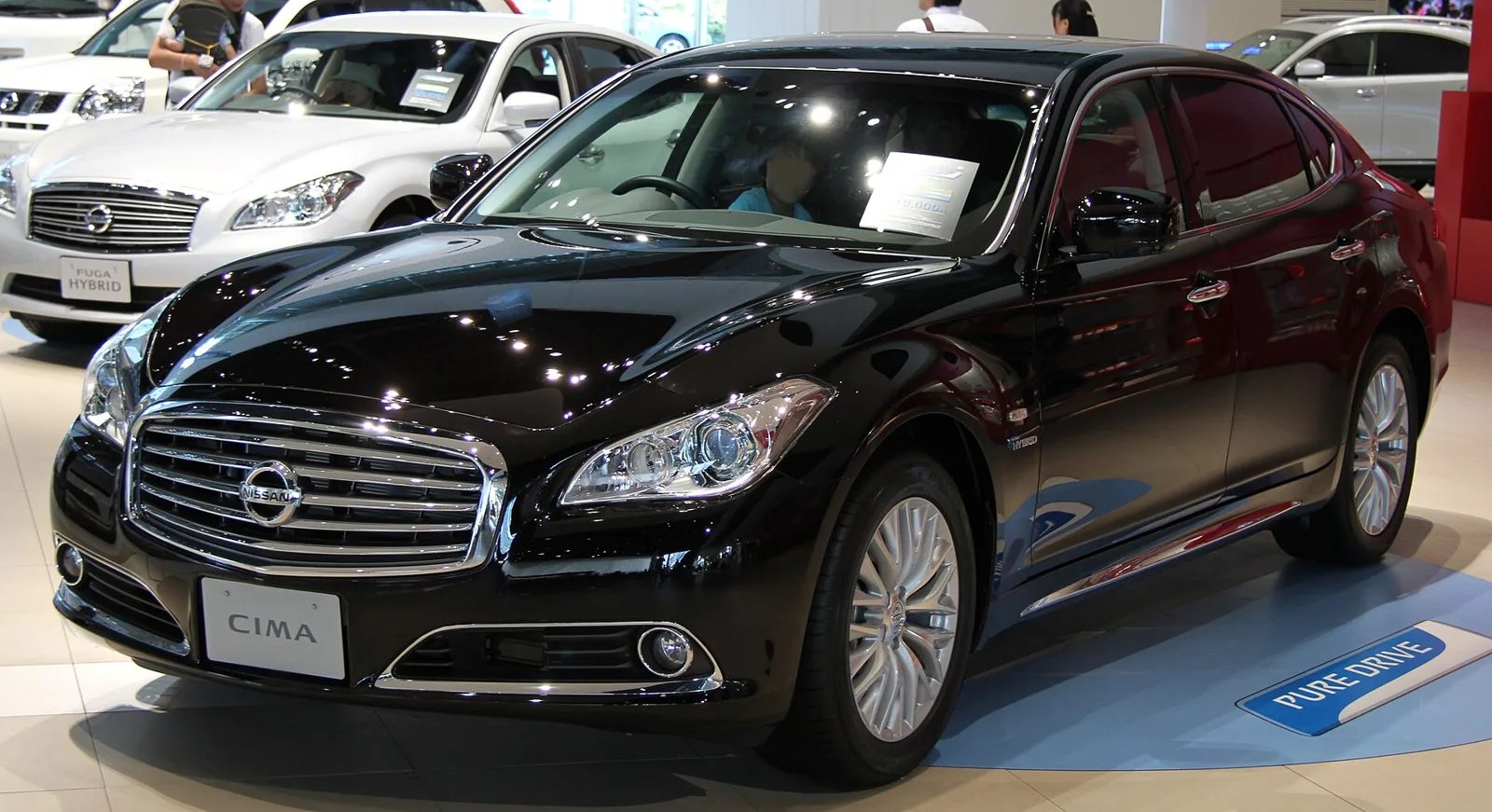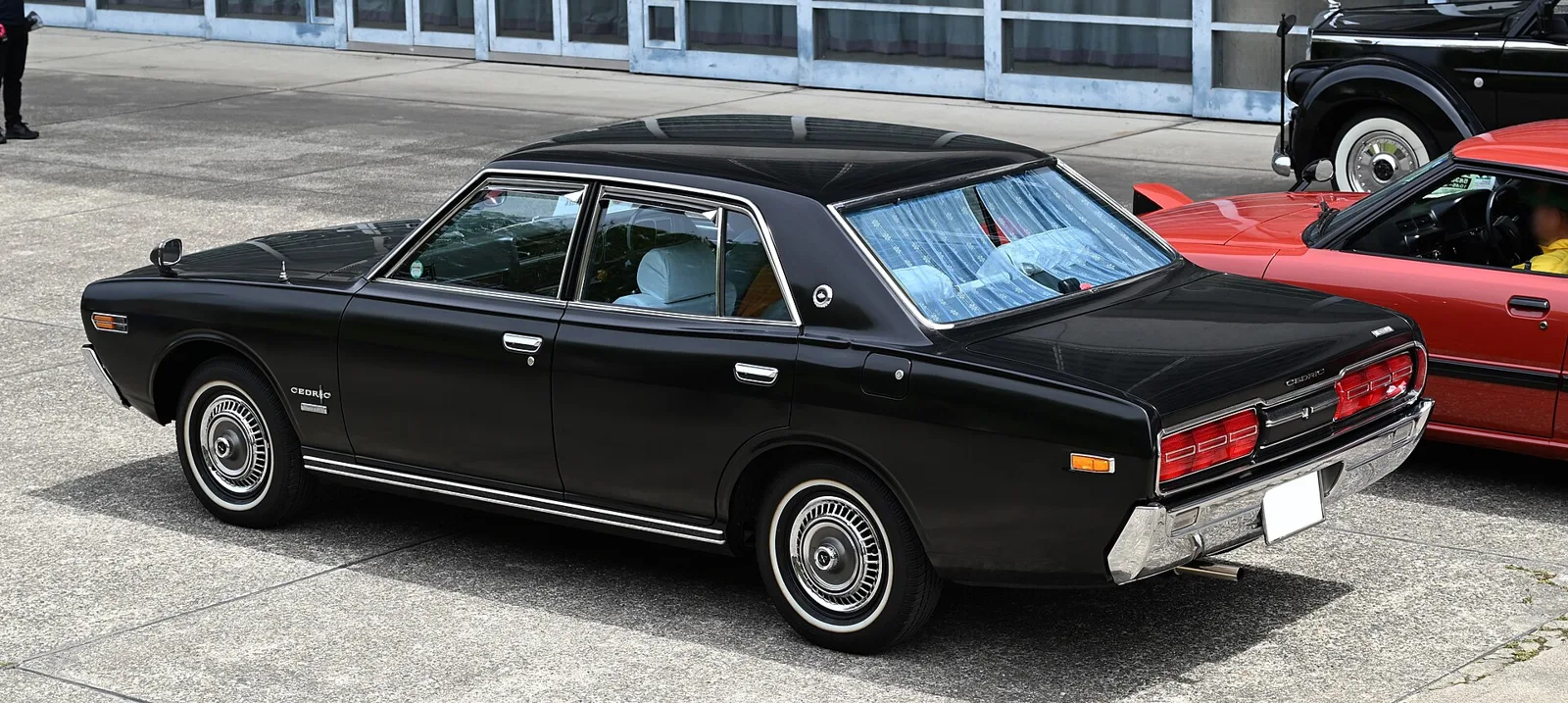
The window-framed four-door version of Nissan's Cedric and Gloria, sold to fleets, taxis and officials.
Nissan's window-framed four-door Cedric and Gloria sedan became badge-engineered sister cars with the 230 series of 1971. Its private-use production ended in August 2002, and commercial versions continued until the last sales in December 2014. The Cedric name itself was used at home and abroad from the Y30 series onward.
The Nissan Cedric/Gloria Sedan is the window-framed four-door version of two sister cars, the Nissan Cedric and the Gloria that came from Prince Motor. Its basic structure was shared from 1971, and the private-use sedan lasted until August 2002, while commercial versions were built until December 2014.
What made the Cedric and Gloria sedan different from the hardtop?
The sedan kept window frames on its doors, while the hardtop was sashless and had no B-pillar. Nissan sold the sedan mainly to corporate buyers and the four-door hardtop to the general public, a split that Toyota Motor later copied with its Crown.
Fleet buyers relied on the sedan heavily. Company cars, official vehicles, police cars, taxis, hire cars and driving school cars all used it. The range then divided into private-use models and commercial taxi-specification versions. This entry concentrates on the private-use cars, while the commercial models have their own separate entry.
Catalogues made the distinction explicit. Four-door models with window frames were called sedans, and the sashless four-door and two-door models were listed as hardtops.
A window-framed four-door that companies, officials and taxi firms relied on, and that the Gloria shared until 1999.
How did the Cedric and Gloria become sister cars?
Nissan Motor and Prince Motor merged, and from the 230 series, launched in February 1971, the Cedric and Gloria were built on one basic structure through badge engineering. Until then, the Prince-derived car had been sold as the Gloria, and the Nissan car as the Cedric.
From the 230 series the body styles grew to three: a four-door sedan with window frames, a sashless four-door pillarless hardtop with no B-pillar, and a two-door pillarless hardtop. The two-door hardtop ended with the 330 series. From the 430 series onward the line-up was a four-door sedan, a four-door hardtop and a wagon or van.
The 230 series also dropped the triangular quarter windows in the front doors. The official name Cedric/Gloria Sedan came later, in June 1991, when the hardtop moved to the Y32 series.
When did the first Cedric go on sale?
The first-generation Cedric, the 30 series, went on sale on 12 April 1960 with a single 1,500 cc (91.5 cu in) engine. A 1,900 cc (116 cu in) Custom version followed in November 1960. In October 1962 a minor change replaced the vertical single row of headlights with a horizontal one, and the car became the H31.
How did the 130 series introduce the L20 engine?
The 130 series went on sale on 21 October 1965 and debuted the well-known OHC inline six-cylinder L20 engine. Only the top Special Six used it; there were also cars with the OHV inline six J20, which disappeared in October 1969.
Changes came steadily. In October 1966 the front grille and tail lamps were redesigned, and the tail lamps changed again in October 1967. The September 1968 major facelift produced the later P130 type, with substantially revised interior and exterior, and the opening triangular windows in the rear doors became fixed.
The October 1969 update upgraded the L20 and moved the wheels from 13 inches to 14 inches. It also introduced two new top grades, the Special GL and the Personal DX, which were equipped with power steering and power windows. In June 1970 Nissan added the Nissan Matic floor-type automatic.
What did the 230 series launch in 1971 add?
The 230 series reached showrooms on 23 February 1971, after the merger of the two makers, and its hardtops followed on 1 April. The sedan with window frames took the name Cedric Sedan or Gloria Sedan, and both cars shared a single basic structure.
In August 1971 the 2600 series arrived with the L26 engine. A June 1972 update added the 2600 Custom Deluxe and Deluxe and dropped the Super Deluxe. A four-door hardtop joined the range in August 1972, which turned the earlier window-frame car into the four-door sedan.
The April 1973 update complied with the emissions rules of that year and brought exterior changes to the 2,600 cc (159 cu in) cars. The sedan's rear turn signal became independent, with an orange lens like the hardtop's, while the Gloria sedan had a horizontal lamp with an orange indicator.
What changed with the 330 series?
The 330 series arrived on 27 June 1975. Its sedan used round quad headlamps, like the four-door hardtop, and the three-number-plate cars grew to 2,800 cc (171 cu in) with the L28 engine. The 2,000 cc cars gained EGI versions, the SGL-E and GL-E, in October 1975 to make up for their lack of power.
The L20E engine in those versions met the 1975 emissions rules. In June 1976 the petrol cars became the 331 type under the 1976 rules, and the late-model version arrived in June 1977.
A 2800E Brougham topped the range, and the SD22 inline four-cylinder diesel powered the 220D GL, 220D Deluxe and 220D Standard models. In November 1978 the 2000 SGL-E Extra was added, complying with the 1978 emissions rules.
Why did the 430 series matter?
The 430 series reached showrooms on 8 June 1979 and introduced the LD28, Japan's first inline six-cylinder diesel, which was based on the L engine. The L28E received the ECCS engine control system, and a model with the L20ET, Japan's first turbo engine, was added in October 1979.
Styling split the range. The Standard used round quad headlamps and half caps, while DX and above had square quad headlamps and full wheel covers. The straight-line six-light window arrangement included a small opera window in the C-pillar. Only the cheapest Japanese-market Standard lacked it, and a resin garnish covered that spot instead.
Police cars (YP430) followed the Standard except for the engine, and only their front bumper took 3-number-plate specification. The April 1981 late model brought a new engine bonnet, revised tail lamps and resin bumpers, but the Standard stayed in the earlier form and continued in production that way.
From April 1981 the L28E rose from 145 PS (143 hp) to 155 PS (153 hp), and ECCS was adopted for the L20E cars as well. In June 1982 an electronically controlled overdrive four-speed automatic with full lock-up became available for the 280E, the 200E Turbo and the 200E.
Overseas 430 Cedrics had headlamps that depended on region. Middle East and South American cars used the same square quad lamps as Japan, while European and Australian cars used the irregular twin lamps that Japan had fitted to the four-door hardtop.
How did the Y30 series change the engines?
The Y30 series, launched on 22 June 1983, replaced the inline six L engine with the V6 VG engine. The six-cylinder LPG version kept the L20 until 1987. The earlier DATSUN 220C, 240C and 260C names gave way to the official Nissan Cedric name, used both at home and abroad.
The Y30 taxi dashboard carried over almost unchanged to the Y31 commercial cars. Diesel cars kept the inline six LD28, a 2.8-litre engine that stayed within the 5-number-plate rules because it was a diesel.
Y30 updates followed quickly. On 9 January 1984 the V30E Brougham VIP arrived as a new top grade for the VG30E-equipped cars, and colour-coded bumpers spread beyond the 3-litre (183 cu in) cars to the V20E GL and above. The VG30ET engine arrived in June 1984 with the Turbo Brougham, and the top grade moved to the V30 Turbo Brougham VIP.
The June 1985 late model replaced the LD28 with the RD28, a diesel based on the RB engine. VG20ET cars rose from 170 PS (168 hp) to 180 PS (178 hp) with a jet turbo. Cornering lamps were added, the NISSAN mark on the boot lid moved from left to right, and tachometers went into the VG30ET, VG30E and VG20ET cars.
Overseas versions also changed. The ASEAN-market Standard swapped its SD23 for the TD25, keeping the inline four. In Mexico, which then had an assembly plant only at Aguascalientes, a police car based on this sedan was adopted, fitted with the VG30ET engine and roughly the equivalent of the Brougham Jet Turbo in Japan. On 5 November 1986 laminated front glass became standard on all cars, and two-point seat belts were added to the centre seats.
What did the Y31 series of 1987 add?
The Y31 series launched on 17 June 1987 and gave every car except commercial vehicles four-wheel independent suspension, using struts with semi-trailing arms, which improved handling stability. A Gran Turismo grade was also introduced, and the sedan is often called the SY31 to tell it apart from the hardtop.
Autech Japan built stretch limousines and Royal limousines. The Royal Selection I, the Royal Selection II with a centre partition, and the Royal Selection III with a centre partition and separate rear seats were offered. Their price was about 1,000 to 1,500 man yen. The column-manual sedan became a commercial-only model.
The June 1988 update added the Gran Turismo SV to the VG20DET cars and a column automatic to the RD28 Super Custom. Automatic cars gained a shift lock system. In June 1989 an intercooler was fitted to the VG20DET, which together with high-octane fuel lifted output from 185 PS (182 hp) to 210 PS (207 hp). A five-speed automatic with electronic control was added as well.
A 150L version, built by Autech Japan with its body lengthened by 150 mm (5.9 in), joined the range in 1989. The VG20DET Brougham became a 3-number-plate car that year and returned to 5-number-plate status in August 1990, when fully automatic air conditioning and a rear audio control unit became standard on the Classic and similar grades.
What was the 1991 major facelift?
On 19 June 1991 the Cedric and Gloria sedans received a major facelift. The opera window in the C-pillar was dropped, the roof's rear edge was extended by 100 mm (3.9 in) and the rear window became more upright. Production was by Nissan Shatai, and the hardtops moved to the Y32 series that year.
The Gran Turismo series, the turbo engines and the five-speed automatic were withdrawn in the same facelift, while the Super Custom gained a tachometer. A 3-number-plate version of the VG20E Brougham was added.
How did the Y31 late models evolve in the 1990s?
The 1993 update moved the odometer and trip meter from the lower part of the speedometer to the centre, and the Super Custom lost its RD28 cars. In 1994 a driver's airbag became standard, and models from the Classic upwards with steel wheels could take a 15-inch aluminium wheel as an option.
The second major facelift came on 22 August 1995. Three-number-plate cars received a new grille, headlamps and bumper, while five-number-plate cars got a new grille, tail lamps and a changed steering wheel. The Super Custom G and keyless entry arrived, and the hardtop changed to the Y33 in June.
ABS became standard on all grades in September 1996. The CNGV compressed natural gas version followed in March 1997. In June 1998 the dashboard was reshaped, passenger airbags and brake assist became standard, and the optional AV monitor grew to 7 inches.
August 1999 brought the Gloria Sedan merger, a zone body and front side airbags as options on petrol cars, and an RD28E diesel. The Brougham diesels and the Classic SV were dropped, leaving only the Classic in that engine line.
When did private-use Cedric production end?
The private-use petrol sedan ended in August 2002. Its indirect replacement was the first-generation Bluebird Sylphy, known as the G10, of that period. Commercial versions continued in production after meeting the emissions rules, leaving only the four-cylinder LPG version in the range.
The last commercial sales took place on 1 December 2014, which ended the Cedric's 54-year history.
Y30 and Y31 engine line-up
| Engine | Displacement | Layout and fuel | Series |
|---|---|---|---|
| CA20P | 2,000 cc (122 cu in) | Inline four, LPG | Y30 |
| L20P | 2,000 cc (122 cu in) | Inline six, LPG | Y30 |
| CA20S | 2,000 cc (122 cu in) | Inline four, petrol | Y30 |
| VG20E | 2,000 cc (122 cu in) | V6, petrol | Y30 |
| VG20ET | 2,000 cc (122 cu in) | V6, petrol, turbo | Y30 |
| VG30E | 3,000 cc (183 cu in) | V6, petrol | Y30 |
| VG30ET | 3,000 cc (183 cu in) | V6, petrol, turbo | Y30 |
| LD28 | 2,800 cc (171 cu in) | Inline six, diesel | Y30 |
| RD28 | 2,800 cc (171 cu in) | Inline six, diesel | Y30 |
| NA20P | 2,000 cc (122 cu in) | Inline four, LPG | Y31 |
| RB20P | 2,000 cc (122 cu in) | Inline six, LPG | Y31 |
| VG20P | 2,000 cc (122 cu in) | V6, LPG | Y31 |
| VG20DET | 2,000 cc (122 cu in) | V6, petrol, twin-cam turbo | Y31 |
| RD28E | 2,800 cc (171 cu in) | Inline six, diesel | Y31 |
| SD23 | 2,300 cc (140 cu in) | Inline four, diesel | Export, early Y30 |
| TD25 | 2,500 cc (153 cu in) | Inline four, diesel | Export, late Y30 and Y31 |
| TD27 | 2,700 cc (165 cu in) | Inline four, diesel | Export, Y31 |
| VG30S | 3,000 cc (183 cu in) | V6, petrol, carburettor | Export, Y30 and Y31 |
Which grades and special models stood out?
Grades across the generations included Standard, Deluxe, Custom Deluxe, GL, SGL, Brougham and, from the Y30, Brougham VIP, with Patrol versions alongside. The early Y30 Excellence was a special version based on the GL, and the Y31 range included the Classic SV and Super Custom G.
China had its own VIP model, named to avoid confusion with the Brougham that existed on American luxury cars sold there. Mexico had a Patrol built on the Brougham, whose wheels were borrowed from the Z31, in addition to the Japanese version based on the Standard.
Why did the sedan matter to Japanese buyers?
The sedan was widely used as a fleet car, bought by companies, government offices, police and taxi operators. Nissan sold the four-door hardtop mainly to the general public, so the same line served corporate buyers and private buyers.