From the 1996 design work to the 2001 launch, the 2006 and 2008 facelifts and the 604 hp SL 65 AMG.
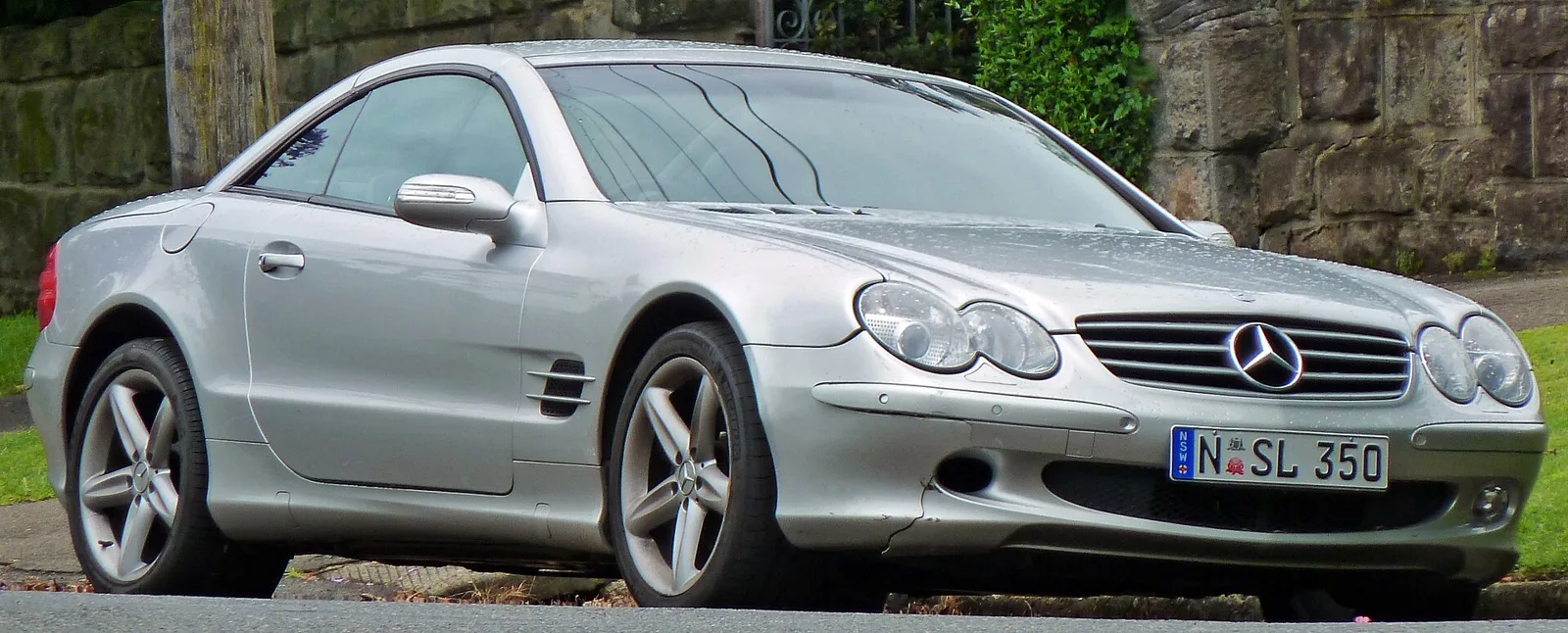
The Mercedes-Benz R230 SL-Class replaced the R129 and was introduced in 2001, with production starting in Bremen that October. It offered V6, V8 and V12 engines across its life, including the 604 hp SL 65 AMG, and was superseded by the R231 in 2011.
The Mercedes-Benz R230 was the SL-Class generation that replaced the R129 at the 2001 Frankfurt Motor Show. Development began in early 1996, and the car was revised in 2006 and 2008 before the R231 took over in 2011. Its engines ran from a 3.5-litre V6 to a twin-turbocharged V12,
When did development of the R230 begin?
Development of the successor to the R129 began in early 1996, when the R129 was already more than six years old. Design work started on 27 January 1996, and ten designers in Germany, California and Japan submitted draft designs.
Hundreds of sketches formed the basis for twelve quarter-scale models, which were digitised so they could be manipulated on a computer. Design then moved along two parallel routes, one in the physical studio and one in a virtual environment.
The studio route centred on traditional 1:4 scale models, most of which began life as clay. The virtual route took place in a room packed with computer processing technology, called the CAVE, short for Computer Aided Virtual Environment.
The final design was approved by the board on 16 June 1997 and refined into production specifications through 1998. Patent applications were lodged in Germany on 9 September 1999 and in the United States on 1 March 2000.
An SL that ran from a 3.5-litre V6 to a twin-turbocharged V12, all from one design begun in 1996.
How did the virtual design room shape the car?
The CAVE was the same facility used earlier to design the W203 in 1995. A supercomputer there produced full-size images of selected designs through five projectors, letting designers inspect every inch of each surface. The process ran alongside the physical models rather than replacing them.
Parallel to the virtual process, the twelve scale models were also scrutinised, and four standouts were chosen to be built as full-size mock-ups.
Interior design evolved alongside the scale models, so the cabin and the body were developed side by side rather than one after the other.
When did the R230 go on sale?
The new SL was unveiled in July 2001, after more than five years of development, and was introduced at the Frankfurt Motor Show that September. Production started on 13 October 2001 at the Bremen plant, and European sales began that November.
The car made its first public appearance as the Formula One Safety Car at the 2001 German Grand Prix at Hockenheim. The street version followed at the 2001 IAA, and the launch was supported by a film-style advertisement called Lucky Star.
The SL kept its folding hardtop. The 2006 revision made the roof quicker to operate, reducing the opening time from 20 seconds to 16 seconds.
What was the 50th Anniversary Edition?
The 50th Anniversary Edition arrived for the 2004 model year to mark 50 years of the SL roadster. Only 500 units were made, and each came in iridium silver metallic with black leather and black ash wood trim. Buyers could choose between two engines.
One option was a 245 PS (180 kW) 3.5-litre V6 with a five-speed automatic. The other was a 5-litre 306 PS (225 kW) V8 with a 7G-TRONIC automatic, and both versions included exclusive twin-spoke rims.
Standard features included a custom luggage bag for the rear shelf and many other options that were fitted as standard. The edition was a clear celebration of the roadster's heritage.
What was the SL 55 AMG?
The SL 55 AMG arrived in 2002 with a three-slat grille in place of the four-slat version used before. Its top speed was limited to 250 km/h (155 mph), and an extension to 300 km/h (186 mph) was available for an additional cost.
The 6.2-litre V8 replaced the earlier engine for the 2009 model year. Mercedes engineers claimed that the car could reach 208 mph without an electronic speed limiter.
On that figure it would have been the quickest car with a conventional automatic gearbox anywhere, until the SLR McLaren arrived in 2003.
How powerful was the SL 65 AMG?
The SL 65 AMG arrived in 2004 with 604 hp (450 kW) at 5500 rpm from a twin-turbocharged 5,980 cc V12. It retailed for $179,720 in 2005 and was the top-of-the-line model after the 2006 facelift.
Mercedes-Benz listed a 0-60 mph (97 km/h) time of 4.2 seconds on its official website. Road tests suggested that the car took under 4 seconds to reach 60 mph (97 km/h) from a standstill.
Car and Driver recorded 60 mph (97 km/h) from a standstill in 3.8 seconds and 100 mph (161 km/h) in 8.2 seconds. Its quarter mile took 11.9 seconds at 123 mph (198 km/h).
How quick was the SL 600?
The SL 600 was the most powerful non-AMG SL, with a V12 that produced 368 kW (500 PS; 493 hp) and 800 Nm (590 lb ft) from 2003 to 2006. For 2007 the output rose to 380 kW (517 PS; 510 hp) and 830 Nm (610 lb ft) of torque.
Mercedes-Benz gave the SL 600 a 0-100 km/h (62 mph) time of 4.7 seconds. Car and Driver's figures were 3.6 seconds to 60 mph (97 km/h) and 8.6 seconds to 100 mph (161 km/h), with a quarter mile of 11.9 seconds at 120 mph (193 km/h).
The SL 600 went out of production in 2011, and from then on the SL 65 AMG was the sole V12 in the R230 and R231 cars.
What changed in the 2006 facelift?
The SL was facelifted at the 2006 Geneva Motor Show with new engines for the SL 350 and SL 500, the SL 550 name in North America and a new top-of-the-line SL 65 AMG. Performance also improved on the SL 55 AMG and the SL 600.
The front bumper gained three large cooling intakes and a sharper V-shape, and the fog lamps had chrome surrounds. New light-alloy wheels and a new rear light completed the exterior changes.
The cabin got softer leather, fresh interior colours, metal door sills stamped with the Mercedes-Benz name and a removable luggage cover. A remote boot-lid release was offered as an option.
A new 7-speed 7G-Tronic automatic came with the new engines. The Sport option made manual shifts up to 30% quicker in M mode, and steering-wheel paddles were added.
How did Active Body Control work?
Active Body Control, or ABC, was improved in 2006 to reduce body movements in dynamic driving by up to 60%. It was standard on all models except the SL 350, and it relied on a high-pressure hydraulic pump with four hydraulic struts.
The hardware included a high-pressure pump, four sensor-equipped hydraulic struts, accumulators, a pulsation damper, valve blocks and a fluid reservoir. Working pressure was above 200 bar.
Owners had to keep the system serviced. The hydraulic fluid and filter had to be replaced every two years or 20,000 km.
What did the 2008 facelift change?
The facelifted SL was revealed at the Geneva Motor Show in March 2008 with a more aggressive front end. It had two long powerdomes on the bonnet and a single-bar grille in place of the earlier three-bar design, and the engines were updated.
The SL 350's 3.5-litre V6 was uprated to 311 PS (229 kW; 307 hp) at 6500 rpm, a 16 percent gain over its predecessor. Torque rose from 350 Nm to 360 Nm (266 lb ft).
The V6 could rev to 7200 rpm for periods, and it had a higher compression ratio, a new intake manifold and lighter valve-train parts. Fuel use did not suffer, with the SL 350 returning 9.9 litres per 100 kilometres, 0.4 litres better than the earlier 200 kW car.
The entry-level SL 280 was added with a 170 kW (231 PS; 228 hp) six-cylinder, with 300 Nm (221 lb ft) arriving at 2500 rpm. It reached 100 km/h (62 mph) in 7.8 seconds, with NEDC fuel use of 9.4 L/100 km. The AIRSCARF heating system, which also appeared in the SLK, was fitted.
What was the SL 63 AMG?
The facelifted SL 63 AMG replaced the 5.4-litre M113 V8 with the 6.2-litre M156 V8 used across AMG models, producing 525 PS (386 kW; 518 hp) at 6800 rpm and 630 Nm (465 lb ft) of torque at 5200 rpm.
The SL 63 AMG reaches 100 km/h (62 mph) in 4.6 seconds and is limited to 250 km/h (155 mph). The engine was built by Mercedes-AMG, and the car carried a new AMG-developed 7-speed transmission.
A modified SL 63 was the Formula One Safety Car for the 2008 and 2009 seasons.
How did the SL 63 AMG transmission work?
The AMG SPEEDSHIFT MCT 7-speed used no torque converter. Instead it had a compact wet start-up clutch and could double-declutch under computer control. It offered four modes, C, S, S+ and M, and shifts took 100 milliseconds in manual mode.
The name MCT stands for Multi-Clutch Technology, which refers to the multiple clutches and bands a planetary automatic uses for each gear. In effect the MCT was a 7G-Tronic unit with the torque converter removed.
The AMG DRIVE UNIT acted as the central control unit for the transmission and the car's driving dynamics. Race Start was a launch control system that maximised acceleration while keeping traction at the driven wheels.
Drivers could shift using the new AMG selector lever or the steering-wheel paddles.
What was the SL 63 AMG Edition IWC?
The Edition IWC was a limited run of 200 SL 63 AMG cars, finished in Designo Magno Kashmir white. Deliveries began in November 2008, after sales opened that autumn, and each car came with a Grosse Ingenieur watch from the Swiss maker IWC Schaffhausen.
Equipment included an AMG exterior carbon package with a matte surface, an interior carbon matte trim and Tobago Brown nappa leather upholstery. The AMG Performance package was also fitted as part of the specification.
What was the SL 65 AMG Black Series?
The Black Series was the high-performance SL 65 AMG, unveiled in Monterey in 2008. Its turbochargers were 12% larger, and the car produced 58 PS (43 kW; 57 hp) more than the standard model while weighing 250 kg (551 lb) less.
Carbon fibre composite panels cut weight, and the folding roof was dropped for a fixed roof. That change freed space for a retractable rear spoiler, along with a rear apron with diffuser fins.
Figures quoted for the car were a limited top speed of about 200 mph (322 km/h) and 0-100 km/h (62 mph) in 3.8 seconds. The AMG Speedshift Plus five-speed automatic offered C, S, M1 and M2 modes, and its gearshift times were 25 percent quicker than in M1.
The front axle track was 97 mm wider than the regular model and the rear was 85 mm wider. A KW coilover suspension set-up was developed for the car, and the front tyres were fitted to 19-inch AMG alloys.
Production totalled 350 cars, with half of them destined for the US market.
What other special editions did the R230 receive?
Several limited editions were built, including the 2007 50th Anniversary SL 550, the Night Edition for the 2011 model year and the Grand Edition that marked the anniversary of Karl Benz's invention of the automobile.
The 2007 50th Anniversary SL 550 was finished in pewter with burgundy leather, black ash wood trim, 18-inch double five-spoke wheels and matching luggage. Accounts differ on the build total, with figures of 75, 500 or 550 quoted.
The Night Edition was finished in matte black, with 19-inch AMG five-spoke wheels in a two-tone finish and black nappa leather with chrome trim. Only 100 cars were made for the 2011 model year.
The Grand Edition was offered on the SL 300, SL 350 and SL 500. The SL 350 version added titanium 19-inch AMG wheels, chrome exhaust tips and a nappa leather interior, while the Japan model went on sale on 5 August 2011.
When did the R230 end production?
The R230 was superseded by the R231 SL-Class in 2011, after revisions in 2006 and 2008. The SL 600 went out of production that year, which left the SL 65 AMG as the sole V12 across the two generations.
The V12 ran from the SL 600 of 2003 through to the SL 65 AMG. Across its life the R230 used V6, V8 and V12 engines.
What are the key R230 specifications?
| Model or item | Key figures |
|---|---|
| Generation | R230, introduced 2001, superseded by the R231 in 2011 |
| Development | Design work from 27 January 1996; final design approved 16 June 1997 |
| Production start | 13 October 2001, Bremen plant |
| SL 280 | 170 kW (231 PS; 228 hp); 300 Nm (221 lb ft) at 2500 rpm; 0-100 km/h in 7.8 seconds |
| SL 350 | 3.5-litre V6, 311 PS (229 kW; 307 hp) at 6500 rpm; 9.9 litres per 100 km |
| SL 600 | 368 kW (500 PS; 493 hp) and 800 Nm (590 lb ft), 2003 to 2006; 380 kW (517 PS; 510 hp) from 2007 |
| SL 55 AMG | Limited to 250 km/h (155 mph), extendable to 300 km/h (186 mph) |
| SL 63 AMG | 525 PS (386 kW; 518 hp) at 6800 rpm; 0-100 km/h in 4.6 seconds |
| SL 65 AMG | 604 hp (450 kW) at 5500 rpm from a 5,980 cc twin-turbo V12 |
| SL 65 AMG Black Series | 350 built; 250 kg (551 lb) lighter; about 200 mph (322 km/h) |