An XJS-derived grand tourer with a 4.0-litre V8, a supercharged XKR, a run of limited editions and 90,064 cars built by 2005.
The Jaguar XK8, project code X100, was a grand tourer launched in 1996 with a 4.0-litre V8 in coupe and convertible form. The supercharged XKR followed in 1998, the engines grew to 4.2-litres in 2002, and 90,064 XKs were built by 2005.
The Jaguar XK8, project code X100, is a grand tourer that Jaguar launched in 1996 as the first generation of a new XK series. It was offered as a two-door coupe or convertible with a 4.0-litre V8, and the supercharged XKR followed in May 1998. The car shares its XJS-derived platform with the Aston Martin DB7, and Jaguar built 90,064 examples before production ended in 2005.
Where did the XK8 come from?
The XK8 traces its roots to the XJ41 coupe and XJ42 convertible, two mid-1980s studies that were cancelled after Ford's 1989 takeover of Jaguar. Those studies later evolved into both the XK8 and the Aston Martin DB7, and the production car went on sale in October 1996 after development began in 1992.
Jaguar had concluded by 1982 that the XJ-S had grown too large and heavy to be a proper successor to the E-Type, so the first stylistic work on the XK8 dates from as far back as that year. The XJ41 and XJ42 projects reached an advanced state of development before the change of ownership.
Design work started in late 1991, and a design was chosen by October 1992 and frozen for production in 1993. Engineers began building prototypes in December 1993, once the project had formal sign-off, and patent applications for the design followed in June 1994.
The programme wrapped up in 1996. Its debut came in March that year, and showroom sales started in October 1996 on the XJS-derived platform.
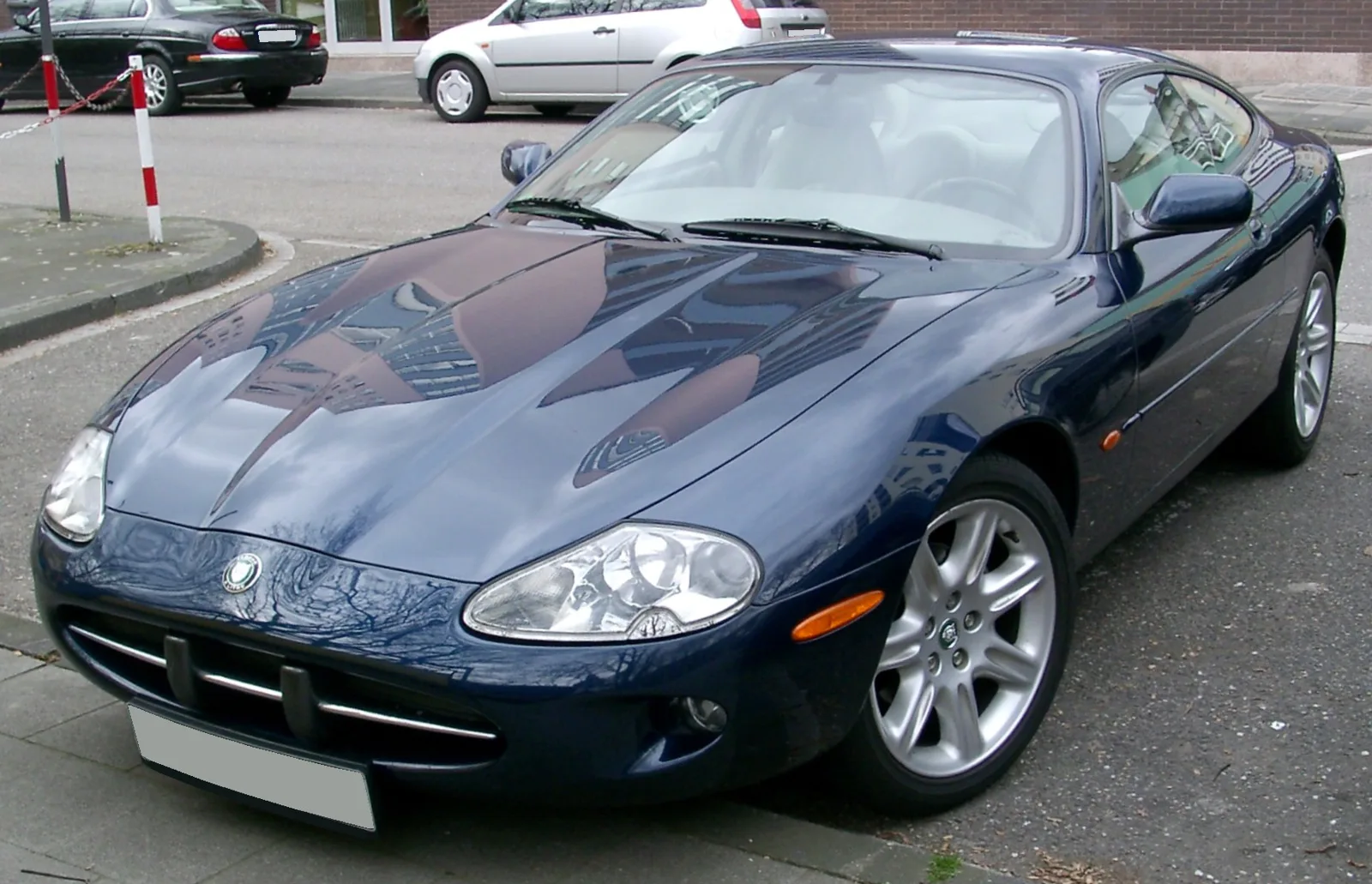
The first XK grand tourer, built on a platform shared with the Aston Martin DB7.
How did Ford's takeover affect the XK8 project?
Ford Motor Company took over Jaguar in 1989, and the new management judged that upgrading the company's dated production facilities was the higher priority. The XJ41 and XJ42 projects were cancelled, and the XJ-S received a major facelift and was renamed the XJS as a stop-gap solution.
Keeping the XJS in production with a facelift bought the company time. The XJ41 and XJ42 studies ultimately evolved into the Aston Martin DB7 and the XK8, which launched in 1994 and 1996 respectively, so the coupe and convertible ideas survived in two separate cars.
What engines did the XK8 and XKR use?
The XK8 used a new 4.0-litre 32-valve Jaguar AJ-V8 engine. The XKR, introduced in May 1998, used a supercharged version of the same V8, and in 2002 both models were enlarged to 4.2-litres.
The blower is an Eaton unit of 1.8 L (112 cu in), a size it shares with the Ford F-150 SVT Lightning pickup. It turns at 1.9 times engine speed. The XKR also received bonnet louvres, a small rear spoiler and a meshed front grille to set it apart from the XK8.
The 4.2-litre AJ34 engines arrived in 2003 in both naturally aspirated and supercharged forms, replacing the earlier units. Buyers could therefore choose between the two power levels in the same body styles, with the supercharged car carrying the XKR badge.
How did the XK8 handle and ride?
The XK models are 25 per cent stiffer than the XJS they followed, and they borrow a second-generation independent rear suspension from the XJ40 saloon. Adaptive CATS suspension came first as an option on the coupe, and the convertible received it in 1997.
Servotronic II power steering was fitted to all models from 1998. Jaguar's Adaptive Cruise Control, introduced in late 1999, was optional on both models. From 2000, GPS was available on all XK models and replaced the three gauges on the centre console.
Early cars used a ZF 5HP24 five-speed automatic with the 4.0-litre engine and a Mercedes W5A580 five-speed with the supercharged version. From 2002 both 4.2-litre models received the ZF 6HP26 six-speed automatic.
The XK8 came standard with 17-inch alloy wheels, while the XKR had 18-inch wheels as standard. Options included 19-inch and 20-inch wheels. On the XKR, the tyres were Pirelli P Zero units, 245/45ZR-18 at the front and 255/45ZR-18 at the rear. Both models were held to 250.1 km/h (155.4 mph) electronically.
Which limited editions did Jaguar build?
Jaguar built several limited runs of the XK, including the XKR Silverstone, the XKR 100, the 4.2-S, the Carbon Fibre Edition and the Victory Edition. Silverstone cars totalled 558 across two phases, while the Victory Edition reached 1,050 cars.
The Silverstone celebrated Jaguar's 2001 entry into Formula One. It used the XKR engine with better transmission, steering, suspension and brakes. The Brembo 4-piston brakes with aluminium callipers stopped the car from 97 km/h to 0 in 103 feet (31 m), and the cars wore 20-inch silver BBS wheels with a platinum paint finish that was available only on that model.
Phase one was based on the model year 2000 XKR and planned 100 cars for the UK, but 102 were built, all with right-hand drive. Phase two was based on the 2001 model year, was built in 2000 and totalled 456 cars. Phase two cars were available in both right and left-hand drive.
The XKR 100 marked the centenary of Jaguar's founder, and 500 coupes and convertibles were built in 2002 in combined total. It came with Anthracite paint, Recaro seats, 20-inch BBS alloy wheels, Brembo brakes and dark wood dashboard panels.
Jaguar showed the 4.2-S at the Geneva Motor Show on 1 March 2005. It was the final XK built on the 1996 original's design. Production was limited to 200 cars. The electronic limiter was removed so the car could reach 280 km/h (174 mph), and it had 20-inch BBS Perseus wheels with cross-drilled Brembo discs.
The Carbon Fibre Edition was among the most restricted of all, with 100 released in the UK in late 2004 and 200 built for the USA in 2005. The XK8 convertible was the only configuration, and carbon fibre replaced the usual wood on the dash, console and door elements. Jaguar quoted 0-60 mph in 6.3 seconds for its 294 horsepower 4.2-litre V8.
The Victory Edition was introduced at the 2005 Los Angeles International Auto Show to celebrate four Trans-Am championship wins in the North American road racing series. It was offered for model year 2006 on all four XK models, and 1,050 cars were built.
A 1997 XK8 special edition was offered in the 1996 Neiman Marcus Christmas catalogue, an early sign of the model's special-edition appeal.
What was the XKR-R concept?
The XKR-R was a 2001 concept that was very similar to the production XKR, built as a test bed for future Jaguar models. It used a 336 kW (451 hp) engine, a limited-slip differential and a six-speed manual transmission.
Two cars were made: an open-top show car for the public and a functional coupe test car. The test car had a carbon fibre trim interior like the show car, along with Recaro racing bucket seats and six-point harnesses.
Tiff Needel, a motoring journalist, drove the XKR-R test car on Top Gear in 2001.
How many XK8 and XKR cars were built?
Jaguar built 90,064 XKs between 1996 and 2005. The XK8 convertible was the largest group at 46,760 cars, and production of the XK8 and XKR ceased on Friday 27 May 2005.
The breakdown was 19,748 XK8 coupes, 46,760 XK8 convertibles, 9,661 XKR coupes and 13,895 XKR convertibles. Because of US import and registration rules, several Carbon Fibre Editions were registered as 2006 models in the USA even though the production run had already ended.
How did reviewers judge the interior?
Top Gear presenter Jeremy Clarkson likened the original XK8 interior to sitting inside Blenheim Palace. Other reviewers were less impressed, criticising the high seating position and the gauge layout.
Two interior trims were offered. The sport trim, designed by Karen Anderson, was aimed at younger buyers and used cloth seats with leather upholstery. The classic trim was the more luxurious option and relied heavily on leather.
The XK models kept the 2+2 seating layout of the XJS. Both body styles came with burl walnut trim and side airbags as standard.
What are the Jaguar XK8 specifications?
| Specification | Detail |
|---|---|
| Type | Two-door grand tourer, coupe or convertible, 2+2 seating |
| Launch | Unveiled March 1996; on sale from October 1996 |
| Engine (XK8, 1996) | 4.0-litre 32-valve Jaguar AJ-V8 |
| Engine (XKR, 1998) | Supercharged V8 with a 1.8 L (112 cu in) Eaton supercharger |
| Engine (from 2002) | 4.2-litre, with AJ34 units from 2003 |
| Gearbox | ZF 5HP24 five-speed to 2002; ZF 6HP26 six-speed from 2002 |
| Top speed | Electronically limited to 250.1 km/h (155.4 mph) |
| Standard wheels | 17-inch alloys (XK8); 18-inch (XKR) |
| XKR tyres | Pirelli P Zero 245/45ZR-18 front, 255/45ZR-18 rear |
| Carbon Fibre Edition | 294 horsepower 4.2-litre V8; 0-60 mph in 6.3 seconds |
| Production, 1996-2005 | 90,064 cars |