Eight-cylinder Horch luxury cars from Zwickau, built through the Daimler and Fiedler eras with a range that grew and shrank in quick succession.
Built from 1926 to 1935, the Horch 8 family came from Zwickau and took its name from a new eight-cylinder engine. Its first model, the 303, arrived with twin overhead camshafts and servo brakes. The 350 became the best-selling model with 2,855 units.
The Horch 8 was a family of luxury cars that the Zwickau maker built from 1926 to 1935. Its name came from the new eight-cylinder engine that launched the line, and that engine lifted Horch a step above its earlier cars. Over the decade the family spread into many wheelbases and bodies before the economic crisis took hold.
Where did the Horch 8 family come from?
The family grew out of a production plan that followed Moritz Straus's arrival in 1920 and Paul Daimler's in 1922. The aim was to shrink the catalogue to a single model, and the first step was the 10M20, designed earlier by Arnold Zoller. The 10M25 that replaced it stayed in production until 1926, when Horch was ready for the next step.
Germany still lacked eight-cylinder engines even though its car makers were famous for prestige. Eight cylinders were regarded as the peak of technical refinement, and an eight-cylinder Horch would have placed the Zwickau company even more firmly among the nation's great luxury names.
The eight-cylinder Horch aimed at the top of German luxury, and the range that followed tested that ambition model by model.
When was the first Horch 8 introduced?
The 303 was the first Horch 8. It was shown at the Berlin Motor Show, which ran from 29 November to 7 December 1926, and series production began on 2 January the following year, once the eight-cylinder engine was finalised. It was the first German eight-cylinder.
The 303 rode on a steel chassis carried over from the 10M25 with only detail changes. Solid axles remained at both ends, but the rear switched from a cantilever leaf arrangement to semi-elliptic springs. The wheelbase was 3.45 m (11.3 ft), and the model was also known as the 12/60 PS.
What made the Horch 8 engine different?
The inline eight was unusually compact, with the whole unit only 880 mm long. A long stroke, paired cylinders sharing liners and water jackets, Alusil pistons and inclined valves all contributed to that packaging, and battery ignition replaced the older magneto. Many of these ideas were well ahead of their time.
Long stroke and paired cylinders
The stroke measured 118 mm against a 65 mm bore, a proportion that allowed the block to be shortened. Each pair of cylinders shared one stretch of water jacket, which saved both size and weight. The pistons were made from Alusil, an aluminium and silicon alloy, closely related to a material that BMW would adopt decades later for its engines, although the cylinder liner technique was different.
Valves, combustion and friction
Twin overhead camshafts were driven by two vertical shafts, a layout that very few makers used at the time and then almost only in competition. The piston crowns were concave, and the valves were inclined at 13 degrees, which gave a combustion chamber close to a hemisphere. Engineers also worked hard to cut friction so that thermal efficiency would improve.
What did the 303 chassis and brakes include?
The 303 sat on a steel frame derived from the 10M25 and used drum brakes of 401 mm on all four wheels, assisted by a Dewandre vacuum servo. Its engine was a 3,132 cc unit fed by a vertical MOV carburettor. That servo put the car among the first in the world with servo-assisted brakes.
The engine gave 60 PS (44 kW; 59 hp) at 3,200 rpm, enough for 100 km/h (62 mph). Before owners could reach that speed, the engine went through a running-in routine that forbade more than 50 km/h for the first 1,500 km and 70 km/h in a second stage. The four-speed gearbox worked with a dry multi-plate clutch.
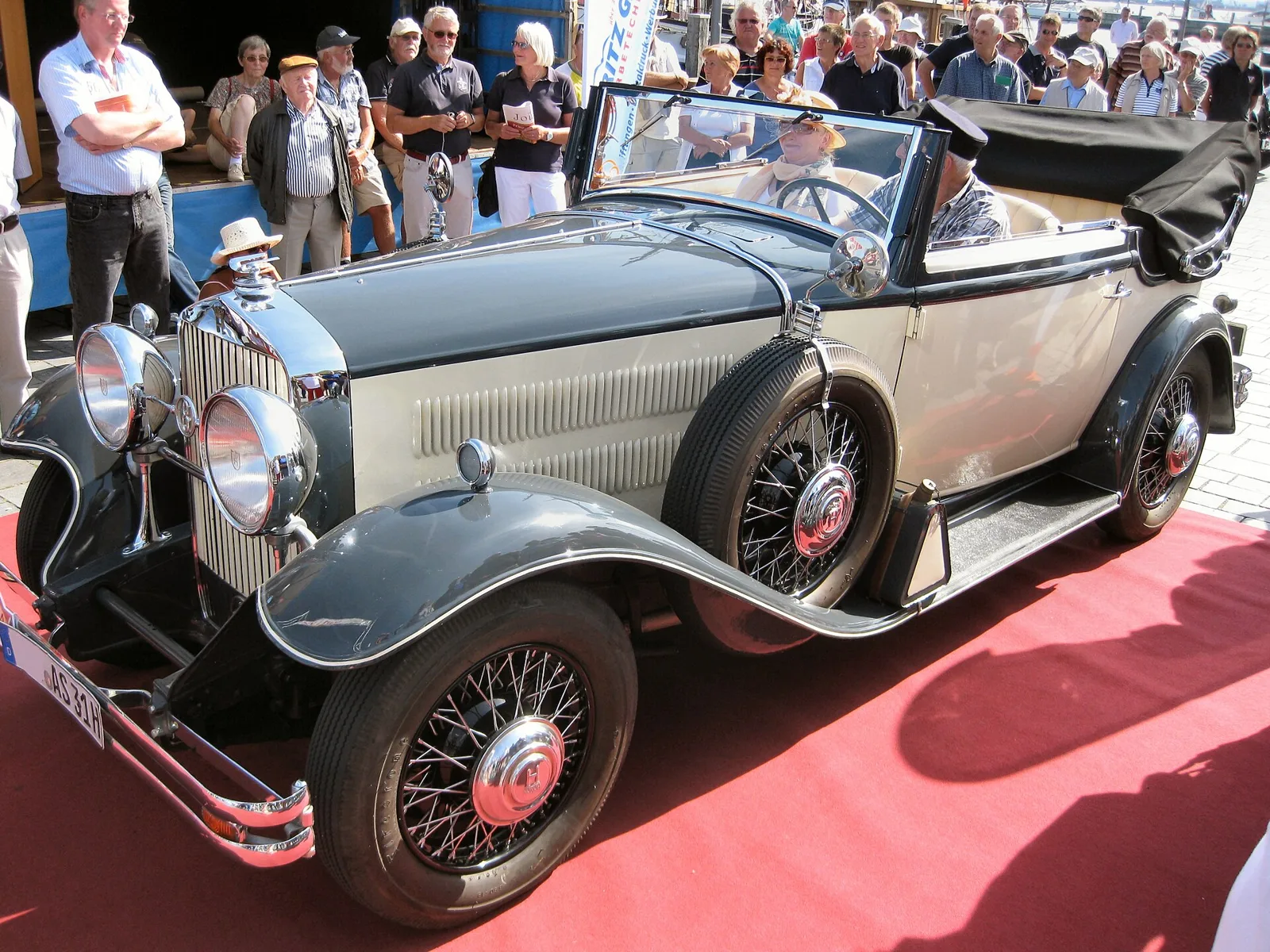
Buyers could order a six-seat torpedo body, a pullman limousine or a pullman cabriolet on the 3.45 m (11.3 ft) chassis. Those who wanted only a bare chassis could have it fitted with coachwork of their own choosing.
How did the 304 and 305 extend the line?
The 304 arrived a few months after the 303 with the same engine on a shorter 3.16 m (10.4 ft) chassis. The short wheelbase suited sportier bodies, from a two-seat roadster to a two-door cabriolet, and a Weymann limousine with hydraulic shock absorbers was also offered.
At the end of 1927 both gave way to the 305 and 306. The bore grew from 65 to 67.5 mm, giving 3,376 cc (206.0 cu in) and 65 PS (48 kW; 64 hp) at 3,200 rpm, although performance barely moved. The 306 gained a four-seat Weymann cabriolet.
A single new model, the 350, replaced both at the end of 1928 in two wheelbases. Its bore rose to 73 mm, lifting displacement to 3,950 cc (241.0 cu in) and output to 80 PS (59 kW; 79 hp), and the top speed could reach 110 km/h (68 mph). The torpedo body and the bare chassis disappeared from the price list. The six-seat limousine and six-seat cabriolet stayed on the long chassis, while short-wheelbase cars could be ordered only as four-seat cabriolets.
Bodywork followed American fashion, which was also selling in several European markets, including Germany, and posed a real threat to models from the Continent. Larger and heavier bodies, especially on the long chassis, brought no gain in performance.
Which Horch 8 sold best?
The 350 was the best-selling of the Horch 8s, with 2,855 units produced from its 3,950 cc engine and 80 PS. Its triumph faded quickly once the great economic crisis broke out at the end of the decade, and the long-wheelbase 350 gave way to the 375.
The 375 arrived in November 1929, only days after the Wall Street crash. It had a lowered frame and a wider track for better stability in corners, new steering, bumpers with three horizontal strips, and the winged sphere badge on the radiator. Its engine kept 4 litres and 80 PS, but received a new carburettor. The short-wheelbase 350 was replaced by the 400, a shorter 375 with a single-plate clutch and a 3-speed gearbox aimed at a lower price. Some 400s were fitted with bodywork and equipment for the German police. The 400 came only as a four-seat limousine and as a two-door, four-seat cabriolet.
How did Fritz Fiedler change the Horch 8?
Fritz Fiedler became technical director when Paul Daimler retired at the end of 1929. His brief was to cut production costs, so he dropped some of Daimler's refined solutions in favour of simpler engineering, starting with a single camshaft in place of the twin-cam layout.
Daimler's engines had a very long stroke that favoured torque. Fiedler's engines cut the stroke from 118 to 104 mm, and the bore went to 87 mm in the first model of the new generation. A crankshaft with 10 main bearings instead of 5 was another notable change.
The first Fiedler-era car was the 500 of September 1930. Its single-overhead-camshaft engine displaced 4,944 cc (301.7 cu in) and produced 100 PS (74 kW; 99 hp) at 3,400 rpm, with a 4-speed gearbox and a single-plate clutch. The 500 reached 120 km/h (75 mph) and came as a six-seat limousine or cabriolet.
In December 1930 the 405 entered the catalogue as a simplified 375 without the servo brake, though it kept the multi-plate clutch and 4-speed gearbox. It ran through most of 1931 alongside the 400, and its end marked the close of the Horch 8s conceived under Daimler.
Why did the Horch 8 range become so complicated?
Between September 1930 and the end of 1931 the range grew faster than it could be described. The 410, 450, 420, 470, 440 and 430 each joined within months, engines ran from roughly 3 litres to 5 litres, and the gearboxes came in 3-speed, 4-speed and ZF forms. The result was a list in which several models shared an engine.
By February 1931 the list read as follows: the 400 and 405 with twin-cam 3.9-litre engines, the 410 with a single-cam 4-litre, the 420, 450 and 470 with single-cam 4.5-litre engines, and the 500 with a single-cam 5-litre. The 410 and 450 had appeared in January 1931, with single-overhead-camshaft engines of 4,014 cc (244.9 cu in) and 4,516 cc (275.6 cu in). They produced 80 PS (59 kW; 79 hp) and 90 PS (66 kW; 89 hp), with top speeds of 105 km/h (65 mph) and 115 km/h (71 mph). The 440 followed in July as a 410 with a 4-speed gearbox, but only on the long chassis.
In September 1931 the economy 430 joined, using a de-bored version of the new single-cam engine at 3,009 cc (183.6 cu in), later raised to 3,131 cc (191.1 cu in). It made up to 65 PS (48 kW; 64 hp) and reached 100 km/h (62 mph). Its list price matched the 410, but tax and fuel bills were lower.
In September 1931 nine models were on sale at once, and by the end of that year the two twin-cam models were withdrawn to leave room for the newer engines. Seven models remained, and Moritz Straus's goal of a one-model range had clearly failed.
Soon afterwards the 480 joined the 500 with the same 5-litre engine and the 470's gearbox, the 500 A received minor updates, and in spring 1932 the 710 and 720 arrived as long-wheelbase versions of the 410 and 420.
Horch 8 models at a glance
| Model | Introduced | Engine | Output | Top speed |
|---|---|---|---|---|
| 303 | 1926 | 3,132 cc (191.1 cu in) | 60 PS (44 kW; 59 hp) | 100 km/h (62 mph) |
| 350 | End of 1928 | 3,950 cc (241.0 cu in) | 80 PS (59 kW; 79 hp) | 110 km/h (68 mph) |
| 410 | January 1931 | 4,014 cc (244.9 cu in) | 80 PS (59 kW; 79 hp) | 105 km/h (65 mph) |
| 450 | January 1931 | 4,516 cc (275.6 cu in) | 90 PS (66 kW; 89 hp) | 115 km/h (71 mph) |
| 500 | September 1930 | 4,944 cc (301.7 cu in) | 100 PS (74 kW; 99 hp) | 120 km/h (75 mph) |
| 430 | September 1931 | 3,009 cc (183.6 cu in), later 3,131 cc (191.1 cu in) | 65 PS (48 kW; 64 hp) | 100 km/h (62 mph) |
How did the Horch 8 family end?
The range shrank as the Auto Union era began. The 420 left the catalogue in August 1932 and was replaced by the 750, which had hydraulic brakes. Two months later the 440 went out of production, and the 430 and 410 disappeared the following spring and summer, with the 830 taking over from the 430.
Horch was then preparing to come under the control of DKW and become one of the four rings of Auto Union. By the end of summer 1933 the range comprised the 710 with a 4-litre engine, the 720 and 750 with 4.5-litre engines, and the 500 B and 780 with 5-litre engines. In November 1933 the 710, 720 and 750 were withdrawn, and the 750 B replaced the 750 with minimal changes. The 780 also left the scene. The 500 B and 780 had also swapped mechanical brakes for hydraulic ones.
The 750 B lasted until February 1935, and the 500 B was cancelled in June. Those two last models were replaced by the 850, which carried a 5-litre engine, and the Horch 8 story came to an end.
Why does the Horch 8 still matter?
The Horch 8 matters because it brought eight cylinders, servo brakes and a set of advanced engine ideas to German luxury cars in the late 1920s. Its compact block and Alusil pistons pointed to priorities that car makers would later treat as basics. In its home market it signalled Horch's ambition to stand with the country's leading luxury names.
The family also reflects the turbulence of its era. Two technical directors gave it different characters, a policy to slim the range failed, and Horch was about to pass under DKW control as the family went into decline. What remains is a clear record of how a Zwickau maker tried to reach the top of the market with an eight-cylinder engine.