Poland's answer to the Polski Fiat 125p, a front-drive five-door hatchback built only as prototypes before talks and money ran out.
The FSO Wars was a compact five-door hatchback developed by Poland's Passenger Car Factory between 1981 and 1985 as a successor to the Polski Fiat 125p. Two prototypes were shown in Warsaw in 1986, but work stopped when money ran short and licence talks with FIAT had advanced.
The FSO Wars was a Polish compact car that stayed a prototype. Developed between 1981 and 1985 to succeed the Polski Fiat 125p, it had front-wheel drive, a transverse engine and a five-door body. Two prototypes were shown in Warsaw in October 1986, but the project was stopped because money was short and talks with FIAT had moved ahead, so it never reached series production.
Why did FSO need a new compact car in the early 1980s?
By the start of the 1980s the cars that FSO built differed considerably in engineering from their Western European rivals. The Polski Fiat 125p, made since 1967, was the main product, and its later modernisation was to be cut back sharply. In May 1981 the factory set out a plan for a modern compact hatchback with front-wheel drive, sized to cut manufacturing outlay by about 30%.
The Polonez was to continue as well, but only after significant changes that would make it more attractive, lift its technical standing and lower the cost of building it. The new compact was to offer roughly the performance of the 125p, with considerably lower fuel use and a less complex design that made production easier.
A handful of prototypes, a licence search and a factory that could not fund the last step.
What were the three routes to a new FSO car?
Three options were weighed. The first was to buy a licence. The second was to form a joint stock company with a foreign car concern. The third was to design a new car independently. The first and third options were seen as the most promising, so the hunt for a foreign licensor and the in-house design went forward together.
A licence brought a practical advantage that the other routes did not. It could open up credit from abroad given the financial limits of the domestic industry. The plan would have allowed the factory to turn out as many as 200 thousand cars a year.
How did the Wars design work begin?
The design team began work on the body in November 1981, when a first plaster model at a scale of 1:5 was produced with interchangeable front and rear sections. In April 1982 that model was tested in the wind tunnel of the Institute of Aviation in Warsaw. A second 1:5 model followed in May 1983, and a full-size mock-up was completed two months later.
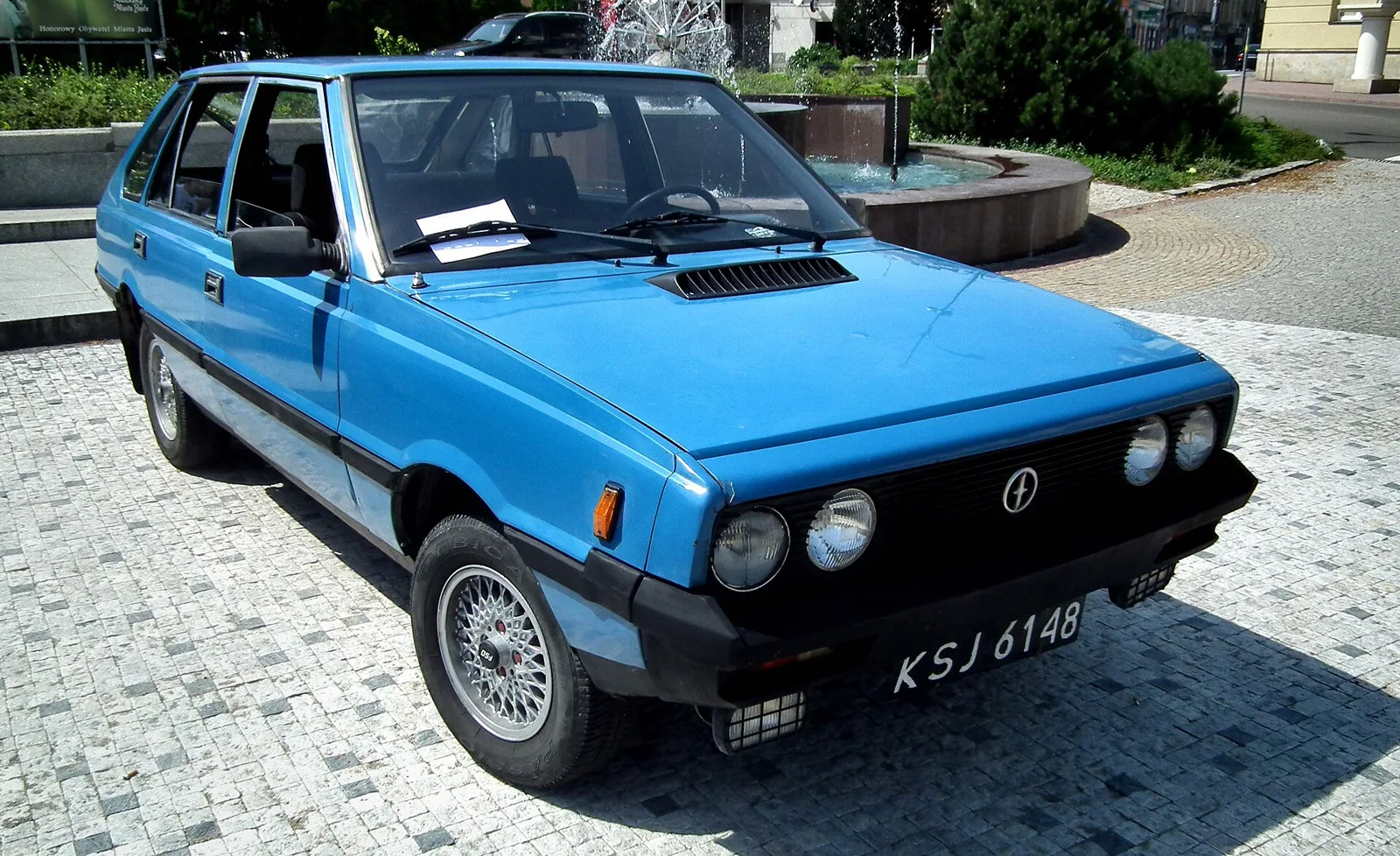
A team under Miroslaw Gorski began the design of the car in 1983. The car was to be designed mainly by Polish specialists using domestic components, although some parts were bought abroad to shorten development time and protect quality. The body documentation was finished in May 1985, and the first prototype was built that October. A red prototype followed late in 1985, and a blue one later still.
How did the Wars programme unfold year by year?
- May 1981: plan for a new compact hatchback presented, with a licence search running alongside design.
- July 1981: the assumptions are approved by the FSO Technical and Economic Council.
- November 1981: work on the body shape starts with a 1:5 plaster model.
- April 1982: the model is tested in the Institute of Aviation wind tunnel.
- Early 1982: POL-MOT approaches 14 car concerns about a licence.
- May 1983: second 1:5 model; July 1983: full-size mock-up.
- May 1985: body documentation complete.
- October 1985: first prototype built; late 1985: red prototype follows.
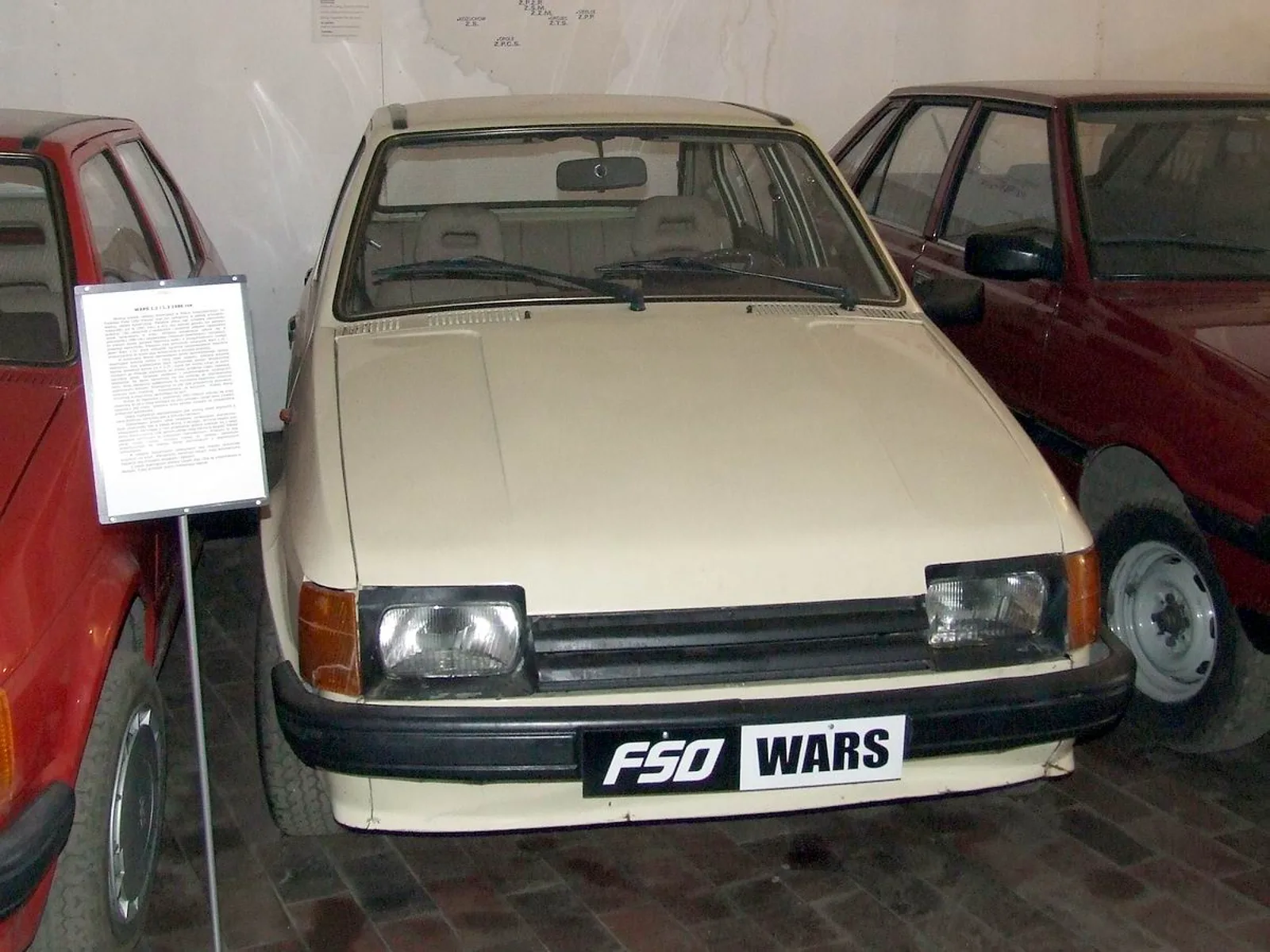
- January 1986: cream prototype shown at a press conference, photography banned.
- 24 October 1986: official presentation in Warsaw with the second and third prototypes.
- 1987: road tests end.
- 1 December 1988: FIAT agreement initialled, then torn up the same day.
- October 1989: FSO reopens talks with FIAT over the Tipo.
- January to May 1990: talks with Daihatsu on the Charade.
- Planned 1995: start of production for the Wars 2, which never got beyond models and a mock-up.
When was the Wars first shown?
The cream prototype appeared at a press conference at FSO in January 1986, and photography of the car was not allowed at that event. The official unveiling came on 24 October 1986, at an exhibition called Polish Motor Industry held in the Dziesiecialecia Stadium in Warsaw. The second and third prototypes were displayed there.
The name Wars was suggested by Edward Pietrzak, who was the managing director of FSO at the time. Road testing ran until 1987. The results were judged positive, but development was halted for lack of sufficient funds and because the licence talks had made considerable progress.
What did the Wars look like and how was it built?
The Wars had a self-supporting five-door hatchback body, the layout common on cars of the lower-middle class. Antoni Kasznicki designed the body shape, and a team under Jan Politkowski handled the structural work needed to meet the passive safety rules in force in the United States. Body assembly took place in the body design section of FSO, using panels that the WSK Mielec works had shaped.
Every window was curved. The windscreen was laminated, while the other glass was toughened. The bumpers were thin-walled and made from semi-rigid plastic to keep their weight low. The fuel tank sat between the axles, under the rear seat, so that it would stay sealed in a rear-end impact. Resistance to corrosion was put at six years, with the protective coating needing periodic topping up.
Wind tunnel work on the mock-ups refined the shape to a drag coefficient of Cx=0.35. Cars of the same class built in the second half of the 1980s, from the Volkswagen Golf II to the Renault 11, were a little longer, yet the Wars was no worse than them in wheelbase, at 2,520 mm (99.2 in). With only a handful of prototypes built, crash testing was not undertaken.
What was the Wars like inside?
Miroslaw Kowalczuk shaped the cabin with ergonomics as a guiding principle. Two passengers sat in individual front seats, and three could ride on the rear bench. The front seats slid fore and aft and offered adjustable backrest angle and head restraints. The seats were shaped and sized to leave as much room as possible for the occupants.
The rear bench folded, which raised the luggage capacity from 300 l to 1,200 l. Some trim parts, the switches among them, were adapted from the Polonez. The dials, with a rev counter, came from MERA-Poltik in Lodz, while the heating and ventilation system, operated by sliders, was developed at the Industrial Automotive Institute in Warsaw.
What engines did the Wars use?
Two versions of an in-line four-cylinder petrol engine were fitted to the prototypes, mounted transversely at the front. The block and the five-bearing crankshaft were cast iron, and the aluminium cylinder head housed a single cast-iron camshaft driven by a rubber toothed belt. The smaller engine displaced 1,092 cc (66.6 cu in), while the larger one displaced 1,290 cc (78.7 cu in).
| Engine | Capacity | Power |
|---|---|---|
| Smaller prototype unit | 1,092 cc (66.6 cu in) | 54 PS (53 hp) |
| Larger prototype unit | 1,290 cc (78.7 cu in) | 61 PS (60 hp) at 5,200 rpm |
Torque from the larger engine peaked at 93 Nm (69 lb ft) when the crankshaft reached 2,800 rpm. A cable-operated single-plate dry clutch connected it to a five-speed manual gearbox. Power reached the front wheels through driveshafts of unequal length, which had Birfield-Rzeppa constant-velocity joints at their ends. The carburettor came from the Car Accessories Factory in Lodz.
How fast and how thrifty was the prototype?
On the road, the more powerful prototype managed 150 km/h (93 mph) at its maximum, and in use it averaged roughly 6.5 l/100 km (43.5 mpg-imp; 36.2 mpg-US).
The production plan went further. Once series production began, the car was to receive a diesel of about 1.6 litres, along with later petrol units with single-point injection and hydraulic tappets. These were plans only.
How did the Wars handle and stop?
The Wars had independent suspension on all four wheels. The front axle used MacPherson struts with lone lower transverse arms and a stabiliser bar. At the rear, two bearing-mounted trailing arms carried coil springs and telescopic shock absorbers. The road wheels were 155/70R13.
The brakes were dual-circuit and cross-split, with ventilated front discs and rear drums. The rear drums had automatic adjustment for clearances and a brake force regulator. The second prototype, which carried the 1.3 engine, gained a vacuum-assisted servo along with a warning for a low brake fluid level and for worn linings.
Which foreign carmakers were approached for a licence?
In early 1982 the foreign trade company POL-MOT wrote to 14 car concerns. Once the replies came in, talks began with Daihatsu, FIAT, Renault and SEAT. After four offers had been studied, Daihatsu and FIAT were invited into more detailed discussions. Daihatsu offered its Charade, while FIAT was at first willing to allow production in Poland of its compact Ritmo and later of the smaller and more modern Uno.
The Italian offer won in the end. It came with better financing terms for the new investment, and FIAT said it would stop building the Uno in Italy when the Polish line began. The deal was initialled on 1 December 1988, and the same day the Ministry of Industry cancelled it. In October 1989 FSO management returned to FIAT, which offered the production rights to its Tipo. From January to May 1990 talks with Daihatsu covered assembly and later production of the Charade.
What was the Wars 2 meant to be?
Even after the road tests ended in 1987 and an agreement with FIAT was signed in 1988, FSO kept considering a new passenger car of its own design to succeed the Polonez. The sudden collapse of the Italian talks in December 1988 pushed the factory back toward building a compact car independently, using its earlier experience.
At the end of the 1980s and into the early 1990s, two 1:5 scale models of a car called the Wars 2 were produced, along with a full-size mock-up built on the structural body of the Wars prototypes. Production was planned to begin in 1995, but no prototype cars were made.
What does the Wars story say about Polish car-making?
The Wars project shows how closely the plan depended on outside partners. FSO had a design brief, a set of prototypes and a clear view of the cars it needed, but it lacked the funds to finish the job. Each attempt to bring in a foreign partner, from the licence approaches to the FIAT agreement, fell away before production could begin.
The car combined front-wheel drive, wind-tunnel shaping and a planned corrosion regime in one package. Development lasted until 1987, when further design work was halted.