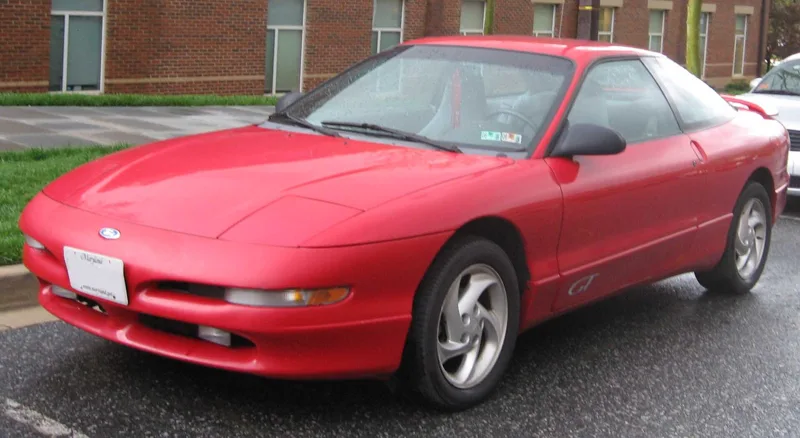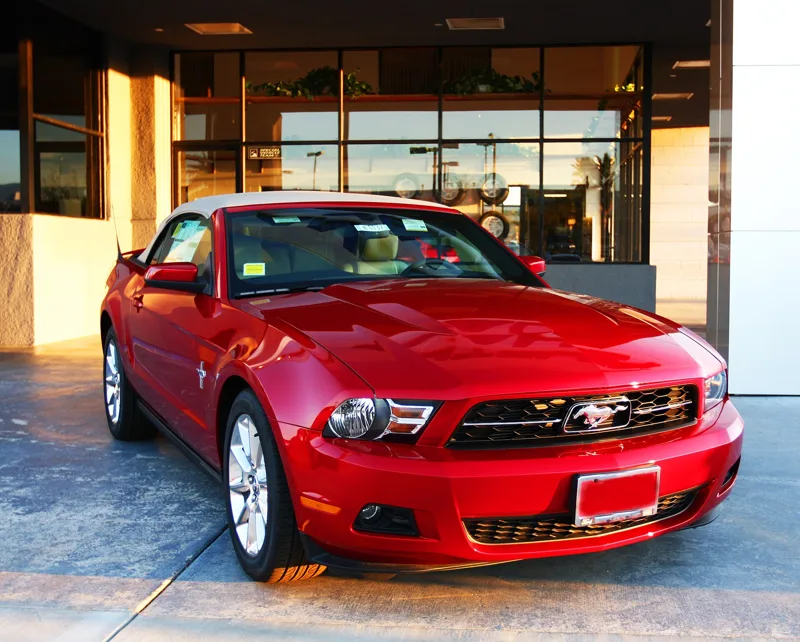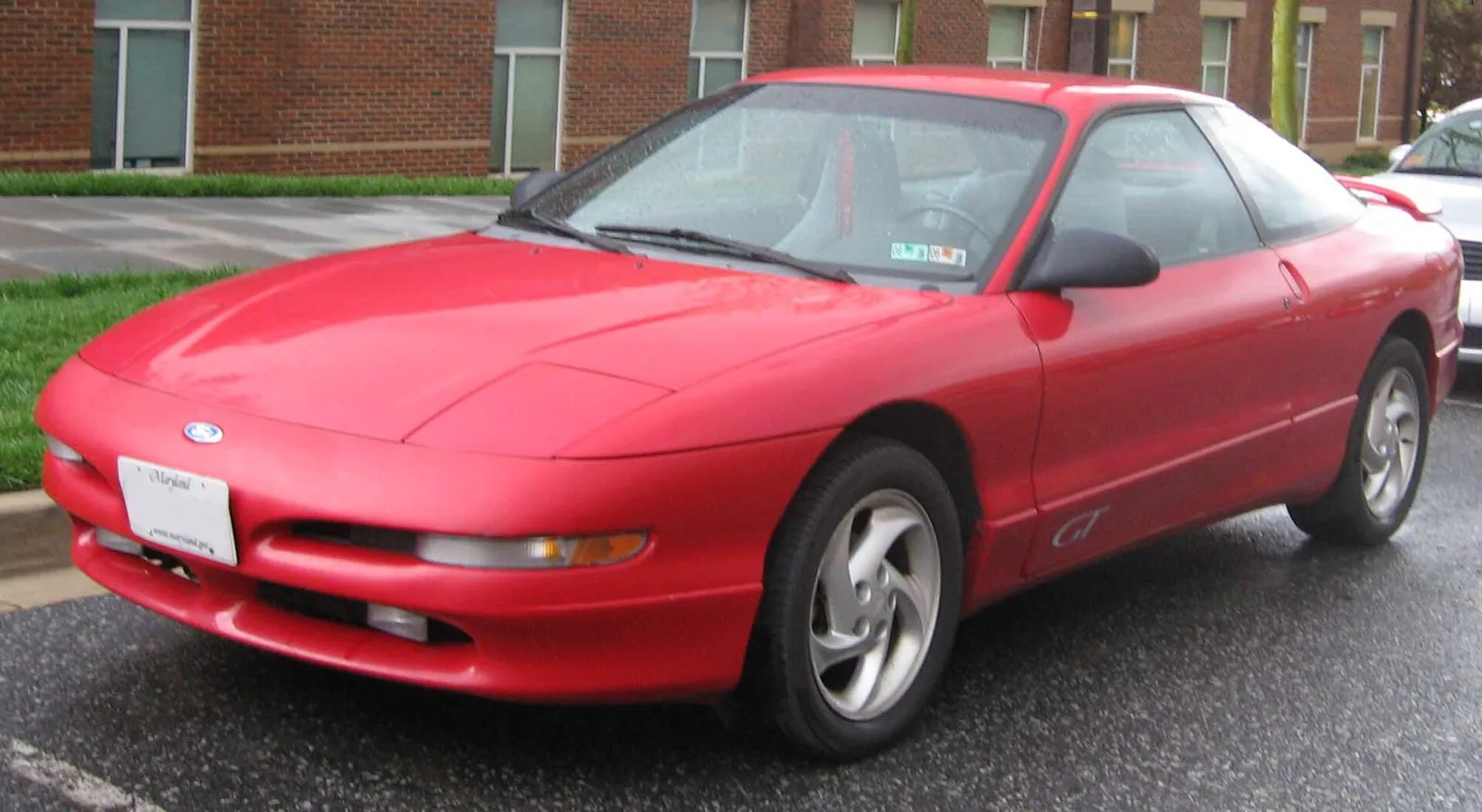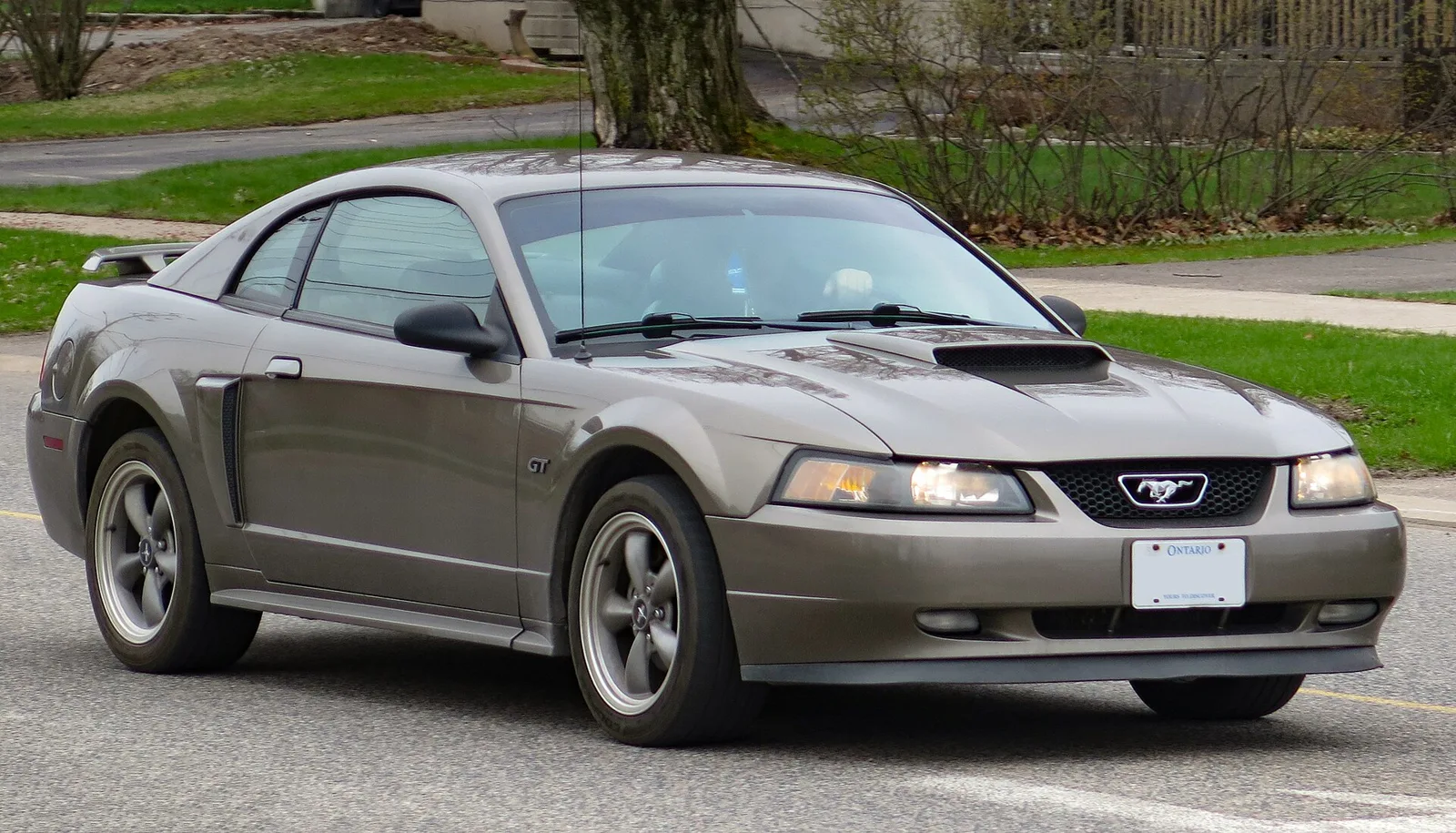
A 1994 redesign on the last Fox platform brought back the convertible, a 215 hp GT and a 320 hp Cobra by 1999, then a facelift and limited editions until 2004.
The fourth-generation Ford Mustang, codenamed SN95, was built from 1994 to 2004 on a revised Fox platform. It brought back the convertible, offered a 218 PS GT and a Cobra, and received a New Edge facelift in 1999 before a run of limited editions.
The fourth-generation Ford Mustang, known inside Ford as the SN95, was built from the 1994 model year to 2004. It was the first major redesign of the pony car in fifteen years, and it used a revised version of the Fox platform, the last vehicle to ride on that architecture. The convertible returned, the coupe became the only closed body, and the notchback and hatchback were dropped.
When did the fourth-generation Mustang arrive?
Ford introduced the car in November 1993, and the launch took place on 9 December 1993. Bud Magaldi styled the body, which borrowed a few cues from the classic Mustangs while the overall look was new. The convertible came back, so buyers again had an open-top option alongside the coupe.
A two-seat show car called the Mustang Mach III had previewed the design at the 1993 Detroit show. Darrell Behmer and Bud Magaldi designed it, and it carried a supercharged 4.6-litre DOHC V8 rated at 456 PS (336 kW; 450 hp). That engine never reached production, but it pointed toward the Modular V8 that would later power the car.
A car that carried the pony name through the Fox era's final years with a 218 PS GT and a 324 PS Cobra by 1999.
What changed on the Fox platform?
Ford committed US$700 million to improving the Fox platform for the 1994 car. The goals were better handling and quieter running, with less vibration than the previous Mustang. At the front, MacPherson struts gained longer lower control arms, new spindles and revised anti-roll bars. The rear used a four-bar link and a solid axle in a new layout.
The standard rear axle ratio of 2.73:1 was later changed to 3.27:1. Every car gained four-wheel disc brakes, although anti-lock brakes were an option. Three-point seat belts and dual front airbags were fitted from the first year, and the dashboard drew on the Thunderbird, with a dual-cockpit layout full of curves and sweeps.
Inside, the preferred package offered power windows and locks, keyless entry, air conditioning and cruise control, and it added a trunk net. A Mach 460 sound system, a 230-watt multi-speaker unit with a CD player, could also be specified.
What did the base V6 offer?
The base car used Ford's 3.8-litre Essex V6, an overhead-valve engine that produced 147 PS (108 kW; 145 hp) at 4,000 rpm and 292 Nm (215 lb ft) at 2,500 rpm. A five-speed manual was standard, and an AODE four-speed automatic was available as the alternative at launch.
For 1996 the V6 picked up five horsepower through a new powertrain control module called the EEC-V, and the AODE gave way to the 4R70W four-speed automatic. The V6 remained the entry point to the range, below the GT and Cobra, at the bottom of the range.
How much power did the GT make?
The Mustang GT returned in January 1994 with the 302 cu in pushrod small-block V8 carried over from the 1993 car. Peak output was 218 PS (160 kW; 215 hp) at 4,200 rpm, with 386 Nm (285 lb ft) of torque arriving at 3,400 rpm. Drivers could reach 97 km/h (60 mph) in the high-six second range.
The GT's 302 had been carried over from 1993, so the 1994 car continued that engine's story. The GT also had a firmer suspension, dual exhaust tips and 16-inch wheels in place of the base car's 15-inch items. Its rear axle started at 3.08:1 and later became 3.27:1 or 3.55:1, according to transmission and year. Motor Trend chose the 1994 GT as its Car of the Year.
A one-year GTS followed in 1995. It was a stripped-down GT that kept the performance hardware but dropped many non-performance features, much like the 5.0 LX of the Fox era. That year also marked the last appearance of the 5.0 pushrod V8, which had been in use since the 1960s.
Why did the Modular 4.6-litre V8 draw criticism?
For 1996 Ford retired the 302, a small-block that had been built since 1968, and launched the Modular 4.6-litre SOHC V8. The first version was rated at 215 hp at 4,400 rpm, matching the output of the outgoing V8.
The engine was built at two plants, Windsor and Romeo, and a W or an X in the eighth position of the VIN shows which one made it.
For 1998 the Modular gained a small increase, reaching 228 PS (168 kW; 225 hp) at 4,750 rpm, while torque rose to 393 Nm (290 lb ft) by 3,500 rpm. Calibration and a modified fuel system delivered the gain. Critics still judged the 4.6 inadequate against the larger pushrod V8 of the Chevrolet Camaro, even though it matched or beat the old 302 on paper.
What was the SVT Cobra?
Ford's Special Vehicle Team built a higher-performance version of the GT called the Cobra. For 1994 and 1995 the 5.0-litre V8 received unique intake manifolds, cams, fuel injectors and cylinder heads. Suspension and brakes were changed as well, with 13-inch front discs and COBRA-embossed calipers, plus Cobra-specific shocks, struts and springs.
From 1996 the Cobra used the 4.6-litre DOHC Modular V8, rated at 309 PS (227 kW; 305 hp) with 407 Nm (300 lb ft). A special Mystic Cobra colour package added a Chrom-a-lusion exterior finish, similar to the Mysti-Chrome package seen on 2004 models. Ford produced 2,000 Cobras across the 1994 to 1998 run. The 1994 and 1995 engines were modified 5.0-litre units, which set those cars apart from the 4.6-litre models that followed.
What did the 1999 New Edge facelift change?
Production of the facelifted SN95 began in November 1998, ahead of the 26 December 1998 update that marked the 1999 model year. The redesign adopted Ford's New Edge design language, which traded many soft curves for sharper contours, bigger wheel arches and creases in the bodywork.
The roofline and interior stayed largely the same, and the platform did not change. New wheels and hubcaps were the most visible addition on the outside, and the look was a clear break from the softer styling of the car's first year.
The base V6 moved to split-port induction for 1999, lifting output to 193 PS (142 kW; 190 hp) at 5,250 rpm, and torque reached 298 Nm (220 lb ft) by 2,750 rpm. The GT kept the 4.6-litre V8, now rated at 264 PS (194 kW; 260 hp) at 5,250 rpm, and its torque peaked at 409 Nm (302 lb ft) at 4,000 rpm. Intake manifold runner control reached the V6 in 2001, lifting it to 196 PS (144 kW; 193 hp).
Smaller changes followed. The 2001 dashboard accepted double-DIN stereo heads, and the rear window defroster switch moved to the lower centre stack. Minimal changes occurred from year to year, and every 1999 Mustang except the Cobra carried 35th Anniversary badges on its front fenders. The fog lamp switch went to the same panel, and the traction control button sat on the lower switch row.
How did the Cobra return after 1999?
The Cobra came back for 1999 with a 32-valve 4.6-litre V8 rated at 324 PS (239 kW; 320 hp) at 6,000 rpm, while 430 Nm (317 lb ft) arrived at 4,750 rpm. It also brought independent rear suspension, which routed the exhaust under the axle.
Sold in 2003 and 2004, the Cobra Terminator used a supercharged engine rated at 395 PS (291 kW; 390 hp). It came with a sharper front and rear fascia, better-bolstered seats with angle-adjustable headrests and 18-inch wheels.
Which special editions were built?
Several special editions gave the late SN95 its character. Most were distinguished by badges, wheels or paint, and each was built in a limited number. The Bullitt, for example, was available only as a coupe, while the 35th Anniversary cars came as both coupes and convertibles.
Anniversary and limited editions
For 1999 the 35th Anniversary package covered 2,318 GT coupes and 2,310 convertibles. It came in black, silver metallic, white or red, with a body-coloured hood scoop, a rear spoiler, side scoops and 17-inch five-spoke wheels. Silver inserts and a pony logo marked the interior.
The 2000 Spring Feature Edition was a GT trim, and its colours included Performance Red, Laser Red and Zinc Yellow. Ford produced 3,091 of them, with 17-inch performance wheels, body-coloured scoops and two black GT stripes on the hood. Black Mustang inserts sat on the embossed bumper.
The 40th Anniversary edition was sold in 2004 as an $895 option on either the Standard or the GT, in coupe or convertible form. Its Crimson Red paint was exclusive to the package, and Ford built 4,558 Crimson Red cars. Forty-one of them went to Roush Industries for conversion into Roush Mustangs.
Bullitt and Mach 1
The 2001 Bullitt was a mildly upgraded GT, sold only as a coupe. It received a suspension lowered by 3/4 inch, Tokico shocks, Cobra-derived 13-inch front brakes and an upgraded exhaust and intake. Power rose to 265 hp (198 kW), five more than the standard GT, and the car came in Dark Highland Green, True Blue or Black. Torq-Thrust style wheels replaced the standard units, and the fog lights were removed for the US market, though Canadian cars kept them.
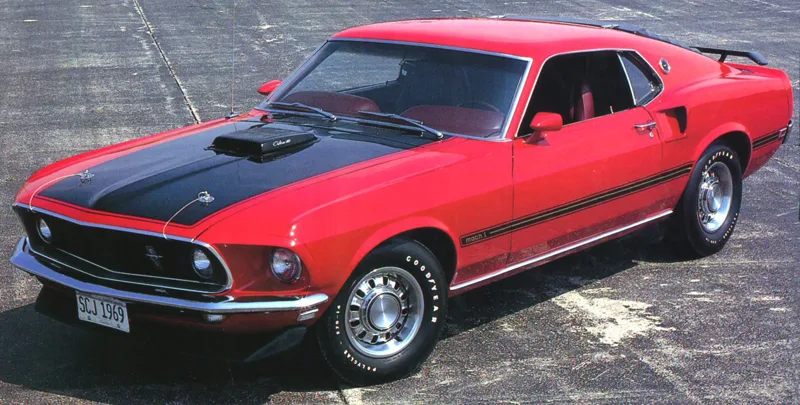
The Mach 1 followed in 2003 and 2004, based on the 305 hp (227 kW) 4.6-litre DOHC engine. It had a retro interior with seats modelled on the 1960s Mach 1, along with retro gauges and a unique aluminium shifter ball. It also received the Bullitt's suspension upgrades, including Tokico struts at the rear. Its bonnet carried a functional Shaker scoop, a three-tier hood and decals, and the car used the C-pillar covers from the 1994 to 1998 Mustang.
Centennial package
To mark Ford's centenary in June 2003, the Mustang GT was offered in a $995 Centennial package. It added 17-inch wheels, anti-lock brakes, traction control, dual exhausts and a power driver's seat, plus Centennial badges for the fenders and decklid. Every car in the run was black.
How did the Mustang reach Australia?
The fourth generation was sold in Australia from 2001 to 2002, as Ford's answer to the Holden Monaro, a rival whose design later fed the reborn Pontiac GTO. The Mustang had never been designed for right-hand drive, so Ford Australia hired Tickford Vehicle Engineering to convert 250 cars a year to meet Australian Design Rules.
The conversion work carried a development cost of A$4,000,000, and a very high selling price hurt sales. Ford had to rework components and set up a dedicated production process for each car. In total, only 377 Mustangs found Australian buyers between 2001 and 2003. Ford Racing Australia also built a V10 convertible for promotion, powered by a 6.8-litre Modular V10 from the American F-Series Super Duty, with an Australian-made supercharger.
Fourth-generation Mustang specifications at a glance
| Specification | Detail |
|---|---|
| Code name | SN95, revised Fox platform |
| Launch | November 1993 introduction, 9 December 1993 launch |
| Base V6 | 3.8 L Essex, 147 PS (108 kW; 145 hp) at 4,000 rpm |
| GT 1994 | 302 cu in pushrod V8, 218 PS (160 kW; 215 hp) |
| Modular V8, 1998 | 4.6 L SOHC, 228 PS (168 kW; 225 hp) at 4,750 rpm |
| Cobra 1996 to 1998 | 4.6 L DOHC, 309 PS (227 kW; 305 hp), 407 Nm (300 lb ft) |
| Cobra 1999 | 32-valve 4.6 L V8, 324 PS (239 kW; 320 hp) |
| Cobra Terminator | Supercharged, 395 PS (291 kW; 390 hp), 2003 and 2004 |
| Bullitt 2001 | 265 hp (198 kW), lowered 3/4 inch |
| Final car | Built on 10 May 2004 |