A 2010 debut, a 2011 launch on both sides of the Atlantic and a 2012 title as the world's best-selling car, with a transmission that drew steady complaints.
The Ford Focus Mk III was launched in March 2011 as a global compact, built in seven plants under the One Ford plan. Its North American engine was a 2.0-litre direct-injection unit, and the car was the world's best-selling model for 2012.
The third generation Ford Focus, known as the Focus Mk III, was unveiled in Detroit in 2010 as a 2012 model year car. It was the first Ford designed while Alan Mulally ran the company, under a One Ford strategy that sought globally designed cars with minimal changes. It went on sale in Europe and North America on the same day in 2011, and it became the world's best-selling car in 2012.
What was the Ford Focus Mk III?
The Focus Mk III was the third generation of Ford's compact car, with codename C346. The cars shown in Detroit were a four-door sedan and a five-door hatchback, both introduced with a new 2.0-litre direct-injection four-cylinder engine. A five-door estate was shown in Geneva a month later.
The new model reunited the North American and global Focus lines. The previous North American version was discontinued, and the car launched on March 2, 2011, in both regions, with production starting near the end of 2010 in Europe and North America.
A global compact built under the One Ford plan, which became the world's best-selling car in 2012 despite a troubled dual-clutch gearbox.
Why was the Focus Mk III a One Ford car?
The One Ford plan was the strategy of CEO Alan Mulally, who wanted Ford to leverage its global resources. The aim was to create competitive vehicles that could be sold in each segment across the world, with only minimal changes from one market to the next.
The Focus was the clearest example of that approach. Production later followed in Asia, Africa and South America.
Ford also planned a compact sedan for its Mercury division, which would have been sold as the Mercury Tracer. Two Mercury dealers said so, although Ford never confirmed it, and the plan was scrapped when Ford announced the closure of Mercury in summer 2010.
How was the Focus Mk III styled?
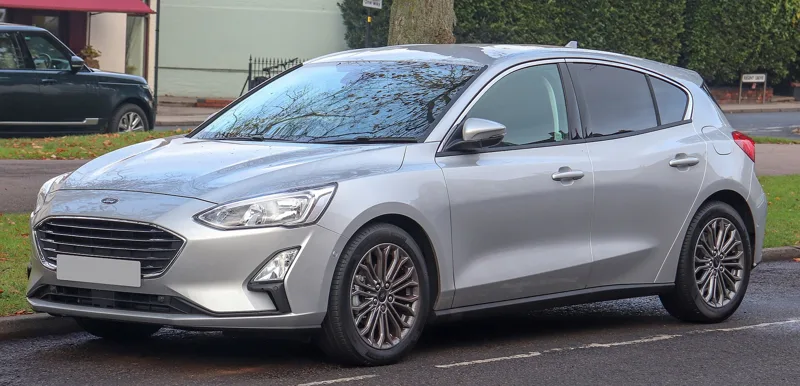
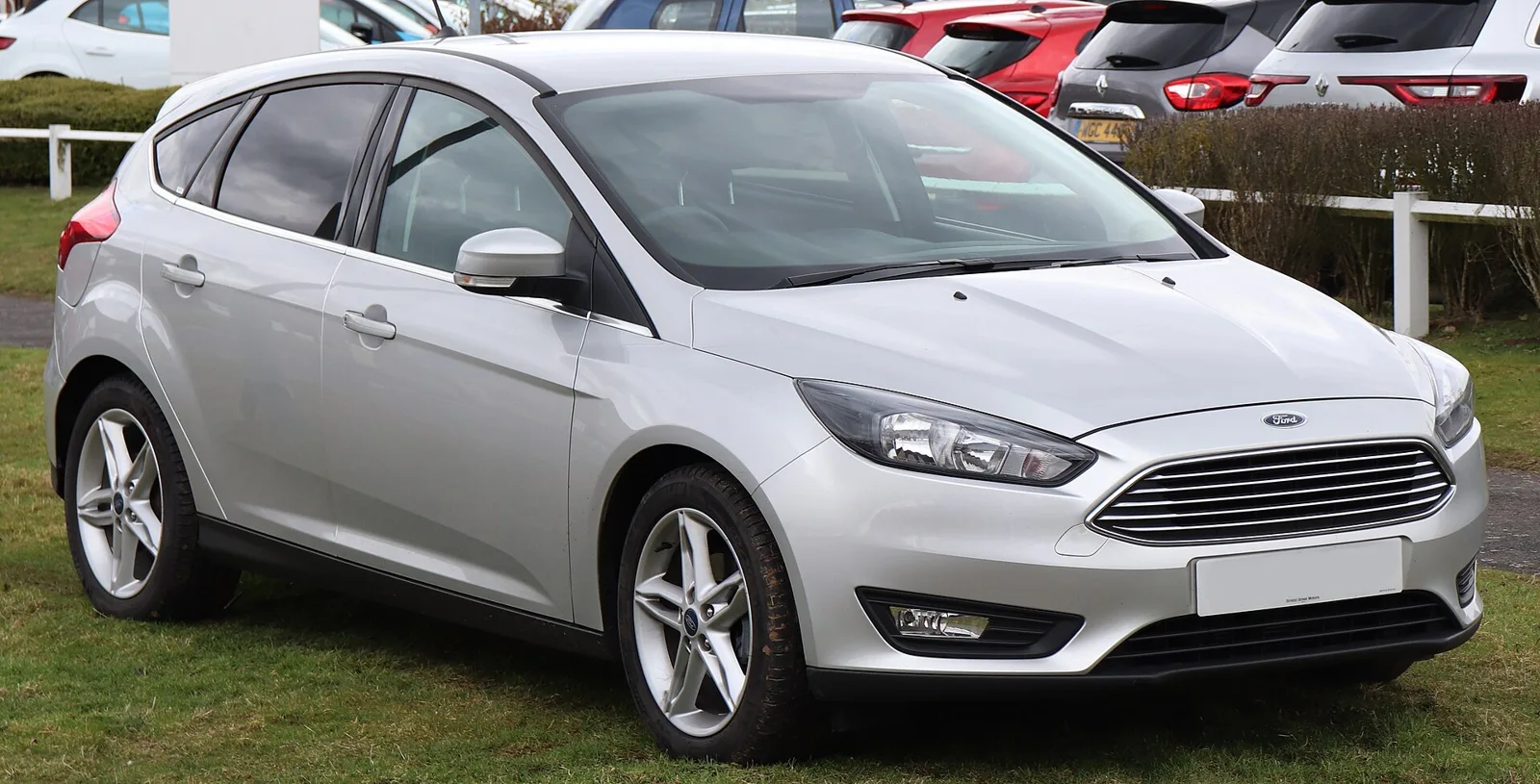
The styling rested on Ford's Kinetic Design language. The front lights had a new shape, the trapezoidal grille carried triangular features, and the hatchback's tail lights sat lower, similar to the Ford Fiesta.
Ford wanted the car to feel more upmarket than its predecessor. It offered two types of centre console, with the basic version tied to smaller engines and the premium console fitted to the more powerful models.
The interior was redesigned with new materials and an infotainment system. The sedan's space-saving gas struts for the trunk were replaced with cheaper gooseneck hinges, a change that reflected its economy-car image against the premium hatchback.
Designers also used the Third Age Suit, a garment that restricts movement to simulate the physical limits of an elderly person. The insights from the suit were built into the car, and the Focus also carried a patented capless fuel tank.
Where was the Focus Mk III built?
Ford pitched the Focus as a global car, made in several factories with engine and trim changes for local rules. Production started in Saarlouis, Germany, in December 2010 for Europe, and in Wayne, Michigan, for North America and Chile from February 2011.
Production followed at Vsevolozhsk in Russia, where the estate started in January 2012, then at Rayong in Thailand and Chongqing in China in May 2012. Taoyuan in Taiwan began in November 2012, and General Pacheco in Argentina started building the car for most of South America in 2013.
The Focus Electric, which was assembled at the Michigan Assembly Plant in Wayne, shared its line with the petrol Focus and the C-Max plug-in hybrid. That spread of sites showed how the one-car approach was applied.
What engines did the North American Focus Mk III use?
The Focus launched with a single engine, a 2.0-litre Duratec 20 direct-injection four-cylinder with Ti-VCT, producing 160 hp (119 kW). Flex Fuel capability was added in mid-2012, except in states that follow partial zero-emissions rules.
The engine derived from the port-injected 2.0-litre of the previous Focus. A sporty ST variant arrived in late 2012, with a turbocharged 2.0-litre making 366 N m (270 lb ft) and 252 hp (188 kW), but only with a six-speed manual.
For the 2015 refresh a 1.0-litre three-cylinder EcoBoost became an extra-cost option on the SE, and a 2.3-litre EcoBoost arrived with the new RS trim for 2016.
How economical was the North American Focus?
The EPA rated the 6-speed automatic at 28 city and 38 highway MPG, while the 5-speed manual achieved 26 city and 36 highway MPG. Only four-door sedans and five-door hatchbacks were sold in the US and Canada.
The SFE package, short for Super Fuel Economy, was an add-on for the SE sedan with the PowerShift automatic. It lifted highway economy to 40 MPG through aerodynamic items from the ECOnetic, including a rear spoiler, low rolling-resistance tyres and active grille shutters.
The platform was a quarter stronger than the previous North American car.
What was the PowerShift transmission problem?
The Focus equipped with the DPS6 PowerShift dual-clutch transmission drew heavy criticism for shuddering, and several owners brought lemon law claims. The fault was tied to dry clutches on the petrol models, and Ford's response was to replace the clutch pack when shudder exceeded 250 rpm after a complaint.
Ford has made at least six revisions of the clutch packs and transmission control modules. Newer versions were more resistant to wear and fluid contamination, since one source of shudder was a seal that leaked fluid onto the dry clutches.
Some of the complaints came from normal operating behaviour, because the DPS6 had no torque converter fluid coupling and behaved more like a manual gearbox than a conventional automatic. Ford later changed the clutch material for better performance across temperatures.
The National Highway Traffic Safety Administration did not require a recall, and Ford did not issue one voluntarily. Focus cars with a conventional manual transmission were not affected by the reliability issues.
What other reliability issues affected the Focus Mk III?
Many first-year cars developed rust under the front bonnet, partly because of the seam sealer between the bonnet's structural part and its outer skin. Water seeped in and created corrosion, which was similar to problems on other Ford models of the period.
The hatchback's trunk lid had a second problem, as a plastic insert vibrated against the metal skin and wore through the paint. Later models received a relocated park brake lever, a redesigned adjustable head restraint and a more ergonomic accessory plug.
What engines were offered in Europe?
In Europe the 1.0-litre EcoBoost three-cylinder turbo came in 100 hp (75 kW) and 125 hp (93 kW) forms. It replaced the 1.6 Ti-VCT Duratec in 2012 and was the entry point to the range for most buyers.
The 1.6-litre Ti-VCT ran from 85 hp (63 kW) up to 125 hp (93 kW), with 105 hp (78 kW) in between. Torque was 104 lb ft (141 N m) in the entry version, 110 lb ft (150 N m) in the middle and 117 lb ft (159 N m) at the top. Euro 5 and Euro 6 emissions standards were met through improved manifolds.
The 1.6-litre EcoBoost came with the Durashift B6 manual in 112 kW (150 hp) and 136 kW (182 hp) forms. Both delivered 180 lb ft (240 N m) of torque, with 270 N m (200 lb ft) on overboost, and the 150 hp car needed 7.6 seconds to reach 60 mph, and the 182 hp car needed 7.1.
Diesel buyers had the 1.6-litre Duratorq, which had eight valves instead of sixteen. The basic version made 71 kW (95 hp) with 170 lb ft (230 N m), while the top version reached 86 kW (115 hp) and peaked at 285 N m (210 lb ft) on overboost. The Econetic model made 105 hp (78 kW).
The top diesel was the 2.0-litre Duratorq, available with PowerShift and rated in 112 kW (150 hp) and 138 kW (185 hp) forms. Torque reached 300 lb ft (400 N m) in the stronger version, against 270 lb ft (370 N m) in the lesser.
What was the Focus Mk III's Australian line-up?
The Australian Focus was announced in 2010 and arrived in August 2011 as a hatch and a sedan, with four trims: Ambiente, Trend, Sport and Titanium. The petrol engines were a 1.6 with 92 kW and 159 Nm, and a 2.0 with 118 kW and 198 Nm, plus a 2.0 turbo-diesel making 120 kW and 340 Nm.
Most cars used a 5-speed manual, but the 6-speed PowerShift was standard on the Titanium and optional on the others. In Asia the Focus arrived in March 2012 at the Bangkok International Motor Show, with sedan and hatchback bodies in several markets.
How did the Focus ST and RS develop?
Ford revealed the Focus ST at the 2010 Paris Motor Show and gave more detail at the 2011 Frankfurt Motor Show. Its 2.0-litre EcoBoost made 366 N m (270 lb ft) of torque and 252 hp (188 kW), which was 25 hp more than the previous five-cylinder ST managed.
The ST reached 100 km/h in 6.1 seconds and had a top speed of 248 km/h (154 mph). It was also 30 kilograms (66 lb) lighter than the five-cylinder car it replaced, and the ST appeared in the 2012 film The Sweeney, for which Ford supplied six cars.
The third-generation RS was revealed at the 2015 Geneva Motor Show with a 2.3-litre EcoBoost producing 261 kW (355 PS; 350 bhp) at 6000 rpm. Peak torque reached 475 N m (350 lb ft) at 3200 rpm, sent to all four wheels through a torque-vectoring system with a rear unit designed by GKN.
The RS added Drive Modes and Launch Control, along with an industry-first Drift Mode, and it reached 100 km/h in 4.7 seconds. It reached showrooms in 2016, starting at roughly GBP 31,000.
How did the Focus Mk III get its 2014 facelift?
The Mk 3.5 mid-cycle facelift debuted at Geneva in 2014. It brought thinner, sharper headlights and a new trapezoidal grille, with a family face shared with the C-Max, Grand C-Max, S-Max and Galaxy.
For the 2015 model year a 1.5-litre turbocharged EcoBoost replaced the older 1.6 and 2.0 offerings in the 110 and 132 kW versions. Inside, the dashboard buttons were replaced by an eight-inch touchscreen, and the steering wheel gained three spokes.
The 2016 Focus RS added a Drift Mode that let drivers slide the car more easily and safely. The ST in its facelifted form kept its 2.0-litre EcoBoost and six-speed manual, while the diesel options were updated to produce 150 and 185 hp.
What was the Focus Electric?
Ford launched its pre-production Focus Electric in January 2011 at the Consumer Electronics Show, rather than at the traditional North American auto show. The concept had been unveiled as the Focus BEV at the 2009 Frankfurt Motor Show, based on the European second-generation car.
The Focus Electric used a complete electric drive train supplied by Magna Steyr, with a 23 kWh battery pack that was liquid cooled and lithium-ion. It managed 76 mi (122 km) between charges and was limited to 84 mph (135 km/h), and it was initially sold in 19 metropolitan areas across the United States.
For 2017 and 2018 the electric Focus gained DC fast charging through a CCS connector and a larger battery. European series production ended by April 2017, and North American production finished in May 2018.
What were the Focus Mk III's racing and rally efforts?
Chip Ganassi Racing ran a Focus in IMSA's Continental Tire series in 2014. Hoonigan Racing Division ran two Focus RS rallycross cars across the 2016 and 2017 seasons, with Ken Block and Andreas Bakkerud driving.
Ford Performance and Hoonigan withdrew from World Rallycross on September 4, 2017. Ford later released a final model year with special colours and a limited-slip differential.
How many Focus RS cars were sold in the final year?
The 2018 Focus RS was the final model year for the car. Ford Performance released Final Edition cars with a Quaife limited-slip differential, although power and torque were unchanged from earlier years.
Only 1,000 2018 Focus RS cars were available for US drivers and 500 for Canada. The UK-only Heritage Edition used a Mountune FPM 375 package that raised power from 345 bhp to 375 bhp, with only 50 made.
What are the Ford Focus Mk III specifications?
| Specification | Detail |
|---|---|
| Codename | C346, third generation |
| Debut | Detroit show in 2010, as a 2012 model year car |
| Launch | North America and Europe, March 2, 2011 |
| North American engine | 2.0-litre Duratec 20 direct injection, 160 hp (119 kW) |
| North American economy | 6-speed automatic 28 city and 38 highway MPG; 5-speed manual 26 and 36 |
| SFE package | 40 MPG highway, SE sedan with PowerShift |
| ST power | 188 kW (252 hp) and 366 N m (270 lb ft), manual only |
| ST performance | 0 to 100 km/h in 6.1 seconds; top speed 248 km/h (154 mph) |
| European 1.0 EcoBoost | 75 and 93 kW (100 and 125 hp) |
| Australian 1.6 petrol | 92 kW and 159 Nm |
| Focus RS (2016) | 2.3-litre EcoBoost, 261 kW (355 PS; 350 bhp) at 6000 rpm |
| Focus Electric range | 76 mi (122 km) on a charge, 23 kWh battery |
| Best-selling status | World's best-selling car for 2012 |