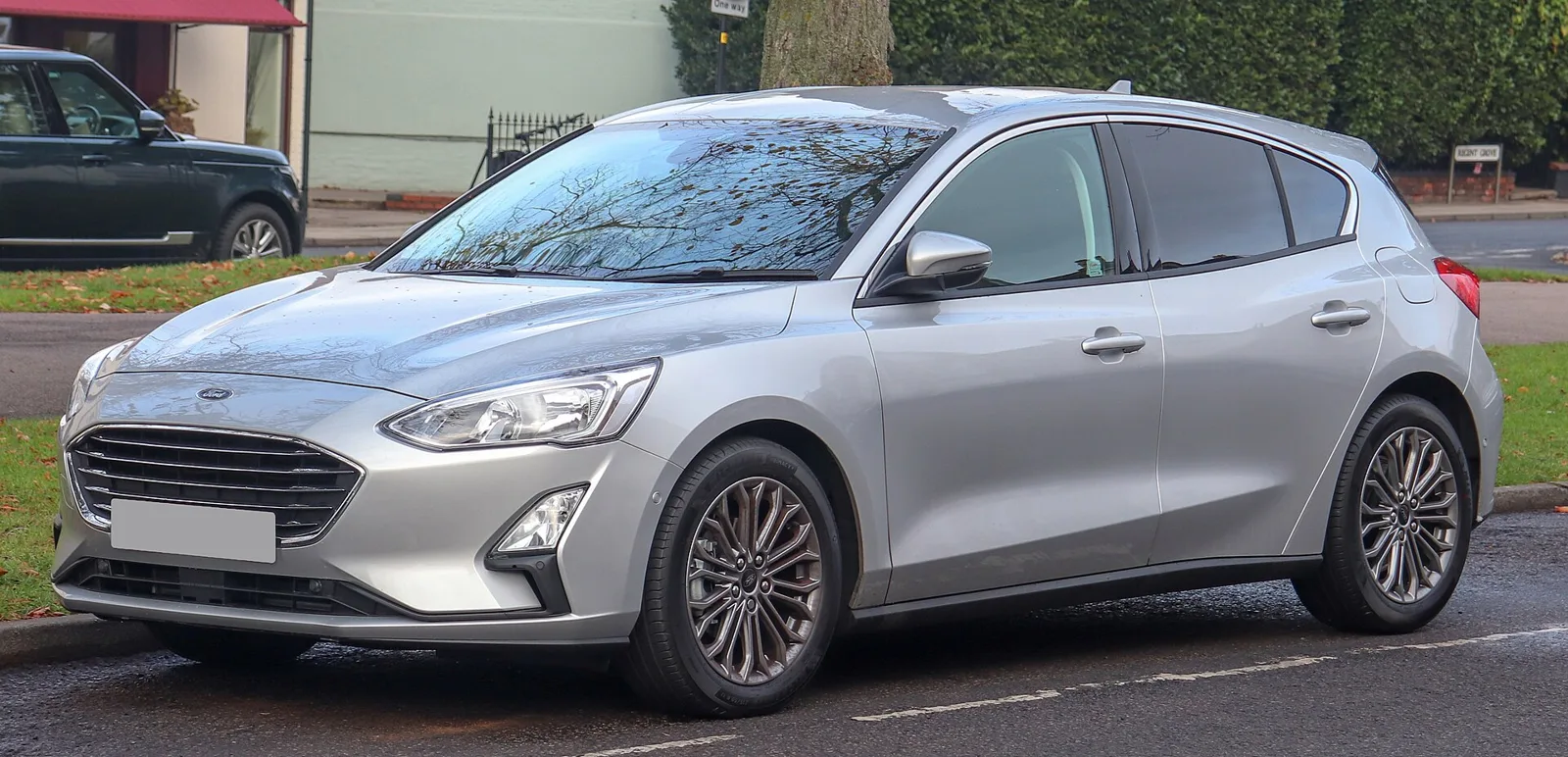
A C2-platform family hatch with a hot ST, limited Edition models and an Australian exit for the performance version in 2022.
Ford's fourth-generation Focus succeeded the third model in 2018 and was built until 2025 as a family car in hatchback, estate and saloon form. It stood on the C2 platform, and after exits in the Americas and Southeast Asia it was sold mainly in Europe and Australasia.
The fourth-generation Ford Focus, codenamed C519, was a small family car built from 2018 until 2025. It sat on the C2 platform, which was 20 percent stiffer in torsional rigidity than the C1 it evolved from. By the end, the car was sold mainly in Europe, China, Taiwan and Australasia, after Ford dropped it in many regions, including both Americas.
What changed from the third-generation Focus?
The Mk4 Focus was up to 88 kg (194 lb) lighter than the Mk3 and had a wheelbase stretched by 53 mm (2.1 in). Ford moved the wheels higher into the sheet metal, which reduced the perception of the car's overall length and mass. Ford unveiled the European and Asian versions on 10 April 2018.
A small family car that ended up sold mainly in Europe, China and Australasia after Ford left much of the Americas.
How much space did the Focus offer?
Rear shoulder room grew by nearly 61 mm (2.4 in), knee clearance by 51 mm (2.0 in) and legroom by 71 mm (2.8 in). The estate's boot could hold 1,650 litres (58 cu ft), and its load height rose by 43 mm (1.7 in).
The load-height gain was one of the figures Ford quoted alongside the rear-seat measurements. Together they describe a car that offered more usable room than its outside dimensions suggested, which was the point of moving the wheels higher into the sheet metal.
What trim levels did the Focus come in?
At launch the car came in six trim levels, namely Trend, Ambiente, Active, Titanium, ST-Line and Vignale. Only the ST-Line and Titanium were introduced in China, so the range was adjusted market by market. Trend and Ambiente were not among the Chinese launch trims, which shows how the line-up was tailored by region.
The Vignale was the luxury-oriented version. Its 18-inch wheels sat alongside a leather cabin, a heads-up display, a self-parking function and a Bang and Olufsen sound system. Satin aluminium trim on the roof rails, fascia and rocker inserts, plus a signature Vignale grille mesh, set it apart from the rest of the range.
The ST-Line was the sporty choice. It came with dark 17-inch wheels, a sports body kit, a large diffuser, a roof spoiler that works, wing pieces low on the body and shiny twin exhaust tips.
The Active was a crossover-styled Focus with bespoke front-end styling, black protective wheel arches, rocker claddings and front and rear skid plates. Its ground clearance was lifted by 30 mm (1.2 in), and it came as a hatchback or station wagon.
What made the Focus ST different?
The ST used a 2.3-litre EcoBoost petrol engine rated at 280 PS (276 hp; 206 kW), with a six-speed manual as standard. The EcoBoost car was the first front-wheel-drive Ford to use an electronic limited-slip differential, and it reached the market in mid-2019 after Ford announced it in February 2019.
The alternative was a 2.0-litre EcoBlue diesel producing 190 PS (187 hp; 140 kW), also with the MMT-6 six-speed manual as standard. A seven-speed automatic, based on the Ford 8F40 without second gear, was planned as an option with wheel-mounted paddle shifters.
The chassis work went further than the engine. EcoBoost cars carried Continuously Controlled Damping, while larger front brakes of 330 mm with two pots and rear discs of 302 mm offered better fade resistance. An Electric Brake Booster gave a more consistent pedal feel when driven hard, and steering software reduced torque disturbance from the electric power steering.
Outside, the ST had a revised grille, 18- or 19-inch alloy wheels, a larger rear spoiler and twin-exit tailpipes on petrol cars. Inside, Recaro front seats came with aluminium gear knob, pedals and scuff plates, plus decorative elements with grey stitching.
The optional Performance Pack brought launch control, a shift light, rev matching for the manual EcoBoost, a Track driving mode, adjustable dampers that can spot potholes, red brake calipers and ambient interior lighting.
Which special editions did the ST get?
Ford produced three special ST versions: the Edition of August 2021, the Track Pack of September 2022 and an updated Edition in April 2024. The first was limited to 300 cars for the UK and 200 for Europe.
The 2021 Edition used the 2.3-litre petrol engine, a six-speed manual and a hydraulically activated electronic limited-slip differential. Its KW suspension had 50 percent stiffer powder-coated springs and manually adjustable coilovers, and its flow-formed 19-inch alloys were 10 percent lighter. It came only in Azura Blue with Gloss Black detailing.
The Track Pack, revealed the following year, kept the Edition specification and added Pirelli P Zero Corsa tyres, front four-pot brakes borrowed from the Mustang Mach-E, and Ford Performance seats. Black accents stayed, and the car could be ordered in different exterior colours.
The April 2024 Edition paired the petrol engine and six-speed manual with KW coilover suspension set to the Nurburgring setting, front 363 mm brakes, flow-formed 19-inch alloys and Pirelli tyres. Standard equipment included a Driver Assist pack, a winter pack and a 675 W B&O Premium Sound System, with Motion Blue stitching inside.
Did Ford make a Focus RS?
No. In April 2020 Ford ruled out a Focus RS for this generation, pointing to emissions rules across Europe and the cost of development. The ST therefore remained the top performance version in the range.
How did the 2022 refresh change the car?
The June 2022 update added a mild hybrid called the EcoBoost Hybrid. It used Ford's 1.0-litre three-cylinder turbo in two tunes, one rated at 123 hp (92 kW) and the other at 153 hp (114 kW). It also brought a digital instrument cluster that owners could configure, measuring 12.3 inches.
The hybrid system replaced the standard alternator with a belt-driven integrated starter-generator. It recovered energy during braking and coasting and stored it in a 48-volt lithium-ion battery under the front passenger seat. Both versions used a six-speed manual.
The Connected trim was fitted with a wireless phone charger as standard, along with SYNC 3 navigation infotainment, adaptive cruise, front and rear parking sensors and a rear camera. The ST-Line and Active gained dual-zone climate control, a mirror that dims by itself, rain-sensing wipers and Ford's door-mounted Securicode keypad.
Why did the Focus leave North America?
Ford said in April 2018 that it would end passenger car sales in North America, the Mustang aside, to shift its attention to trucks and SUVs. The Focus Active was meant to be the only version sold there, but Ford dropped those plans in August 2018 because of US tariffs on exports from China, where the model was made.
Ford also dropped plans to build the fourth-generation Focus in Thailand after sales of the previous car were weak, and it halted passenger car sales and production in that country.
Ford restricted the four-door saloon across much of Eastern Europe, including the Baltic states and the Balkans, and in Turkey, Cyprus and many Asian and African countries. The Focus also left Russia, Belarus, Kazakhstan and Israel as part of a broader reorganisation of the European branch.
When did the Focus reach Australia?
The fourth-generation Focus launched in Australia in November 2018, and it was fully imported from Germany rather than Thailand as the previous car had been. Trend and ST-Line arrived first, Ambiente, Active and Titanium followed in mid-2019, and the Focus ST came in 2020.
The Australian wagon was a first for the market, and it was sold only in ST-Line guise. It was initially the only variant with fully independent rear suspension, while the other versions used a torsion-beam rear.
What were the Focus specifications?
| Specification | Detail |
|---|---|
| Codename | C519 (Focus Mk IV) |
| Production | 2018 to 2025 |
| Body styles | Hatchback, estate (wagon), saloon |
| Wheelbase increase | 53 mm (2.1 in) |
| Weight reduction | Up to 88 kg (194 lb) against the Mk3 |
| Estate boot | 1,650 litres (58 cu ft) |
| Focus ST engine | 2.3-litre EcoBoost, 280 PS (276 hp; 206 kW) |
| Focus ST diesel | 2.0-litre EcoBlue, 190 PS (187 hp; 140 kW) |
| Australian petrol engines | 1.5-litre EcoBoost three-cylinder, 134 kW (182 PS; 180 hp), 240 Nm; 2.3-litre EcoBoost, 206 kW (280 PS; 276 hp), 420 Nm |
| Australian transmissions | 8-speed automatic on the 1.5 L; six-speed manual on ST; seven-speed automatic at no cost as an option |
The fourth-generation Focus was a family hatch with a wide engine range, from a 1.5-litre three-cylinder in Australia to a hot 2.3-litre ST, and it kept the body styles of the car it replaced.
Did the Focus earn a five-star safety rating?
Yes. The Focus earned a full five-star ANCAP rating in 2019, matching the Euro NCAP result. Ford's Co-Pilot360 package bundles adaptive cruise with stop-and-go, road sign recognition and lane centring, which works up to 200 km/h (124 mph).
The rest of the list ran to adaptive front lights that bend with the road, an active parking system with a park-out function, pre-collision assist that recognises pedestrians and cyclists, evasive steering assist, blind-spot warning with rear cross-traffic alert, a wide-angle rear camera, wrong-way alerts, Ford's MyKey driver controls and post-collision braking.
Why did Australia drop the Focus ST?
Ford Australia took the Focus ST and Fiesta ST off its line-up on 5 August 2022. Only forty facelifted Focus STs had been secured for the country, and the company blamed the chip shortage, along with a push to favour higher-selling models.
The range had been cut back in June 2020 to the ST-Line Hatch, Active and ST, with the wagon dropped. Independent rear suspension was added to the ST-Line, and FordPass 4G modems allowed remote unlocking and starting from a smartphone.
The 2022 facelift left only the ST and ST X in Australia, and the two standard-spec versions were removed. The ST X added LED matrix headlights and 19-inch alloys, while the standard ST lost equipment, including the 19-inch alloys the range had carried before.
When did production of the Focus end?
Ford of Europe said it intended to stop production in 2025 as its line-up shifted toward electric vehicles. That brought the fourth generation to an end after roughly seven years on sale.
The company was also investigating other uses for the Saarlouis factory in Germany, including selling the facility to another manufacturer.