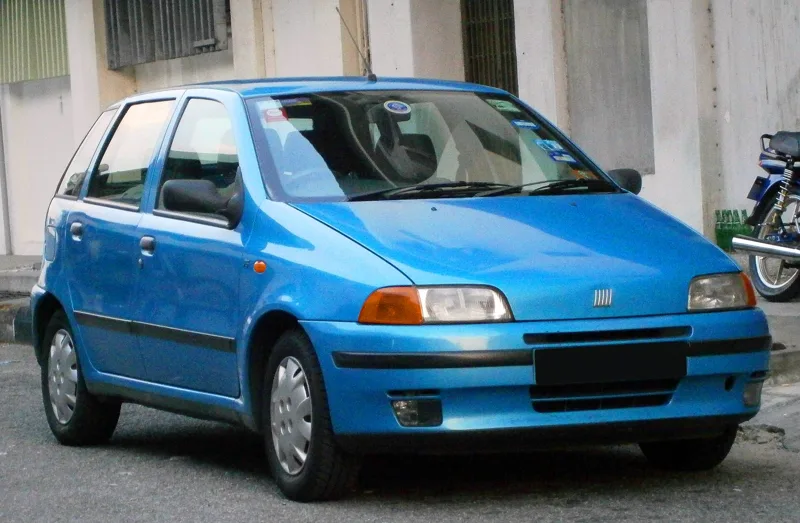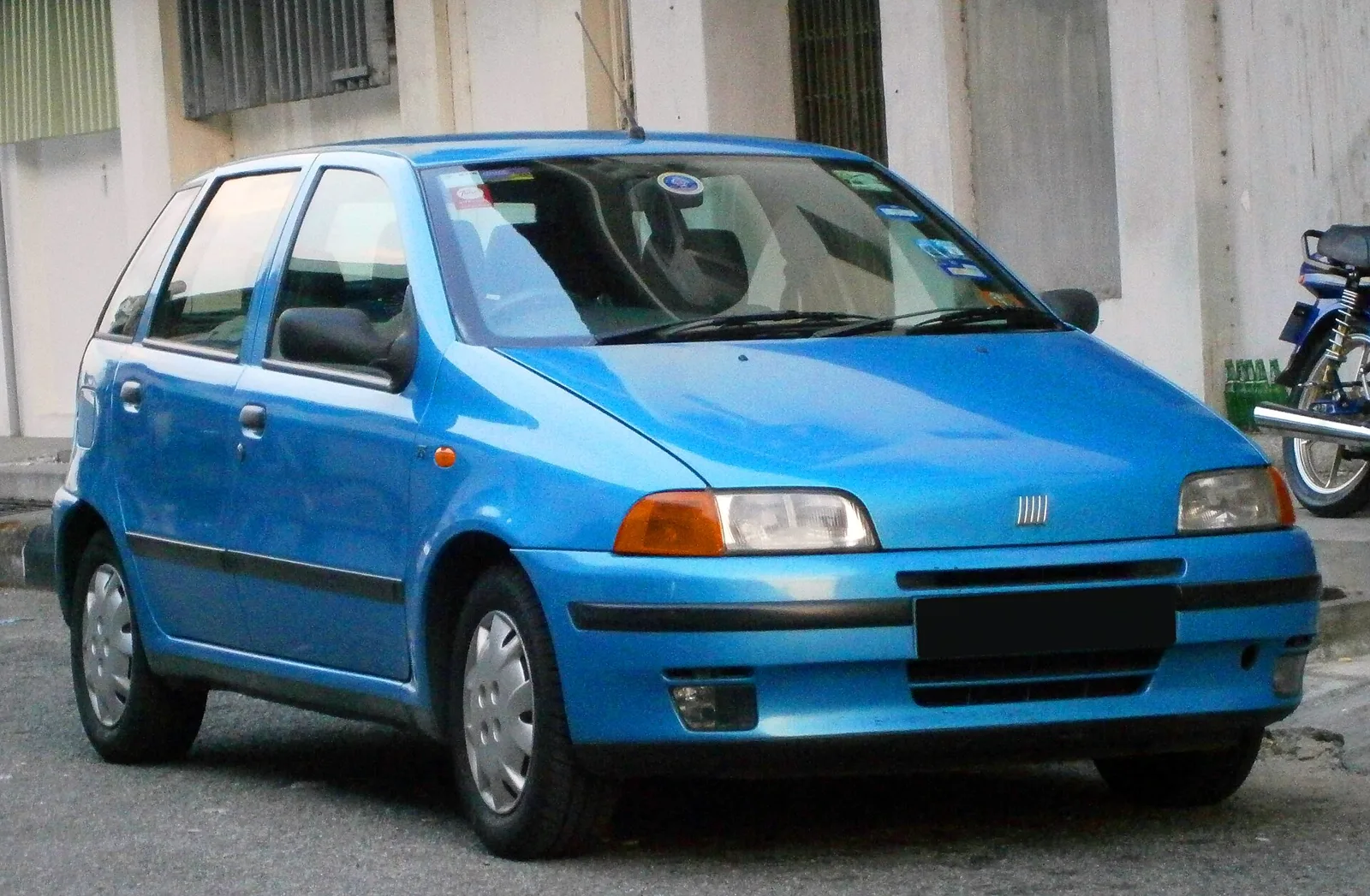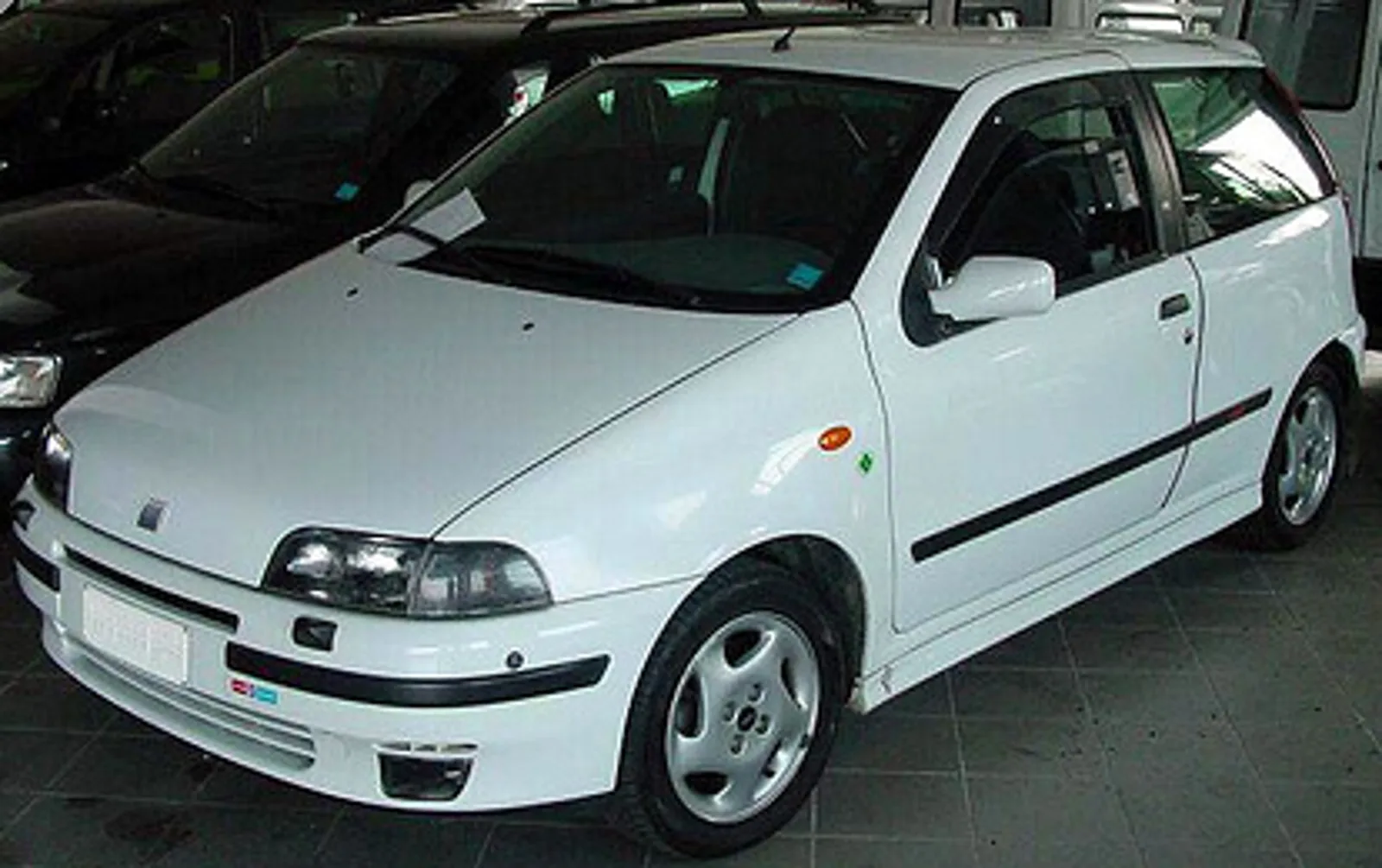
A 1,372 cc turbo at the top of the 1993 Punto line, three versions in six years and the engine changes that split its production.
Fiat's 1993 Punto GT was a turbo flagship with a 1,372 cc engine and 98 kW (133 PS; 131 hp). Two restyles split its life into three versions, production ended around 1999, and the HGT models ideally took its place.
The Fiat Punto GT topped the power ladder of the Punto family that Fiat introduced in 1993. Its turbocharged 1,372 cc engine produced 98 kW (133 PS; 131 hp), and Fiat's own figures put its 0 to 100 km/h time at 7.9 seconds.
Where did the GT name come from?
GT stands for GranTurismo, a designation Fiat had already used on the Tipo. The GT was not part of the launch line-up. It appeared a few months later, the timing Fiat usually used for its sportier and more special models.
Its character came from forced induction. A water-cooled turbocharger, an air-to-air intercooler and an oil radiator all served the engine.
The engine was a 1,372 cc (83.7 cu in) unit derived from the one in the second series Fiat Uno Turbo. Multipoint electronic fuel injection with integrated static ignition fed it, and boost of 1.3 bar could climb to 1.6 bar for a few seconds in overboost.
A turbo at the top of the Punto range, refined in three steps until 1999.
What were the three versions of the Punto GT?
The GT went through two major restyles that divided its production into three versions. The first ran from 1993 to 1995, the second from 1995 to 1997, and the third from 1997 until production ended around 1999. Each change touched the look, the interior or the engine.
First version, 1993 to 1995
The first car came with 14-inch alloy wheels fitted with 185/55 tyres. Its black plastic side skirts were not body-coloured, and the side mouldings were black with a red stripe. Twin-reflector headlamps adjustable in height, fog lamps, four-sensor ABS and headlamp washers completed the front end.
Inside, the sports seats were trimmed in a mixed velvet fabric called slate velvet. That fabric was not strictly sporty, but it was specific to the model. The steering wheel and gear knob were leather, and the instrument panel had a black background with a red stripe.
The speedometer scale ran to 240 km/h, alongside a rev counter and gauges for water temperature, fuel, oil pressure and turbine pressure. An airbag was an option, and choosing it meant giving up the leather wheel for the Punto ELX wheel covered in leather. Passenger airbags and a radio preparation were also available on request. The radio preparation came with a pocket for a 16.5 cm woofer in the front door, and the rest of the equipment matched the Punto ELX.
Second version, 1995 to 1997
The second version was presented in 1995. Its front headlamps kept the same characteristics but used black reflectors and a dark outer finish, which gave the nose a smoked look and a sportier appearance. The side skirts were now body-coloured.
The side mouldings became all black, carrying a stylised GT logo that was introduced with this version and repeated on the tailgate. The instrument surrounds changed from black to white, a finish specific to this version, and the seats were lower with a more wrapping profile.
The steering wheel was redesigned to match the wheels fitted to the Fiat Barchetta and Fiat Coupe. It came with an airbag as standard, while the passenger airbag stayed optional. The FIAT logo on the wheel was raised and in the same colour as the plastic at first, and later it was replaced by a coloured metal badge.
The standard upholstery became a grey fabric, with leather available on request. The front door plastics were reworked to match the panels of the Punto S, although the trim stayed specific to the GT.
The engine code remained 176A4.000 with the same rating. The electrical system did change, with a new engine control unit that carried Fiat's CODE security system. A transponder in the key allowed the unit to recognise the original key, and without it the engine would not start.
Third version, 1997 to 1999
The second restyle, in 1997, changed the car's looks only slightly. The dashboard plastic turned a darker grey, a change that applied to the whole Punto range from 1997 onwards. The alloy wheels kept their design but became metallic anthracite instead of light grey.
The seats kept a shape similar to the second series, but the upholstery became a dark blue and black fabric with the GT logo across its whole surface, called black fabric. The mirrors gained a body-coloured outer cap that could be removed and painted separately, a change that also applied across the Punto range.
Manual recirculation air conditioning became standard, where earlier versions had electric control. The interior lost the vanity mirror in the driver's sun visor, the glovebox lock, and the warning light for failed stop lamps and worn pads. None of these features was offered as an option.
How did the engine change over the GT's life?
The first and second versions used the 176A4.000 engine. From 1997 it was replaced by the 176B6.000, which gave up some performance to meet the stricter Euro 2 anti-pollution rules and brought output down to 96 kW (130 PS; 128 hp).
The third version's engine was reworked at the top end. The cylinder head was replaced, a new throttle butterfly controlled the intake, and idle was linked directly to the valve. Compression rose to 9:1, which held boost at a steady 1.2 bar.
Those changes cost 3 PS, taking total output to 130 PS (128 hp), and the 0 to 100 km/h sprint stretched to 8.2 seconds. The higher compression did bring better flexibility at low revs.
The engine management also controlled overboost. At full demand it raised boost for a few seconds from the 1.3 bar operating pressure to 1.6 bar, adding power and torque.
Engine and performance figures
| Specification | Detail |
|---|---|
| Engine | 1,372 cc (83.7 cu in), four cylinders, two valves per cylinder, single overhead camshaft |
| Bore and stroke | 80.5 mm and 67.4 mm |
| Output, first and second versions | 98 kW (133 PS; 131 hp) at 5,750 rpm |
| Output, third version | 96 kW (130 PS; 128 hp) at 5,600 rpm |
| Torque | 204 Nm (150 lb ft; 21.2 kgm) at 3,000 rpm |
| 0 to 100 km/h | 7.9 seconds (first version); 8.2 seconds (third version) |
| Top speed | Nearly 205 km/h (204.7; 127 mph) |
| Boost | 1.3 bar, 1.6 bar in overboost; 1.2 bar in the third version |
How did the brakes change?
The GT kept disc brakes on all four wheels, with ventilated fronts, throughout its life. The calipers changed in three stages. The first had no pad retaining spring, the second was revised to remove the noise problem, and the third used a larger single-piston caliper.
The third-version caliper matched the one used on the Bravo GT and other FIAT group cars. Its piston covered the whole of a larger, reshaped pad, while the disc stayed unchanged. Braking improved as a result.
The first and second version calipers were dimensionally identical and shared the same pad. The rear calipers were changed from the second half of 1998, but the pad model stayed the same.
Which cars took over from the GT?
The models that ideally took over from the GT were the HGT and the Punto HGT Abarth. The HGT name showed its kinship with the GT by adding an H to the designation.
Both cars used a 1.8-litre 16-valve unit of 1,747 cc (106.6 cu in), rated at 131 PS (129 hp) and also fitted to the Fiat Coupe and Fiat Barchetta. The H prefix had appeared before, on a Bravo HGT with a 2.0 20-valve five-cylinder engine.
The Tipo HSD, short for High Safety Drive, was one of the last Tipo models, and it carried anti-intrusion bars in the doors along with airbags. On the HGT the H is presumed to stand for High Gran Turismo.
How did production end?
Production officially ended in late 1999, together with the other first-series Punto models. Cars continued to be sold for a while afterwards, because Fiat used the period after the second series arrived to clear its stock.
Such cars were often sold at large discounts, so a GT could still be bought even after the second series had been introduced.
Fiat's figures put its top speed at nearly 205 km/h (127 mph), with 98 kW (133 PS; 131 hp) coming from a turbocharged 1,372 cc engine.