A tiny two-door from 1922 to 1926, sold as the 5HP and 5CV, that brought consumer credit, a female-focused sales drive and a surprising record of long-distance robustness.
Built by Citroen from 1922 to 1926, the Type C was a light two-door car with an 856 cc four-cylinder engine. It was also sold as the 7.5HP in Britain, and consumer credit and detailed parts manuals supported sales of about 81,000 cars.
The French maker Citroen built the Type C light car from 1922 to 1926, producing close to 81,000 examples. It was sold as the 5HP in France and the 7.5HP in Britain, and it followed the 10HP Type A and B2 as the second model that Andre Citroen designed and sold himself.
Where did the Type C come from?
The Type C grew out of post-war Europe, where inflation was eating into savings and industry was struggling. Andre Citroen admired Henry Ford's methods of mass production, and he turned his wartime munitions works towards building vehicles. He chose to enter the small car market that Peugeot and Renault then dominated.
His ammunition factory had reached a remarkable 50,000 shells a day during the war, and the same discipline shaped the car business. French tax benefits encouraged makers to build cyclecars weighing no more than 350 kg, but Citroen decided on a proper small car instead.
The engineer Edmond Moyet led the design. He had worked on popular cars at Le Zebre before joining Citroen, and he had recently drawn a similar vehicle for Amilcar, called the CC. The Type C was shown at the Motor Show in November 1921, and orders and deliveries began in spring 1922.
A tiny two-door with a wooden body and a surprising record on the road, sold to a public that Citroen had taught to think of it as a woman's car.
How did the Type C compare with the Type A and B2?
The 5HP sat below the 10HP Type A in Citroen's line-up, and it was aimed at the market beneath it. The Torpedo cost 8,500 francs in 1922, about 60 percent of the 13,900 francs asked for the 10HP B2. This price gap was central to the car's early sales appeal.
It also undercut its main rival, the Peugeot Quadrilette at 10,000 francs, and the Quadrilette was only a cyclecar. The Quadrilette was only a cyclecar, so the Type C offered a full car at a lower price.
The body was only 3.2 metres long, with a wheelbase of 2.25 metres on the short chassis. Its elegant radiator mask and tapered boat-tail rear gave it a character well beyond its size.
How did Citroen sell the 5HP?
Citroen sold the 5HP with consumer credit, spare parts support and advertising aimed at women. The credit company was a new idea at the time, and it allowed buyers to purchase cars over time rather than paying in full at once.
The company also introduced a spare parts manual, a repair instruction manual, detailed repair rates and a standard exchange system for mechanical parts that were refurbished at the factory.
The advertising was especially unusual. It showed the car driven by a young woman, which was a deliberate move to reach a female audience at a time when that was rare in car marketing.
How well did the 5HP sell?
After a slow start in 1922, sales picked up quickly. By 1924 the 5HP accounted for half of Citroen's sales, with nearly 30,000 vehicles a year, and it became the leading popular car in Europe. Sales owed much to the price and to the car's reputation for robustness.
Louis Renault is said to have joked that the 5HP kept him from dozing at the wheel.
Pierre Dumont, writing in a 1976 book on the Quai de Javel, described a car that ran at 60 km/h and seemed able to keep that pace indefinitely. He credited its success to its robustness, its elegance, especially as a cabriolet, and its price.
Why was the 5HP renamed the 5CV?
The name changed in 1925, when the method for rating engines moved from horsepower, or HP, to cheval vapeur, or CV. The 5HP therefore became the 5CV, although the car itself changed very little. The change was one of calculation rather than design.
In Britain the same car was sold as the 7.5HP, following local rating practice. The name simply reflected the British rating practice.
How far did Citroen's sales network reach?
Between 1919 and 1925 Citroen built a network of five thousand agents around the world. The whole network was built in six years. Overseas it set up subsidiaries and exclusive dealers in places as varied as Japan, Denmark, North Africa, Australia and South America, among others.
From 1925 the company also ran factories across Spain, Italy, Poland, Algeria, Belgium and England. Local production helped it avoid import duties, including the McKenna duties that applied to imported cars in England.
Which bodies did the Type C come in?
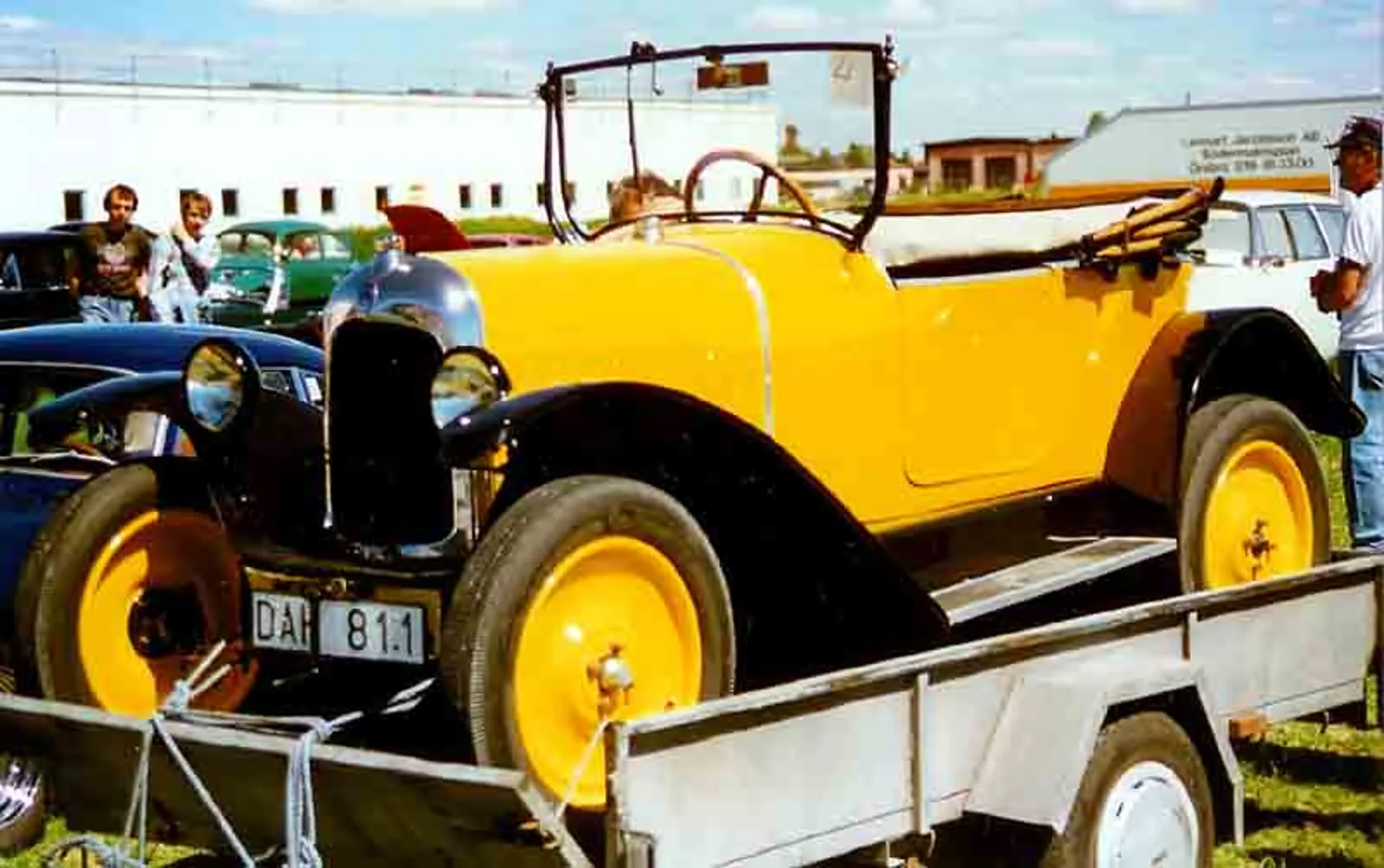
The first body was the two-seat Torpedo, launched in May 1922. It set the car's sporty image from the start. In 1923 it was joined by a more luxurious Cabriolet with a folding hood, and in 1924 Citroen added a three-seat Torpedo and a delivery van.
Each body gave the car a different character. The Torpedo was a sporty open tourer, the Cabriolet was a more comfortable convertible, and the van and delivery car turned the chassis to commercial work.
What were the Type C's engine and performance figures?
The 856 cc four-cylinder produced 8.2 kW (11 bhp), and it gave the car a top speed of 60 km/h (37 mph). The car weighed 543 kg (1,197 lb), most of which was in the engine, gearbox and rear axle, and it used about 5 L/100 km.
The 55 mm (2.2 in) bore and 90 mm (3.5 in) stroke gave the engine a small displacement, and thermosiphon cooling kept it simple. From 1 June 1925 a fan was fitted to all models, having previously been limited to the Cabriolet. A single Solex carburettor supplied the fuel.
The original battery and coil ignition was replaced after six months by magneto ignition, which had proved more reliable. The gearbox had three unsynchronised ratios plus reverse, and it could whine in first and second gear when worn.
Was the Type C a reliable car?
Yes, by the standards of its class, and it had a notable record on the road. In 1925 a used Torpedo driven by two students covered 17,000 km in five months around Australia, with no engine trouble in extreme conditions.
Citroen had also equipped it with a differential and an electric starter, which made it attractive to drivers who wanted easy handling.
What were the Type C's weak points?
Braking was the car's clearest weakness. It had no brakes on the front wheels, and the transmission brake and rear hand brake had to be balanced carefully. Drivers who misjudged that balance risked breaking a rear wheel shaft, and many owners later linked the transmission brake to the rear brakes.
The gearbox also needed attention. The sprocket could sing in first and second gear, and worn bushes made the gearbox noisy and caused misalignment over time.
How was the Type C's body built?
The body frame was timber, with metal panels nailed onto it. It was the last Citroen built with timber bodywork. The car had a single door on the passenger side, which opened forwards, and its hinges were hidden on most versions.
The chassis used a trapezoidal ladder frame reinforced with cross beams to resist twisting. Four inverted quarter-elliptical leaf springs carried the car, and from 1925 the heavier Cabriolet gained friction dampers at the back.
Why did production of the Type C end in 1926?
Production ended in May 1926. The 5HP sold well, but it was not profitable enough, and Andre Citroen decided to stop building it ahead of the all-steel B14, a decision made against general opinion. The problem was margin, not demand.
A planned all-steel C4 version was abandoned because it would have cost too much to produce.
How many Type Cs survive today?
About 81,000 Type Cs were built, and roughly 3,000, or around 4 percent, are estimated to survive. Survivors are now valued by collectors and enthusiasts of the period, and many rebuilds use period parts. Many of the rest were converted into utility vehicles and tractors.
The 5HP is now the typical car of the 1920s vintage scene, and it is easy to rebuild from period parts and modern reproductions.
What did the Type C look like inside?
Inside, the Type C had a bench seat covered in leatherette, a polished aluminium dashboard with only an ammeter and a light and ignition switch, and storage pockets fitted in each door. The Torpedo carried its spare wheel on the driver's side.
Trim colours changed with the body and chassis. The first cars were yellow, and the long-chassis Torpedos came in Bordeaux red, blue or Havana brown, with leatherette seats in red, black or brown to match.
A chest at the rear of the Torpedo could be opened from above and closed with a lid, and two supports on the boot lid could carry a trunk measuring about 40 by 80 cm. The running boards were aluminium with long grooves, painted black with polished groove tops.
The headlamps had black bowls and nickel rims, joined by an adjustable nickel-plated crossbar. The convertible hood opened around a single axis and was waterproof, and side curtains gave all-weather protection.
How did the tyres and chassis change?
The early car ran on 700x80 Michelin Cable tyres inflated to 400 to 500 kPa, which made the ride harsh and the handling mediocre. Both tyre types were fitted during the car's production run. In June 1924 Michelin's 715x115 Cable Confort balloon tyres replaced them, running at 250 kPa.
Those tyres were fitted to every car from June 1924, after first being offered as extra equipment. The switch came partway through production. In 1927 Confort Bibendum tyres at 150 to 175 kPa appeared as replacements for the original beaded-edge rims.
At the end of 1923 the short C2 gained 100 mm, stretching its 2,250 mm (89 in) wheelbase to 2,350 mm (93 in), and it gained an extra crossbar that supported the rear of the body. This long chassis, the C3, was built without further change until production ended.
The lengthening allowed the three-seat Torpedo and the delivery car to be built, and it can be seen from how far the spare wheel sits from the rear wing. The banjo-type rear axle was later given a helical-cut pinion in 1928, which was easier to make and more robust.
Which chassis and body codes did the Type C use?
The Type C used two chassis: the short C2 and the long C3, which reached the market in spring 1922 and October 1923 respectively. Citroen's naming of body types was complicated, and wartime archive losses let errors spread, so collectors rely on chassis and body codes to identify cars.
The two-seat Torpedo T2 was built on the short chassis from May 1922 to September 1923, and then on the long C3 until spring 1925. The Cabriolet TL ran from 1923 to June 1926 on both chassis.
The three-seat T3-1, with a folding jump seat, was built on the long chassis from October 1923 to September 1924. Buyers disliked the discomfort of the folding seat, and only about 8,000 were built before the T3-2 replaced it.
The T3-2 Trefle followed in October 1924, with two front seats and a third seat at the rear centre. It ran until June 1926, and its body could be finished in Bordeaux red, Canon blue or Havana.
What are the Citroen Type C specifications?
| Specification | Detail |
|---|---|
| Production | 1922 to 1926; about 81,000 built |
| Engine | 856 cc four-cylinder; bore 55 mm (2.2 in); stroke 90 mm (3.5 in) |
| Power | 8.2 kW (11 bhp) |
| Top speed | 60 km/h (37 mph) |
| Weight | 543 kg (1,197 lb) |
| Fuel use | About 5 L/100 km |
| Length | 3.2 metres |
| Wheelbase, short chassis | 2,250 mm (89 in) |
| Wheelbase, long chassis | 2,350 mm (93 in), from late 1923 |
| Launch price | 8,500 francs for the 1922 Torpedo |
| Front brakes | None |
| Ignition | Battery and coil, then magneto from about six months |
| Tyres, early | 700x80 Michelin Cable at 400 to 500 kPa |
| Tyres, from June 1924 | 715x115 Cable Confort at 250 kPa |
| Delivery car payload | 125 kg; 1,083 units |