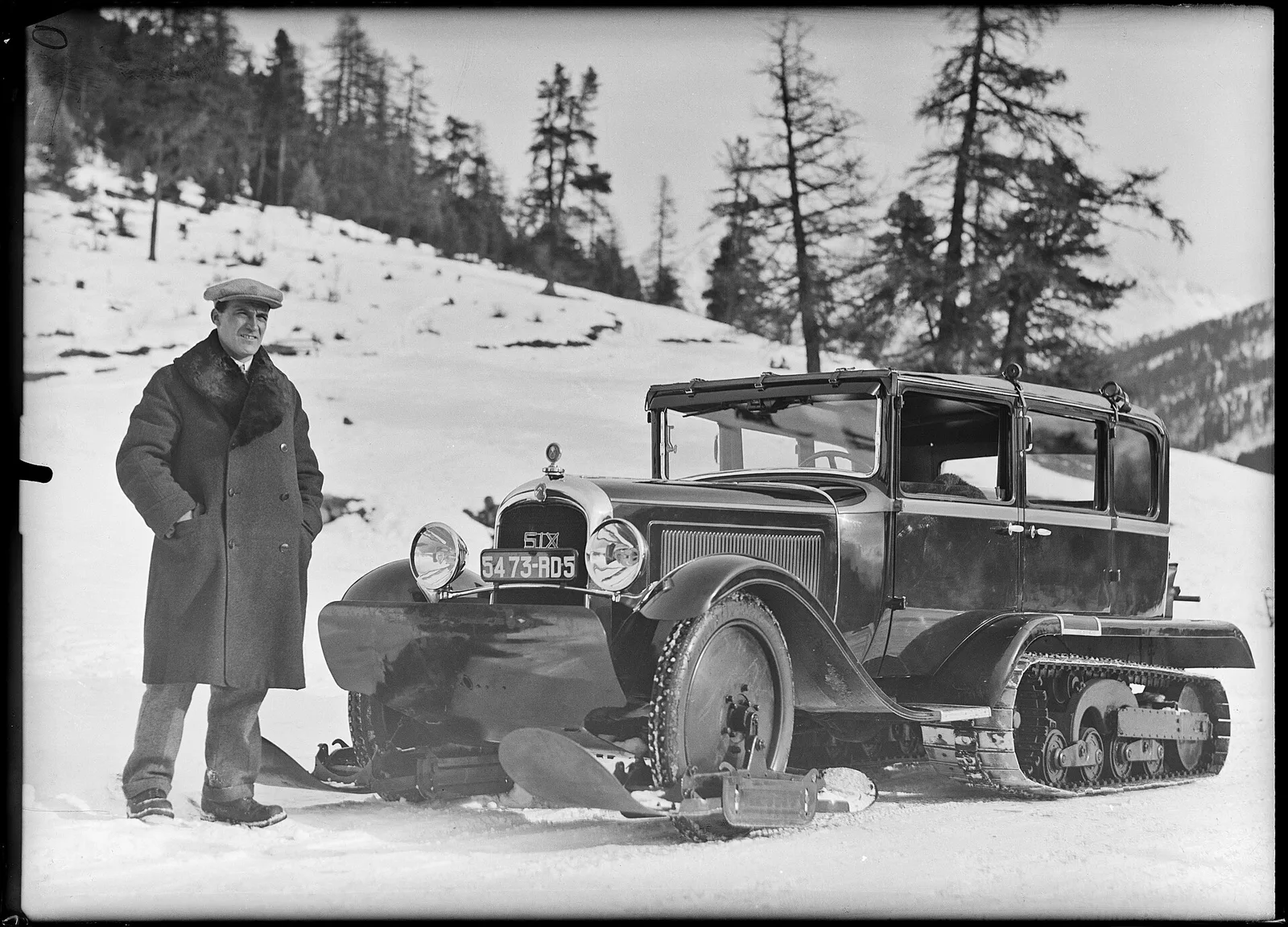
A chain-drive running gear designed by Adolphe Kegresse, built by Citroen from 1921 to 1937 for winter roads, liaison work and army tractors.
The Citroen-Kegresse was a half-track built by Citroen from 1921 to 1937, using a chain-drive running gear designed by Adolphe Kegresse. The P1T was the first series model, and the range grew to include tractors, armoured carriers and cavalry versions.
Citroen-Kegresse half-tracks were a family of vehicles that Citroen built between 1921 and 1937, each fitted with a chain-drive running gear designed by the French engineer Adolphe Kegresse. The track drive replaced the rear axle, so vehicles could stay usable through Russian winters and the mud of the thaw. The French army took many of them, and Poland, Belgium and the United States also bought or copied the design.
Where did the half-track idea come from?
The idea began in Russia. Kegresse was technical director of the Tsar's motor vehicle fleet, and he developed the first half-track vehicles there so that the Tsar's cars stayed usable in winter and in the mud and slush of the thaw. After the October Revolution he returned to France and joined Citroen, where he built on that earlier work.
Kegresse lived from 1879 to 1943. Citroen produced the half-tracks from 1921, and it usually fitted them with its standard car engines, some of them with reduced output. Those engines were too weak even for the period, and that remained a shortcoming of the vehicles to the end.
A chain drive fitted to a car chassis, built to keep vehicles moving through winter mud.
How did the chain drive work?
The rear axle was replaced by a chain drive. At first the drive roller sat at the back and the guide roller at the front, and the chain drive carried four road wheels. The chain itself was originally built from vulcanised sheet-metal plates, and the running gear went through a number of changes in the following years.
Engineers did learn to master the way the track drive behaved. The weak point that never went away was power, because the engines stayed too weak for the work, even by the standards of the day.
What were the first series models?
The P1T was the first Citroen-Kegresse built in series, following several prototypes in 1921. It began life as the K1, where the K stood for Kegresse, but Andre Citroen asked for the designation to be changed to P1T, and the change was made quickly.
The P1T used the engine of the Citroen B, a four-cylinder unit of 1,452 cc giving 20 PS. Its gearbox had three forward gears, one reverse and a transfer gearbox. The wheelbase was 1.90 m (6.2 ft), the chassis weighed 608 kg (1,340 lb), and the top speed was 29 km/h (18 mph). The first vehicles had only three road wheels a side, not the later four.
The P4T of 1924 to 1925 used the same engine, throttled to 18 PS (13 kW; 18 hp), and its wheelbase was stretched to 2.15 m (7.1 ft). The complete vehicle weighed 1,135 kg (2,502 lb), and its top speed was given as 29.8 km/h (18.5 mph). Its gearbox matched the P1T's.
The P2T, built in a handful of examples in 1924 and 1925, differed from the P4T of that time in its four-cylinder Mors engine of 2,815 cc (171.8 cu in). Some accounts describe it as nothing more than a P1T with a shortened wheelbase, which leaves its identity open to dispute.
The P6 was a special build for the company Citracit (Compagnie Transafricaine Citroen), which wanted to use vehicles built around 1924 and 1925 on Sahara crossings. It had a 2.8-litre four-cylinder Mors engine (171 cu in), and only a few were built, if any.
Which models served the French army?
The French army bought many of them. About 70 P1T were ordered in 1923 as all-terrain liaison vehicles, and around 42 P4T were procured for the same job. A further 16 P4T, fitted with a machine gun, went to French forces in Syria, and at least 58 P7T were acquired between 1925 and 1927.
Other army uses were more modest. Two 1924 prototypes of a lightly armoured infantry supply vehicle, which never reached series production, stayed with a cavalry regiment until 1937, at least eleven P1T served as ambulances carrying two lying wounded each, and a few P1T were used as aircraft tugs. One P1T also went to the Danish army in 1922.
Schneider armoured 16 of the P4T with 7 mm plates and fitted them with a turret carrying a Hotchkiss machine gun or a Puteaux 37 mm gun. Their combat weight was 2.1 tonnes (2,100 kg), and their bodywork measured 1.40 m (4.6 ft) across, 3.40 m (11.2 ft) in length and 2.20 m (7.2 ft) in height. They stayed in Syria until the late 1930s. One of them was found again in Afghanistan.
Around 1925 one P7T was armoured and given a rotating turret, with a Puteaux 37 mm gun on one side and a Hotchkiss MG on the other. The arrangement resembled the turret of the White TBC reconnaissance vehicles that France had overarmoured, but the car remained a single prototype.
Not every idea succeeded. The P20 armoured infantry carrier was built as a prototype around 1930 and tested by the French army, which did not order a larger series. The prototype was sold to the Dominican Republic. The P28 lightly armoured supply vehicle was rejected too, and the army took the Renault UE Chenillette instead.
What were the later P-series models?
The later models split into roles. The P10 and P17 towed light field guns, the P14 towed heavy field guns, and the P15N was built for deep snow. The P16 armoured reconnaissance vehicle, known as the AMC after its body maker, was built in 96 series examples from 1930 to 1931.
Between 1928 and 1931 the P10 was offered as an off-road car and as a light gun tractor. The P17 followed it from 1930 to 1934, mainly towing light field guns and their ammunition trailers. The P14 was built from 1930 to 1932, and one example took part in the Croisiere Jaune.
The P28 was developed around 1931 to supply infantry on the battlefield. Three prototypes were tested at Vincennes in July 1931, using the 30 PS engine of the Citroen C4 and carrying 6 mm of armour. A cavalry reconnaissance version followed with a 67 PS engine of 3,020 cc (184.3 cu in). Fifty were ordered and delivered from 1932 to 1933, but their untempered steel armour did not satisfy in any way.
The P26 was an open-topped infantry carrier with two large road wheels in place of the usual four small ones. Two prototypes were built in 1931, and nine vehicles originally ordered as P26B were delivered as the P104. Its open top resembled that of the later German Schuetzenpanzerwagen Sd.Kfz. 251 and the American M3. The P104 had a covered fighting compartment and a three-litre engine with 67 PS. It weighed 4,750 kg (10,472 lb) without its turret and 5,000 kg (11,023 lb) with it.
The P107 succeeded the P17 and was built from 1935 to 1937 as a gun tractor. From 1937 to 1940 the firm Unic built it as the Unic P107. The P112 started from a shortened Type 45 chassis. Its tyred rear axle could be swapped for a tracked unit that sat clear of the ground on the road and was lowered for off-road work. The French army tested a prototype extensively from 1936 to 1937, but series production did not follow.
How did Belgium, Britain and Poland build their own versions?
Belgium's army trialled Citroen-Kegresse P14 vehicles around 1932 as tractors for a newly procured canon de 120L mle.1931 gun. The trials went well, and Belgium took out a copying licence. Around 130 to 140 FN-Kegresse 3T were built between 1934 and 1940, first at Minerva and later at FN, with a stronger FN engine of 55 PS in place of the Citroen unit.
In Britain Crossley Motors produced 115 units between 1925 and 1929, and surviving photographs show that Kegresse chassis were used. Burford built 55 for the British army and partly for the Indian army in British India. Other British firms built prototypes and small series of half-tracks in the 1920s, but without Kegresse chassis.
The Polish army acquired 229 Citroen-Kegresse half-tracks of the types P4T, P14, P17 and P19. About 90 P4T received an armoured body and a rotating turret with a machine gun, and they became the Panzerauto wz.28. Their 20 PS engine left them badly underpowered for a vehicle of over two tonnes.
From 1934 those Polish P4T were given the engine of the Polski Fiat 508, which produced 2 PS more, and their half-track running gear was replaced by a normal rear axle with wheels. Off-road capability fell, but road speed rose. The Lastwagen wz.34 truck with a half-track running gear, built from 1936, was followed by more than 300 units, and about 400 Zugwagen C4P gun tractors used the same running gear.
What did the German, Soviet and American half-tracks change?
Very little of Kegresse's design survived in them. The German half-track tractors had considerably longer track chassis, wheels hung on torsion bars, and in-house engines with much higher output. Those chassis were never a copy of the Citroen units, although Citroen had maintained an assembly plant at Cologne-Poll from 1927 to 1935.
In the Soviet Union, the GAZ-60 was based on the GAZ-MM, and the ZIS-22 and ZIS-42 on the ZIS-5. In every case the base was a standard truck, with a Russian track drive fitted where the rear axle had been, and it bore no resemblance to Kegresse's design. The United States bought three Citroen-Kegresse vehicles from France in 1931 for testing, and its own Second World War half-tracks were larger, heavier and far more powerful.
Which buyers took the half-tracks?
Buyers ranged from armies to farmers. Denmark took a P1T in 1922 and two P7T in 1924, and the Portuguese army received further P7T. Poland bought 135 P4T chassis, while Portugal and Argentina took a few more P4T of their own.
Farmers were also a target. Those buying a P4T as a farm tractor were granted 5,500 francs, paid over three annual instalments. The idea was that many more P4T would be available to the French army in wartime. By 1926, however, only 50 such civilian-registered vehicles existed.
Outside Europe, French Indochina ordered nine P104 for delivery in 1935, and French East Africa at Djibouti received three P104 with a machine gun in a rotating turret. Uruguay bought three P28, and the Austrian Post used P15N vehicles as winter post buses on the Arlberg and Tauern roads. In 1933 the Reichswehr took delivery of one Citroen-Kegresse of unspecified type in East Prussia and tested it intensively.
Which expeditions tested the vehicles?
Kegresse-equipped vehicles were sent on two long Citroen expeditions. The Croisiere Noire of 1924 and 1925 ran from Colomb-Bechar in Algeria through Niger and Chad to Madagascar and South Africa, and some P4T were used on it. The Croisiere Jaune of 1931/32 carried a P14, six P17 and several P21 vehicles.
The Croisiere Noire was intended to prove the reliability of Citroen. The P21, built around 1931 with the six-cylinder engine of the Citroen 15A Rosalie, shared the second expedition with the P14 and P17.
Specifications at a glance
| Specification | Detail |
|---|---|
| Production years | 1921 to 1937, Citroen |
| Running gear | Chain drive replacing the rear axle |
| P1T engine | 1,452 cc, 20 PS |
| P1T wheelbase | 1.90 m (6.2 ft) |
| P1T weight | 608 kg (1,340 lb) |
| P1T top speed | 29 km/h (18 mph) |
| P4T engine | P1T engine throttled to 18 PS (13 kW; 18 hp) |
| P4T weight | 1,135 kg (2,502 lb) |
| P7T wheelbase | 2.35 m (7.7 ft) |
| P28 cavalry engine | 3,020 cc (184.3 cu in), 67 PS |
| P28 top speed | 39.5 km/h (24.5 mph) |
| P104 weight | 4,750 kg (10,472 lb) without turret |
Why did the design matter?
The design was practical rather than glamorous. It kept motor vehicles moving through winter, mud and slush, and armies used the results for towing, carrying and ambulance work. Citroen's catalogue of types ran from the early P1T to the P112, and the number of variants shows that the basic idea was adapted again and again.
Each change met the same limit. The engines were rarely strong enough for the loads the chassis could carry, and that shortcoming stayed with the family until the end.