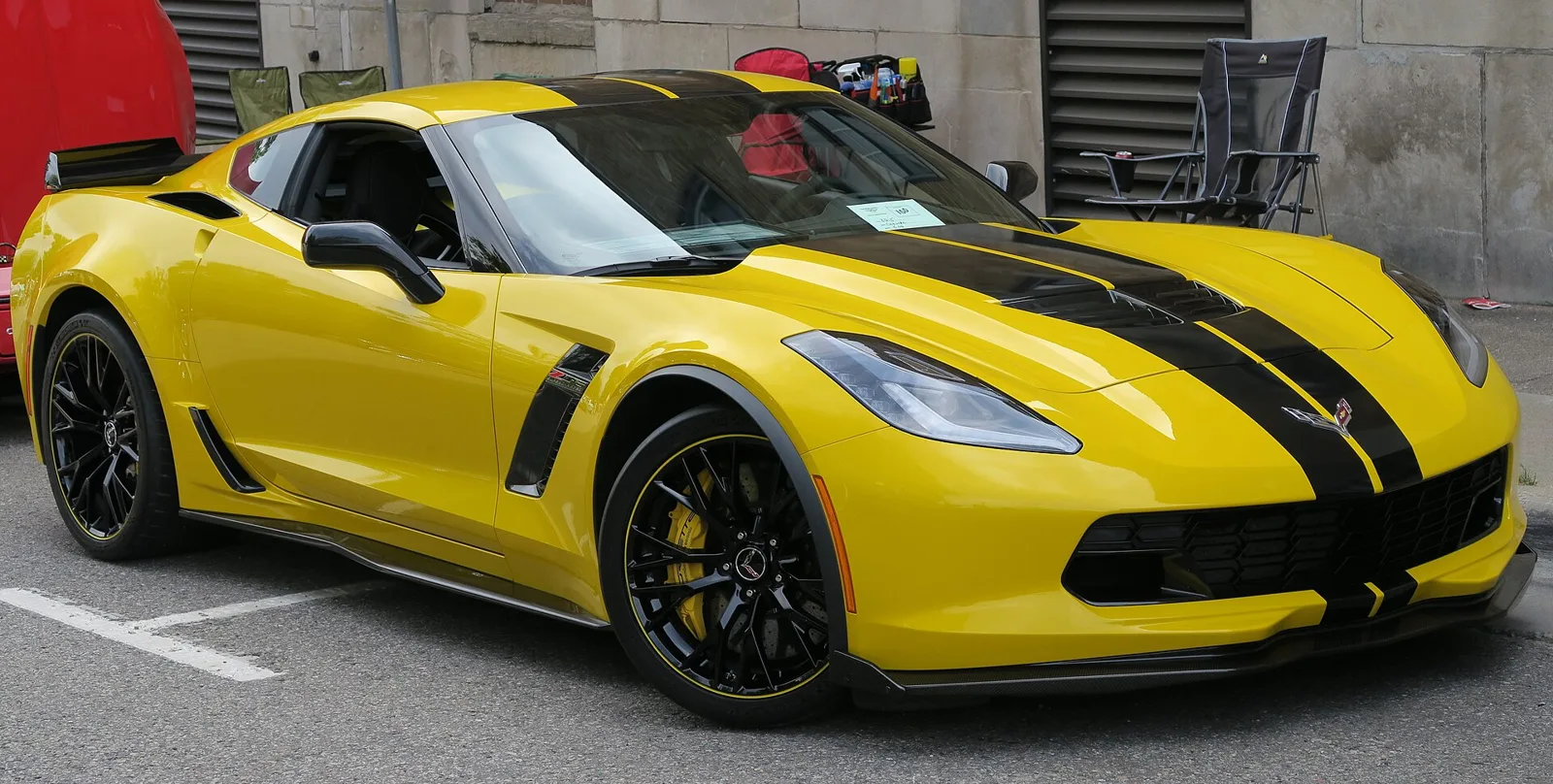
A front mid-engined layout, an LT1 V8 rated at 340 kW and Z06 and ZR1 models that took the car into supercharged performance territory.
The Chevrolet Corvette C7 ran from 2014 to 2019 with a front mid-engined layout. Its LT1 V8 was joined by supercharged Z06 and ZR1 versions, and the C7.R racer won the GTLM class at Le Mans. Chevrolet chose that layout partly to keep costs down.
The Chevrolet Corvette C7 was a front mid-engined sports car built from the 2014 to 2019 model years. Its base LT1 V8 produced 340 kW (460 hp), and the Z06 and ZR1 models later lifted the range into supercharged performance territory. Racing versions of the car also won their class at Le Mans.
Where did the C7 Corvette come from?
General Motors began planning the C7 in 2007 and first aimed it at the 2011 model year. Delays followed, and the team chose a front mid-engined, rear-wheel-drive platform because it kept costs lower than the alternatives. Mid-engine and rear-engine layouts had both been considered before that decision.
The lead exterior designer, Hwasup Lee, led a team that finished the body design between 2010 and 2011. Kirk Bennion served as design director for the C7, and Tom Peters approved the design for the division in 2011.
Chevrolet unveiled the 2014 Corvette in Detroit on 13 January 2013. The first C7 Corvettes reached buyers in the third quarter of 2013, and the generation stayed in production until the 2019 model year.
A front mid-engined Corvette that kept the Stingray name and added supercharged V8s above it.
What did the C7 look like?
The C7 was an evolutionary redesign of a long-running theme, though its designers added aggressive angular elements. Functional aero aids were fitted to nearly every body panel, and Edmunds called the rear the most controversial styling element of the car.
Trapezoidal taillights and four tailpipes marked the rear, and the styling drew criticism from the press. The headlamps carried integrated LED daytime running lights, and the front of the car was drawn with the same angular language as the rest.
Carbon fibre formed the bonnet, and the roof panel could be removed. Its fenders, doors and rear quarter panels stayed fibreglass composite, and the chassis was built from hydro-formed aluminium. Aerogel, which keeps heat from the transmission tunnel out of the cabin, was one of the less visible parts of the package.
How much power did the LT1 V8 make?
The all-new LT1 6.2 L small block V8 produced 340 kW (460 hp) and 630 Nm (465 lb-ft) with the performance exhaust fitted. Without that exhaust, output dropped to 455 hp (339 kW) and 460 lb-ft (620 Nm). With the eight-speed automatic, the car reached 97 km/h (60 mph) in 3.7 seconds.
Pushrods and overhead valves remained, inherited from the earlier small block family. To that layout it added direct fuel injection, Active Fuel Management and variable valve timing, so the basic design was familiar even as the details changed.
Suspension used independent, unequal-length double wishbones at each corner. Transverse fibreglass mono-leaf springs carried over in a form similar to the predecessor's, and buyers could add magnetorheological dampers for adaptive control.
The Tremec 7-speed manual used active rev matching, which controlled engine speed through each gearchange. The eight-speed automatic was the other gearbox on offer, and the 3.7-second sprint to 97 km/h (60 mph) was recorded with that unit.
How did the 2014 Stingray sell?
Customer deliveries of the 2014 Stingray Coupe began in September 2013. A month after the first Stingray, 485 vehicles had been delivered, and 38% of early orders specified the 7-speed manual while 75% included the Z51 Performance Package. Those two percentages show how early buyers split between transmission and performance equipment.
Production of the convertible started at the end of 2013, and the cars were built at the Bowling Green, Kentucky, assembly plant. The first production convertible sold for US$1,000,000 at a charity lot, a headline figure for a car that had only just reached dealers.
Which variants came first?
The Stingray range began with a coupe and a convertible, and the Z51 Performance Package became a common choice. Concepts shown at the 2013 SEMA show were named Gran Turismo, Atlantic and Pacific. Premiere Editions were produced for both body styles.
Dry sump lubrication, 19-inch front and 20-inch rear wheels, an electronic limited-slip differential and Brembo brakes came with the Z51 Performance Package. Those items made it the most complete way to order the base car's running gear.
Premiere Edition coupes were limited to 500 units in Laguna Blue Tintcoat, while convertibles were limited to 550 units in Lime Rock Green. Those two editions marked the introduction of both body styles, so they carry a place in the first year of the range.
What changed for the 2015 model year?
For the 2015 model year, the 8L90 eight-speed automatic became an option on every Corvette model, and dual mode exhaust became standard on Z51 cars. The Performance Data Recorder was offered as an optional system in the same period, letting drivers log their own laps.
The eight-speed automatic gave buyers a second transmission choice beside the 7-speed manual, and it was offered across the range rather than on a single trim.
Dual mode exhaust was standard on Z51 cars from that year, which set the Z51 apart from the base car.
What was the Performance Data Recorder?
The Performance Data Recorder was an optional system that let drivers capture performance data while driving and review it afterwards. A 720p camera in the windshield header recorded the view ahead, and a dedicated GPS receiver tracked the car's position.
Track Mode displayed speed, rpm, g-force, a location-based map and lap time over the recorded video. The data could be read back on the car's own display when parked, which kept the recording practical for a weekend at the circuit.
Recorded laps could be studied in Cosworth Toolbox software, which overlays them on a satellite map of the track. The software let an owner see where each lap was driven, not just how long it took.
What made the Z06 different?
The Z06 used a supercharged LT4 6.2 L V8 rated at 650 hp (659 PS; 485 kW) at 6,400 rpm. Its top speed was 298 km/h (185 mph), and its US base price was US$78,995 in the model's first year on sale.
Torque reached 650 lb-ft (881 Nm) at 3,600 rpm, while peak power came at 6,400 rpm. That spread meant the supercharged V8 delivered its pulling force well before the top of the rev range. Buyers could also take a US$5,000 option to assemble their own engine, a package tied to the Bowling Green plant where the cars were built.
The Z06 came as a coupe and as a convertible from the 2015 model year, and it rode on 19x10-inch front and 20x12-inch rear wheels. The convertible had been unveiled at the 2014 New York auto show, alongside the coupe.
Carbon ceramic brakes arrived with the Z07 package, which also revised the suspension tuning. Stage 2 and stage 3 carbon fibre aero packages could be added on top of it, and the stage 3 kit was the one aimed at the greatest downforce.
Which special editions came later?
The 2016 model year brought Twilight Blue, Spice Red and Jet Black Suede design packages. The Z06 C7.R Edition followed as a limited run, and the Grand Sport joined the line for 2017 as a hybrid of the Z51 and Z06. The Carbon 65 Edition and the 2019 Drivers Series closed out the list.
Limited to 500 units, the Z06 C7.R Edition carried its own VIN sequence beginning at 700001. Its features linked the road car to the C7.R racer that had won the GTLM class at Le Mans.
Production of the Carbon 65 Edition was capped at 650 units worldwide.
Grand Sport Collector Edition production ended at 935 cars, made up of 784 coupes and 151 convertibles. That run was built on the Grand Sport, which arrived for 2017. The Drivers Series for 2019 totalled 95 cars, and four Corvette Racing drivers each chose a livery for the car.
What was the ZR1?
The ZR1 was a Z06-based model with a 6.2 L pushrod LT5 V8 rated at 755 hp (765 PS; 563 kW). It was unveiled at the 2017 Dubai Motor Show, and its top speed was 345.82 km/h (214.88 mph) with the low rear wing fitted.
Weight came to 1,614.8 kg (3,560 lb), and the car generated 430.9 kg (950 lb) of downforce at top speed. Its torque was 969 Nm (715 lb-ft) at 4,400 rpm. Its supercharger was 52% larger than the Z06 unit, and output rose from 650 hp in the Z06 to 755 hp.
Pratt and Miller's Corvette racing team helped develop the aero package. The optional ZTK package delivered 60% more downforce than a Z06 with the Z07 package, which made it the aero choice for owners who spent time on track.
How did the C7 perform in racing?
The C7.R was the racing version of the Z06, unveiled at the 2014 Detroit show. It used a 5.5-litre LS7.R naturally aspirated V8 rated at 491 hp (498 PS; 366 kW), and it won the GTLM class at the 24 Hours of Le Mans.
Hockenheim was the venue for the GT3-R unveiling on 3 October 2015. It was the first factory-backed Corvette built outside Pratt & Miller, and Callaway Engineering built it.
Its 6.2 L V8 came from APP Racing Engines, with output of 550-600 hp (558-608 PS; 410-447 kW) depending on restrictors. The engine was paired with an X-Trac 6-speed gearbox.
What awards did the C7 win?
The C7 won Automobile Magazine's Automobile of the Year 2014 and Road and Track's Performance Car of the Year 2013, and it was a finalist for Motor Trend Car of the Year. Car and Driver also put it on its 10Best list in 2014, 2015, 2017, 2018 and 2019, with 2016 the only year missing from that run.
Criticism of the car's styled elements ran alongside the praise, and the press commented on them. Edmunds singled out the rear in particular.
How did C7 production end?
The 2017 model year ran from 11 July 2016 to 29 May 2017, and production paused on 28 July 2017 for paint and ZR1 line work. Production resumed on 6 November 2017, and the generation ended with the 2019 model year.
Auctioned on 28 June 2019, the final C7 was a black Z06 coupe. The sale closed out a generation that began with the 2014 Stingray and ran through a long list of special editions.
Corvette C7 specifications
| Specification | Detail |
|---|---|
| Model years | 2014 to 2019 |
| Engine (base) | LT1 6.2 L small block V8, pushrod, direct injection |
| Output (performance exhaust) | 340 kW (460 hp); 630 Nm (465 lb-ft) |
| Output (without performance exhaust) | 339 kW (455 hp); 620 Nm (460 lb-ft) |
| Transmission | 7-speed manual or 8-speed automatic |
| 0-60 mph (97 km/h) | 3.7 seconds with 8-speed automatic |
| Z06 engine | LT4 supercharged 6.2 L V8; 650 hp (659 PS; 485 kW) |
| Z06 top speed | 298 km/h (185 mph) |
| ZR1 engine | LT5 6.2 L (6,162 cc) pushrod V8; 755 hp (765 PS; 563 kW) |
| ZR1 top speed | 345.82 km/h (214.88 mph) |
| ZR1 weight | 1,614.8 kg (3,560 lb) |
| Z06 US base price | US$78,995 |
| ZR1 supercharger | 52% larger than the Z06 unit |
| Premiere Editions | 500 coupes (Laguna Blue Tintcoat); 550 convertibles (Lime Rock Green) |
| Grand Sport Collector Edition | 935 built: 784 coupes, 151 convertibles |
| Drivers Series | 95 cars for 2019 |