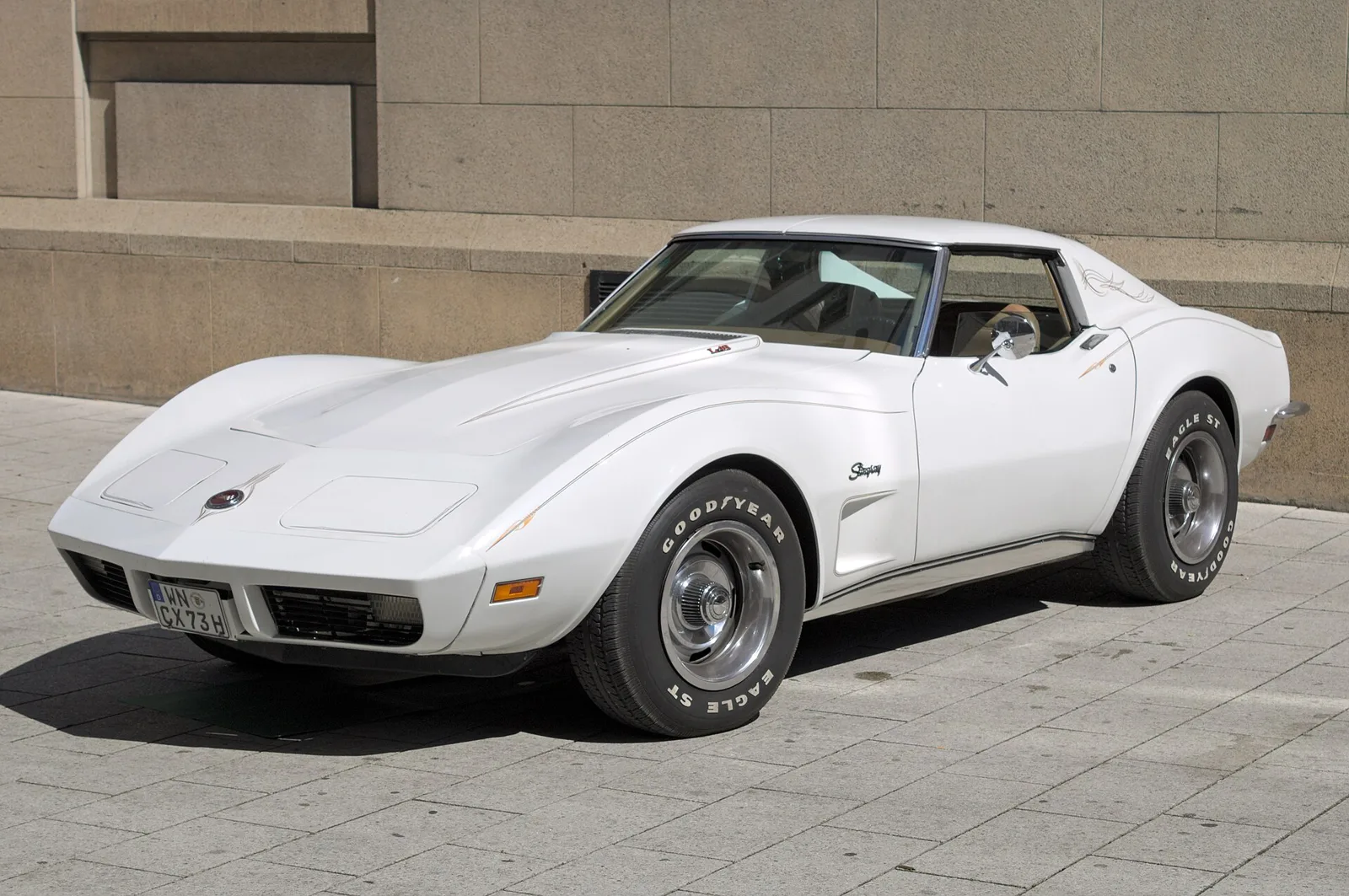
Built from 1967 to 1982, the third-generation Corvette started with 427 big-blocks, set a production record in 1979 and ended with a fuel-injected small-block.
The Chevrolet Corvette C3 was the third generation of the Corvette, built from 1967 to 1982. It moved from big-block muscle to a touring sports car, with a 1979 peak of 53,807 cars that remains the record. Its Stingray script appeared on the front fenders from 1969, spelled as one word.
The third-generation Corvette brought a fully redesigned body and interior in 1968, and it lasted until 1982. Much of the engine and chassis carried over from the car before it, but the Corvette changed character across those fifteen years.
Where did the C3 design come from?
The C3 was patterned on the Mako Shark II, a concept designed by Larry Shinoda under Bill Mitchell's direction and started in early 1964. Once the mid-engined layout was abandoned, Dave Holls's Chevrolet Styling group took the car on, and Henry Haga's studio fitted it to the Stingray chassis for production.
The lower body kept much of the Mako II's shape, though the contours were softer. The roof took the sugar scoop treatment, a vertical back window borrowed from the mid-engined concepts developed by the Duntov group. The rear window and the roof section above the seats were meant to come out from the start.
The concept was renamed Manta Ray along the way. Before the car was unveiled, Mattel's die-cast Hot Wheels Custom Corvette, a GM-authorised model of the 1968 car, reached shops several weeks ahead and gave enthusiasts an early look.
From a 427 big-block to a fuel-injected touring car, the C3 changed more than its engines.
What changed with the 1968 body?
The 1968 Corvette had a completely redesigned body and interior. The coupe became a notchback with a near-vertical removable rear window and removable T-top panels, while convertibles kept a soft folding top with an optional hardtop. Coupes came with hold-down straps and vinyl bags for the roof panels.
Other details were new. The headlights were concealed and operated by engine vacuum, the wipers hid behind a vacuum-operated door that proved troublesome, and the side vent windows gave way to Astro Ventilation, a fresh-air system. There was no glove box, and the battery moved behind the seats to balance the weight.
Inside, a large round speedometer and tachometer sat in front of the driver, with auxiliary gauges clustered above the console. The door handles sat flush with the top of the doors and used a separate release button.
How powerful were the 1968 engines?
The base engine in 1968 was the L30, a 327 cu in (5.4 L) small-block putting out 300 hp (224 kW). Option choices ranged from the 350 hp (261 kW) L79 small-block to a series of 427 cu in (7.0 L) big-blocks, which together made up nearly half the cars.
Big-block choices began with the L36, a 390 hp (291 kW) engine on a Rochester four-barrel, followed by the L68 at 400 hp (298 kW) with a Holley triple two-barrel set-up. The L71, with its tri-power carburettors, put out 435 bhp (441 PS; 324 kW) and peaked at 5,800 rpm. The L89 was the same engine with aluminium heads.
The most extreme option was the L88, which Chevrolet designed for racing rather than the street. Its published rating was 430 hp (321 kW), but it carried a large four-barrel carburettor, aluminium heads, a special air induction system and 12.5:1 compression. Only 80 were ordered.
What happened in 1969?
The small-block grew to 350 cu in (5.7 L) in 1969 with output unchanged, and the Stingray script appeared on the front fenders as one word. Coupes with their removable roof panels made up 57% of cars and began outselling roadsters.
A labour dispute stretched the 1969 production cycle, which lifted volume. It was also the last year for the L88 and the only year for the ZL1 option, which is covered with the other special models.
How did the LT1 and LS5 change the 1970 range?
The 1970 range added the LT1, a 350 cu in (5.7 L) small-block rated at 370 hp (276 kW) with a solid lifter, a forged steel crankshaft and 11:1 compression. The LS5 454 cu in (7.4 L) big-block made 390 hp (291 kW) SAE gross and took about a quarter of sales.
The LT1 was rare. It made up less than 8% of production and could not be ordered with air conditioning, but it came with a domed hood bearing LT1 decals. Motor Trend's May 1970 test timed an LT1 through the quarter mile in 14.36 seconds at 101.69 mph.
A ZR1 package added racing suspension, brakes, stabilizer bars and other performance parts to LT1 cars. The LS7 deserves a mention. Chevrolet advertised it at 460 hp (466 PS; 343 kW) with a single 800 CFM Holley carburettor, but it seems never to have reached retail buyers and appeared only as a crate engine.
The short model year cut production to 17,316 for 1970, down nearly 60%.
Why did engine power fall in 1971 and 1972?
Engines were detuned in 1971 to run on lower-octane fuel, lowering compression ratios. The base 350 dropped to 270 hp (201 kW), while the LT1 slipped to 330 hp (246 kW) and the LS5 454 made 365 hp (272 kW).
The 1971 LS6 was a 454 with aluminium heads, rated at 425 hp (317 kW), the highest output of the 1970 to 1972 model years. It could be ordered with an automatic, while the ZR2 package paired it with a four-speed only.
1972 changed the rating system. SAE net figures replaced SAE gross, which made the numbers look much lower: the base 350 was now listed at 200 hp (149 kW), the LT1 at 255 hp (190 kW) and the LS5 at 270 hp (201 kW). That was also the last year for the LT1 and the ZR1 package built around it.
The LS5 was not offered in California. It was the start of a pattern in which Chevrolet limited some powertrains there because of the state's tougher smog rules.
Convertibles were fading, and the Stingray was no exception. The 1972 car sold only 6,508 copies, around 9% of the market, which placed it third behind the Cutlass Supreme's 11,571. It still beat the Impala's 6,456 and the Mustang's 6,401.
Why did the Stingray turn into a touring car in 1973?
The 1973 Corvette started its move from muscle car to touring sports car. Radial tyres and redesigned body mounts improved the ride, and interior sound levels fell by 40%. The chrome front bumper gave way to a federally required urethane nose that added 35 lb (16 kg).
Car and Driver wrote in December 1972 that the small-block gave the Corvette a sense of balance rare in any GT car, and preferred it to the big-blocks for that reason, even though the big engines delivered more torque.
Which engines did the 1973 and 1974 Corvettes use?
The base L48 350 made 190 hp (142 kW) in 1973, while the L82 replaced the LT1 as the high-performance small-block at 250 hp (186 kW). The LS4 454 big-block arrived in 1973 with 275 hp (205 kW) and took over from the LS5.
Nearly 20% of cars took the L82, which cost $299, and 15% chose the LS4. The LS4 also brought a cowl induction hood that drew air through a rear hood intake under full throttle, cutting 0-60 mph times by a second while keeping the engine bay cooler.
Road & Track's 1973 test called the car pleasant and rewarding to drive. Hi-Performance Cars compared the three engines and favoured the base L48 for the best all-round balance, with 6.8 seconds to 60 mph (97 km/h) against 6.7 for the L82 and 6.4 for the LS4. The Z07 off-road suspension was rare, with only 45 produced in 1973.
What changed in 1974 and 1975?
The 1974 car got a new urethane rear bumper with an aluminium impact bar, and it was the last year for true dual exhausts, the last without a catalytic converter and the last 454 big-block. In 1975 the catalytic converter arrived, and the base engine fell to 165 hp (123 kW).
The 1975 Corvette was marketed as a more efficient car. Service intervals grew, and unleaded-only warnings sat on the fuel gauge and filler door. Power fell hard: the L82 dropped 45 hp (34 kW) to 205 hp (153 kW). Only 12% of cars were ordered as convertibles, and Chevrolet believed it would be the last soft-top ever. The convertible returned in 1986.
How did the 1976 and 1977 cars differ?
Steel floor panels replaced the fibreglass floor over the catalytic converter, reducing cabin noise, and the L48 rose to 180 hp (134 kW) while the L82 made 210 hp (157 kW). Cast aluminium wheels finally became optional, and a leather-wrapped three-spoke wheel replaced the criticised four-spoke unit of 1976 in 1977.
Car and Driver recorded 6.8 seconds to 60 mph in both L48 and L82 four-speed 1976 cars. The magazine also took a four-speed L48 on a 4,000-mile (6,400 km) road trip to Alaska and came back impressed by how well the car had stood up to the trip.
The 1977 cars had the steering column moved 2 inches (51 mm) closer to the dash for a more arms-out seating position. Leather trim became standard, and power steering and power brakes followed. Cruise control was available only with automatic transmission, and the Corvette passed half a million built since production began in 1953.
What was special about the 1978 fastback?
The 1978 model year marked 25 years of the Corvette, and it brought a fixed-glass fastback rear window, the most noticeable change to the body. The fastback improved aerodynamics and luggage space, and it gave the ten-year-old body a fresh look.
The fastback was not the only change. The base L48 made 185 hp (138 kW), or 175 hp (130 kW) in California and high-altitude cars, and the L82 gained a dual-snorkel air intake that lifted it to 220 hp (164 kW). Corvettes also moved to metric tyres, with P225/70R15 as standard, and the fuel tank grew from 17 to 24 gallons.
Bill Mitchell's favourite colour, silver, inspired the Silver Anniversary option. Listed as B2Z at $399, it brought the first two-tone paint since 1961, with silver over grey and a pinstripe. Aluminium wheels and sport mirrors were mandatory extras that added another $380.
Road & Track's L82 reached 60 mph (97 km/h) in 6.6 seconds, with a top speed of 127 mph (204 km/h). The quarter mile took 15.3 seconds at 95 mph. The Indy 500 pace car replica, RPO Z78, was black over silver with a red pinstripe, and 6,502 were produced, about 15 percent of total output.
Why did 1979 set the production record?
The 1979 model year reached a peak of 53,807 cars, a record that still stands. Bolt-on spoilers and glass roof panels drew buyers, and the spoiler cut drag by about 15%. Nearly 7,000 cars took the spoilers, and close to 15,000 took the glass roof panels at $365 each.
The 1979 car also had lightweight high-back bucket seats, about 24 pounds lighter, tungsten-halogen high beams as standard and a cassette option for $234. Output rose too, thanks to new open-flow mufflers. The base engine made 195 hp (145 kW), and the L82 reached 225 hp (168 kW).
1979 was also the last year a manual could be ordered with the L82. About 82% of 1968 cars had manual transmissions, but by 1979 fewer than 20% of cars were delivered with one.
What changed from 1980 to 1982?
The 1980 Corvette got integrated aerodynamic bumper spoilers and an aluminium Dana 44 independent rear differential, and California cars had to take a 305 cu in (5.0 L) V8 with automatic only. The base price rose by more than $1,200 to $14,345.24 during the model year.
The California car's 305 was rated at 180 hp (134 kW). Buyers there were credited $50 but had to pay $250 for emissions certification. Everywhere else the L48 350 made 190 hp (142 kW).
For 1981 there was only one engine, the L81 350 at 190 hp (142 kW), available with manual or automatic transmission. That was the last C3 offered with a manual, and it managed 0-60 mph in 8.1 seconds. Production moved from St. Louis to Bowling Green, Kentucky, in mid-1981.
1982 brought Cross-Fire Injection, a throttle-body system with two throttle bodies that produced 200 hp (149 kW). It came with the new 700-R4 four-speed automatic, which had an overdrive that cut engine speed by 30 percent at cruising speed, although the transmission proved problematic. The last C3's published figures were 7.9 seconds to 60 mph and 16.1 seconds for the quarter mile at 85 mph (137 km/h).
Which special models stand out?
Several special models set the C3 apart, from the 1969 ZL1 all-aluminium big-block to the 1978 Indy 500 pace car replica and the 1982 Collector Edition. Chevrolet also leased three Stingrays to Apollo 12 astronauts, and a rare four-door Corvette America appeared in 1980.
ZL1 (1969)
The ZL1 option offered an all-aluminium 427 cu in (7.0 L) big-block rated at 430 hp (321 kW) gross, and it ran the quarter mile in 10.89 seconds. Testing suggested closer to 460 hp (343 kW) gross, against a net rating of 376 hp (280 kW).
Motor Trend called the ZL1 the fastest production car built up to that time in a late 1968 road test. For decades experts believed only two had been built, both coupes, until Car and Driver revealed a third, a red car, in December 1969. Its owner, a Gulf Oil engineer, still owns it and occasionally races it.
In 2023 one of two factory-built 1969 ZL-1s sold at auction through RM Sotheby's Arizona for $3,140,000.
ZR1 and ZR2 (1970 to 1972)
The ZR1 special engine package cost $1,221.00 and was available only with the LT1. It included a heavy-duty four-speed, power brakes, an aluminium radiator and revised suspension. Because it was competition equipment, it could not be ordered with power windows, power steering, air conditioning, a rear defogger, wheel covers or a radio. Only 53 were built, 25 in 1970, 8 in 1971 and 20 in 1972.
The ZR2 package cost $1,747.00, appeared only in 1971 and paired the LS6 454 with the ZR1 kit. Only 12 cars were built with it, including two convertibles. Some believe the ZR letters stood for Zora Racer, after Zora Duntov, but a 2008 Corvette production manager said the codes were usually random and gained meaning from enthusiasts.
Indy 500 pace car (1978)
The C3 was chosen as the pace car for the 1978 Indianapolis 500. The replica was an option package, and it grew into a run that made up about 15 percent of production. Its black over silver metallic paint, bright red pinstripe and spoilers at each end set it apart from the regular car.
Corvette America (1980)
The Corvette America had four doors and a wheelbase stretched by about 30 in (760 mm) to fit them. Accounts differ on whether General Motors or California Coach Motors built it, and only five were made.
Collector Edition (1982)
A hatchback rear window debuted on the 1982 Collector Edition, a foretaste of the C4. It had its own serial sequence, silver-beige paint and alloy wheels patterned on the 1967 bolt-ons. Its base price of $22,537.59 made it the first Corvette above $20,000, and 6,759 of the 25,407 cars built in 1982 were Collector Editions.
How did reviewers and magazines judge the C3?
Reviewers liked the C3's straight-line pace and its improving ride, but they kept finding faults with the rear end and a cabin that stayed cramped. Hot Rod later listed the 1973 to 1974 LS4 Corvette among the ten most collectable muscle cars, calling the big-block Corvettes the only post-1970 muscle cars worth a place there.
What did the C3 cost, and how did the line-up change?
The list price rose from $4,663 in 1968 to $18,290 by 1982. The choice narrowed too: 1968 offered six engines and five transmissions, while 1982 offered one small-block and one four-speed automatic. Emissions rules and fuel economy concerns had reshaped the car by then.
C3 specifications at a glance
| Specification | Detail |
|---|---|
| Production | 1967 to 1982; model years 1968 to 1982 |
| Record year | 1979, 53,807 built |
| 1968 base engine | L30 327 cu in (5.4 L), 300 hp (224 kW) |
| 1968 top big-block | L71 427 cu in (7.0 L), 435 bhp (324 kW); L88 rated 430 hp (321 kW) |
| 1969 ZL1 | All-aluminium 427 cu in (7.0 L), 430 hp (321 kW) gross, 10.89 seconds in the quarter mile |
| 1970 LT1 | 350 cu in (5.7 L), 370 hp (276 kW) factory rating |
| 1974 LS4 | 454 cu in (7.4 L), 270 hp (201 kW) |
| 1978 L82 | 220 hp (164 kW) with dual-snorkel intake |
| 1980 base price | $14,345.24 by the end of the model year |
| 1982 engine | Cross-Fire Injection, 200 hp (149 kW) |
| 1982 performance | 0-60 mph in 7.9 seconds; quarter mile in 16.1 seconds at 85 mph (137 km/h) |