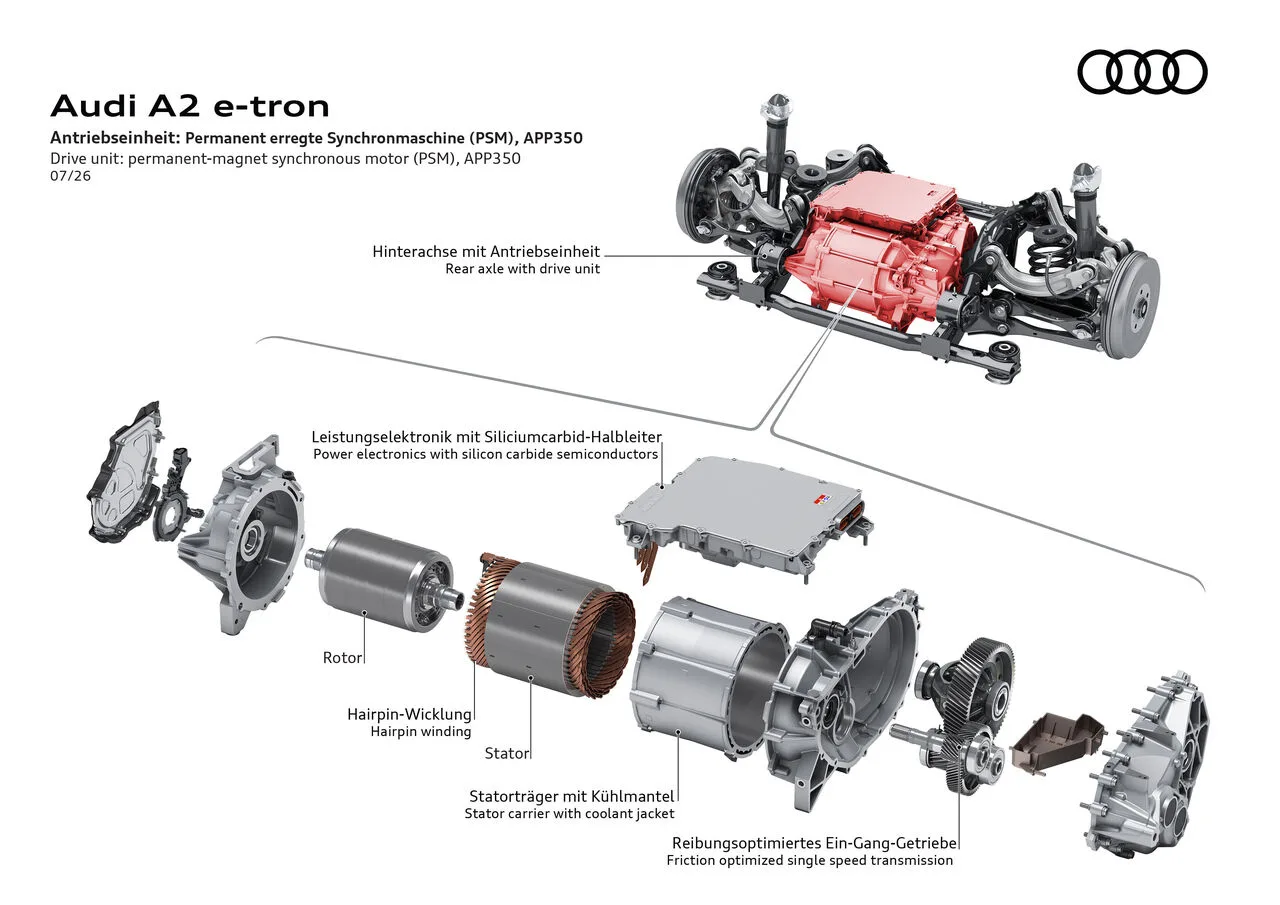
A silicon carbide inverter, a thinner rotor and a delta-wound stator lie behind the efficiency claim for the new electric compact.
Audi has detailed the electric drive of the new A2 e-tron, which it calls the most efficient Audi built. The 140 kW version with the optional efficiency package is rated at 12.8 kWh/100 km on the WLTP cycle. A rear motor with up to 350 Nm and a silicon carbide inverter deliver the gain.
Audi says the new A2 e-tron is the most efficient car it has made, and it has now explained where the saving comes from. The headline figure is 12.8 kWh/100 km on the WLTP cycle, for the 140 kW car fitted with the optional efficiency package. The gains come from the inverter, the motor and the gearbox rather than from one single change.
A motor tuned for everyday driving
At the rear sits a permanent-magnet synchronous motor, mounted parallel to the axle and running at a 400-volt level. It is the Volkswagen Group APP350, produces up to 350 Nm and was reworked specifically for the Modular Electric Drive Matrix, known as MEB. Audi offers it in three power levels.
Compared with the earlier MEB motor, the APP310, the rotor laminations are more than 30 percent thinner, which Audi says cuts the iron losses that build up as the material is magnetised again and again. The rotor segments are also staggered instead of lined up, a change aimed at the vibration that is most noticeable when pulling away from rest. Audi says the dominant tonal components are almost eliminated, so the cabin should be quieter.
The stator winding has moved from a star to a delta configuration, with fewer parallel branches. The company says this pays off most under partial load, the territory of city traffic and country roads.
Silicon carbide in the inverter
The pulse inverter turns direct current from the high-voltage battery into the alternating current the motor needs. Audi has replaced the usual silicon transistors with silicon carbide MOSFETs, which lose less energy each time they switch and allow efficiency of more than 97 percent.
New software takes advantage of that speed. An adaptive strategy lowers the switching frequency at medium speed and load, the ground where most drivers spend their time, and fewer switching events mean less lost energy. Audi adds that the power electronics can still supply full power at a low state of charge.
The inverter has a second job. It superimposes high-frequency harmonics on the motor current to cancel out disruptive noises, depending on the operating point.
Gearing and oil
The compact transmission uses two ratios. The 125 kW and 140 kW versions run at i=10.21, while the 170 kW car uses i=11.53. Audi says each ratio keeps the motor in its most efficient speed range. Fine machining of the gear teeth leaves smoother flanks and less friction, and that in turn allows a very low-viscosity transmission oil. Combined with revised oil routing, it reduces the churning losses in the gear set.
| Power level | Gear ratio |
|---|---|
| 125 kW | i=10.21 |
| 140 kW | i=10.21 |
| 170 kW | i=11.53 |
Audi did not give consumption figures for the other power levels in this announcement. The 12.8 kWh/100 km figure applies only to the 140 kW version with the efficiency package.