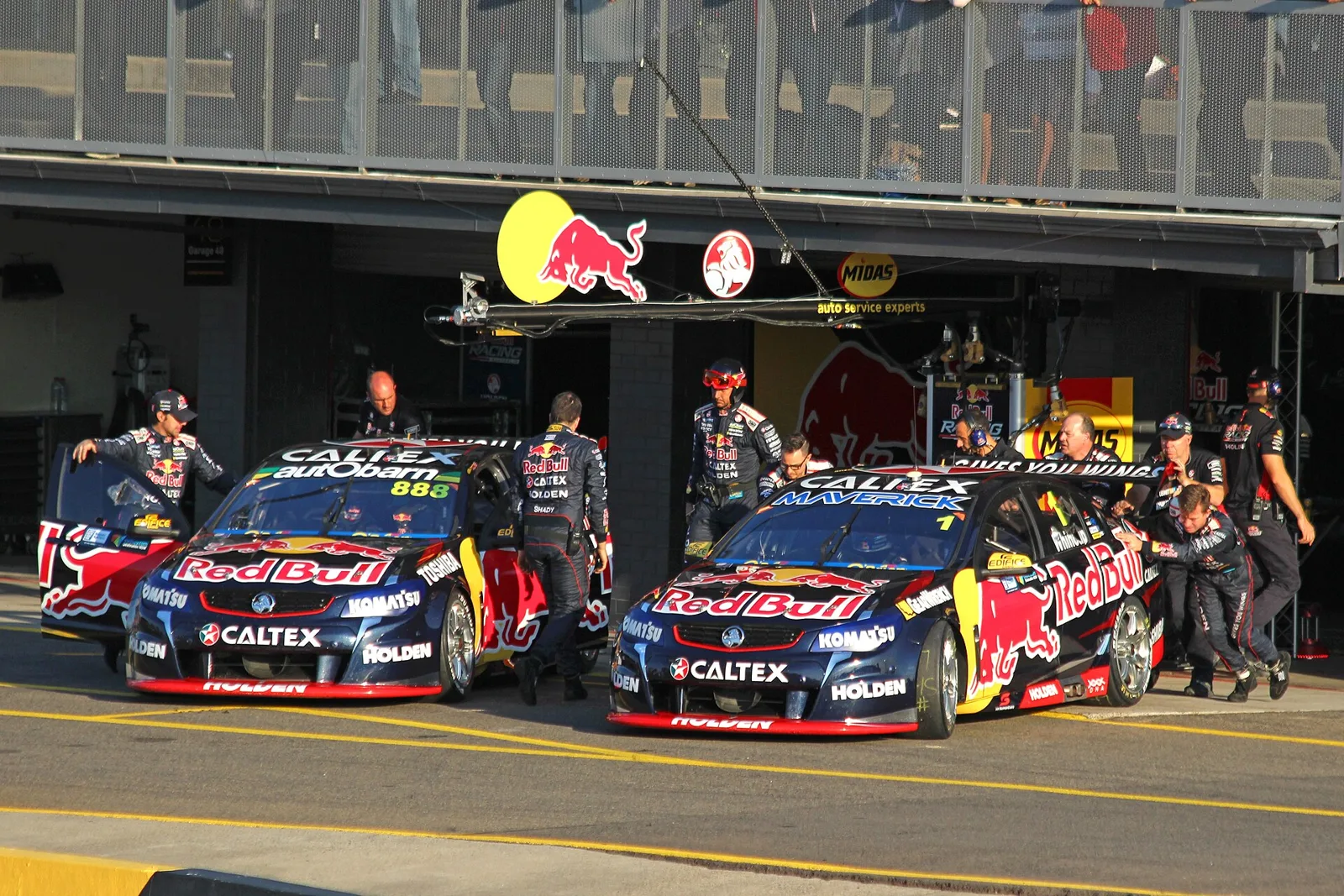
From a 1996 British touring car start to a Brisbane base, eleven drivers' titles, thirteen teams' titles and ten Bathurst 1000 wins, with a 2026 return to Ford.
Triple Eight Race Engineering is a Brisbane-based Supercars team that has won eleven drivers' titles, thirteen teams' titles and ten Bathurst 1000s. It started as a 1996 British touring car team and returned to Ford in 2026.
Based in Brisbane, the Red Bull Ampol Racing operation (its formal name is Triple Eight Race Engineering) has collected eleven drivers' crowns, thirteen teams' titles and ten Bathurst 1000 victories. It has been the only Brisbane-based V8 Supercar team since its formation, and it returned to Ford in 2026 for the first time since 2009.
What is Triple Eight today?
This year's line-up is three Ford Mustangs, driven by Broc Feeney, Will Brown and Jackson Walls. The squad also gives technical help to Blanchard Racing Team and tests at Queensland Raceway, a venue it uses for its preparation work.
The Brisbane base began in the old Briggs Motor Sport workshop in Bowen Hills in 2003, and the operation later relocated to Banyo in 2009. That site has housed the team for most of its Supercars history.
A team that made Brisbane its home and built eleven drivers' titles, thirteen teams' titles and ten Bathurst wins.
How did the team start?
Triple Eight Race Engineering was formed in 1996 in the United Kingdom, running Vauxhall's programme in the British Touring Car Championship. It later expanded into Australian V8 Supercars when it bought the Briggs Motor Sport team in September 2003.
Along with the purchase came a purpose-built site in Bowen Hills and a team of 35 staff. Brisbane engineers and the UK team collaborated on two new Ford BA Falcons, and the principals secured heavy backing from Ford.
What happened in the team's first seasons?
The team debuted at the 2003 Sandown 500, and 2004 was its first full season in V8 Supercars. It was a disappointing year, with both cars dogged by mechanical problems. Paul Radisich finished 19th in the championship, while Max Wilson finished 28th.
The team's car speed was nonetheless close to the front-runners on many weekends, which set the stage for a sharp turnaround. In 2005 Craig Lowndes and Steve Ellery were signed, and Stone Brothers Racing engineer Campbell Little joined the team.
How close did Lowndes come to the 2005 title?
Lowndes was the catalyst for change in 2005, and the team's performance improved with powerful and reliable Stone Brothers Racing engines. He finished second in the championship, narrowly missing out on the title won by Russell Ingall.
The year's high points included a Sandown 500 win for Lowndes and Yvan Muller and a third place for Ellery with Adam Macrow at the Bathurst 1000. He added three more round wins and four pole positions, one of them at Bathurst.
Why was the 2006 title so controversial?
In 2006 Jamie Whincup replaced Ellery and made an instant impact with a win at the Clipsal 500. Lowndes scored four round wins that year, including sharing the Bathurst 1000 victory with Whincup.
Lowndes led the championship until Round 11, but he lost the series lead to Rick Kelly after a crash in Tasmania. The title battle went to Phillip Island with the two contenders separated by just seven points.
Early in the final race, Kelly drove hard on Lowndes through a fast section, sending him into a spin that took out Lowndes and Todd Kelly. Rick Kelly was given a drive-through penalty and finished 18th, but he had won the championship.
Lowndes and Triple Eight protested, claiming Kelly had deliberately taken Lowndes out, and the stewards dismissed the appeal. Lowndes was later awarded the Barry Sheene Medal, which the team saw as some consolation.
How did Whincup become a champion?
In 2007 the team kept Whincup and Lowndes, and Vodafone replaced Betta Electrical as the title sponsor. Whincup narrowly missed the drivers' title by two points that year, with Garth Tander and Toll HSV Racing Team winning the last race at Phillip Island.
The 2008 season gave Whincup the crown, and the Lowndes-Whincup pairing took another Bathurst 1000 victory. That season Ford announced it would withdraw support from all but two teams from 2009, a decision that cost the team an estimated $2 million a year.
In 2009 Triple Eight won fifteen of the twenty-three races, with Whincup winning eleven races and the title. Lowndes added four wins at Winton, on the Gold Coast and at Barbagallo. The team ran new FG Falcons, and the Ford logos were replaced by a stylised pink pig's head for one of its sponsors, Hog's Breath Cafe.
Why did the team switch to Holden?
Because Ford's support had ended, Triple Eight announced before Bathurst in 2009 that it would switch to arch rival Holden from 2010. The move was controversial, but the team signed a three-year deal with Holden and re-signed with Vodafone until the end of 2012.
The 2010 season opened with a 1-2 finish for Whincup and Lowndes. Whincup won both races in Abu Dhabi, Bahrain and Hamilton before losing the lead, and he finished second in the championship with Lowndes fourth.
In 2011 Whincup regained the title from Lowndes and the team won the teams' championship. In 2012 the team dominated, winning 19 races, including the Sandown 500 and the Bathurst 1000 with Whincup and Paul Dumbrell, and Whincup took the title from Lowndes.
What did the Red Bull years bring?
Vodafone did not renew its sponsorship in June 2012, and Red Bull took the naming rights from the 2013 V8 Supercars season onwards. That season the team raced the new Holden VF Commodore, and Whincup took the top spot in the standings with Lowndes close behind.
The 2016 line-up grew to three cars when van Gisbergen joined, and the team secured the extra slot through a contract that had last been used in 2014. Van Gisbergen won the 2016 championship, which put the team back at the top of the standings.
Lowndes raced under the Team Vortex and Autobarn Lowndes Racing banners in 2016, 2017 and 2018, while Whincup and van Gisbergen raced under the Red Bull branding.
What was the factory Holden period?
From 2017 until 2020 Triple Eight was the factory Holden team, rebranded as the Red Bull Holden Racing Team. It developed the ZB Commodore that debuted in 2018, and it led development for the expected V6 twin-turbo engine.
In April 2018, however, Holden chose to halt development of the turbocharged V6 and keep its V8 layout for the time being. That meant a planned wildcard entry never happened, and the team's engine work was reshaped.
How did the team handle the end of Holden?
For 2021 and beyond the team rebranded as Red Bull Ampol Racing, after Holden was retired at the end of 2020. It was the first time since 2010 that Triple Eight raced without factory support, and only the second time in its V8 Supercars history.
Whincup retired after 2021, his 16th full-time season with the team, and Broc Feeney took his place. The team switched to the Chevrolet Camaro ZL1 for 2023 under Gen3, and Will Brown replaced van Gisbergen for 2024 after van Gisbergen moved to NASCAR.
The 2026 season marks the team's return to Ford, a brand it had not run with since 2009.
Development and wildcard programmes
Triple Eight also raced in development categories. Its feeder cars carried Andrew Thompson in 2011, Scott Pye in 2012 and Casey Stoner in 2013, and the programme won the series title in 2011. From 2014 it gave technical assistance to Eggleston Motorsport.
The team returned to the Super2 series for 2019 with two cars for Brenton Grove and Kurt Kostecki. It scaled back to one car for Angelo Mouzouris in 2020, and in 2021 it ran two cars again, with Mouzouris joined by Broc Feeney.
Wildcard entries were a regular part of the programme as well. In 2013 Triple Eight ran an extra car at Bathurst with Andy Priaulx and Mattias Ekstrom, qualifying 18th and finishing 10th. In 2021 Broc Feeney and Russell Ingall drove a wildcard at Bathurst, and in 2022 Craig Lowndes and Declan Fraser drove another.
The team also built cars for other operations. It supplied chassis to Dick Johnson Racing from 2009 to 2012 and to Team 18 from 2016 to 2025, and it will supply SCT Motorsport from 2026.
What are the team's key results at a glance?
| Year | Driver | Event | Result |
|---|---|---|---|
| 2003 | Team | Sandown 500 | Debut, after the Briggs Motor Sport purchase |
| 2005 | Craig Lowndes | Championship | Second, narrowly behind Russell Ingall |
| 2006 | Rick Kelly | Championship | Title won after the final-race collision with Lowndes |
| 2008 | Jamie Whincup | Championship | Drivers' title, with a third Bathurst 1000 for the pairing |
| 2009 | Jamie Whincup | Championship | Title, with fifteen team wins from twenty-three races |
| 2011 | Jamie Whincup | Championship | Title regained, with the teams' championship |
| 2012 | Jamie Whincup | Championship | Title won, with 19 team wins in the season |
| 2016 | Shane van Gisbergen | Championship | Title in the third Triple Eight car |
| 2026 | Team | Return to Ford | First Ford season since 2009 |
Why does Triple Eight matter?
Triple Eight matters because it shows how a team from a non-Supercars background can become one of the sport's most successful operations. Its record of drivers' and teams' titles, its Bathurst results and its ability to switch manufacturers keep it near the top of the Australian V8 scene. Its Ford and Holden years also show how a single manufacturer partnership can shift the balance of a whole grid.
Its ownership has also changed over time. Each change of shareholder brought new capital and new faces, while the team kept its focus on the Supercars grid and its Brisbane base.
Ownership and management are now tied closely to the driver line-up, which is one reason the team's identity has stayed steady through several manufacturer changes. Roland Dane and other shareholders built the business, and Jamie Whincup became a shareholder and team principal as the team moved into its later years.