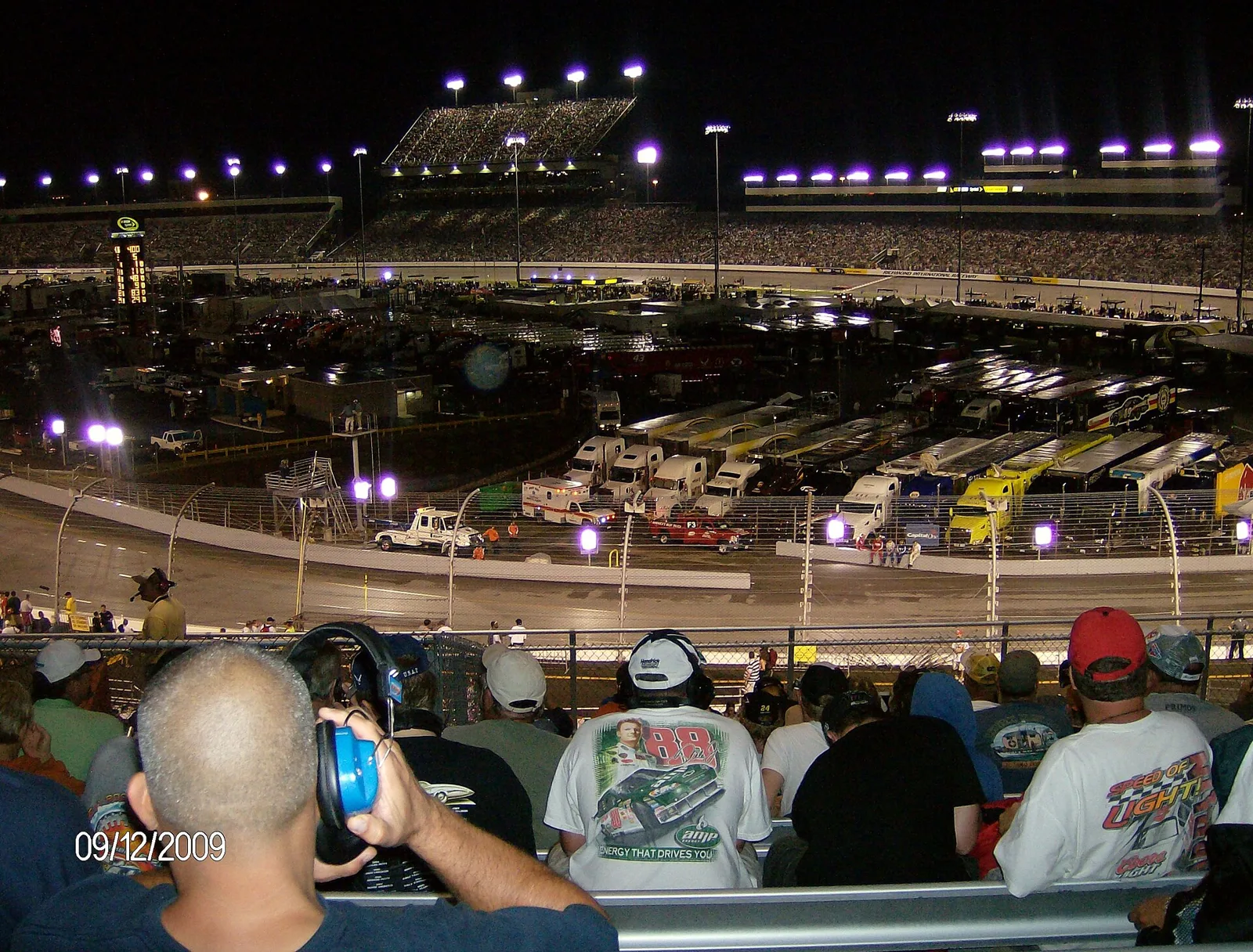
A Virginia oval built in 1946 for a state fair exposition, remodelled in 1988 and later scaled back under NASCAR ownership.
Built for a 1946 state fair exposition, the Virginia venue now runs a 0.750 mi (1.207 km) oval. It was remodelled in 1988, peaked at 112,029 seats and is owned by NASCAR. It has hosted NASCAR races since 1953 and is led by president Lori Collier Waran.
Richmond Raceway is a 0.750 mi (1.207 km) D-shaped oval in Richmond, Virginia, with roots in a 1946 state fair exposition. It has hosted major races since its first season, including NASCAR and IndyCar events, and it has been rebuilt twice. Its capacity has moved up and down over the decades, and it is now owned by NASCAR.
Where is Richmond Raceway and how big is it?
Richmond Raceway is in Richmond, Virginia, served by Interstate 64 and U.S. Route 360. The current track measures 0.750 mi (1.207 km), with 14 degrees of banking in the turns, 8 degrees on the frontstretch and 2 degrees on the backstretch. The complex covers about 575 acres of land.
A fairgrounds track from 1946 that grew to 112,000 seats, then shrank back under NASCAR ownership.
How did the Atlantic Rural Exposition build the track?
In June 1942, during the Second World War, the Virginia State Fair Association bought a 460-acre farm called Strawberry Hill. The exposition, known then as the Atlantic Rural Exposition, was planned as an agricultural trade show for the fall of 1946, and its 1946 budget included $10,000 for a half-mile race track.
The track was completed in June 1946. Its grandstands held 3,200 people at the start, and the exposition opened as scheduled on October 7 that year. Harness races were delayed by rain, but the track officially opened to the public on October 11, 1946.
When did Richmond Raceway first race?
The first automobile race was held on October 12, 1946, the last day of the exposition, and Ted Horn won it. In November 1946 the track began running events sanctioned by the American Automobile Association, and the first motorcycle races followed in May 1947.
The following year a night race was run on May 19, after new lights were installed. In 1953 the track held its first NASCAR Grand National race, which Lee Petty won on April 19 that year.
What were the paving and decline years like?
The track was paved in August 1968, with the first race on the new surface on September 9. It was lengthened to 0.542 mi (0.872 km) soon after paving, reclassified as a half-mile track months later, and then set at 0.542 mi again. The lower lanes in the second and fourth turns were repaved in 1972.
By the early 1970s the track was criticised for its fan facilities and for a lack of seats. It was also considered one of the poorest in purse money on the Cup circuit, and a 1974 report said only Bristol, Nashville and North Wilkesboro offered lower purses.
Why did replacement plans for the track fail?
Co-promoters Ken Campbell and Paul Sawyer first proposed a track in Prince George County in 1973, planned at 1.75 mi with 50,000 seats. The Colonial-America project was revived in 1976 after county highway proposals were approved, but organisers abandoned it in June 1977 because costs had risen and the economy had weakened since the original proposal.
A Dinwiddie County plan followed later in the decade, for a 1.250 mi track with 40,000 seats. Bonds of up to $8.5 million were approved, but the financing stalled as investor Warner W. Hodgdon ran into financial trouble. The Isle of Wight County proposal of 1985 collapsed after the host cities asked NASCAR for a 15-year guarantee, which NASCAR refused in November 1987.
How was the track remodelled in 1988?
In June 1987 Sawyer and the exposition announced plans to enlarge and remodel the track. The true oval was reshaped into a D-shaped oval, lengthened to 0.75 mi (1.21 km). Work began on the remodel after the final race on the old fairgrounds, which was held on February 21, 1988 and won by Neil Bonnett.
The track was completed in time for the Miller High Life 400 on September 11, 1988, and Davey Allison won the first event on the new layout.
When did Richmond add lights and grow its seating?
In April NASCAR allowed night racing with temporary lights, and the first night races ran on August 3 that year. NASCAR allowed the lights as a test of whether a permanent system would work. Permanent lights were installed in 1995, and capacity reached about 83,000 that year.
Lights were part of the early plan to make the track a night venue. The Henrico County Board of Supervisors approved a plan to expand the track to 125,000 seats in 1995. About 12,000 backstretch seats were added in 1997, bringing capacity to almost 96,000.
How did the ISC purchase change the track?
Sawyer began negotiating to buy the state fairgrounds in 1998 so the track could build parking. The Sawyer family later sold the track to the France family-owned International Speedway Corporation for $215,000,000, with Sawyer saying the family could not finance the expansion without risking everything it owned.
Under ISC, the track added seats steadily. Capacity reached 102,420 in 2000, and a 2004 repave was followed by a 7,843-seat tower in 2007 that lifted capacity to 112,029. SAFER barriers were installed in 2003, and a 153 foot video scoring tower went up in 2010.
Why did Richmond's capacity shrink?
The decline came in a series of steps, each tied to falling attendance. Capacity fell after attendance declined from the 2008 Chevy Rock and Roll 400, the race that ended a 33-race sell-out streak. Capacity was cut to 94,063 in 2011, to about 75,000 two years later and to 60,000 in 2016.
A $30 million renovation was announced in July 2017 and renamed the track Richmond Raceway. Seats in the third and fourth turns were demolished, leaving capacity at 51,000. NASCAR bought the track in 2019 after buying out ISC.
Which races run at Richmond today?
The Cook Out 400 is the track's fall Cup race, and the spring Cup race was the Toyota Owners 400, held from 1959 to 2024. A Truck Series race runs as a support event, and the Xfinity Series ToyotaCare 250 ran until 2024.
IndyCar first raced at the track in 2001 and held events there annually until 2009. The 2020 race was cancelled because of COVID-19 restrictions and was never rescheduled.
Who leads Richmond Raceway now?
Lori Collier Waran replaced Dennis Bickmeier as president after he left to become executive director of the Henrico County Sports Authority. Bickmeier had led the track for 11 years, and Waran came from Virginia Business Magazine, where she was chief revenue officer.
NASCAR has owned the track since 2019. In 2023 the track changed its logo again, adding the Richmond skyline and the James River.
How has the track's capacity changed over time?
| Year | Capacity | Change |
|---|---|---|
| 1946 | 3,200 | Original exposition grandstands |
| 1995 | About 83,000 | Permanent lights and new seats |
| 2000 | 102,420 | ISC era growth |
| 2007 | 112,029 | Tower raised the peak |
| 2011 | 94,063 | First cut under declining attendance |
| 2016 | 60,000 | Backstretch grandstands demolished |
| 2018 | 51,000 | Seats removed in turns three and four |
| 2024 | Under 50,000 | Some seats removed for tray tables |
How did the grandstands change after the remodel?
The years after the remodel brought a steady run of grandstand work. In 1993 the pit road entrance was reconfigured after driver complaints, and the Dogwood and Henrico grandstands were expanded in the first two turns and on the backstretch, bringing capacity to approximately 70,000.
The following year the frontstretch grandstands named Commonwealth and Azelea were torn down, and their larger replacements came with extra luxury suites. Permanent lights followed in 1995, and about 12,000 backstretch seats were added in 1997. The lights helped the track host races after dark for the first time.
Which other series raced at Richmond?
The track has hosted several series beyond NASCAR, and some of them appeared only briefly. The USAC Silver Crown Series and the USAC National Midget Championship both ran there, and the International Race of Champions also appeared on the schedule.
The Indy Racing League first came to Richmond in 2001, and its later return in 2020 was cancelled due to COVID-19 restrictions, with the race never rescheduled.
What did the track look like before the remodel?
In 1962 the track added some 4,200 seats in its first and fourth turns, increasing seating from 4,800 to approximately 9,000. The pit area was renovated at the same time, with a new scoreboard and protective walls and guardrails. In 1975 Sawyer announced grandstands that lifted seating to 18,000, and in 1983 a $250,000 renovation added a 2,500-seat grandstand.
The early racing included fatal incidents. In 1958 the track's second fatality was driver Gwyn Staley, who crashed during a NASCAR Convertible Division event and died from numerous injuries.
How were the 2017 amenities upgraded?
The 2017 renovation was a $30 million project that covered the complete garage area, the infield amenities, a party deck on the fourth turn and a specialised RV parking area. Work began in September 2017 and was completed the following September.
The changes were presented as a rebrand as well as an upgrade. The track took its current name in the process, and in 2023 its logo was changed again to feature the Richmond skyline and the James River.
How was the fairgrounds land acquired?
The track sought the state fairgrounds land in 1998 to build more parking for its expanding crowds. The Sawyer family had offered $40,000,000 for the land in December 1998 and threatened to build a new racetrack if it could not buy it.
By February 1999 both the track and the state fair officials said the parties were closer to a deal. A vote by the exposition's shareholders in July approved the sale by 5,381 to 21, and the sale was finalised in August 1999. The sale to ISC, for $215,000,000, followed later that year.
Under ISC the day-to-day operations passed to Doug Fritz, a marketing employee, who was appointed general manager. The Sawyer family had run the track for decades before that change.