A German team and car builder founded in 2000 by Hans Reiter, known for Lamborghini GT cars, ADAC GT Masters titles and the KTM X-Bow race cars that followed.
Reiter Engineering is a German team and car builder founded in 2000 by Hans Reiter. It was Lamborghini's partner from 2000 to 2014 and has since built KTM's X-Bow race cars.
Reiter Engineering is a German team that also builds race cars. Motorsport engineer Hans Reiter set it up in 2000. It was a partner of Lamborghini for 14 years, built GT cars for customer teams, and since 2014 has helped build the KTM X-Bow range of race cars.
What does Reiter Engineering do?
The company is both a team and a car builder. It develops race cars and sells them to customer teams, and it has also run its own entries in several championships across Europe and beyond.
Its work has centred on GT cars, first for Lamborghini and later for KTM. Hans Reiter has been the driving force behind the business since its founding, and the company's subsidiary Sareni United handled a separate line of GT3 cars.
A Lamborghini partner that became a car builder in its own right, with a KTM range and a street-legal X-Bow.
How did the team enter sports car racing?
Reiter first competed in sports car racing in 2000, entering a custom Lamborghini Diablo in the FIA GT Championship. The car was modified from the spec used in the Lamborghini Supertrophy one-make series, and it was the first of many race cars built by the company.
The Diablo GTR scored its only points in 2001. It was replaced by the Murcielago R-GT, which was based on the first generation Lamborghini Murcielago, at the end of 2003. The R-GT scored points on its debut in 2004 with a third place at Valencia.
What happened in the 2006 and 2007 seasons?
Sponsorship arrived in 2006, and the operation ran as B-Racing RS-Line Team with two cars before switching to All-Inkl.com Racing mid-season. Three finishes in the points were its best return that year, the top one a sixth at Brno.
2007 brought Reiter's greatest success in the FIA GT Championship. The team opened the year with its first victory, with Christophe Bouchut and Stefan Mucke winning at Zhuhai. The two-car team scored points in six of ten races, which gave All-Inkl.com Racing seventh in the Teams' Championship and Reiter tied for ninth.
How did the Gallardo GT3 era begin?
In 2006 the FIA GT3 European Championship was introduced, and Reiter ran a three-car team in it with a new Lamborghini Gallardo-based Gallardo LP520 GT3. The team's best finish was third at Mugello, and it finished eighth in the Teams' Championship.
Albert von Thurn und Taxis won the Lamborghini Manufacturers' Cup that season. A total of 49 Gallardo LP520 GT3s were built worldwide, and in 2009 Keita Sawa won the Macau GT Cup in one of them.
Why did Reiter move to the ADAC GT Masters?
Reiter moved its Gallardos to the new ADAC GT Masters series in Germany for its inaugural 2007 season. Using the same formula as the FIA GT3 effort, the team improved on its previous results.
The team won nine races in the twelve-race season and took the Teams' Championship. Christopher Haase won the drivers' championship in the No. 7 car, and in the No. 6 car Thurn und Taxis and Peter Kox finished second in the standings. Haase and Thurn und Taxis were again second in 2008.
In 2011 Ferdinand Stuck and Johannes Stuck finished second in the drivers' standings, and Reiter Engineering became team champion that year.
How was the Murcielago developed?
The partnership with Lamborghini continued with the Murcielago R-GT, developed in 2003 with aid from Lamborghini and Audi Sport. The R-GT removed the four-wheel drive system to comply with FIA, ACO and JAF rules, and it kept the standard V12 with air restrictors.
Customer teams raced the R-GT too: DAMS ran one in the FIA GT Championship, and Krohn-Barbour Racing ran one in American sportscar racing. The Japanese Lamborghini Owners Club also commissioned derivatives for Super GT and the 2006 Le Mans 24 Hours.
The Murcielago LP670 R-SV followed in 2010, an evolution of the R-GT that complied with the updated FIA GT1 World Championship rules. It was unveiled at the 2010 24 Hours of Spa weekend.
What were the later Gallardo cars?
From 2010 to 2014 Reiter developed three new Gallardos for the GT3 class: the LP560 GT3 in 2011, the LP600+ GT3 in 2012 and the GT3 FL2 in 2013. It also helped develop Lamborghini's GT2 entry, the Gallardo LP560 GT2, which raced the 2009 Le Mans Series season.
The GT3 FL2 was the last customer GT3 car Lamborghini used from Reiter, because Lamborghini moved to the Huracan GT3 built by its own motorsport division. Reiter made one final run with the Gallardo in the Reiter Extenso R-EX.
What was the Reiter Extenso R-EX?
The R-EX was an extensive update of the Gallardo GT3 FL2, introduced in 2015. The name stood for Reiter Extenso, referring to its wide range of updates, and it was the culmination of the Gallardo in motorsport.
The car kept the 5.2-litre naturally aspirated V10 and was made from 100 per cent carbon fibre. It was five inches wider than the GT3 FL2 for extra rear grip, and only 10 units were produced. The car's first outing came in the 2015 Blancpain GT Sprint Series, where a qualifying race at Moscow Raceway went its way in round four.
How did Sareni United build the Camaro GT3?
Team owner Hans Reiter founded the subsidiary Sareni United in 2012. It was responsible for GT3 race cars based on the fifth-generation Chevrolet Camaro, and the Sareni Camaro GT3 was unveiled later that year as a cost-effective car for customer teams.
The car used a 7.9-litre Katech V8 that delivered 650 hp, and it was released at 195,000 euros, about half the price of an average GT3 car. It debuted in the 2012 ADAC GT Masters, and Reiter ran a works entry there for three seasons.
How did the KTM partnership begin?
After the Lamborghini partnership ended in 2014, Reiter began building GT4 and GT2 race cars for KTM. The X-Bow GT4 was unveiled in 2015, and the X-Bow GTX and X-Bow GT2 followed in 2020, built in a collaborative effort between the two companies.
The X-Bow GT4 debuted in the 2015 GT4 European Series and took its first race win at Zandvoort in its first race. The X-Bow GT2 debuted in the 2022 Fanatec GT2 European Series, and the GT4 later received an Evo version in 2019.
What is the Reiter Young Stars programme?
In 2016 Hans Reiter set up the Reiter Young Stars programme, which supported rookie drivers and engineers in the GT4 European Series. Each rookie pairing drove a KTM X-Bow GT4 and was supported by engineers and business students from different European universities.
The best male and female drivers of the programme earned a seat in the Blancpain GT Series Sprint Cup the following year. Caitlin Wood and Marko Helistekangas were the first graduates in 2016, and the programme ran for two years in 2016 and 2017.
What changed with the X-Bow GT4 Evo and GTX?
The X-Bow GT4 Evo arrived in 2019 as a refinement of the original car. It drew on research and development data from the X-Bow GTX, which was being developed at the same time, and it focused on straight-line speed while keeping the cornering performance of the earlier car.
The Evo received a power increase of up to 440 hp unrestricted, and 375 hp when subject to a series balance of performance. The X-Bow GTX that followed is a longer wheelbase track-only car, using a 2.5-litre Audi TFSI five-cylinder engine and retaining the Formula 3 homologated carbon fibre monocoque.
How did the 2022 racing programmes go?
In 2022 Reiter took part in the Michelin Le Mans Cup for the first time with a Ligier JS P320 in the LMP3 class, driven by factory drivers Freddie Hunt and Mads Siljehaug. It was the first time the team raced in a car it had not built itself, which marked a notable step for the company.
The team also raced the KTM X-Bow GT2 Concept in the 2022 Fanatec GT2 European Series. That car was the more powerful SRO GT2 specification of the GTX, and its debut in that series showed how the company's KTM work had moved into a higher class.
What did the Sareni Camaro GT3 do in competition?
Despite being built by Sareni, the Camaro GT3 remained badged as a Chevrolet. It debuted in the 2012 ADAC GT Masters with YACO Racing and Muhlner Motorsport, and The team ran a factory entry for three seasons, first under the Sareni United name in 2013, then in 2014 and 2015.
The car also raced in the Australian GT Championship with several customer teams from 2014 to 2016. Dale Paterson Motorsports ran the Camaro from 2018 and kept using the chassis until it was retired at the end of 2021. It was also entered in New Zealand endurance events in a joint effort between two local teams.
What is the KTM X-Bow GT-XR?
The road-going X-Bow arrived in 2022, built on the same platform as the GTX and GT2 Concept race cars. It keeps the 2.5-litre Audi TFSI five-cylinder engine from the original X-Bow, which came from the Audi RS3, and it produces 493 hp and 429 lb-ft of torque, delivered to the rear wheels.
The car uses a 7-speed DSG gearbox and carries a 95-litre fuel tank for up to 620 miles of range. Its dry weight is 1,250 kg, with a front-to-rear weight distribution of 44:56. Factory figures give a 0-60 mph time of 3.4 seconds and a top speed of 174 mph, and the car costs 284,900 euros.
Was there a road-going Murcielago?
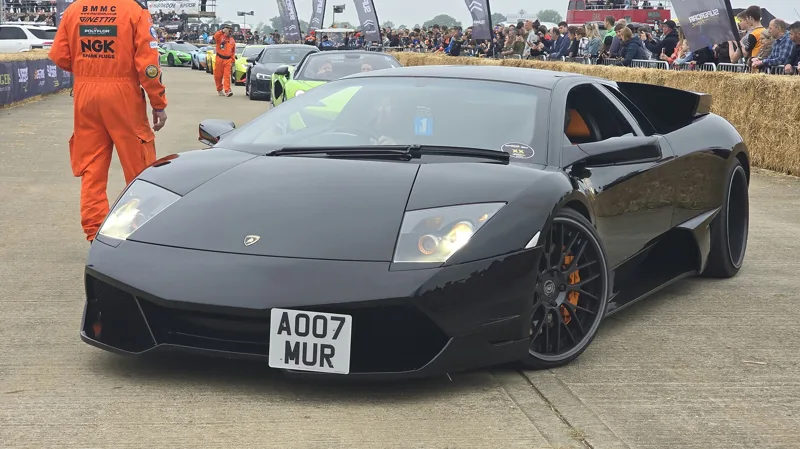
In 2008 Reiter introduced the Murcielago R-GT Streetversion, an aftermarket package for the Murcielago. It included carbon fibre bodywork, aerodynamic upgrades, black OZ alloy wheels and race-tuned suspension, and the car was converted from all-wheel drive to rear-wheel drive.
Reiter built only one unit of the Streetversion, although many of its parts were later sold separately as aftermarket items for the Murcielago.
What are the team's key results at a glance?
| Year | Car or team | Event | Result |
|---|---|---|---|
| 2001 | Diablo GTR | FIA GT Championship | Only points finish of the Diablo |
| 2004 | Murcielago R-GT | FIA GT Championship | Third at Valencia on debut |
| 2007 | Reiter with Bouchut and Mucke | FIA GT, Zhuhai | First victory |
| 2007 | Gallardo, ADAC GT Masters | Team and driver titles | Nine race wins and Haase's drivers' title |
| 2011 | Reiter Engineering | ADAC GT Masters | Team champion |
| 2012 | Sareni Camaro GT3 | ADAC GT Masters | Series debut |
| 2015 | KTM X-Bow GT4 | GT4 European Series | First race win at Zandvoort |
| 2015 | Reiter Extenso R-EX | Blancpain GT Sprint Series | Qualifying race win at Moscow Raceway |
| 2022 | KTM X-Bow GT-XR | Road car launch | Unveiled as a street-legal version |
Why does Reiter Engineering matter?
Reiter Engineering matters because it shows how a small German firm can build race cars for major manufacturers and then build its own championship record on top. Its Lamborghini and KTM programmes give it a clear place in GT racing history.
The company's road car, the X-Bow GT-XR, also shows how race technology can reach customers. Its work on both race and road cars makes Reiter a useful case study in the business of GT car building.