A Bradford venue built on a former quarry, home to the Bulls, and for decades a shared ground for speedway, stock cars and some of England's biggest rugby crowds.
Odsal Stadium is a Bradford venue whose sunken bowl opened in 1934 and was built on a former quarry. It is the home of the Bradford Bulls and has hosted speedway, stock cars and record rugby league crowds, including 102,569 in 1954.
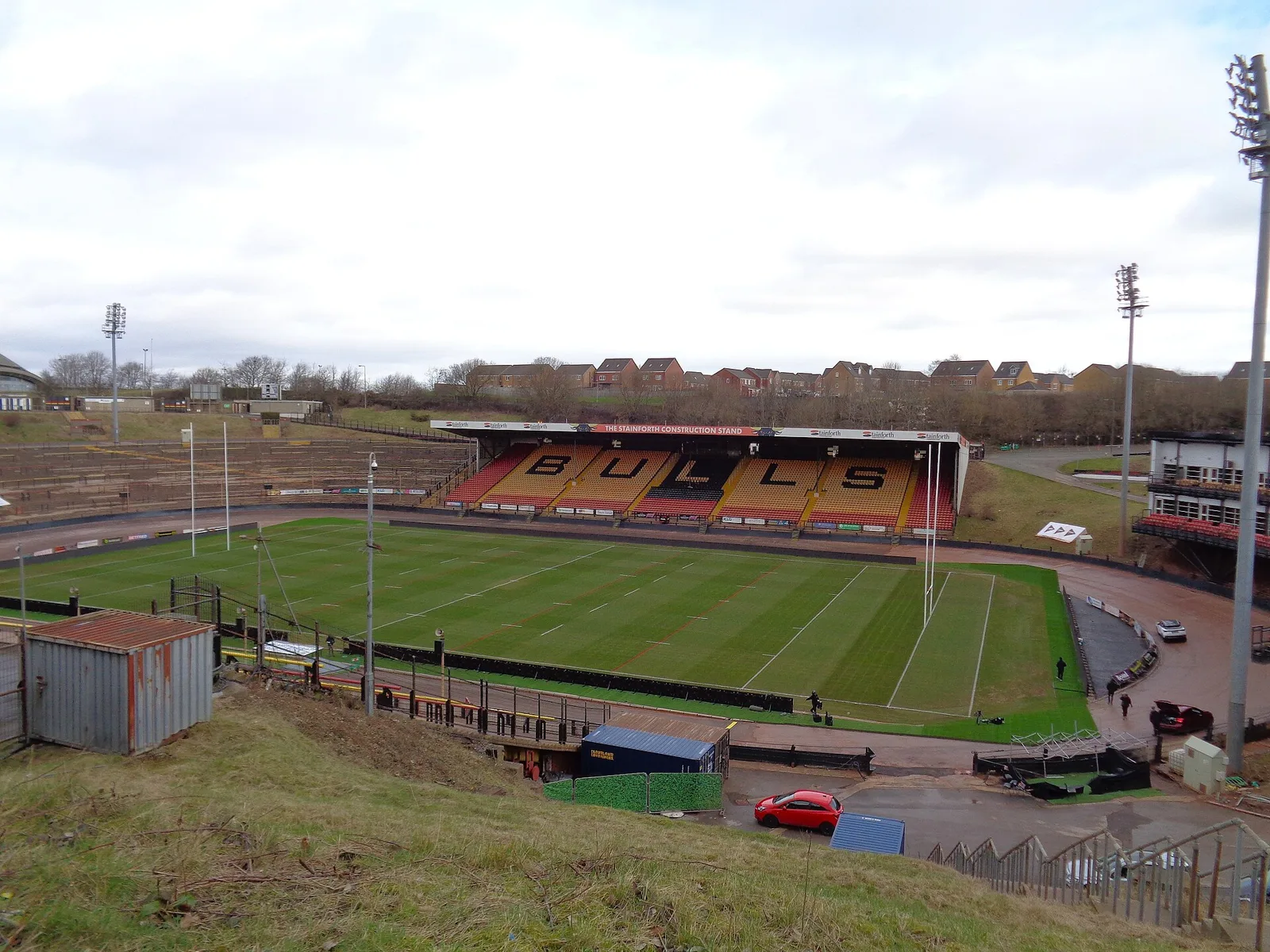
Odsal Stadium is a multipurpose ground in Bradford, West Yorkshire, and it has been the home of rugby league's Bradford Bulls since its opening in 1934. Its sunken bowl surrounds a grass pitch, and an oval motorsport track has run alongside it for much of the stadium's history.
What is Odsal Stadium?
Odsal is best known as the home of the Bradford Bulls, but it has also hosted speedway, stock cars, American football, women's football, basketball, show jumping, tennis, live music and international rugby league. It is currently known as Bartercard Odsal Stadium after a sponsorship deal in 2024.
Other sport and entertainment included a 1939 tennis tour starring Budge, Tilden, Vines and Stoefen, basketball, kabaddi and a 2017 hockey exhibition that stood in for Wembley in an Indian film. The stadium was owned by Bradford City Council at first. Its leasehold was bought by the Rugby Football League in 2012, when the council was in financial difficulty, and in 2025 the Bradford Bulls bought it back.
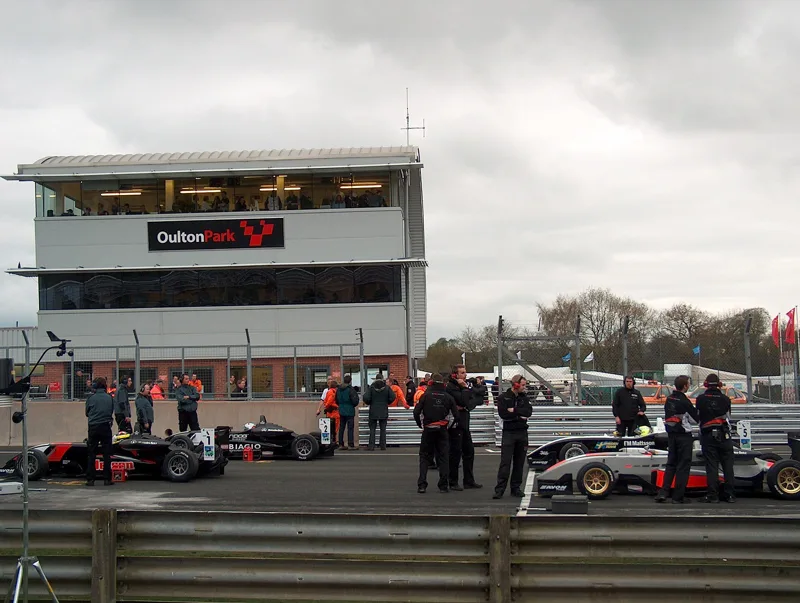
The layout is unusual for a British stadium. The grass pitch sits in a sunken bowl, encircled by an oval shale track that was first used for motorcycle speedway and later for stock cars.
A sunken Bradford bowl built on a quarry, where speedway, stock cars and record rugby crowds shared the same ground.
How did Odsal begin?
Bradford Northern, a club founded in 1907, had played at several grounds before the early 1920s, when the limits of its Birch Lane home became clear. In 1933 Bradford City Council offered the club land at Odsal Top, and the club signed a ten-year deal on 20 June 1933.
The site was a former quarry that had been used as a landfill. Ernest Call, the council's director of cleansing, devised a system of controlled tipping that deposited 140,000 cartloads of household waste, creating the banking that still characterises the ground.
The club was responsible for the boundary fencing, the dressing rooms and the seating. A turf fund of 900 pounds paid for the pitch, and a stand costing 2,000 pounds was paid for by the Rugby Football League, holding 1,500 spectators on benches and tip-up seats.
Sir Joseph Taylor, the president of Huddersfield, formally opened the ground on 1 September 1934. Huddersfield won the opening match 31 to 16, Ray Markham of Australia scoring four tries before an estimated 20,000 spectators.
The stadium's later history includes a 1951 proposal from council engineer Ernest Wardley for a 92,000-place stadium of the sort seen in continental Europe, costing 250,000 pounds. Only terracing on the Rooley Avenue end, costing 50,000 pounds, was built in 1964 before the plan was dropped. Floodlights came first in 1951, when the north of England's first night rugby match was staged there.
When did the stadium host its biggest crowds?
The stadium's record rugby league attendance was 102,569, set at the 1954 Challenge Cup final replay between Halifax and Warrington. It remained the world record for a rugby league match until 1999.
A domestic record that was not a final, 69,429, came at a 1953 third-round Challenge Cup match between Bradford Northern and Huddersfield, and the largest international crowd was 42,685 when England beat New Zealand 25 to 9 on 20 December 1947.
| Record | Crowd | Event | Date |
|---|---|---|---|
| All-time rugby league | 102,569 | Challenge Cup final replay | 5 May 1954 |
| International rugby league | 42,685 | England v New Zealand | 20 December 1947 |
| Speedway | 47,050 | England v Australia Test | 5 July 1947 |
| Super League | 24,020 | Bradford v Leeds | 3 September 1999 |
| Stock cars | 38,000 | Opening stock car meeting with V8 cars | 26 May 1954 |
How did speedway come to Odsal?
Speedway was first staged at Odsal on 23 June 1945. The rugby club's director, Harry Hornby, worked with the local promoter Johnnie Hoskins to build a sloping oval of compacted dirt around the rugby pitch, giving the stadium a dual purpose.
Crowds of more than 20,000 regularly came to the meetings in the years after the war. The highest speedway attendance was 47,050 on 5 July 1947, when the England team beat Australia 65 to 43 in a Test match. It remains the largest speedway crowd ever at the stadium.
Speedway declined, and Bradford's home team folded in 1973. The track then hosted stock cars on a tarmac surface, after the shale had been covered by Stuart Bamforth in 1977.
Speedway's early years were brisk. In 1948 a concrete starting platform, believed to be the first of its kind in British speedway, was built at Odsal. In 1970 a promoting trio, Whaley, Parker and Bridgett, brought the Nelson Admirals to the stadium, and the team adopted the Bradford Northern name, while the Bradford Barons lasted only 1974 and 1975.
How did stock cars develop at Odsal?
Odsal hosted professional stock car events from the sport's arrival in England. The earliest British meeting was held at New Cross in south-east London on Good Friday 1954, and two further meetings there were followed by Odsal's fourth British stock car event, which used V8 cars.
The track was shale when speedway returned for the 1985 Speedway World Final, which the stadium hosted after the closure of White City. The final was won by Erik Gundersen, ahead of Hans Nielsen and Sam Ermolenko, who finished on the same score in a three-way run-off.
The track was used again in the 1990 World Final, won by Per Jonsson of Sweden after a run-off with Shawn Moran. Moran later lost his silver medal after failing a drugs test, and Todd Wiltshire, in his first World Final, finished third.
Speedway's final major event there was a 1997 Grand Prix round, won by Brian Andersen of Denmark ahead of America's then world champion, Billy Hamill. Mark Loram, of the Bradford Dukes, finished fourth, and he later became world champion in 2000.
Stock car racing returned in May 2021 with the Stan Woods Memorial for pre-1975 cars, which 4,000 fans watched. The BriSCA Formula 1 and Formula 2 championships then came back to the stadium on the restored shale track.
Odsal also hosted football, rugby and other sports in the 1980s. After the 1985 Valley Parade fire, Bradford City played their Second Division home matches at Odsal until December 1986, after a Football League delegation visited on 23 September 1985. Segregation fences went up, 1,000 uncovered seats were bolted on, and the total spent on the ground reached 3.5 million pounds.
The 1978 second Ashes Test drew 26,761 spectators to see Great Britain beat Australia. In 1989 the Leeds Cougars chose Odsal as their base for the entire American football season.
How did the Bradford Bulls shape the stadium?
Bradford Northern was renamed the Bradford Bulls in 1996, when the Super League began. The club wanted better hospitality, and in 2000 it announced plans for suites on the South Bank, which would cut into the track and garages around the pitch.
The South Bank was built between 2001 and 2002, and the club spent two seasons at Valley Parade while the work took place. That construction effectively ended speedway's association with the ground.
Several redevelopment plans were drawn up in 2009, including a 18,000-seat stadium created by raising the pitch 15 metres, but funding for the scheme was withdrawn by the council and the plans were shelved.
The club's financial problems grew after 2012, when the RFL bought the leasehold. The Bulls were relegated to the Championship in 2014, and the club was formally liquidated in early 2017, when a phoenix club was formed.
The Bulls left Odsal for a groundshare at Crown Flatt in 2019 because of running costs, including a rent of 72,000 pounds payable to the RFL. Their last home match at Odsal was on 1 September 2019, after 85 years at the stadium.
How did the stadium come back into use?
In 2021 the Bulls agreed a return as co-tenant with stock car promoters YorStox. Their deal allowed the restored shale track to return, and the pitch had to be narrowed to accommodate it, which fell below the normal standard for professional rugby league.
The Bulls bought the stadium back from the RFL in 2025. The club's return to Super League in 2026 led to a series of ground improvements, including new floodlights, LED advertising boards and repainted South Bank suites.
The Bulls ended a 20-year lease with stock car promoters Odsal Motor Sports on 4 May 2026, which ended stock car racing at Odsal once again. The club cited the ground's upgrades and the demands of Super League as its reasons.
The 2009 redevelopment plan was ambitious. It linked the stadium with the neighbouring Richard Dunn Leisure Centre in an Odsal Sports Village, with a 120-bed hotel, and one option would have raised the pitch by 15 metres to create an 18,000-seat ground. Money pulled from the scheme went towards two new special schools instead.
What is the stadium like today?
The Rooley Avenue End is open terracing for 7,290, and the big screen goes up there for televised matches. The East Stand is the only covered and seated stand on the pitch side, holding 4,890 people, and the South Bank holds 620 in its hospitality suites.
The West Stand is uncovered terracing with a capacity of 9,309, and it houses the changing rooms and the television gantry. The grass pitch has a distinctive concave shape, and its corners can be removed to allow the motorsport track to be used.
In August 2025 a small fire broke out in a South Bank hospitality area after a match against Toulouse Olympique, causing an evacuation and a fire service callout, but no one was injured.
The grass pitch has a concave contour because of the stadium's use for stock cars and speedway, and the pitch was narrowed by several metres to make room for the track. The pitch is the smallest permitted in Super League, at 88 by 55 metres.
Non-sporting events now include a Bradford Dance Festival, which was held at the stadium in 2022, and talks, business conferences and monthly car boot sales. In 2023 the Bulls were the first English rugby league club to hold an Iftar, in a South Bank suite.
The ground's name has changed with its sponsors. It was the Grattan Stadium, Odsal from 2006 to 2010 and the Provident Stadium from 2013 to 2017, before the Bartercard name was adopted in March 2024.