A Halifax inventor who navigated by tram rails started a family of road markers, from rubber-domed studs to ground glass in road paint and the colour codes of kerbside lines.
Cat's eyes are retroreflective road studs invented by Percy Shaw and patented in 1934. Raised pavement markers use lenses or glass to throw headlights back at drivers, glass beads in road paint do the same for painted lines, and yellow lines tell drivers where they may stop, wait or pass.
When the tram-lines in a Halifax suburb were pulled up, Percy Shaw saw how much he had relied on their polished steel to find his way at night. The stud he built in response, patented in 1934, became the first of a whole family of raised pavement markers, and its cousins now include ground glass in road paint and yellow lines that tell drivers where to stop.
What is a cat's eye and how does it work?
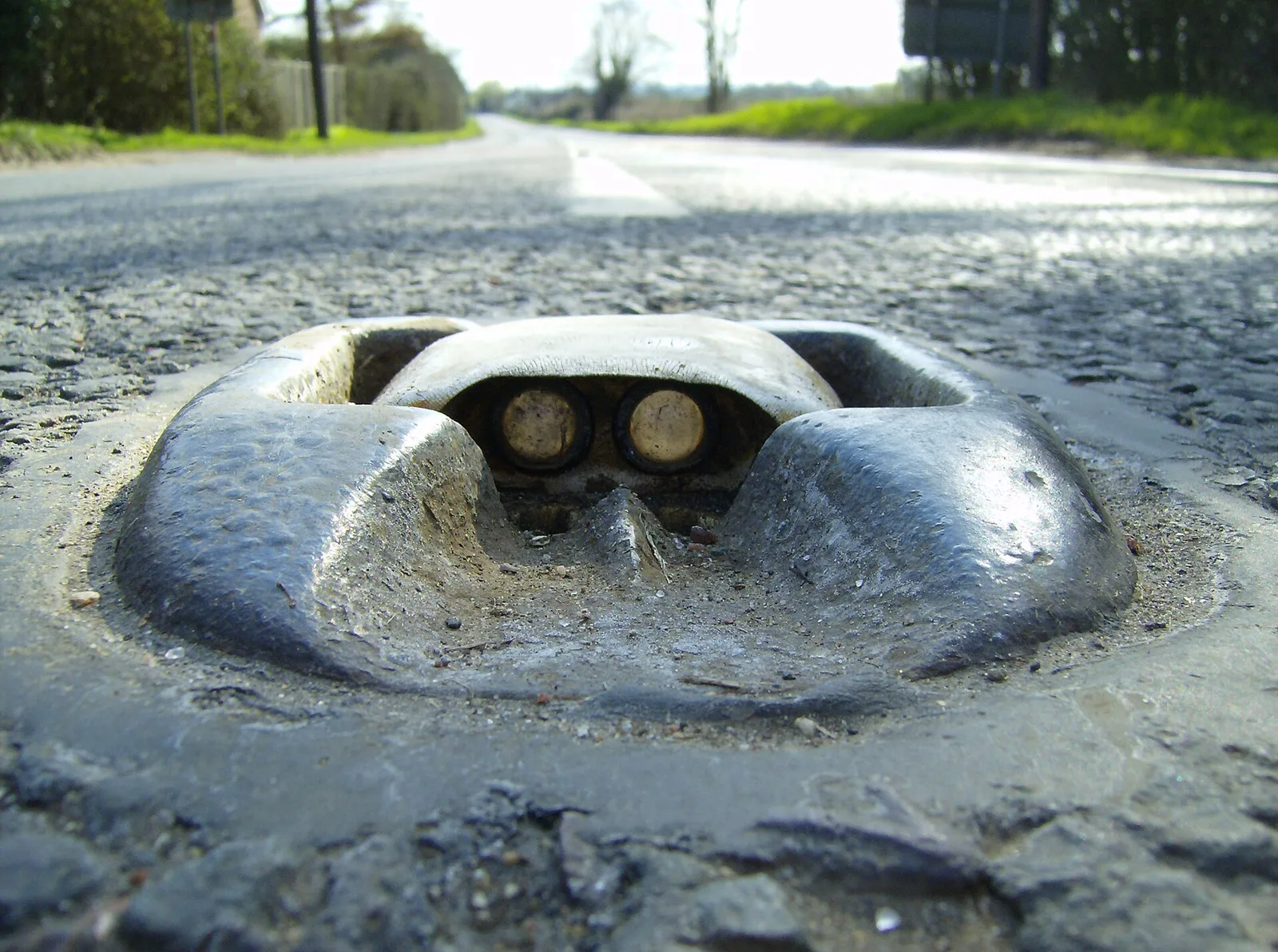
The cat's eye, or road stud, throws a car's headlights straight back at the driver, which makes a small lump of rubber and glass look bright from a long way off. It was the first of the raised pavement markers. The original has two pairs of reflectors sunk into a white rubber dome inside a cast iron housing, and a stud in the middle of the road shows one pair to traffic in each direction.
The clever part is the cleaning. The rubber dome is flexible, and passing traffic occasionally squashes it down. As the reflectors sink below the road surface, a fixed rubber wiper sweeps their faces clean, much as a windscreen wiper would, and the base tends to hold water after rain, which helps the washing along. Metal kerbs around the dome protect it from impact, and they also give tactile and audible feedback to a wandering driver.
A single-ended version, in other colours, is widely used at road margins and as a lane divider. Cat's eyes are especially valuable in fog, and they largely survive snow ploughs.
Percy Shaw realised he had been using polished tram rails to find his way at night.
Who invented cat's eyes?
Shaw came from Boothtown in Halifax, in the West Riding of Yorkshire, and the tram-lines that vanished were those of the nearby suburb of Ambler Thorn. The name comes from the eyeshine thrown back by a cat's eyes. He invented the stud in 1933 and patented the design in 1934, under patents 436,290 and 457,536. A United States patent, number 2,146,359, followed in 1939.
On 15 March 1935 Shaw founded Reflecting Roadstuds Limited in Halifax to make the studs, and Catseye is the firm's trademark. It became the first manufacturer of raised pavement markers. Shaw acknowledged that the idea owed something to an earlier lens, devised six years before his patent for advertising signs by a Herefordshire accountant, Richard Hollins Murray.
The Second World War did the marketing. During the blackouts of 1939 to 1945, with shuttered headlights on cars, the value of Shaw's studs became obvious, and mass use spread across the UK. After the war, James Callaghan and Sir Arthur Young headed a Ministry of Transport committee that gave the studs firm backing, and use eventually spread worldwide. In 2006 the Great British Design Quest, run by the BBC and the Design Museum, put cat's eyes among Britain's top 10 design icons, in company with Concorde, the Mini, the Spitfire, the K2 telephone box, the World Wide Web and the Routemaster bus.
What do the colours of cat's eyes mean?
Each colour is a message. In the UK, white studs mark a single carriageway's centre line and the lanes of dual carriageways and motorways. Amber and red studs flag lines you should not normally cross, amber on the right along the central reservation and red on the left, though red may be crossed to reach the hard shoulder in an emergency. Green studs mark lines that can be crossed, at a slip road or lay-by for example.
| Colour | United Kingdom | Continental Europe | North America |
|---|---|---|---|
| White | Centre line of a single carriageway; lane markings on dual carriageways and motorways | Lane markings; may show red on the reverse to warn wrong-way drivers | Lane markings, or the right pavement edge |
| Yellow or amber | Amber on the right, along the central reservation | Next to the central reservation; also hard shoulders in Ireland | Separates opposing traffic, or marks the left edge of one-way roads |
| Red | Left-hand side of dual carriageways; may be crossed in an emergency | Hard shoulder and road edge; no-entry and wrong-way roads | Areas closed to traffic |
| Green | Slip road or lay-by; may be crossed | Slip-roads that leave and rejoin dual carriageways | Emergency vehicles can open a gate into a gated community |
| Blue | Not in the standard UK colour scheme | Entrances to police-only slip-roads | Fire hydrants |
Studs are hard to see by day, so they are generally used alongside painted lines. During motorway repair work, temporary studs with only a reflective strip, usually day-glow green and yellow, can stand in for painted lines and divide lanes on their own. Plastic traffic pillars slot into the socket of a retractable stud, and are often paired with two rows of temporary studs to separate traffic moving in opposite directions.
In Continental Europe permanent studs are rare. They are inconspicuous in daylight and so always accompany painted reflective lines. The nearest American equivalent is the Stimsonite marker, a fixed plastic unit without the rubber self-cleaning feature, invented in 1963.
Can cat's eyes light up by themselves?
Several versions do. Solar-powered studs, known as solar road studs, show a red or amber LED to traffic and have been installed in dangerous places around the world. After one installation in Essex in autumn 2006, the BBC reported concern that the rapid flashing, around 100 times a second, might trigger epileptic seizures, and the Highways Agency suspended the programme. By 2015 the suspension appeared to have ended, as LED studs were being fitted on freshly resurfaced sections of the A1 and A1(M) in Tyne and Wear and County Durham.
Channel 4's Accident Black Spot demonstrated flashing blue LED studs on 19 December 2000. They would warn of ice once the temperature fell as low as a provisional 3 degrees C (37 degrees F). Proposals in 2013 would have turned the standard white light amber for four seconds after a vehicle passes.
What are raised pavement markers?
A raised pavement marker is a road safety device in many shapes and colours, made from plastic, ceramic, thermoplastic paint, glass or now and then metal. Road turtles, delineators, road studs, cat's eyes, Botts' dots and convex vibration lines are all particular types, and people often just call them reflectors. Metal, plastic and ceramic versions have a lens or sheeting that bounces headlights back, while glass studs use a dome to gather the light and a reflective layer to return it.
In the United States, Canada, Mexico, parts of South America, Thailand and Australia, the plastic marker typically has two angled faces toward the driver and one or more corner reflector strips. Butyl pads, epoxy glue or bitumen hold it down. Where snow is light, it sits on top of the road, and its retroreflective surface can be seen from far away at night and in rain. In snowplough country the marker goes in a shallow groove, or a protective metal casting is embedded in a recess so the marker pokes just above the surface, much like a cat's eye.
The plastic marker came about three decades after Shaw's stud. Sidney A. Heenan, an American engineer working for the Stimsonite Corporation in Niles, Illinois, filed a patent application on 23 October 1964, and patent 3,332,327 was granted on 25 July 1967. In 1965 a San Diego police motorcycle officer, Kenneth Grant Maine, improved the white epoxy-resin marker and applied for a patent, passing it to the California Bureau of Highways, now Caltrans.
What are Botts' dots and convex vibration lines?
Botts' dots are round, non-reflective markers, white or yellow, made of plastic or ceramic and glued down with epoxy. They often replace painted lines on highways and interstates, though they do not suit areas where snow is ploughed.
A convex vibration marking is a different idea: a line of raised bumps, some of them coated with glass beads of high refractive index. Driving over it at speed sets up a strong vibration that tells the driver they are leaving the lane. Laid across the road, these lines appear at toll plazas, ramp entrances, mountain roads, runs of sharp bends, downhill stretches, the end of a highway and the gates of schools and businesses. Laid along the road, they sit on medians, edge lines and dangerous sections.
A glass road stud is a dome sitting on a reflective base, made in many colours and sizes, and Taiwan has adopted it widely. Lit LED markers glow from within and do not need headlights. A single-point LED stud has limited daytime visibility, whereas a multi-LED linear unit can be seen in full sun and shows both position and direction, which matters in fog or a snow whiteout.
How do glass beads make road markings glow?
Glass beads of soda lime glass are what give painted road markings their retroreflectivity. Light from a vehicle's headlights is refracted inside beads that are embedded in the marking, then thrown back into the driver's line of sight. In the 2010s North America used about 227 million kilograms (500 million lb) of beads each year. Remarking a five-lane highway takes roughly 520 kilograms (1,150 lb) per mile, and in Europe the beads are typically spread at 0.4 kilograms per square metre of marking.
Most beads start as crushed recycled float glass, fed into tall vertical furnaces. At about 1300 degrees Celsius the irregular shards melt and, within milliseconds, pull themselves into a round shape. Virgin glass melts work too, and beads with a refractive index of 1.5 come out of either route.
Were glass beads once toxic?
For a time, some were. Manufacturers used to add arsenic, antimony and lead to the glass. Lead made it more durable under harsh road conditions, while arsenic and antimony helped remove gas bubbles and took the colour out of the glass, since a colourless bead gives the best retroreflectivity. The toxic elements can leach into the environment.
Demand was so heavy that beads were imported from countries with outdated rules and techniques, and contaminated product reached the market. Regulations in many countries removed it, and recent analyses in Europe found that beads from several manufacturers worldwide were free of lead, arsenic, antimony, cadmium, chromium and mercury. Beads gathered from the environment showed no contamination.
The picture still has a history. The US Environmental Protection Agency points to the Resource Conservation and Recovery Act as the law that limits heavy metal content. Between 2008 and 2015, three heavy metals turned up in beads imported to the United States and Brazil from countries with little or no regulation, and also in domestic production at varying levels. North American beads contained roughly 15 mg of arsenic per kg, while some from China reached up to 1000 mg/kg. Current limits are under 150 mg/kg, or under 50 mg/kg in the Australian standard.
Water speeds up the breakdown of the glass, while abrasion can knock beads out of the marking. In lab tests that left beads in environmental conditions for 160 days, 96% of the arsenic readings exceeded New Jersey's limit of 3 micrograms per litre, 75% of the lead readings exceeded its 65 limit and 27% of the antimony readings exceeded its 78 limit. No feasible alternative to glass beads is known, though zirconium, tungsten, titanium and barium have been suggested as safer ingredients.
What do yellow lines mean?
It depends on the country, and on whether the line runs beside the kerb or down the middle. Across the UK, the Isle of Man and Ireland, a single yellow line along the kerb means no parking or waiting at certain times, shown on nearby signs or at the entry to a Controlled Parking Zone. Stopping to load, or to pick up and set down passengers, is generally allowed. A double yellow line bans waiting at all times, except where signs show seasonal limits, and the ban runs from the centre of the road to the back of the footway. Section 51 of the Road Traffic Act 1960 first introduced double yellow verge lines in the UK, and it was repealed in 1972 and replaced.
Loading is allowed on double yellow lines unless short stripes across the kerb say otherwise: one bars it at the times on the sign, and two bar it always.
Elsewhere the same colour can mean something else. In New South Wales, a broken single yellow line beside the kerb marks a clearway, while everywhere else in Australia an unbroken one means you must not stop. Yellow centre lines appear in snowy parts of Australia because they stand out against the white. In New Zealand a solid yellow centre line may be crossed only to enter or leave a driveway.
Continental Europe mostly leaves yellow for roadworks, where temporary yellow lines overrule the usual white ones. Switzerland uses yellow to mark special lanes for buses, taxis or bikes. India treats a double yellow line as a firm no-passing order, and a double white line as little more than advice.
In North America, a yellow line means crossing it puts you in a lane with oncoming traffic. A double solid yellow line creates a no-passing zone in both directions. Where it applies, a faster vehicle cannot cross to overtake, must match speed and must follow the slower one until a passing zone or a turn-off. Four exceptions apply: turning left into a driveway or side street, getting past cyclists or pedestrians who block through traffic, emergency manoeuvres and temporary changes during roadworks. In rural areas one of the two lines may turn dashed, creating a one-way no-passing zone: drivers on the dashed side may pass with care, while those on the solid side may not.
The United States rules are written into the Manual on Uniform Traffic Control Devices. Section 3B.01 prohibits a single solid yellow line on two-way undivided roads, and section 3B.06 allows it only on divided highways and one-way ramps. Some states vary, and Vermont and Pennsylvania permit passing on a double yellow in certain conditions. In California a black line is painted between the two yellow lines to make them easier to see. British Columbia makes it an offence to touch or cross a solid double yellow line at any time, with exceptions for avoiding obstructions and for entering or leaving the highway safely. Canadian drivers face no uniform meaning for a solid yellow line, because provinces differ: Nova Scotia lets drivers cross it to pass when safe, while New Brunswick does not permit passing.
One side effect: yellow line paint can contain a chromate pigment, which may add to urban pollution as the paint breaks down.
Have cat's eyes ever caused accidents?
Cat's eyes have been blamed for two fatal incidents. In the 1957 Mille Miglia, a Ferrari 335 S driven by Alfonso de Portago at 240 km/h (150 mph) near the village of Guidizzolo suffered a front left tyre blowout, flipped and flew out of control. The crash killed the driver, his navigator and nine spectators. Enzo Ferrari was prosecuted on 11 counts of manslaughter and acquitted in 1961, after a panel of engineers advised the court that the likely cause of the blowout was the car striking a cat's eye. The 2023 film Ferrari follows that line, blaming a damaged metal cat's eye for slicing the tyre, which matches the Italian judiciary's findings.
On 25 April 1999 on the M3 in Hampshire, a van knocked the steel body of a cat's eye loose. It crashed through the windscreen of the car behind and killed a passenger instantly, and the coroner recorded accidental death. Investigators accepted that stud bodies sometimes work loose but said nothing like it had happened before. A question reached the House of Lords, and the Highways Agency looked into the long-term strength and performance of different road studs.
What does this mean for someone driving at night?
The colours do the work. On a British motorway, red studs on the left mark a line you cross only when an emergency takes you onto the hard shoulder, and amber ones on the right show the central reservation. Across Continental Europe, a stud that shines red toward you means you are travelling the wrong way, and in North America a marker that is clear one way and red the other does the same job. European studs always work alongside painted reflective lines.
Lit studs and safer glass beads
Lit markers are the visible trend. LED studs have been fitted on parts of the A1 and A1(M) since 2015, and proposals in 2013 would have made the lights respond to passing traffic. For glass beads, further research into alternatives to heavy metals would help cut leaching into roadside soils.