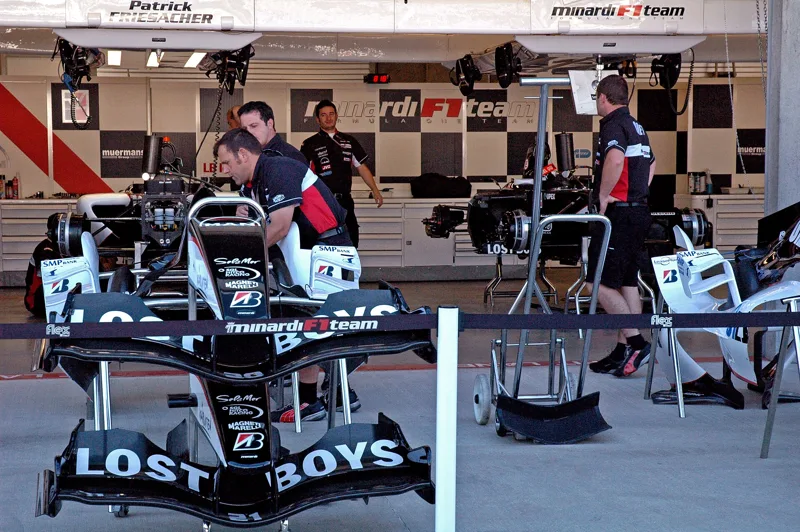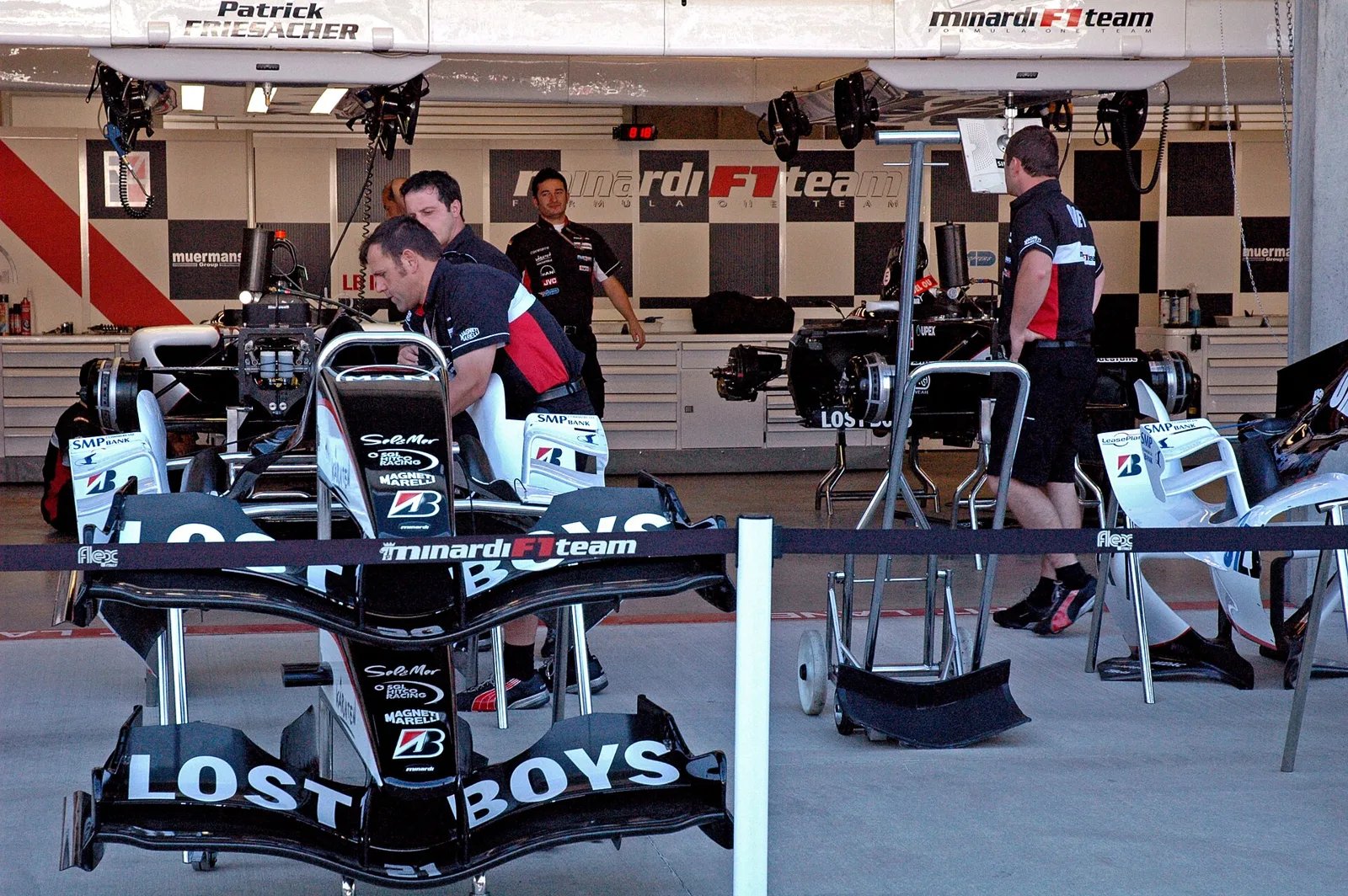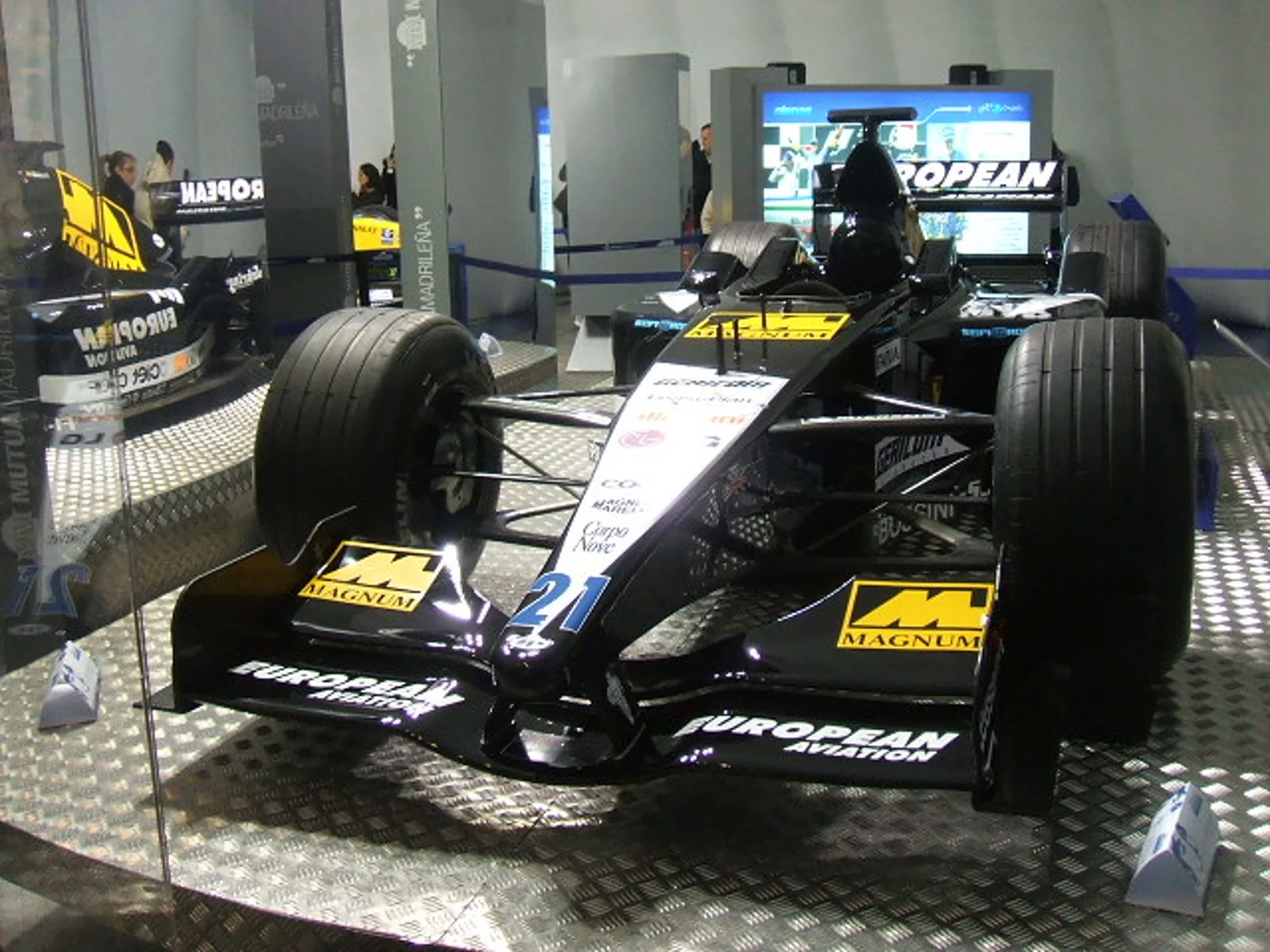
Built in weeks after a change of ownership, the Minardi PS01 carried Tarso Marques and rookie Fernando Alonso through a points-free 2001 season.
The Minardi PS01 was the car Minardi raced in the 2001 Formula One World Championship. Gustav Brunner designed it in Faenza, Italy, during a change of ownership, and it scored no points for the team. Its drivers were Tarso Marques and Fernando Alonso, with Alex Yoong replacing Marques from the Italian Grand Prix.
The Minardi PS01 was the car the Italian Minardi team raced in the 2001 Formula One World Championship. It was designed in a hurry after a change of ownership, and it was driven by Tarso Marques, who was returning to Formula One, and by Fernando Alonso, a Spanish rookie. The team left the season without a single point, but the year gave Alonso his first full taste of top-level racing.
How was the PS01 designed and built in such a rush?
The PS01 was built in a hurry because the technical partnership with Fondmetal ended at the close of the previous season and a deal for Supertec engines fell through. Minardi had to take the design in-house, and with no firm engine, Brunner changed the car four times. It was launched in Melbourne on 28 February 2001.
Brunner, an Austrian designer, worked on the car at the team's base in Faenza, Italy. Fondmetal had provided the aerodynamic design, the wind tunnel and the model-making facilities until the partnership ended, so Minardi kept limited use of the old wind tunnel while it built its own capacity. The design was tidy and efficient, but the team had little time to prove it.
Paul Stoddart's arrival also changed how the work was split. Staff at Faenza and the 45 people at European Formula Racing in Ledbury were linked by regular flights that moved people and parts quickly. Minardi had 100 employees in total, and both centres expanded during the season, with Ledbury taking on research and development.
Testing was limited. One chassis went through crash tests on 5 February 2001, and the team chose conservative side-impact structures that added weight rather than risk failing the test. A shakedown at the Autodromo di Vairano on 21 February covered thirty laps, with system checks and an aero-balance test.
Brunner did not see the season through. He left in May 2001 to become chief designer of Toyota's Formula One project. Gabriele Tredozi, the technical coordinator, became technical director, took responsibility for the car's development and oversaw a revised titanium gearbox with a new rear suspension layout.
A car built in weeks, a rookie named Alonso and a season without a single point.
Who drove the Minardi PS01 in 2001?
Tarso Marques and Fernando Alonso drove the car for most of the season. Marques had last raced an F1 car in 1997, while Alonso had graduated from Formula 3000 and was under contract to Flavio Briatore's driver management scheme. Alex Yoong took over from Marques at the Italian Grand Prix.
Alonso was the more consistent qualifier of the pair. He set the nineteenth quickest time at the season opener in Australia and was often ahead of Marques on the grid. Marques had an uneven start: he failed the 107% mark in Australia and was barred from starting in Britain under the same rule.
Marques's season ended with a change of role. Before the Belgian Grand Prix the team announced that Yoong would replace him from the Italian Grand Prix. Marques stayed on as test and reserve driver, and he helped develop Minardi's 2002 car, the PS02.
Yoong made his mark in a different way. He became Malaysia's first Formula One driver, and his first qualifying session put him twenty-second, behind Alonso. He started from the pit lane in Japan after electrical repairs and finished sixteenth in his first Formula One race.
What changed when Paul Stoddart took over?
Paul Stoddart took control as the season approached and reshaped the team. Fondmetal and Telefonica left the picture, the car moved to a mostly black livery, and the main sponsors became Stoddart's own company, European Aviation, and the Malaysian gambling firm Magnum.
Stoddart bought a 70% stake on 30 January 2001 from shareholders that included Gabriele Rumi and the team's founder, Giancarlo Minardi. Rumi was terminally ill, and Stoddart bought the team only two months before the first race of the season, so the car had to be finished under heavy pressure.
The management structure was new too. Rupert Mainwaring, a former Tyrrell team principal, managed the team, while Frederic Dhainaut, an experienced Minardi employee, ran the Italian section. The two halves of the business kept in contact through the regular air links between Faenza and Ledbury.
Stoddart also used the car in promotion. The Minardi Thunder in the Park event at Donington Park on 21 August 2001 featured eight Minardi F1x2 two-seaters with Nigel Mansell and the team's drivers among those at the wheel. The closing race between five of the two-seaters ended when Mansell crashed into Alonso's car.
Race-by-race record
The season was a mix of qualifying struggles and early retirements. Alonso and Marques often started near the back, and only a handful of races produced classified finishes worth noting. The table lists each Grand Prix from Australia to Belgium, with the later Italian, American and Japanese rounds covered in the text.
Australia opened the season. Alonso qualified nineteenth and Marques twenty-second, and Marques retired after four laps with an engine problem. Alonso finished twelfth, two laps down on the winner, which gave the PS01 its first classified finish. Malaysia followed with the team's first double finish, Alonso thirteenth and Marques fourteenth, in mixed conditions. A torrential downpour damaged the team's equipment early in the race and cut radio contact with both drivers.
Brazil gave Marques his best result, ninth, while Alonso retired after twenty-six laps with a throttle problem. At San Marino Alonso crashed heavily on the sixth lap, and Marques retired on lap fifty-four with a fuel line fault. Spain produced two more finishes, Alonso thirteenth and Marques sixteenth.
Austria and Monaco ended in retirement for both drivers. Canada was a mixed round: Marques equalled his best result with ninth place, while Alonso's driveshaft joint broke after seven laps.
| Grand Prix | Alonso | Marques |
|---|---|---|
| Australia | twelfth | Retired after four laps |
| Malaysia | thirteenth | fourteenth |
| Brazil | Retired after twenty-six laps | ninth |
| San Marino | Crashed on the sixth lap | Retired on lap fifty-four |
| Spain | thirteenth | sixteenth |
| Monaco | Retired, mechanical | Retired, mechanical |
| Canada | Retired after seven laps | ninth |
| Europe | fourteenth | Retired after seven laps |
| France | seventeenth | fifteenth |
| Britain | sixteenth | Did not start (107% rule) |
| Belgium | Retired after two and a half laps | fourteenth |
Taken together, the table shows how often the car reached the grid without reaching the finish. Marques's two ninth-place finishes were the car's best results, and Alonso's tenth place in Germany came next, all just outside the points.
Europe was another double-edged weekend. Alonso climbed from twenty-first to finish fourteenth, while Marques retired after seven laps when an electrical fault shut down his engine. France brought Marques fifteenth and Alonso classified seventeenth, after he was called into the garage five laps early with a suspected engine problem.
Britain saw Marques excluded by the 107% rule for the second time that season, and Alonso finished sixteenth after a wheel came loose. Germany was the high point of Alonso's year.
Hungary ended in retirements. Belgium was wet. Alonso's race lasted two and a half laps before gear selection problems ended it, while Marques finished fourteenth despite suspension trouble and a punctured tyre.
The season finished in the United States and Japan. Alonso's best qualifying of the year came at the US Grand Prix, where he managed seventeenth, but a broken driveshaft during a pit stop ended his race after 36 laps. In Japan he finished eleventh, while Yoong came home sixteenth in his first Formula One race after starting from the pit lane.
How many points did the PS01 score?
The PS01 scored no points in 2001, so Minardi finished unclassified in the Constructors' Championship. Its best results were two ninth-place finishes for Marques, in Brazil and Canada, and the tenth-place target that Stoddart had set was never reached.
Stoddart had hoped for tenth place or better in the Constructors' Championship in the first season. He also had a five-year plan to get the team running in the midfield, so the first year was meant to be a start rather than a finish.
The problems were both technical and practical. Limited testing and an elderly engine held back the car's pace, and staff split across two sites relied on flights to move parts between them. The 107% rule kept Marques out of the British Grand Prix, while retirements ended most of his other races early.
Alonso's year was more encouraging, with a tenth place at Germany and a seventeenth-place qualifying session in the United States. Those results gave a hint of the driver he would become, even if the car could not turn them into points.
Was there an updated version of the PS01?
Yes. Minardi ran an updated car, the PS01B, which had a revised rear end and gearbox. Marques was the first driver to use the B-spec at the Hungarian Grand Prix, and the upgrade formed part of a wider programme of changes during the year.
The updated car came out of a busy development year. The team reworked the rear suspension and gearbox, and the revised titanium gearbox was built alongside a new rear suspension layout. The B-spec was a targeted fix rather than a new car.
The development work carried into the next season. Marques helped with the PS02 for 2002, so the lessons from the PS01 and the PS01B were passed on to the following car rather than being lost when the season ended.