A dune-side circuit built on wartime roads, rebuilt after noise battles and brought back into Formula One in 2021.
Circuit Zandvoort is a 4.259 km (2.646 mi) track in the dunes north of Zandvoort, Netherlands, 35 km (22 mi) west of Amsterdam. It has hosted racing since 1948 and returned to Formula One in 2021 as the Dutch Grand Prix. The current official lap record is 1:11.097, set by Lewis Hamilton in 2021.
Circuit Zandvoort is a 4.259 km (2.646 mi) motor racing track set among the dunes north of Zandvoort, on the Dutch coast 35 km (22 mi) west of Amsterdam. Racing at the site dates back before the Second World War, and the track returned to Formula One in 2021 as the revived Dutch Grand Prix. That partnership with the sport ended in 2026, and the circuit now carries the Mascot name for sponsorship reasons.
Where is Circuit Zandvoort and what is it called?
The circuit lies in the dunes close to the North Sea coast. It was known as Circuit Park Zandvoort until 2017. It currently carries the name Mascot Circuit Zandvoort, a sponsorship title that sits alongside its long history as a home of Dutch motor racing.
The first motor racing at the site took place on the streets before the war. The initial street event came on 3 June 1939, and a permanent track followed later, built on communications roads that the occupying German army had laid out. The shape of the circuit was therefore partly dictated by those existing roads rather than by a clean sheet design.
Built on wartime roads and rebuilt through a long noise dispute, Zandvoort returned to Formula One in 2021.
Who designed the original Zandvoort track?
John Hugenholtz is not credited with the design, despite his role as chairman of the Dutch Auto Racing Club. He became the first track director in 1949. The layout is linked instead to S. C. H. 'Sammy' Davis, the 1927 Le Mans winner, who joined as an adviser on the track's design in July 1946.
The opening event, the Prijs van Zandvoort, was held on 7 August 1948. The event was renamed the Grote Prijs van Zandvoort in 1949 and the Grote Prijs van Nederland in 1950, which set the pattern for the Dutch Grand Prix title that followed.
When did the Dutch Grand Prix run before 1985?
The 1952 race was the first to count towards the World Championship, although it used Formula Two regulations, and the 1953 race followed the same pattern. The event did not take place in 1954, 1956 or 1957. The 1955 race was the first true Formula One event, and the race came back in 1958 and stayed on the calendar until 1985, with 1972 the only gap.
The 1985 race was the last Dutch Grand Prix of the twentieth century. The years that followed were spent solving the problems that had made the circuit hard to develop, and the event would not return until the 21st century.
Why was the circuit rebuilt in the late 1980s?
Noise pollution was the core problem, because the track sat close to a residential area. Track management planned to move the southern section away from housing and build a more compact circuit in the former infield. The Provincial Council of North Holland approved the plan in January 1987, but the company that ran the circuit, CENAV, went into receivership a few months later.
A fresh foundation, the Stichting Exploitatie Circuit Park, took over the rebuilding and the track became Circuit Park Zandvoort. In summer 1989 the circuit was remodelled into an interim club layout of 2.526 km (1.570 mi), while the cleared southern section became a bungalow park and new premises for local football and field hockey clubs.
How did the modern Grand Prix circuit take shape?
In 1995 the circuit was granted A status by the Dutch government and began building an international Grand Prix layout. The project was completed in 2001, when the track was redesigned to 4.307 km (2.676 mi) and a new pits building was added, developed by HPG, the company run by John Hugenholtz Jr., the son of the former director. A grandstand was then placed beside the long straight.
Among the big events are DTM and A1 Grand Prix, along with the RTL Masters of Formula 3, which began as the Marlboro Masters before the tobacco advertising ban. A noise restriction moved the event to the Belgian circuit of Zolder for 2007 and 2008, but it returned to its historical home in 2009.
Which series raced at Zandvoort in the 2000s?
A1 Grand Prix opened its 2006/07 season at Zandvoort between 29 September and 1 October 2006. The first race of the 2008/09 season was moved there from the Mugello circuit on 4 to 5 October 2008, because the new chassis for the cars were delayed. The Dutch round later went to TT Circuit Assen in 2010, and when A1GP went bankrupt before its fifth season, Superleague Formula took its place.
How did Formula One return to Zandvoort?
In November 2018 Formula One Management invited the circuit's owners to propose a Grand Prix for 2020. A letter of intent followed in March 2019, and on 14 May 2019 the Dutch Grand Prix was confirmed for 2020 and beyond, for at least three years with an option to extend by another two. The 2020 race was placed fifth on the provisional calendar, between the Chinese and Spanish Grands Prix.
The 2020 race was cancelled because of the COVID-19 pandemic, and Formula One returned to the circuit on 5 September 2021. In 2019 the track had also been named the host for the Formula 2 and Formula 3 Championships, replacing support races that had been held at Circuit Paul Ricard. The municipality of Zandvoort spent four million euros on better access routes to the track.
What changes were made to meet Formula One standards?
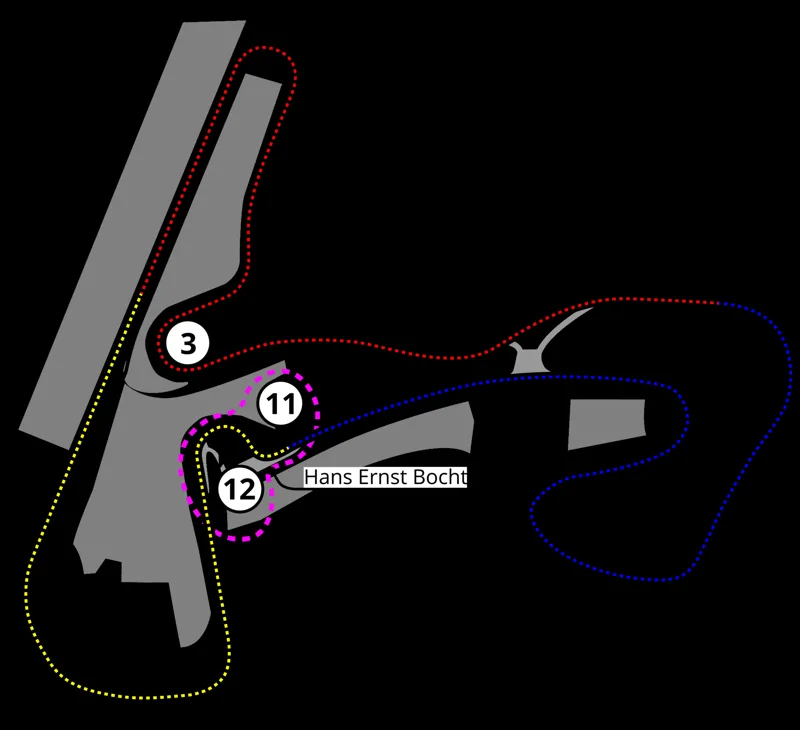
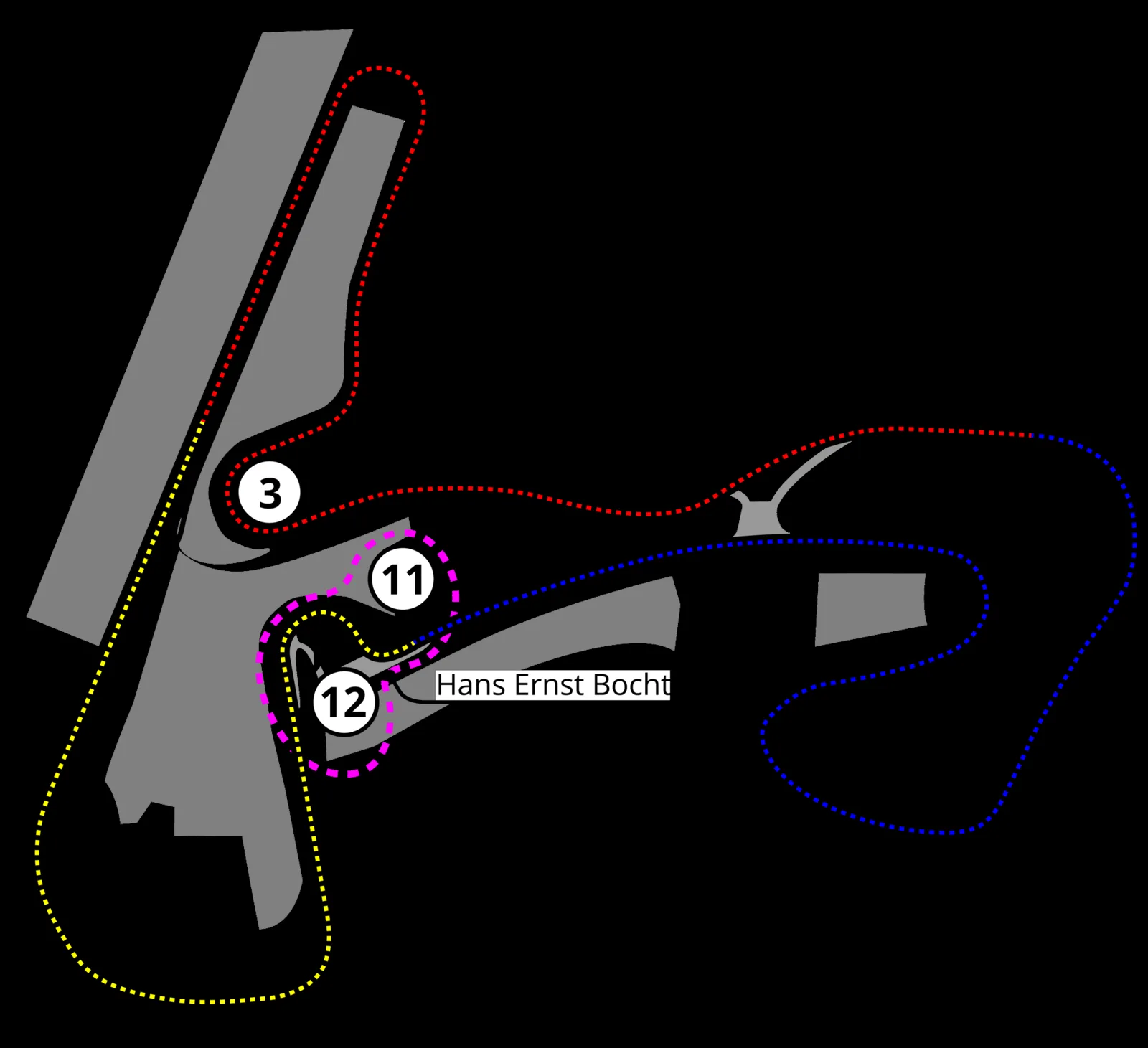
Jarno Zaffelli carried out several alterations to bring the track up to Formula One standards. He added banking to turn 14, named the Arie Luyendijkbocht, and to turn 3, named the Hugenholtzbocht. The layout as a whole stayed the same, so the character of the circuit was preserved for the return of the sport.
What is the Zandvoort layout like?
The circuit gained a reputation for fast, sweeping corners and for the Tarzanbocht hairpin at the end of the start and finish straight. Tarzan is the most famous corner, and its camber creates excellent overtaking chances, with cars able to pass on either the outside or the easier inside line. Its name is said to come from a local man nicknamed Tarzan, who would part with his dune vegetable garden only if a nearby corner bore his name.
The corners follow a numbered sequence from the start and finish line. Turn 2 is the Gerlach corner, turn 3 the Hugenholtz corner and turn 7 the Scheivlak. Turn 8 is the Masters corner, formerly the Marlboro corner, while turn 10 carries the CM.com name, formerly Vodafone. Turns 11 and 12 are the Hans Ernst corners, and turn 14 honours Arie Luyendyk.
How has the length of the Zandvoort track changed?
The circuit has been reshaped several times since 1948, and its length has changed with each redesign. The current layout measures 4.259 km (2.646 mi) and has been in use since 2020. The table below shows the length in each period, so readers can see how the track grew and shrank through its history.
| Period | Length |
|---|---|
| 1948 to 1971 | 4.193 km (2.605 mi) |
| 1972 to 1979 | 4.226 km (2.626 mi) |
| 1980 to 1989 | 4.252 km (2.642 mi) |
| 1990 to 1998 | 2.526 km (1.570 mi) |
| 1999 to 2019 | 4.307 km (2.676 mi) |
| 2020 to present | 4.259 km (2.646 mi) |
Which corners at Zandvoort are the most cambered?
Turns 3, 13 and 14 are among the most steeply cambered corners on the circuit. Turn 3 carries a 19-degree bank, while turns 13 and 14 are banked at 18 degrees. The overall elevation difference across the lap is 8.9 m (29 ft).
What are the Zandvoort lap records?
The current-layout record stands at 1:11.097, set by Lewis Hamilton for Mercedes at the 2021 Dutch Grand Prix. The quickest lap recorded during a race weekend on this layout is 1:08.662, set by Oscar Piastri for McLaren in qualifying at the 2025 Dutch Grand Prix.
Which major series race at Zandvoort today?
The current calendar includes the Formula Regional European Championship, the DTM, the ADAC GT Masters and the Porsche Carrera Cup. The Historic Grand Prix Zandvoort has run since 2012 under the FIA Masters Historic Formula One Championship, and in August the Dutch Grand Prix sits alongside the F1 Academy and the Porsche Supercup.
Has the circuit hosted cycling and running events?
Yes. The 1959 UCI Road World Championships men's race took place at the circuit. France's Andre Darrigade took victory over 290 km (180 mi), and Britain's Tom Simpson finished fourth. Since 2008 the course has hosted the Runner's World Zandvoort Circuit Run, a 5 km road running competition. A 24-hour cycling race has also been staged there since 25 to 26 May 2013, with a 6-hour format added in 2016.