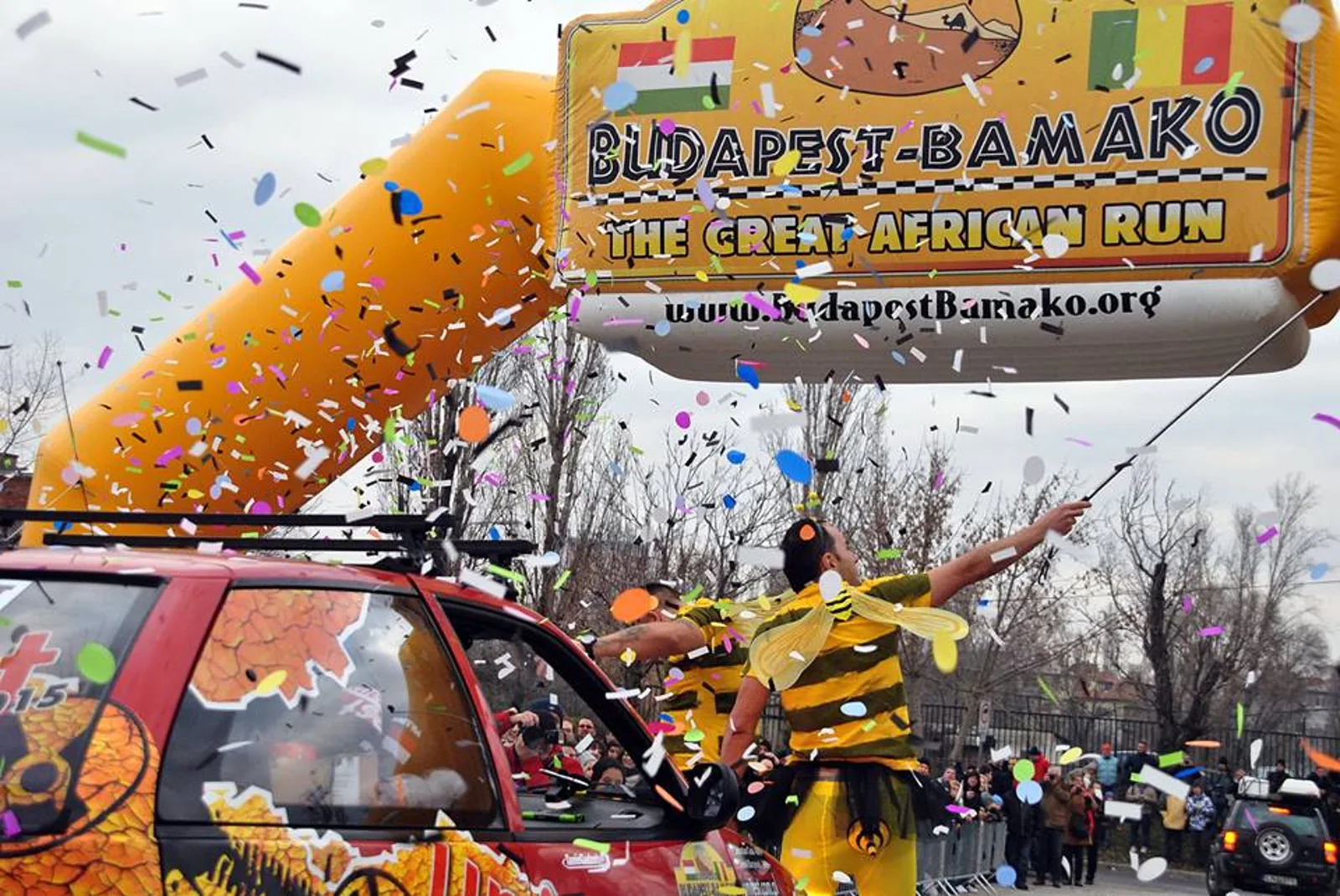
A low-budget alternative to the Dakar Rally, the Budapest-Bamako has carried amateur drivers from Hungary to West Africa while delivering aid along the way.
The Budapest-Bamako is a charity rally from Hungary to Mali, sometimes called the Great African Run. Founded by Andrew G. Szabo, it first ran in December 2005. It is open to almost any street-legal vehicle and crosses the Sahara on its way to West Africa.
The Budapest-Bamako, also known as the Great African Run, is a charity car rally that starts in Hungary and finishes in West Africa, crossing the Sahara on the way. It is described as the largest amateur rally in the world. Almost any vehicle that is street legal can enter, which makes it a low-budget cousin of the Dakar Rally.
What is the Budapest-Bamako rally?
The event is a charity contest that sends amateur teams from Budapest to Bamako in Mali. It was conceived as a cheaper route for rally fans than the stricter and more costly Dakar Rally, and it has since become the largest event of its kind. Teams complete daily stages between the two cities rather than racing against a clock.
In its usual form the route begins in Hungary, then passes through Austria or Slovenia, Italy and France. Teams then head south through Spain and Morocco, cross Mauritania and reach Mali. Later editions added Senegal, Guinea-Bissau, The Gambia, Guinea and Sierra Leone to the itinerary.
Entry is open to any car, motorcycle or individual who wants to take part, and there are no set routes. Points are awarded for completing stages within set time windows, and geocaching challenges along the way bring extra points. A team that fails to finish a stage remains in the event.
A street-legal rally that turns amateurs into charity drivers, carrying aid from Budapest to West Africa mile by mile.
Who founded the Budapest-Bamako and why?
The event was the brainchild of Andrew G. Szabo, a former radio shock jock who went on to build internet businesses in Hungary. He wanted rally fans to have an option that did not require the budget of a works team.
Szabo first imagined a direct drive through the Sahara, passing through Tunisia, Libya, Niger, Burkina Faso and Mali. That plan was dropped in favour of a less risky path that hugged Africa's western edge.
The first run began on 26 December 2005, when forty-two teams lined up in Budapest's Heroes' Square. Two weeks later all but two of them had reached Bamako's Place des Heroes, which translates as Heroes' Square.
What happened in the early editions?
Entries rose quickly. In 2007 more than a hundred teams took part, and only ten of them failed to cross the finish line. By 2008 over 400 people were taking part in 160 vehicles. The machines were varied: one team drove a 1961 Velorex, another ran an Ikarus 435 articulated bus, and others took a Dacia, a Wartburg or a Fiat 126 built in Poland.
Touring teams in 2008 enjoyed theme events, including a Star Wars party in Morocco, a Tropic of Cancer party and a beach party in Mauritania.The 2008 run began a week after the Dakar Rally was cancelled. Several French and Spanish teams withdrew from the Bamako finish because they feared terrorism in Mauritania. The organisers completed the event without serious problems, and the Mauritanian government put large numbers of soldiers and police on guard duty along the route.
In 2009 the racing and touring categories were fully separated, and the course became more demanding, with tighter timing rules and more advanced geographic tests. The next year the Mauritanian and Mali stages were cancelled less than 36 hours before the start, after a warning from the Hungarian Foreign Ministry, and the rally finished in Agadir instead.
The following year brought more change. In 2011 a Spirit category was added, which let old cars enter without paying a fee. In 2011 the rally travelled through Senegal for the first time, and only 125 of the 160 teams finished. Among the competitive entries, just 18 out of 40 finished. In 2012 the finish moved to the capital of Guinea-Bissau, and Bamako stopped being the destination.
In 2013 organisers relocated the finish to Guinea-Bissau because Mali was unstable. Hungary's anti-terror agency pressed for cancellation over kidnapping threats, yet the event went ahead. Of the 142 entrants, 89 reached the finish.
The 2014 rally ended in The Gambia, where the capital, Banjul, hosted the finish ceremonies. Out of 145 teams, 105 finished on time. Days before the start, Szabo had said that 2015 would be the final Budapest-Bamako.
Why did the rally move away from Bamako?
The 2015 edition started amid the Ebola crisis that had affected West Africa in 2014 and 2015. Several members of the Malian government welcomed the teams in Bamako on 1 February 2015. Mali became free of Ebola only days before the start, yet the event saw a record number of cancellations. Of 124 departing teams, 102 reached Mali, and a Hungarian team, Gumis Ember, won the competition.
The following year was harder still. In November 2015 militants seized 170 people at a hotel in Mali, and that frightened many entrants away from the 2016 run. Organisers and the Malian government tightened security, but only 68 of the 120 teams that entered finished. Gumis Ember won again.
Because of security concerns and the difficulties of making arrangements in Africa, organisers said in January 2016 that the event would from then on take place every second year. In the intervening years they would organise a similar charity rally, road trip or adventure elsewhere in the world, starting with a trip to the Baja peninsula of Mexico.
How much aid has the rally delivered?
Charity sits at the heart of the event. Its donations go directly to communities in Mali and Mauritania, and many of its teams are sent by companies as part of their corporate social responsibility programmes. The table lists several of the larger contributions that the rally has carried.
| Year | Aid delivered | Notable project |
|---|---|---|
| 2009 | 700,000 euros | Solar panels and solar ovens for Malian villages |
| 2011 | 800,000 euros | A new well in Diema and 10,000 mosquito nets |
| 2012 | 600,000 euros | Several ambulances donated to Guinea-Bissau |
| 2013 | 800,000 euros | A fully functional fire engine for a Guinea-Bissau mayor |
| 2014 | 750,000 euros | Hospital equipment and 2,000 kilograms of medical aid by air |
| 2015 | 800,000 euros | A new school wing, with most of the aid going to Bamako's Cherifula slum |
| 2016 | 600,000 euros | A radio station to promote gender equality in Diema |
| 2020 | 900,000 euros | A fruit orchard in Sierra Leone and 5000 school bags |
| 2022 | 800,000 euros | A solar electricity system at a school in Masiaka |
In 2008 Budapest Bank donated an ambulance that had been driven all the way from Budapest to Bamako. Over the years other teams delivered school supplies, ambulances and fire engines.
The team whose charity work stands out most is given the Mother Teresa Charity Award, which honours that work directly.
What happened in the recent editions?
The 2018 edition was the twelfth and began on 12 January. Because of security concerns the finish moved to Banjul in The Gambia. The route ran west across Europe to Midelt in Morocco, then through snow in the Atlas mountains, rocky Moroccan trails, wind and sand in Mauritania and dusty tracks in Senegal before the finish on 28 January.
The Jatekshop.hu Team won in a Nissan Patrol that year. A separate group, the Adventure Extra, left Fez in Morocco two and a half weeks behind the main field and had no competitive category. Protests in Senegal forced one group to change its overnight camps in 2024, and a temporary border closure in Guinea affected the other. The 2018 run also saw the first Tesla make the crossing of the Sahara. It was marred by tragedy when a truck swerved onto a team's car and forced it off the road. Its driver suffered life-threatening injuries, was evacuated to Europe and later died.
The 2020 event broke every previous record, with seven hundred and thirty participants from 80 countries. Organisers took the rally to Sierra Leone, and teams had to cross Guinea for the first time. Political unrest in Labe forced a change of route, and the Gaoual-Kindia stage proved so demanding that only 20 percent of the teams completed it. The stage routed teams through Gaoual, a town that made the going harder. The rally finished at Freetown's national stadium on 16 February 2020, and thirty-one teams did not reach the finish.
The Hungarian Koros Auto team won that year, and two Estonian teams took second and third. Sierra Leone's president, Julius Maada Bio, welcomed the teams at the finish. The 2022 edition was the longest, hottest and wettest in the rally's history. It lasted 19 days and covered 9,432 kilometers, and pandemic shutdowns in Morocco forced two postponements of the start. Its participants crossed the Sahara in October, when daytime temperatures could reach 50 degrees Celsius. Guinea was crossed for only the second time in the event's history, and the oldest entrant was 70-year-old Julian Obricki, a Polish driver whose last African event had been the 1988 Dakar.
At the Freetown finish ceremony, an organiser named Szabolcs Petery suffered a fatal heart attack. Koros Auto won again. The 2024 event attracted so many entries that organisers split it into two groups, with 365 teams and 1,102 participants in the main event, and 90 percent of them crossed the finish line in Freetown.
The 2025 edition marked the twentieth anniversary of the rally. It aimed to recreate the 2005 route as closely as possible, though it finished in Banjul rather than Bamako, and it drew 200 participants, many of them veterans of the first run. One entrant was hit by a venomous snake that year, but the medical team saved him. Koros Auto won the race again. The 2026 event set another record for participation and finished in Freetown, and Koros Auto announced that it would end its participation after that year.
Where can the rally be watched?
The Travel Channel began airing a Budapest To Bamako series in 2007, and from 2008 it invited viewers to take part in the rally. By 2009 the programme had five episodes, following an all-male and an all-female team along the route. Hungarian broadcaster RTL Klub has covered the event every year since 2007.
In 2022 a feature-length documentary, Rust To Glory, followed three junk cars as they were rebuilt for the rally. The second half of the film covers their journey, and it is streamed worldwide by Amazon and Apple TV and in Hungary by RTL Plusz.