Nine cautions, a new low-downforce test and a concussion that cost Dale Earnhardt Jr. much of his 2016 season.
The 2016 FireKeepers Casino 400 was a NASCAR Sprint Cup race at Michigan International Speedway that Joey Logano won from the pole. It ran 200 laps with nine cautions, 14 lead changes and a new low-downforce aero test. Chase Elliott finished second.
The 2016 FireKeepers Casino 400 was the fifteenth event on that year's NASCAR Sprint Cup calendar, run on June 12 at Michigan International Speedway. Joey Logano won from the pole after 200 laps that included 14 lead changes and nine cautions. Chase Elliott finished second for the best result of his career, while the race also tested a new low-downforce package.
What was the 2016 FireKeepers Casino 400?
The race was the 15th of the season, and nine drivers had already clinched a Chase position before the green flag. Kevin Harvick led the points with 490. Kurt Busch was 25 points back, Brad Keselowski 48 back, Carl Edwards 53 back and Kyle Busch 74 back.
The preliminary entry list named 40 cars and came out on June 3, 2016, at 12:29 p.m. Eastern. The race was run on the two-mile, D-shaped oval that Michigan uses for its stock car events.
A low-downforce Michigan race that gave Joey Logano the win and left Dale Earnhardt Jr. out for much of the year.
What changed in the aero package?
NASCAR tested a set of changes two weeks before the race. The spoiler was trimmed by one inch, from 3.5 inches to 2.5 inches (8.9 cm down to 6.4 cm), and the splitter came down by two inches (5.1 cm). The deck fin was resized as well.
NASCAR's Steve O'Donnell described the work as a never-ending journey. He said the sanctioning body wanted to move toward low downforce and see how that worked, and it had further levers it could pull if the direction proved right. One of those levers was to reduce corner speeds further so that passing became easier.
How did qualifying and practice go?
Joey Logano won the pole at 36.080 seconds, which was 199.557 mph (321.156 km/h). Martin Truex Jr. qualified second and described the track as slippery and hot, while Tony Stewart took third and said his team was closing on the leaders.
Practice had produced fast times earlier in the weekend. Chase Elliott was quickest in the first session at 35.709 seconds, or 201.630 mph (324.492 km/h). Carl Edwards led the second session at 36.406 seconds, and Austin Dillon set the final benchmark at 37.056 seconds. Qualifying was halted in the first round when David Ragan spun and hit the wall with his right-rear corner.
How did the early laps unfold?
Under mostly sunny skies the field went green at 1:19 p.m. Logano got loose in Turn One and Truex took the lead. Several drivers reported that the new aero changes had left their cars very loose, and the first 10 laps showed the effect clearly.
Logano worked his way back to the front on lap 11, and by lap 25 Truex was closing on him. The first round of green-flag stops started on lap 39, and Logano came in from the front two laps later to hand the position to Keselowski. Landon Cassill was penalised with a pass-through because his crew was over the wall before it was allowed.
Keselowski ran out of fuel on the frontstretch on lap 46. Truex spun in Turn Three moments later, and that caution let Keselowski reach pit road.
The race restarted on lap 51, and Kyle Busch's engine caught fire on the backstretch, bringing out the second caution on lap 54. He said the motor had been struggling for around 30 laps before it failed, and he went on to finish 40th.
What led to Earnhardt's concussion?
A two-car wreck on lap 62 brought out the third caution. Chris Buescher tapped Dale Earnhardt Jr. exiting Turn Two, and Earnhardt then drifted across the front of Allmendinger's car, which sent both drivers into the wall. Earnhardt said afterwards that he knew he was going to hit the wall, and he was disappointed by the incident.
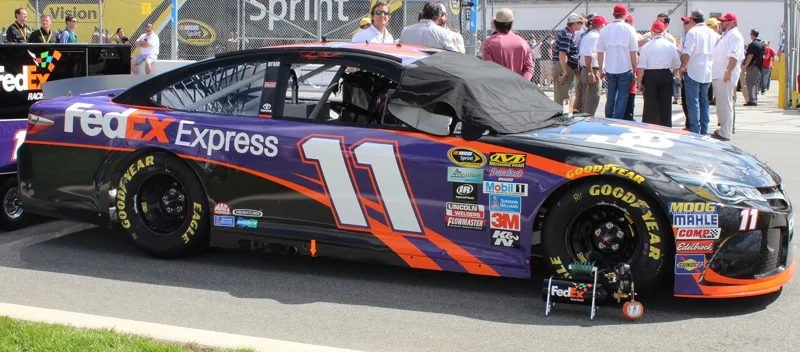
On a podcast in August 2016, Earnhardt acknowledged that a season-ending injury had come from Michigan. He had not understood how serious it was until after the July race at Daytona. Concussion symptoms kept him out from the Kentucky round, and he was not cleared for the rest of the year, so he missed half the season.
How did the closing laps play out?
The closing stage was full of restarts, and the lead changed hands on pit road as well as on the track. Logano and Elliott swapped the front spot several times, and each restart carried a new risk for the front runners.
Elliott chipped away at the gap in the final 20 laps and got within a second of Logano. A seventh caution with 46 laps to go followed a multi-car wreck on the backstretch, and an eighth caution came after Ryan Blaney slammed the wall in Turn Two. Denny Hamlin suffered a left-rear blowout with 12 laps left and hit the inside wall.
Logano drove on from there, winning the race on the final restart with seven laps to go. He said it was a crazy race with low downforce, more cautions and more chances for mistakes.
How did the drivers and media rate the race?
Pete Pistone of the Motor Racing Network rated the race worthy of a B minus, saying the loose cars created a wild style of racing through the field. He argued that clean air still gave the leaders an advantage and that the package remained a work in progress.
Shawn Windsor, writing for the Detroit Free Press, argued that lowering front downforce let drivers push close to 220 mph on the long straights, and that speed differences of up to 40 mph between the straights and the corners gave drivers room to manoeuvre. Matt Weaver of Autoweek said one race was too small a sample to draw firm conclusions, but he called it a massive improvement on the high-drag package used the previous summer.
Who called the race on television and radio?
Fox NASCAR televised the race on FS1 for the second consecutive year, with Mike Joy calling it lap by lap. Jeff Gordon, a three-time Michigan winner, and Darrell Waltrip, a two-time winner, were the colour commentators. Pit lane reports came from Jamie Little, Vince Welch and Matt Yocum.
On radio, the Motor Racing Network carried the race and Sirius XM NASCAR Radio simulcast it. Joe Moore, Jeff Striegle and Rusty Wallace called the action from the booth while the field ran down the front stretch. Dave Moody called from a billboard outside Turn Two, and Mike Bagley worked from a platform outside Turn Three.
Pete Pistone, Winston Kelley and Alex Hayden covered pit road on the radio side, giving listeners a second view of the pit stops that shaped the race.
Race summary at a glance
| Measure | Result |
|---|---|
| Round | 15th of the 2016 Sprint Cup season |
| Date | June 12, 2016 |
| Scheduled laps | 200 |
| Winner | Joey Logano |
| Runner-up | Chase Elliott, a career-best finish |
| Pole | Joey Logano, 36.080 seconds |
| Lead changes | 14 among different drivers |
| Cautions | 9 for 46 laps |
| Red flags | None |
| Race time | 2 hours, 58 minutes and 47 seconds |
| Average speed | 134.241 mph (216.040 km/h) |