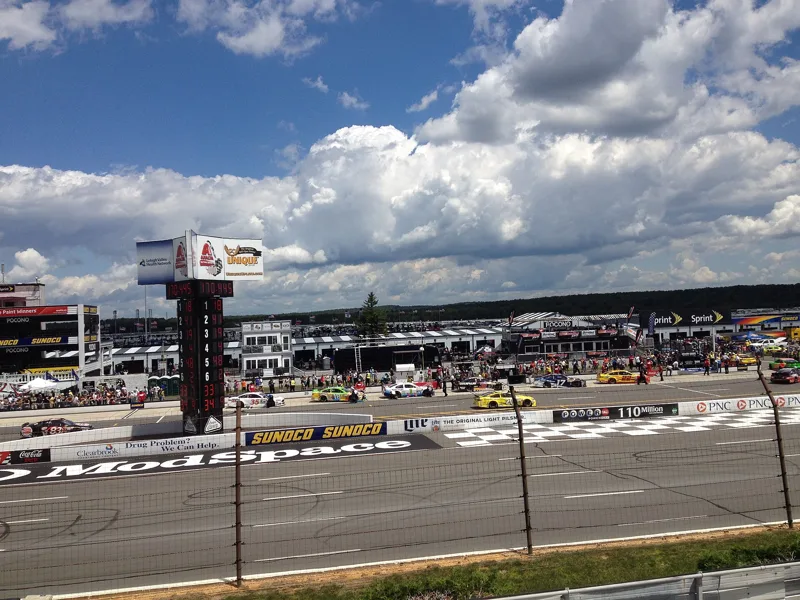
Kyle Busch's third win of 2015 came at New Hampshire after a late duel with Brad Keselowski on a hot July evening.
The 5-hour Energy 301 at New Hampshire on 19 July 2015 went to Kyle Busch, who took his third win of the season. Brad Keselowski came second in the 301-lap event, which featured nine lead changes among seven different drivers.
New Hampshire gave Kyle Busch his third win of 2015, and it came in a race that changed hands nine times between seven drivers. The event was the 19th round of the NASCAR Sprint Cup Series season. In the closing stages Busch held off a steadily narrowing gap from Brad Keselowski.
Who won the 2015 5-hour Energy 301?
Kyle Busch won the 5-hour Energy 301 on 19 July 2015 at New Hampshire Motor Speedway. It was his 32nd career Sprint Cup victory and his third of the 2015 season. Brad Keselowski finished second, with the race covering 301 laps around the 1.058 mile oval in Loudon, New Hampshire.
The win was Busch's second in a row, and his second at New Hampshire. It also marked his seventh victory at the track for Joe Gibbs Racing.
Kyle Busch's third win of 2015 came at New Hampshire after a late duel that never quite turned into a pass for Keselowski.
Why did the win matter in the standings?
Busch climbed to 33rd in the points standings after the win, 58 points behind David Gilliland, who held the 30th place Chase cutoff. He was 487 points behind points leader Kevin Harvick. Toyota won the race but still trailed Chevrolet by 84 points in the manufacturers' standings.
Busch said after the race that the team kept getting better every week, a view that matched the momentum built over two straight wins. Keselowski gave his own team similar credit, saying the crew had brought him two fast cars across two weekends.
How did qualifying set up the race?
Carl Edwards took pole with a lap of 28.179 seconds, which equated to 135.164 mph (217.525 km/h). Joey Logano qualified second, while Jeff Gordon could manage only 23rd after a difficult session. Edwards later led 19 laps in the race but finished seventh.
Edwards said New Hampshire had been a hard track for him, so the pole was a significant result for his team. He added that the team needed another win. Logano, a Connecticut native, said the car was good in race trim even though it had been weaker in qualifying trim during practice.
Gordon was less positive about the day. He said the team had been struggling and that it was disappointing not to qualify further forward.
How did practice go for the teams?
Kyle Larson was quickest in the first practice session at 28.486 seconds, or 133.708 mph (215.182 km/h). Kevin Harvick led the second session at 28.834 seconds, and Carl Edwards produced the final fastest time at 28.614 seconds.
The second session also brought an incident in the pit area. Clint Bowyer collided with Jeff Gordon as Gordon reversed out of his stall. Bowyer said the pit stall made it impossible to see out, while Gordon said his crew had worked hard to repair damage to the right-rear of the car.
How did the race unfold?
Carl Edwards led the field to the green flag at 1:38 p.m., but Busch ran him down and passed him on lap 20. Brad Keselowski took the lead from Busch on lap 68, and the order changed hands repeatedly through pit cycles. Busch took over for good when he stayed out under the sixth caution with 50 laps to go.
The race was scheduled for 1:45 p.m., but the threat of bad weather prompted NASCAR to bring the start forward to 1:35 p.m. The first caution came on lap 22 for debris in turn one, and most of the cars running ninth or worse pitted under it. The restart followed on lap 27, and Edwards was among the drivers who stayed out.
Keselowski ran down the leader in the middle part of the race and got within half a second at one point before taking the lead. He led a race-high 100 laps, more than any other driver. Edwards led 19 laps before finishing seventh.
Ryan Blaney made an unscheduled stop on lap 130 for a loose right-rear tyre, and he then picked up a drive-through penalty for speeding on pit road. Kurt Busch started a wave of green-flag stops from fifth on lap 171, and Kevin Harvick and Keselowski made their own stops in the later stages.
Which incidents shaped the race?
Seven cautions covered 34 laps in total, and the race produced nine lead changes among seven different drivers. Several of the yellow flags came from debris, but a few came from cars that failed or touched the wall. Two notable moments were a fire on Alex Bowman's car and an engine failure that left oil on the track.
On lap 96, Bowman's right-front tyre caught fire as he left his pit stall, which brought out the second caution. The third caution on lap 117 came for debris on the front stretch, and Edwards was the only driver in the top ten to pit under it.
Debris on lap 189 brought out the fourth caution, and J. J. Yeley's car blew up in smoke. Oil from Yeley's car in turn two then brought out the sixth caution with 50 laps to go.
Paul Menard had made contact with Kasey Kahne, then missed pit road on lap 199 and spun trying to get onto it the next lap, which brought out the fifth caution on lap 200. The race restarted on lap 204, and Clint Bowyer's tyre was cut down after contact with the turn two wall. Justin Allgaier had a suspected tyre rub before NASCAR called him to pit road.
What were the final results?
Kyle Busch won, Brad Keselowski was second and Kevin Harvick finished third. Joey Logano took fourth place and Dale Earnhardt Jr. completed the top five. Edwards finished seventh after leading 19 laps, and Busch's win gave Joe Gibbs Racing another victory at the track.
| Position | Driver | Note |
|---|---|---|
| 1 | Kyle Busch | Third win of 2015; 32nd career victory |
| 2 | Brad Keselowski | Led a race-high 100 laps |
| 3 | Kevin Harvick | Finished third |
| 4 | Joey Logano | Started second on the grid |
| 5 | Dale Earnhardt Jr. | Top five despite engine problems |
How did the drivers react after the race?
Busch said the team kept getting better every week. Keselowski praised his crew for bringing him two strong cars in succession. Earnhardt said the car had not driven well and that some gauges had been reading well off, so the team would have to look into it.
Heat was a major theme of the evening. Michael Annett and Matt DiBenedetto were taken to the infield care centre with signs of heat exhaustion and needed fluids, and A. J. Allmendinger was treated for strep throat. Earnhardt said the track demanded hard driving on every lap, because the corners did not let drivers settle into a steady pace.
How was the race broadcast and awarded?
NBC Sports carried the race on NBCSN for American television viewers. Rick Allen, Jeff Burton and Steve Letarte called the action, and Burton brought his own knowledge of the track, having won there four times as a driver. The Performance Racing Network carried the radio broadcast, which was simulcast on Sirius XM NASCAR Radio.
Several awards recognised standout performances. Carl Edwards took the Coors Light pole award, and Brad Keselowski earned the 3M Lap Leader prize for his 100 laps. Kyle Busch collected the Sherwin-Williams Fastest Lap award for lap 5 at 29.166 seconds, or 130.591 mph (210.166 km/h), and the Mobil 1 Driver of the Race award with a rating of 137.2.
Other prizes went to David Gilliland for the Ingersoll Rand Power Move, which gained him two positions, and to Austin Dillon's crew chief Richard Labbe for the Moog Steering and Suspension award, which was decided by a margin of 0.003 seconds. Brett Moffitt was the Sunoco Rookie of the Race. No one claimed the Sprint Cup Leader Bonus, so the $160,000 rolled over to the next event.