Pirelli changed its tyres after Silverstone, a wheel bounced down the pit lane, and Raikkonen could not catch the Red Bull on the Nurburgring.
The 2013 German Grand Prix was the ninth round of the 2013 season, held on 7 July 2013 at the Nurburgring. Sebastian Vettel won from second on the grid, and it was the first win of his career at the race.
Sebastian Vettel won the 2013 German Grand Prix from second on the grid, his first win at his home race. Kimi Raikkonen and Romain Grosjean kept Lotus in the frame behind him, while Fernando Alonso charged late for fourth. The afternoon is also remembered for a wheel that came off Mark Webber's Red Bull in the pit lane.
Why did Pirelli change its tyres for Germany?
Four drivers suffered explosive punctures at fast points of the Silverstone circuit a week earlier, so Pirelli altered the rear tyre construction for Germany. The steel rear belts were replaced with Kevlar, which lowered the operating temperature by up to 10 C (18 F) and reduced the chance of a sudden puncture.
The change was a stop-gap. A more permanent solution was promised for the next round in Hungary, but Germany was the first race to run on the revised tyres.
The FIA also banned the practice of swapping the left and right tyres around the car, which teams had found made each tyre last longer. Pirelli then asked for its recommended pressures and camber settings to be made mandatory, after teams had been running outside them to chase performance.
A home win for Vettel, a wheel that bounced down the pit lane and a cameraman in hospital.
How did qualifying end with Hamilton on pole?
Lewis Hamilton took pole ahead of Sebastian Vettel and Mark Webber, with Raikkonen and Grosjean fourth and fifth. Felipe Massa had led the early part of the session, and Nico Rosberg was knocked out in Q2 by a mistake on his Mercedes team's side.
In Q1, Massa was fastest ahead of Raikkonen's Lotus. Chilton, van der Garde, Bianchi, Pic, Maldonado and Bottas failed to progress from the first session.
Q2 brought a rapid improvement in the closing minutes, which caught several teams out. Webber scraped into Q3 by five one-hundredths of a second, and Massa was fastest again ahead of Raikkonen. Jean-Eric Vergne, Adrian Sutil, Esteban Gutierrez, Sergio Perez and Paul di Resta were eliminated.
Alonso qualified eighth behind his teammate Massa, and both chose the medium tyre for the start. Button and Hulkenberg set no time in Q3 so they could keep their tyres for the race. Charles Pic took a five-place grid penalty for an unscheduled gearbox change.
How did the race open?
Vettel and Webber made strong starts and pressed Hamilton. By the end of the first turn Vettel had shaken off the Mercedes and taken the lead, with Webber moving into second and Hamilton dropping to third.
Massa had a good start too, but he went off at turn one on lap three after locking his rear brakes. His engine stalled and a gearbox failure ended his race. Rosberg, who had struggled in qualifying, barely improved his position in the first five laps.
Alonso and Ricciardo slipped back slightly in the opening laps, and Vettel held the lead for several laps without a serious challenge from behind him.
Pit stops, worn tyres and the wheel that flew
Drivers pitted between laps five and nine to switch from used soft tyres to the mediums. Grosjean led the race until he stopped on lap 13, and he continued to show strong pace afterwards. Both Lotus drivers kept pace with Vettel in the first half, both setting very quick laps.
The stop that mattered most came from Webber's crew. The right-rear wheel was not attached properly, and as he left his pit box it came off, rolled down the pit lane and struck a cameraman. The cameraman was taken to a hospital in Koblenz with reported broken bones and a concussion.
Webber's car was pushed back to its pit box, fitted with a new wheel and sent out again, a lap behind Vettel. He spent the rest of the afternoon trying to recover that deficit.
Why did the safety car change the finish?
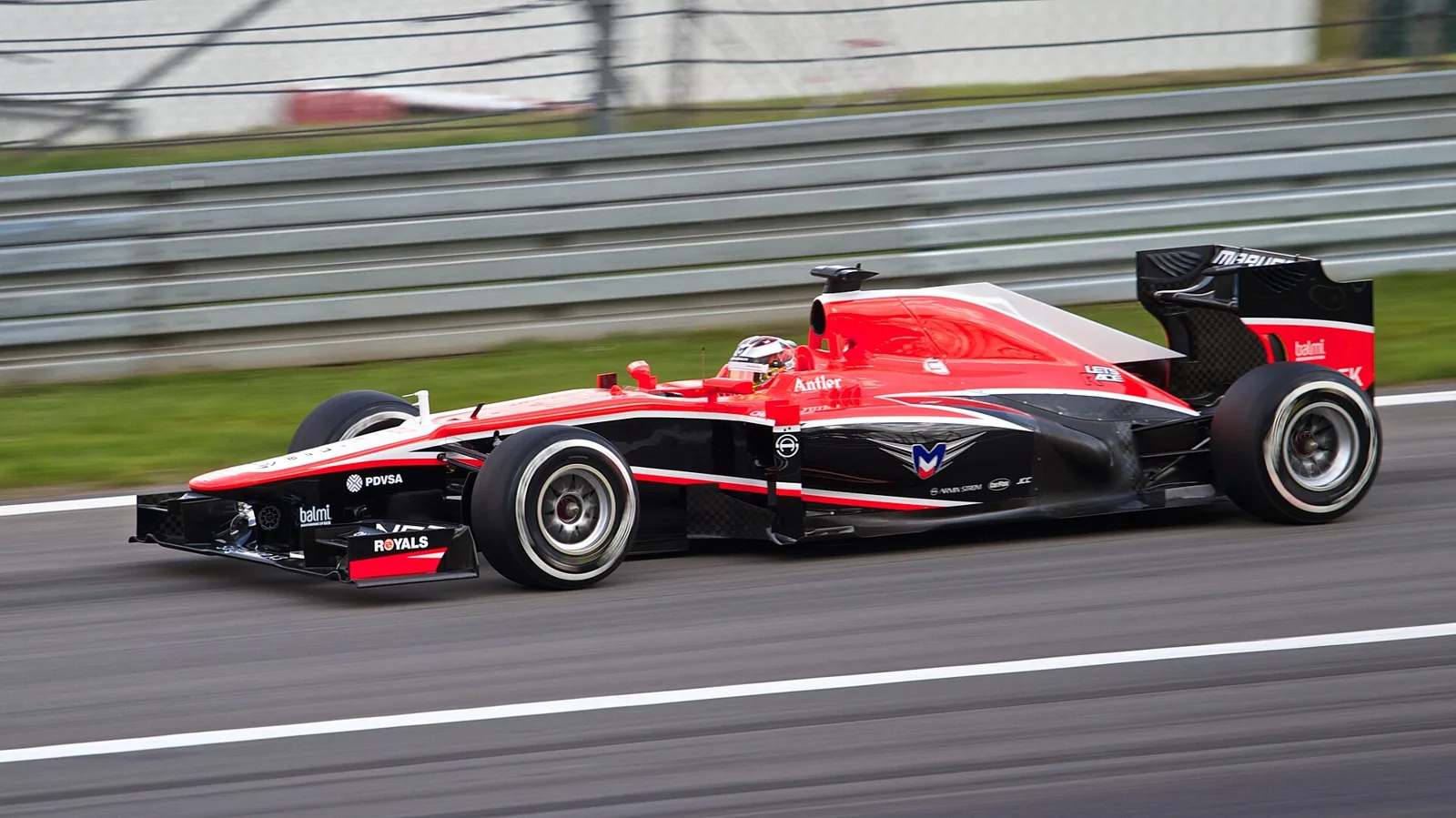
Jules Bianchi's Marussia suffered an engine failure and a fire on lap 23. He pulled to the left, but the car rolled back across the track before a board stopped it, and the resulting safety car let Webber get back onto the lead lap.
Most drivers pitted for fresh tyres under the safety car. Vergne's Toro Rosso suffered a hydraulics failure within two laps of Bianchi's engine failure, but it could return to the pits. Webber, meanwhile, was stuck behind Esteban Gutierrez for more than ten laps before he made his stop.
Raikkonen led on lap 41, after Vettel and Grosjean had pitted for their third time. Lotus waited until lap 49 to switch Raikkonen onto soft tyres, which put Vettel and Grosjean first and second. Grosjean was then told by radio not to hold Raikkonen up, for championship points reasons.
Pastor Maldonado was in the points in eighth, in his 600th Grand Prix for Williams, and his rookie teammate Valtteri Bottas was tenth. Alonso set the fastest lap of the race, almost a second quicker than the first three drivers, and he was closing on Grosjean in the closing laps.
How did Hamilton lose ground from pole?
Hamilton lost the lead to Vettel by the end of the first turn, when Vettel shook him off and took the place. From that point the race was about recovering positions for the Mercedes driver rather than fighting for the win.
Late in the race Hamilton made a move on his former teammate Jenson Button at turn two, which lifted him into fifth. It was a useful result after a start that had promised more.
Who had a difficult afternoon?
Williams had the hardest finish of the day, with Maldonado and Bottas finishing 15th and 16th after wheel gun problems at their pit stops. Paul di Resta's 11th place was his first finish outside the points that season.
Rosberg struggled to keep his Mercedes on the pace and finished ninth at his home race, while Hulkenberg took the final point for Sauber in tenth. Ricciardo finished twelfth, Sutil thirteenth and Gutierrez fourteenth.
Race result and classification
| Position | Driver | Note |
|---|---|---|
| 1 | Sebastian Vettel | Red Bull, started second, first home win |
| 2 | Kimi Raikkonen | Lotus, one second behind the winner |
| 3 | Romain Grosjean | Lotus, just held off Alonso for the place |
| 4 | Fernando Alonso | Ferrari, had used too much of his soft tyres |
| 5 | Lewis Hamilton | Mercedes, started from pole |
| 6 | Jenson Button | McLaren |
| 7 | Mark Webber | Red Bull, wheel incident, rejoined a lap down |
| 9 | Nico Rosberg | Mercedes, ninth at his home race |
| 10 | Nico Hulkenberg | Sauber, took the final point |
What did the result mean for the championship?
Vettel increased his lead to 34 points over Fernando Alonso. Raikkonen's second place moved him to just 7 points behind Alonso, and Hamilton remained fourth with Webber fifth.
The podium was the same as at the 2012 and 2013 Bahrain Grands Prix. Perez and Button both scored their first points in a while, Perez since Spain and Button since Monaco.
It was also the last Formula One Grand Prix at the Nurburgring until the 2020 Eifel Grand Prix, so the 2013 event closed a chapter at the venue for some years.
What fines followed the race?
Red Bull were fined 30,000 euros after Webber's right-rear tyre came off as he left his pit box and bounced down the pit lane. Force India were fined 5,000 euros after di Resta was let out into the path of Vergne.
Paul Allen, the FOM cameraman, stayed conscious after being struck. He was treated at the circuit's medical centre before being flown to Koblenz for observation.
Why is the 2013 German Grand Prix remembered?
It is remembered for three things: Vettel's first home win, the wheel that left Webber's car and struck a cameraman, and the radio instruction that told Grosjean not to hold up Raikkonen. Together they gave the race a mix of triumph and near-disaster.
The win came in Vettel's birthday month of July, and it was his 30th career victory, in his 110th start. He became the 6th driver to reach that figure.